


Microsoft: Windows 8 News and Discussion Thread


Thread Starter
Sanest Florida Man


Joined: Aug 2007
Posts: 46,019
Likes: 11,788
From: Florida
They're working on that, WP 8.1 is supposed to do a lot to combine it with W 8.1, and RT is supposed to be absorbed into WP.
The rumor is that with WP 8.1 and the Update 1 that comes to 8.1 at the same time it will allow apps devs to make one app that runs on both platforms. That's in Spring 2014.
There's already some code-sharing now that does this a little bit but still not there currently.
The rumor is that with WP 8.1 and the Update 1 that comes to 8.1 at the same time it will allow apps devs to make one app that runs on both platforms. That's in Spring 2014.
There's already some code-sharing now that does this a little bit but still not there currently.

Go Giants


Joined: Aug 2004
Posts: 70,003
Likes: 1,260
From: PA
They're working on that, WP 8.1 is supposed to do a lot to combine it with W 8.1, and RT is supposed to be absorbed into WP.
The rumor is that with WP 8.1 and the Update 1 that comes to 8.1 at the same time it will allow apps devs to make one app that runs on both platforms. That's in Spring 2014.
There's already some code-sharing now that does this a little bit but still not there currently.
The rumor is that with WP 8.1 and the Update 1 that comes to 8.1 at the same time it will allow apps devs to make one app that runs on both platforms. That's in Spring 2014.
There's already some code-sharing now that does this a little bit but still not there currently.
Thread Starter
Sanest Florida Man
Joined: Aug 2007
Posts: 46,019
Likes: 11,788
From: Florida
Windows Phone exceeds 10 percent in Europe's smartphone market
http://www.neowin.net/news/report-wi...rtphone-market

UK, FR, ES, DK, IT combined
1QpytWc.png
Your neck of the woods
CC6d4rs.png
http://www.neowin.net/news/report-wi...rtphone-market
UK, FR, ES, DK, IT combined
1QpytWc.png
Your neck of the woods
CC6d4rs.png
Thread Starter
Sanest Florida Man
Joined: Aug 2007
Posts: 46,019
Likes: 11,788
From: Florida
No, you get your apps from the app store unless you have a dev unlocked phone. You can download apps to your PC from the App store and sideload them with a sd card, and you can have a company app store so you can download corp apps that your company manages but mostly just the app store. So far no known cases of malware in the app store
Thread Starter
Sanest Florida Man
Joined: Aug 2007
Posts: 46,019
Likes: 11,788
From: Florida
Further Changes Coming in Windows "Threshold"

Paul Thurrott 12/09/2013 - 1:15pm
Reset 2, the Quickening
After previous revelations about Windows "Threshold," a release we might think of as Windows 8.2, some more information has emerged about Microsoft's plans for the future. And if you were worried that Windows 8.1 didn't go far enough in appeasing desktop users on traditional PCs, I think I have some good news for you.
I first discussed Windows "Threshold" last week in Microsoft to Take Windows to the "Threshold". According to Mary Jo Foley, Threshold is a wave of updates that will bring Windows 8.x, Windows Phone and Xbox One closer together from a user experience perspective. My theory is that Threshold is the release that will put Microsoft on the threshold, if you will, of a truly consolidated OS.
Today, Foley further expanded on the information she's received about "Threshold." And the Windows version of this wave of releases will apparently ship with three product SKUs, or versions: a consumer-focused Windows that is much like Windows RT today, a more traditional consumer release based on the x86 codebase and a traditional Enterprise SKU. Check out her post More on Microsoft's SKU-morphic Windows vision for more information.
I've not heard anything independently about the product versions in Threshold. But I do know about a few changes that Microsoft is planning for what my sources have described as "the next version of Windows," which I assume is Threshold. (Though to be clear, they never used this name.) And they're big news.
They are...
Metro apps running in windows on the desktop. As you can today with third-party utilities such as ModernMix, the next version of Windows will let users optionally run Metro apps in floating windows on the desktop.
Start menu. After bringing back the Start button in Windows 8.1, Microsoft will take the next logical step in the next Windows version and make the Start men available as an option. It's possible this will appear only on those product versions that support the desktop.
There's more coming, and some things still up in the air of course, but I need to verify them with others. In the meantime, I felt this was big enough to get it out there. When you combine this information with Mary Jo's SKU info, you can see that Microsoft is, if not moving forward per se, at least continuing to do the right thing and responding to complaints. And given the changes in the groups responsible for Windows, this wasn't a given at all. It's a good sign.
Reset 2, the Quickening
After previous revelations about Windows "Threshold," a release we might think of as Windows 8.2, some more information has emerged about Microsoft's plans for the future. And if you were worried that Windows 8.1 didn't go far enough in appeasing desktop users on traditional PCs, I think I have some good news for you.
I first discussed Windows "Threshold" last week in Microsoft to Take Windows to the "Threshold". According to Mary Jo Foley, Threshold is a wave of updates that will bring Windows 8.x, Windows Phone and Xbox One closer together from a user experience perspective. My theory is that Threshold is the release that will put Microsoft on the threshold, if you will, of a truly consolidated OS.
Today, Foley further expanded on the information she's received about "Threshold." And the Windows version of this wave of releases will apparently ship with three product SKUs, or versions: a consumer-focused Windows that is much like Windows RT today, a more traditional consumer release based on the x86 codebase and a traditional Enterprise SKU. Check out her post More on Microsoft's SKU-morphic Windows vision for more information.
I've not heard anything independently about the product versions in Threshold. But I do know about a few changes that Microsoft is planning for what my sources have described as "the next version of Windows," which I assume is Threshold. (Though to be clear, they never used this name.) And they're big news.
They are...
Metro apps running in windows on the desktop. As you can today with third-party utilities such as ModernMix, the next version of Windows will let users optionally run Metro apps in floating windows on the desktop.
Start menu. After bringing back the Start button in Windows 8.1, Microsoft will take the next logical step in the next Windows version and make the Start men available as an option. It's possible this will appear only on those product versions that support the desktop.
There's more coming, and some things still up in the air of course, but I need to verify them with others. In the meantime, I felt this was big enough to get it out there. When you combine this information with Mary Jo's SKU info, you can see that Microsoft is, if not moving forward per se, at least continuing to do the right thing and responding to complaints. And given the changes in the groups responsible for Windows, this wasn't a given at all. It's a good sign.






 ???
??? 

Safety Car
Joined: Jul 2007
Posts: 4,845
Likes: 145
Just recently ventured into some games on my WP8, simple ones like MS Solitaire and MS Mahjong. Out of curiosity, I tried them out on the Win8.1 machine at home. The Metro full-screen is actually acceptable for these kind of games, where you want to be immersed and not distracted. (Don't bother me! I'm playing Solitaire!)
Then I noticed that because I'm logged in to Windows Live with all computers, my games are shared on all computers. This is interesting to me. Now I'm wondering if I'm actually playing the same codebase on phone and desktop, which is pretty cool from a developer perspective, although I'm not a game writer and business apps have limited cross-device potential.
I'm on board with the Windows 8 plan.
Then I noticed that because I'm logged in to Windows Live with all computers, my games are shared on all computers. This is interesting to me. Now I'm wondering if I'm actually playing the same codebase on phone and desktop, which is pretty cool from a developer perspective, although I'm not a game writer and business apps have limited cross-device potential.
I'm on board with the Windows 8 plan.

Team Owner
Joined: Jan 2001
Posts: 25,967
Likes: 2,685
From: Jersey
Free version of Windows 8.1 coming. Windows 8.1 with Bing. Bingbook coming to compete with Chromebook?
http://www.theverge.com/2014/2/28/54...ing-experiment
Microsoft experimenting with free version of Windows 8.1
http://www.omgchrome.com/microsoft-c...l-chromebooks/
Microsoft Planning To Create ‘Bingbook’ Rival to Chrome OS?
http://www.theverge.com/2014/2/28/54...ing-experiment
Microsoft experimenting with free version of Windows 8.1
We’re told that Microsoft is aiming to position Windows 8.1 with Bing as a free or low-cost upgrade for Windows 7 users. Any upgrade offers will be focused on boosting the number of people using Windows 8.1. This Bing-powered version of Windows 8.1 may also be offered to PC makers as part of recent license cuts for devices under $250. It’s not clear how committed Microsoft is to these plans, but the experiment is part of a number of initiatives designed to push and monetize Microsoft’s cloud services and apps. Microsoft is increasingly betting on Bing as a platform it can monetize in the future. Microsoft is also considering low-cost or free versions of Windows Phone, and the company is working towards merging its Windows RT and Windows Phone software into a single version designed for ARM-based chipsets.
Bing-powered apps are currently bundled into Windows 8.1, and a leaked version of "Windows 8.1 with Bing" does not appear to reveal any significant changes yet. Microsoft recently unveiled its Windows 8.1 spring update, and the company is expected to further detail the update at its Build developer conference in April. Additional details around the merging of Windows RT and Windows Phone are also expected to be shared at the Build conference.
Bing-powered apps are currently bundled into Windows 8.1, and a leaked version of "Windows 8.1 with Bing" does not appear to reveal any significant changes yet. Microsoft recently unveiled its Windows 8.1 spring update, and the company is expected to further detail the update at its Build developer conference in April. Additional details around the merging of Windows RT and Windows Phone are also expected to be shared at the Build conference.
Microsoft Planning To Create ‘Bingbook’ Rival to Chrome OS?
Microsoft is reportedly experimenting with a free version of Windows 8.1 called ‘Windows 8.1 with Bing’.
The fee-less version of the OS will come bundled with key Microsoft apps and Bing services and will be offered as a ‘free or low cost upgrade’ to existing Windows 7 users, say sources familiar with the plans in conversation with The Verge.
But might the software giant go one step further and offer the Bing-based Windows build to PC makers for free?
According to those very same sources, yes.
Microsoft currently charge laptop and PC makers a licensing fee to ship Windows 8 on their devices. While this makes them money, it also creates a barrier to entry; using Windows is a less attractive proposition on low-end devices than something like Google’s Chrome OS, which is free for OEMs to use.
Google do not directly earn money from sales of devices loaded with Chrome OS.
A free Bing-loaded version of Windows would do two key things for Microsoft: a) it would help the software giant boost the stagnant share of its latest release, and b) help tie users into the Bing ecosystem (e.g., mail, maps, news, etc.) — a source of revenue.
‘Could a Bingbook rival Google’s Chromebook?’
Microsoft recently reduced licensing costs of Windows 8.1 for OEMs making devices retailing at less than $250 — a move many have attributed as a direct response to the explosion in popularity of Chromebooks.
Bingbooks On The Way?
So could a “Bingbook” work? Would it be a rival to Google’s Chromebooks?
The independent Microsoft news site Neowin recently posted screenshots purporting to be from an early build of the OS but, thus far, it bears little difference to the regular version of the OS. Given that Microsoft is said to be keen to retain the ‘paid for’ version of Windows 8.1, any ‘free’ version would need to slice off functionality or limit features involved to shore up a tiered model.
But limiting functionality would come at a cost: user confusion. People may buy a so-called Bingbook expecting a traditional Windows experience only to encounter limited functionality (a situation Windows RT underlines).
‘Microsoft is the company that also rubbished the iPhone and the iPad, before belatedly following suit…’
As the world’s most used browser and search engine the names ‘Chrome’ and ‘Google’ are brands that carry weight, and the ‘differentiator’ of Chrome OS versus a traditional laptop is more apparent.
It’s not yet clear whether so-called ‘Bingbooks’ will happen; sources have stressed that it’s a model the company are simply experimenting with.
It would be a strange turn-around given the amount of heat the company has extolled on the ‘always on’ Chromebooks of late. But then Microsoft is the company that also rubbished the iPhone and the iPad, before belatedly following suit years later.
The fee-less version of the OS will come bundled with key Microsoft apps and Bing services and will be offered as a ‘free or low cost upgrade’ to existing Windows 7 users, say sources familiar with the plans in conversation with The Verge.
But might the software giant go one step further and offer the Bing-based Windows build to PC makers for free?
According to those very same sources, yes.
Microsoft currently charge laptop and PC makers a licensing fee to ship Windows 8 on their devices. While this makes them money, it also creates a barrier to entry; using Windows is a less attractive proposition on low-end devices than something like Google’s Chrome OS, which is free for OEMs to use.
Google do not directly earn money from sales of devices loaded with Chrome OS.
A free Bing-loaded version of Windows would do two key things for Microsoft: a) it would help the software giant boost the stagnant share of its latest release, and b) help tie users into the Bing ecosystem (e.g., mail, maps, news, etc.) — a source of revenue.
‘Could a Bingbook rival Google’s Chromebook?’
Microsoft recently reduced licensing costs of Windows 8.1 for OEMs making devices retailing at less than $250 — a move many have attributed as a direct response to the explosion in popularity of Chromebooks.
Bingbooks On The Way?
So could a “Bingbook” work? Would it be a rival to Google’s Chromebooks?
The independent Microsoft news site Neowin recently posted screenshots purporting to be from an early build of the OS but, thus far, it bears little difference to the regular version of the OS. Given that Microsoft is said to be keen to retain the ‘paid for’ version of Windows 8.1, any ‘free’ version would need to slice off functionality or limit features involved to shore up a tiered model.
But limiting functionality would come at a cost: user confusion. People may buy a so-called Bingbook expecting a traditional Windows experience only to encounter limited functionality (a situation Windows RT underlines).
‘Microsoft is the company that also rubbished the iPhone and the iPad, before belatedly following suit…’
As the world’s most used browser and search engine the names ‘Chrome’ and ‘Google’ are brands that carry weight, and the ‘differentiator’ of Chrome OS versus a traditional laptop is more apparent.
It’s not yet clear whether so-called ‘Bingbooks’ will happen; sources have stressed that it’s a model the company are simply experimenting with.
It would be a strange turn-around given the amount of heat the company has extolled on the ‘always on’ Chromebooks of late. But then Microsoft is the company that also rubbished the iPhone and the iPad, before belatedly following suit years later.



The sizzle in the Steak
Joined: Nov 2001
Posts: 71,436
Likes: 1,877
From: Southern California
Considering M$ is making the 8.1 upgrade "mandatory" for future continued support for 8.1 users....one would think there was more to it.
I guess it's much ad about nothing.
Thread Starter
Sanest Florida Man
Joined: Aug 2007
Posts: 46,019
Likes: 11,788
From: Florida
Also power and search icons on the start screen.
They also officially announced in a future update to 8.1 this that they're adding back the start menu and metro apps will run in their own window on the desktop. Glad this will be a free update and not waiting until windows 9 or whatever
They also officially announced in a future update to 8.1 this that they're adding back the start menu and metro apps will run in their own window on the desktop. Glad this will be a free update and not waiting until windows 9 or whatever
Thread Starter
Sanest Florida Man
Joined: Aug 2007
Posts: 46,019
Likes: 11,788
From: Florida
Another feature of this worthless 8.1 update is support for WIMBoot
What is Windows Image Boot (WIMBoot)?
http://blogs.windows.com/windows/b/s...t-wimboot.aspx
I bet a mini Surface could use something like this...
What is Windows Image Boot (WIMBoot)?
Now that Windows 8.1 Update has been released, we want to talk about a new way that Windows 8.1 can be installed on Windows 8 logo-certified devices (since UEFI is a requirement) with smaller disks, e.g. devices with 16GB or 32GB SSDs or eMMC storage, while still ensuring that there is plenty of storage left for apps and data.
This new deployment option, called Windows Image Boot (or WIMBoot), takes a different approach than traditional Windows installations. Instead of extracting all the individual Windows files from an image (WIM) file, they remain compressed in the WIM. But from the user’s perspective, nothing looks any different: You still see a C: volume containing Windows, your apps, and all of your data.
This is supported with all SKUs of Windows 8.1, with the Windows 8.1 Update. (Remember, we’re not talking about a different version of Windows, just a different way of installing it.)
...
So let’s assume the WIM file (INSTALL.WIM) is around 3GB and you are using a 16GB SSD. In that configuration, you’ll still be left with over 12GB of free disk space (after subtracting out the size of the WIM and a little bit of additional “overhead”). And the same WIM file (which is read-only, never being changed in this process) can also be used as a recovery image, in case you want to reset the computer back to its original state.
...
Expect to see new tablet devices in the coming months that come pre-configured using WIMboot.
This new deployment option, called Windows Image Boot (or WIMBoot), takes a different approach than traditional Windows installations. Instead of extracting all the individual Windows files from an image (WIM) file, they remain compressed in the WIM. But from the user’s perspective, nothing looks any different: You still see a C: volume containing Windows, your apps, and all of your data.
This is supported with all SKUs of Windows 8.1, with the Windows 8.1 Update. (Remember, we’re not talking about a different version of Windows, just a different way of installing it.)
...
So let’s assume the WIM file (INSTALL.WIM) is around 3GB and you are using a 16GB SSD. In that configuration, you’ll still be left with over 12GB of free disk space (after subtracting out the size of the WIM and a little bit of additional “overhead”). And the same WIM file (which is read-only, never being changed in this process) can also be used as a recovery image, in case you want to reset the computer back to its original state.
...
Expect to see new tablet devices in the coming months that come pre-configured using WIMboot.
I bet a mini Surface could use something like this...
Thread Starter
Sanest Florida Man
Joined: Aug 2007
Posts: 46,019
Likes: 11,788
From: Florida
MS Research posted some videos showing possible new capabilities of live tiles then they quickly removed the videos. But not before they were copied
warning: video 1 and 3 has crappy music, so mute ahead of time
Expanding live tiles that turn into interactive widgets
<embed width="440" height="420" type="application/x-shockwave-flash" src="http://v8.tinypic.com/player.swf?file=kbuet0&s=8"><br><font size="1"><a href="http://tinypic.com/player.php?v=kbuet0&s=8">Original Video</a> - More videos at <a href="http://tinypic.com">TinyPic</a></font>
<embed width="440" height="420" type="application/x-shockwave-flash" src="http://v8.tinypic.com/player.swf?file=2mzcpqe&s=8"><br><font size="1"><a href="http://tinypic.com/player.php?v=2mzcpqe&s=8">Original Video</a> - More videos at <a href="http://tinypic.com">TinyPic</a></font>
This shows accessing files from the OneDrive "widget" when it's in the app switcher and dragging that file into another metro app
<embed width="440" height="420" type="application/x-shockwave-flash" src="http://v8.tinypic.com/player.swf?file=ac61hx&s=8"><br><font size="1"><a href="http://tinypic.com/player.php?v=ac61hx&s=8">Original Video</a> - More videos at <a href="http://tinypic.com">TinyPic</a></font>
warning: video 1 and 3 has crappy music, so mute ahead of time
Expanding live tiles that turn into interactive widgets
<embed width="440" height="420" type="application/x-shockwave-flash" src="http://v8.tinypic.com/player.swf?file=kbuet0&s=8"><br><font size="1"><a href="http://tinypic.com/player.php?v=kbuet0&s=8">Original Video</a> - More videos at <a href="http://tinypic.com">TinyPic</a></font>
<embed width="440" height="420" type="application/x-shockwave-flash" src="http://v8.tinypic.com/player.swf?file=2mzcpqe&s=8"><br><font size="1"><a href="http://tinypic.com/player.php?v=2mzcpqe&s=8">Original Video</a> - More videos at <a href="http://tinypic.com">TinyPic</a></font>
This shows accessing files from the OneDrive "widget" when it's in the app switcher and dragging that file into another metro app
<embed width="440" height="420" type="application/x-shockwave-flash" src="http://v8.tinypic.com/player.swf?file=ac61hx&s=8"><br><font size="1"><a href="http://tinypic.com/player.php?v=ac61hx&s=8">Original Video</a> - More videos at <a href="http://tinypic.com">TinyPic</a></font>
Last edited by #1 STUNNA; Apr 11, 2014 at 01:03 PM.



Thread Starter
Sanest Florida Man
Joined: Aug 2007
Posts: 46,019
Likes: 11,788
From: Florida
Windows 8 Start Menu set to return in August

http://www.theverge.com/2014/4/23/56...-second-update
Microsoft revealed earlier this month that the Start Menu will return to Windows 8. While Microsoft is keeping the timing for its return vague, sources familiar with the company’s plans tell The Verge that the Start Menu will likely be available in a second update to Windows 8.1 currently scheduled for August. Microsoft’s Terry Myerson, head of Windows and Xbox software, demonstrated an early prototype earlier this month of what the Start Menu will look like once it’s available. It looks like a hybrid of the old Windows 7 Start Menu mixed in with some Windows 8 Live Tiles along one side.
Myerson also revealed that Microsoft will allow Windows 8-style "Metro" apps to run in the desktop environment inside their own windows. Both the changes bear more than a passing resemblance to a concept by a graphic designer that The Verge highlighted late last year. While Microsoft is expected to deliver the true windowing type of functionality in a "Windows 9" release next year, sources note that the company is pushing to try and get this ready for the second update to Windows 8.1 in August. Both the Start Menu and windowed apps could be pushed to the bigger "Windows 9" release, currently codenamed Threshold, but the current plan is to deliver these changes as soon as possible.
Microsoft revealed earlier this month that the Start Menu will return to Windows 8. While Microsoft is keeping the timing for its return vague, sources familiar with the company’s plans tell The Verge that the Start Menu will likely be available in a second update to Windows 8.1 currently scheduled for August. Microsoft’s Terry Myerson, head of Windows and Xbox software, demonstrated an early prototype earlier this month of what the Start Menu will look like once it’s available. It looks like a hybrid of the old Windows 7 Start Menu mixed in with some Windows 8 Live Tiles along one side.
Myerson also revealed that Microsoft will allow Windows 8-style "Metro" apps to run in the desktop environment inside their own windows. Both the changes bear more than a passing resemblance to a concept by a graphic designer that The Verge highlighted late last year. While Microsoft is expected to deliver the true windowing type of functionality in a "Windows 9" release next year, sources note that the company is pushing to try and get this ready for the second update to Windows 8.1 in August. Both the Start Menu and windowed apps could be pushed to the bigger "Windows 9" release, currently codenamed Threshold, but the current plan is to deliver these changes as soon as possible.
MICROSOFT SPEEDS THINGS UP AGAIN
ZDNet originally reported on the second Windows 8.1 update earlier this week, and claims that it’s being developed as a way to speed up Windows releases. Microsoft already made some internal changes to increase the cadence of its Windows releases to once per year, but it appears that schedule is being accelerated. This is partly because Microsoft needs to fix the shortcomings in Windows 8, but also because competition like Android and iOS are constantly pushing out updates that bring changes and features.
We understand that Microsoft is still planning to merge its Windows Phone and Windows RT products to create a single operating system that runs across ARM-based hardware. At its Build developer conference, Microsoft revealed Windows will be free for computers and phones under 9 inches, a move that’s in place ready for this future version of Windows. We’re told this merger is part of the bigger work for the "Windows 9" release that’s currently due in spring 2015. Microsoft has hinted at this work on numerous occasions, but officials have not yet confirmed the company plans to merge Windows RT and Windows Phone.
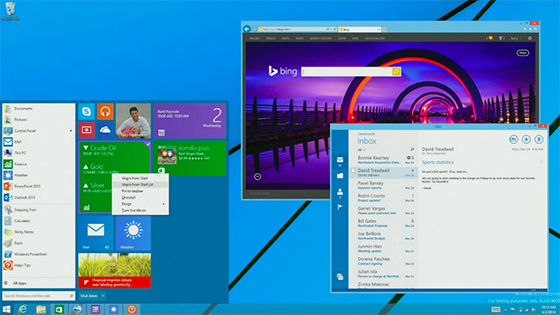
Regardless of Microsoft’s future Windows plans, the current Windows 8.1 Update is a stop-gap towards a second update with additional functionality. If Microsoft is able to deliver the Start Menu to Windows 8 users in August it will address a key complaint from those who are more familiar with the traditional Windows desktop. Many have called for Microsoft to focus on desktop users, and the company has clearly accepted the feedback. "We’re going all in with this desktop experience," said Microsoft’s Terry Myerson earlier this month. It’s a sign that Windows is about to become Windows again.
Myerson also revealed that Microsoft will allow Windows 8-style "Metro" apps to run in the desktop environment inside their own windows. Both the changes bear more than a passing resemblance to a concept by a graphic designer that The Verge highlighted late last year. While Microsoft is expected to deliver the true windowing type of functionality in a "Windows 9" release next year, sources note that the company is pushing to try and get this ready for the second update to Windows 8.1 in August. Both the Start Menu and windowed apps could be pushed to the bigger "Windows 9" release, currently codenamed Threshold, but the current plan is to deliver these changes as soon as possible.
Microsoft revealed earlier this month that the Start Menu will return to Windows 8. While Microsoft is keeping the timing for its return vague, sources familiar with the company’s plans tell The Verge that the Start Menu will likely be available in a second update to Windows 8.1 currently scheduled for August. Microsoft’s Terry Myerson, head of Windows and Xbox software, demonstrated an early prototype earlier this month of what the Start Menu will look like once it’s available. It looks like a hybrid of the old Windows 7 Start Menu mixed in with some Windows 8 Live Tiles along one side.
Myerson also revealed that Microsoft will allow Windows 8-style "Metro" apps to run in the desktop environment inside their own windows. Both the changes bear more than a passing resemblance to a concept by a graphic designer that The Verge highlighted late last year. While Microsoft is expected to deliver the true windowing type of functionality in a "Windows 9" release next year, sources note that the company is pushing to try and get this ready for the second update to Windows 8.1 in August. Both the Start Menu and windowed apps could be pushed to the bigger "Windows 9" release, currently codenamed Threshold, but the current plan is to deliver these changes as soon as possible.
MICROSOFT SPEEDS THINGS UP AGAIN
ZDNet originally reported on the second Windows 8.1 update earlier this week, and claims that it’s being developed as a way to speed up Windows releases. Microsoft already made some internal changes to increase the cadence of its Windows releases to once per year, but it appears that schedule is being accelerated. This is partly because Microsoft needs to fix the shortcomings in Windows 8, but also because competition like Android and iOS are constantly pushing out updates that bring changes and features.
We understand that Microsoft is still planning to merge its Windows Phone and Windows RT products to create a single operating system that runs across ARM-based hardware. At its Build developer conference, Microsoft revealed Windows will be free for computers and phones under 9 inches, a move that’s in place ready for this future version of Windows. We’re told this merger is part of the bigger work for the "Windows 9" release that’s currently due in spring 2015. Microsoft has hinted at this work on numerous occasions, but officials have not yet confirmed the company plans to merge Windows RT and Windows Phone.
Regardless of Microsoft’s future Windows plans, the current Windows 8.1 Update is a stop-gap towards a second update with additional functionality. If Microsoft is able to deliver the Start Menu to Windows 8 users in August it will address a key complaint from those who are more familiar with the traditional Windows desktop. Many have called for Microsoft to focus on desktop users, and the company has clearly accepted the feedback. "We’re going all in with this desktop experience," said Microsoft’s Terry Myerson earlier this month. It’s a sign that Windows is about to become Windows again.

Suzuka Master
Joined: Sep 2006
Posts: 9,863
Likes: 439
well I picked up a couple of Dell Venu 8 pro tablets for $145 each for my wife and I. I have to say that I am very impressed with the tablet overall. This is the older 5000 series tablet. They were 32GB tablets and I added a 128GB card to mine and a 64GB card to my wife's
Windows 8.1 is amazingly fast on this tablet. everything is butter smooth including Blu-ray playback...
Windows 8.1 is amazingly fast on this tablet. everything is butter smooth including Blu-ray playback...