


Next generation starts with p3


Thread Starter
Cost Drivers!!!!
Joined: Mar 2001
Posts: 19,392
Likes: 1
From: burbs of philly
Sounds odd in a way but it doesn't the problem when Sony in the past 5 years and with Apple historically that they've push closed standards. Apple with OSX moved away from their past slightly and must carry through to remain successful. Depsite Sony's historical success in entertainment they've dropped the ball with mp3. They can attempt to battle something they'll have difficulty doing in challenging a great consumer image of Apple OR they can partner. In the end, Microsoft has tried to and is trying to lock up the home entertainment segment. Remember WebTV? The enemy of my enemey is my friend.

something witty
Joined: Apr 2003
Posts: 1,541
Likes: 0
From: Orange County
I wouldn't necessarily call Sony's record with entertainment a 'historical success.' You want to talk about dropping the ball? Sony is still licking their wounds after the beta vs. VHS fiasco. I definately think they have learned their lesson (buying a bunch of studios) but they are fully aware of implications of new media types.

Moderator Alumnus


Joined: Mar 2002
Posts: 64,162
Likes: 14,317
don't forget about Minidisc... I also always thought Memory Stick was too proprietary for their own good. I still do - good thing is nowdays many flash readers have Memory Stick capability. Seems like Sony has been relatively successful with the Memory Stick. Doesn't mean I don't still hate it. Honestly if they never introduced Memory Stick, and decided to go with one of the standards like SmartMedia, Compactflash, SD, XD etc I think they would be in better position now. But hindsight is 20/20. I'm just happy the PSP even has a standard USB-mini port, along with many (if not all) of their newer digital media devices - but they should have done this from day one.
of course, they introduced UMD on the PSP. I think they should have used 3" DVD's instead.
of course, they introduced UMD on the PSP. I think they should have used 3" DVD's instead.
Thread Starter
Cost Drivers!!!!
Joined: Mar 2001
Posts: 19,392
Likes: 1
From: burbs of philly
Originally Posted by farberstyle
I wouldn't necessarily call Sony's record with entertainment a 'historical success.' You want to talk about dropping the ball? Sony is still licking their wounds after the beta vs. VHS fiasco. I definately think they have learned their lesson (buying a bunch of studios) but they are fully aware of implications of new media types.
you are making my point exactly.
Thread Starter
Cost Drivers!!!!
Joined: Mar 2001
Posts: 19,392
Likes: 1
From: burbs of philly
Originally Posted by farberstyle
What point is that? I really didn't see a point in your previous post other than Sony needs to partner with other companies to have success in the entertainment industry.
Sony is an entertainment giant. You're ignoring many aspects of its business if you want to focus in on the betamax etc., My point is that mistakes in the past are now being correctedly slowly. Moreover, the partnership would make sense for both companys. Consumers no longer want singular functionality. Best bang for the buck with the most features is what sells. It's a win-win. Especially if you forget music and think about the possibilities of movie distribution via broadband and the place that Apple and more importantly Sony is trying to secure. Why do you think xb2 has compatibility with media center??
something witty
Joined: Apr 2003
Posts: 1,541
Likes: 0
From: Orange County
I don't think the execs are sitting around Sony saying to themselves, "We can't do this thing alone. We need to bring in a rival electronics manufacturer, especiialy one we are currently targeting."
I think each of these companies, be it Sony or Microsoft are trying to become the household entertainment leader on their own. I don't think there are any businesses in any sector that want to team up with a rival, regardless of what they are trying to achieve.
I will not discount the fact that Sony may want Apple's support in enabling PS3 to download music via iTunes, but I think it is far from a partnership in the literal sense.
I think each of these companies, be it Sony or Microsoft are trying to become the household entertainment leader on their own. I don't think there are any businesses in any sector that want to team up with a rival, regardless of what they are trying to achieve.
I will not discount the fact that Sony may want Apple's support in enabling PS3 to download music via iTunes, but I think it is far from a partnership in the literal sense.
Thread Starter
Cost Drivers!!!!
Joined: Mar 2001
Posts: 19,392
Likes: 1
From: burbs of philly
Originally Posted by farberstyle
I don't think the execs are sitting around Sony saying to themselves, "We can't do this thing alone. We need to bring in a rival electronics manufacturer, especiialy one we are currently targeting."
I think each of these companies, be it Sony or Microsoft are trying to become the household entertainment leader on their own. I don't think there are any businesses in any sector that want to team up with a rival, regardless of what they are trying to achieve.
I will not discount the fact that Sony may want Apple's support in enabling PS3 to download music via iTunes, but I think it is far from a partnership in the literal sense.
I think each of these companies, be it Sony or Microsoft are trying to become the household entertainment leader on their own. I don't think there are any businesses in any sector that want to team up with a rival, regardless of what they are trying to achieve.
I will not discount the fact that Sony may want Apple's support in enabling PS3 to download music via iTunes, but I think it is far from a partnership in the literal sense.
well i could disagree with you more. it's exactly what they are thinking. Each company has something the other company doesn't. Neither can dominate by themselves and their biggest competitor is Microsoft.
something witty
Joined: Apr 2003
Posts: 1,541
Likes: 0
From: Orange County
Originally Posted by Zapata
well i could disagree with you more. it's exactly what they are thinking. Each company has something the other company doesn't. Neither can dominate by themselves and their biggest competitor is Microsoft.
Are you saying that Sony needs help in the video game segment? It sure sounds like it.
Fuck, even I will admit at this juncture that Sony IS ruling the video game segment and I'm an xbox fanboy.
Moderator Alumnus
Joined: Mar 2002
Posts: 64,162
Likes: 14,317
There's ALWAYS room for more, in any aspect of life, anywhere, anything, period. More growth, more progress, more buyers, more games, more competitors, more cars, more technology, more butter, more syrup, more more more more!!!!!
Thread Starter
Cost Drivers!!!!
Joined: Mar 2001
Posts: 19,392
Likes: 1
From: burbs of philly
 i'm going to end this coversation because it doesn't seem like you want to have a mature discussion.
Originally Posted by farberstyle
I will use this later on when some Sony fanboy starts talking about how Sony rules the video game universe.
Are you saying that Sony needs help in the video game segment? It sure sounds like it.
Fuck, even I will admit at this juncture that Sony IS ruling the video game segment and I'm an xbox fanboy.
Are you saying that Sony needs help in the video game segment? It sure sounds like it.
Fuck, even I will admit at this juncture that Sony IS ruling the video game segment and I'm an xbox fanboy.
Thread Starter
Cost Drivers!!!!
Joined: Mar 2001
Posts: 19,392
Likes: 1
From: burbs of philly
Analysts Question Release Timing and Power of Xbox 360
http://biz.gamedaily.com/features.as...AIL_ADDRESS%3E
Thursday, May 12, 2005
Xbox 1.5?
The next-gen Xbox is about to make its official debut on MTV starting tonight, but some analysts think that launching a next-gen system this year may be too soon and that the market may not quite be ready. Some also believe that the technological leap from Xbox to Xbox 360 won't be as big as some would think, leading people to label the system Xbox 1.5.
As the world gets ready to check out Microsoft's next-gen Xbox for the first time on MTV (the infomercial airs tonight at 9:30PM) some in the industry are questioning whether a 2005 launch is too soon to debut a next-gen console, and exactly how big the technological leap from Xbox to Xbox 360 will be.
Launch too soon?
>Because of MTV's on-air schedule listing for the program, it is now widely believed that the next Xbox will ship sometime this November. A November launch for the 360 would mean only a 4-year console cycle for the original Xbox, while the typical console cycle has historically been 5 years. One of the drawbacks of this is that developers may never truly max out the potential of the platform. The deeper into the cycle game creators get, the more familiar they are with the intricacies of developing for that platform. Some of the best-looking titles are often created near the end of a console's lifespan. After all, look at what developers have been able to do lately with the aging PlayStation 2 hardware. Games like Gran Turismo 4 and God of War could almost pass for Xbox titles.
[ "This is more an Xbox 1.5 than an Xbox 2. It's like an Xbox with a broadband cash register built in," PJ McNealy, American Technology Research ]
>Although Microsoft is trying to build up hype levels in the mainstream by showing its new system on MTV, some argue that the market may not be ready for a next-gen system this year. "I question whether Microsoft might be coming out too soon with the next Xbox," IDC analyst Schelley Olhava told The Washington Post.
>Sharing Olhava's concern, Wedbush Morgan Securities analyst Michael Pachter added, "I wonder if there's going to be enough time to get consumers really excited."
>It was Pachter, remember, who said that the current-gen cycle wouldn't end until the PS3 launches. "...we expect the launch of Sony's PS3... to mark the beginning of the next cycle, and think that rapid sales growth will not materialize until 2007," he said. Pachter told GameDAILY BIZ, "I actually don't think the Xbox 360 launching is any different than the PSP launching. It's not going to cause PS2 owners to buy less software."
>Publishers, too, would probably have liked Microsoft to wait until 2006 to launch the 360, as preparing titles for a brand-new platform automatically means a huge investment in research and development. Already we've seen bigger losses or lowered profits in the earnings reports of some publishers who have cited spending on R&D for the next generation.
What kind of visual improvement will there be?
>Then there's the issue of how big a leap the Xbox 360 will bring to video games. Sony spokeswoman Molly Smith recently told BusinessWeek, "We look at delivering a quantum leap in technology, not just Xbox version 1.5." While you'd expect Sony to belittle its closest competitor, others in the industry have expressed similar sentiments about the next Xbox.
>American Technology Research analyst PJ McNealy believes that the Xbox 360 will offer more in the way of online options (e.g. customization, microtransactions, etc.) but that its graphical capabilities will not represent a huge jump over the current Xbox. "This is more an Xbox 1.5 than an Xbox 2. It's like an Xbox with a broadband cash register built in," he said.
>Seamus Blackley, one of the main figures behind the design of the original Xbox and now an agent for Creative Artists Agency, doesn't think there will be a large visual leap either but he doesn't limit his comments to the Xbox 360. According to The Washington Post, he believes that the entire next generation "will see a more incremental increase in technological wizardry compared to previous turning points in the video-game industry."
Backwards compatibility is key
>Another critical issue for Microsoft could be (the lack of) backwards compatibility. Sony's PS3 will almost certainly play PS2 games and Nintendo has already confirmed that the Revolution will be backwards compatible with the GameCube, but Microsoft has not been willing to talk about it. "If they decide not to be backward compatible I question their judgment," Pachter told us in a prior interview. In his report, "Xbox 360 Debut Tomorrow: Answering the $2.4 Billion Compatibility Question," Pachter elaborated on the topic.
>"Should the Xbox 360 be incompatible with the current generation Xbox, we think that publishers will face a dilemma. Most will plan to produce SKUs for the PS2, PSP, and Xbox 360, but will be faced with a decision whether to produce future games for the current generation Xbox," he said. "If the Xbox 360 is incompatible, sales of current generation Xbox hardware are likely to rapidly decline, making the support decision even more difficult. Further complicating the decision is the cost of next generation software development, expected to be $10 - 15 million per game, compared to $3 - 5 million for current generation software development. In order to support both the current and next generation Xboxes, publishers will be required to spend $13 - 20 million per game chasing a combined installed base that is not assured to grow over the first few years without backward compatibility."
>Pachter also thinks that the growth of the industry itself could be adversely affected if Microsoft decides not to include backwards compatibility because publishers may have no choice but to drop support for the current Xbox. "In the event that publishers choose to abandon development of current generation Xbox games in 2006, the negative impact on industry sales growth could be even more dramatic... We think that the outcome of the backward compatibility issue will go a long way toward determining industry sales growth in 2005 and beyond, and we believe that a negative decision could negatively impact share prices for the U.S. publishers."
Xbox 1.5?
The next-gen Xbox is about to make its official debut on MTV starting tonight, but some analysts think that launching a next-gen system this year may be too soon and that the market may not quite be ready. Some also believe that the technological leap from Xbox to Xbox 360 won't be as big as some would think, leading people to label the system Xbox 1.5.
As the world gets ready to check out Microsoft's next-gen Xbox for the first time on MTV (the infomercial airs tonight at 9:30PM) some in the industry are questioning whether a 2005 launch is too soon to debut a next-gen console, and exactly how big the technological leap from Xbox to Xbox 360 will be.
Launch too soon?
>Because of MTV's on-air schedule listing for the program, it is now widely believed that the next Xbox will ship sometime this November. A November launch for the 360 would mean only a 4-year console cycle for the original Xbox, while the typical console cycle has historically been 5 years. One of the drawbacks of this is that developers may never truly max out the potential of the platform. The deeper into the cycle game creators get, the more familiar they are with the intricacies of developing for that platform. Some of the best-looking titles are often created near the end of a console's lifespan. After all, look at what developers have been able to do lately with the aging PlayStation 2 hardware. Games like Gran Turismo 4 and God of War could almost pass for Xbox titles.
[ "This is more an Xbox 1.5 than an Xbox 2. It's like an Xbox with a broadband cash register built in," PJ McNealy, American Technology Research ]
>Although Microsoft is trying to build up hype levels in the mainstream by showing its new system on MTV, some argue that the market may not be ready for a next-gen system this year. "I question whether Microsoft might be coming out too soon with the next Xbox," IDC analyst Schelley Olhava told The Washington Post.
>Sharing Olhava's concern, Wedbush Morgan Securities analyst Michael Pachter added, "I wonder if there's going to be enough time to get consumers really excited."
>It was Pachter, remember, who said that the current-gen cycle wouldn't end until the PS3 launches. "...we expect the launch of Sony's PS3... to mark the beginning of the next cycle, and think that rapid sales growth will not materialize until 2007," he said. Pachter told GameDAILY BIZ, "I actually don't think the Xbox 360 launching is any different than the PSP launching. It's not going to cause PS2 owners to buy less software."
>Publishers, too, would probably have liked Microsoft to wait until 2006 to launch the 360, as preparing titles for a brand-new platform automatically means a huge investment in research and development. Already we've seen bigger losses or lowered profits in the earnings reports of some publishers who have cited spending on R&D for the next generation.
What kind of visual improvement will there be?
>Then there's the issue of how big a leap the Xbox 360 will bring to video games. Sony spokeswoman Molly Smith recently told BusinessWeek, "We look at delivering a quantum leap in technology, not just Xbox version 1.5." While you'd expect Sony to belittle its closest competitor, others in the industry have expressed similar sentiments about the next Xbox.
>American Technology Research analyst PJ McNealy believes that the Xbox 360 will offer more in the way of online options (e.g. customization, microtransactions, etc.) but that its graphical capabilities will not represent a huge jump over the current Xbox. "This is more an Xbox 1.5 than an Xbox 2. It's like an Xbox with a broadband cash register built in," he said.
>Seamus Blackley, one of the main figures behind the design of the original Xbox and now an agent for Creative Artists Agency, doesn't think there will be a large visual leap either but he doesn't limit his comments to the Xbox 360. According to The Washington Post, he believes that the entire next generation "will see a more incremental increase in technological wizardry compared to previous turning points in the video-game industry."
Backwards compatibility is key
>Another critical issue for Microsoft could be (the lack of) backwards compatibility. Sony's PS3 will almost certainly play PS2 games and Nintendo has already confirmed that the Revolution will be backwards compatible with the GameCube, but Microsoft has not been willing to talk about it. "If they decide not to be backward compatible I question their judgment," Pachter told us in a prior interview. In his report, "Xbox 360 Debut Tomorrow: Answering the $2.4 Billion Compatibility Question," Pachter elaborated on the topic.
>"Should the Xbox 360 be incompatible with the current generation Xbox, we think that publishers will face a dilemma. Most will plan to produce SKUs for the PS2, PSP, and Xbox 360, but will be faced with a decision whether to produce future games for the current generation Xbox," he said. "If the Xbox 360 is incompatible, sales of current generation Xbox hardware are likely to rapidly decline, making the support decision even more difficult. Further complicating the decision is the cost of next generation software development, expected to be $10 - 15 million per game, compared to $3 - 5 million for current generation software development. In order to support both the current and next generation Xboxes, publishers will be required to spend $13 - 20 million per game chasing a combined installed base that is not assured to grow over the first few years without backward compatibility."
>Pachter also thinks that the growth of the industry itself could be adversely affected if Microsoft decides not to include backwards compatibility because publishers may have no choice but to drop support for the current Xbox. "In the event that publishers choose to abandon development of current generation Xbox games in 2006, the negative impact on industry sales growth could be even more dramatic... We think that the outcome of the backward compatibility issue will go a long way toward determining industry sales growth in 2005 and beyond, and we believe that a negative decision could negatively impact share prices for the U.S. publishers."


The sizzle in the Steak
Joined: Nov 2001
Posts: 71,436
Likes: 1,877
From: Southern California
Originally Posted by Zapata
well then prepared to be ignored and disappointed because the entire motivation behind both companies is convergence of technology within the home. Gaming systems are keys to the city as far as any company that deal with entertainment. Brilliant move by Sony and Apple if it's true. Alliance to battle microsoft.
NOBODY beleives the consumer is buying the next gen consoles because they are a "home media" center. They are buying them for GAMING.....everything else is second. They will do some secondary aplications...and do them average to poor compared to standalone items like MP3 players, DVR...etc.
Thread Starter
Cost Drivers!!!!
Joined: Mar 2001
Posts: 19,392
Likes: 1
From: burbs of philly
Originally Posted by Moog-Type-S
Motivation by companies is one thing...but the consumer rules in the end.
NOBODY beleives the consumer is buying the next gen consoles because they are a "home media" center. They are buying them for GAMING.....everything else is second. They will do some secondary aplications...and do them average to poor compared to standalone items like MP3 players, DVR...etc.
NOBODY beleives the consumer is buying the next gen consoles because they are a "home media" center. They are buying them for GAMING.....everything else is second. They will do some secondary aplications...and do them average to poor compared to standalone items like MP3 players, DVR...etc.
Again you are missing the point. You take a look at successful gen3 consoles. Xbox and Sony. Part of the success is attributed to the aftermarket. Look at what a ModChip allows you to do with your XBOX and PS2. Open standards with multifunctional devices sell and those that don't are flops. Nintendo is feeling the brunt of it. Why do you think they are going to include standard DVD based games and include a DVD player?????? It's about the merge of technologies. Sorry but you are stuck in 2001. You can poo poo moves by the companies to include additional functions within the gaming system but you are in a small small minority who don't want that kind of functionality. Space is limited. I don't want a thousand devices. If 1 box can do it all, so be it. The technology is there and it adds to the value of gaming system.
The sizzle in the Steak
Joined: Nov 2001
Posts: 71,436
Likes: 1,877
From: Southern California
Originally Posted by Zapata
Again you are missing the point. You take a look at successful gen3 consoles. Xbox and Sony. Part of the success is attributed to the aftermarket. Look at what a ModChip allows you to do with your XBOX and PS2. Open standards with multifunctional devices sell and those that don't are flops. Nintendo is feeling the brunt of it. Why do you think they are going to include standard DVD based games and include a DVD player?????? It's about the merge of technologies. Sorry but you are stuck in 2001. You can poo poo moves by the companies to include additional functions within the gaming system but you are in a small small minority who don't want that kind of functionality. Space is limited. I don't want a thousand devices. If 1 box can do it all, so be it. The technology is there and it adds to the value of gaming system.
 You make lame assumptions. I never said I don't want additional functions for the system. You fail to realize that people are going to buy these systems for gaming first...then everything else is secondary...and those items will perform secondary as compared to stand alone devices.
Thread Starter
Cost Drivers!!!!
Joined: Mar 2001
Posts: 19,392
Likes: 1
From: burbs of philly
Originally Posted by Moog-Type-S
You make lame assumptions. I never said I don't want additional functions for the system. You fail to realize that people are going to buy these systems for gaming first...then everything else is secondary...and those items will perform secondary as compared to stand alone devices.lame? no, you are arguing something that is overtly obvious. This discussion goes back to your shit talking about the ps3 possibly having itunes support built into it. I thought the game system fanboyism was done last week but apparently not....

Banned
Joined: Feb 2005
Posts: 13,252
Likes: 2,654
From: parts unknown
Originally Posted by Moog-Type-S
Remember when all the people were buying the Ps2 and Xbox because they could play DVD's on them....oh wait, that never happened...they bought them to play GAMES on them.
The sizzle in the Steak
Joined: Nov 2001
Posts: 71,436
Likes: 1,877
From: Southern California
Originally Posted by Zapata
lame? no, you are arguing something that is overtly obvious. This discussion goes back to your shit talking about the ps3 possibly having itunes support built into it. I thought the game system fanboyism was done last week but apparently not....
Thread Starter
Cost Drivers!!!!
Joined: Mar 2001
Posts: 19,392
Likes: 1
From: burbs of philly
Originally Posted by Moog-Type-S
Keep on playing the fan-boy nonsense....it suits you well. To make you feel "better" a DVR on the XBox 360 is mediocre at best. One would need a huge hard drive to accomodate the recordings...20 GB is laughable.....Then how will it be able to deal with HD recording....what happens when it all goes to Mpeg4? Again the bottom line is they are game machines 1st.
you are arguing points that i don't disagree with

The sizzle in the Steak
Joined: Nov 2001
Posts: 71,436
Likes: 1,877
From: Southern California
Originally Posted by 03SSMTL-S
the ps 2 was my first dvd player, and a main reason i bought it it gave me the new gaming unit and a dvd player all in one and it was backwards compatable (not that i play old ps1 games any but i can)


Banned
Joined: Feb 2005
Posts: 13,252
Likes: 2,654
From: parts unknown
Originally Posted by Moog-Type-S
You didn't have a DVD player until 2000-2001??
 ) , i have friends who still only have a ps2 as a dvd player
Last edited by 03SSMTL-S; May 16, 2005 at 03:43 PM.
Thread Starter
Cost Drivers!!!!
Joined: Mar 2001
Posts: 19,392
Likes: 1
From: burbs of philly
PlayStation 3 announced for 2006
http://www.gamespot.com/news/2005/05...s_6124681.html
[UPDATE 4] Sony confirms the name and release window of its next-generation console in Los Angeles, will use Blu-ray disc format.
LOS ANGELES--Today saw the second of the big three console makers announce their next-generation platform. At its pre-E3 press conference, Sony Computer Entertainment gave the world its first look at the PlayStation 3, as it now is officially called.
The name was not unexpected, since Sony had been running an extensive teaser-ad campaign prepping the public for the PlayStation 3. The company had laid a blanket of posters around the Los Angeles Convention Center, site of the Electronic Entertainment Expo (aka E3). Bus stalls and billboards around the convention center proclaimed "Prepare for Chang3" in the distinctive PlayStation font with partial shots of the Dual Shock controller's square-circle-triangle-X buttons.
Sony also confirmed the PlayStation 3, will use Blu-Ray discs as its media format. The discs can hold up to six times as much data as current-generation DVDs. It will also support CR-ROM, CDR+W, DVD, DVD-ROM, DVD-R, DVD+R formats. It also confirmed the machine would be backward-compatible all the way to the original PlayStation. It will also have slots for Memory Stick Duo, a SD slot, and a compact flash memory slot. It will also sport a slot for detachable 2.5 inch HDD somewhat similar the Xbox 360's.
Out of the box, the PS3 will have the capability to support seven Bluetooth controllers. It will also have six USB slots for peripherals--four up front and two in the back.
Sony also laid out the technical specs of the device. The PlayStation 3 will feature the much-vaunted Cell processor, which will run at 3.2 Ghz and feature 2.18 teraflops of performance. It will sport 256mb XDR main RAM at 3.2 Ghz, and have 256MB of GDDR VRAM at 700mhz.
Sony also unveiled the PS3's graphics chip, the RSX "Reality Synthesizer based on Nvidia technology. The GPU will be capable of 128bit pixel precision, 1080p resolution, some of the highest HD resolution around. It also has over 300 million transistors lager than any processor available commercially today. It was manufactured using the 90nm process with 8 layers of metal. The RSX is more powerful than two GeForce 6800 ultras, which would cost rough $1000 if bought today.
The PlayStation 3 will also sport some hefty multimedia features, such as video chat, internet access, digital photo viewing, digital audio and video. Sony Computer Entertainment head Ken Kutaragi introduced it as a "Super computer for computer entertainment."
By Tor Thorsen -- GameSpot
POSTED: 05/16/05 03:43 PM PST
LOS ANGELES--Today saw the second of the big three console makers announce their next-generation platform. At its pre-E3 press conference, Sony Computer Entertainment gave the world its first look at the PlayStation 3, as it now is officially called.
The name was not unexpected, since Sony had been running an extensive teaser-ad campaign prepping the public for the PlayStation 3. The company had laid a blanket of posters around the Los Angeles Convention Center, site of the Electronic Entertainment Expo (aka E3). Bus stalls and billboards around the convention center proclaimed "Prepare for Chang3" in the distinctive PlayStation font with partial shots of the Dual Shock controller's square-circle-triangle-X buttons.
Sony also confirmed the PlayStation 3, will use Blu-Ray discs as its media format. The discs can hold up to six times as much data as current-generation DVDs. It will also support CR-ROM, CDR+W, DVD, DVD-ROM, DVD-R, DVD+R formats. It also confirmed the machine would be backward-compatible all the way to the original PlayStation. It will also have slots for Memory Stick Duo, a SD slot, and a compact flash memory slot. It will also sport a slot for detachable 2.5 inch HDD somewhat similar the Xbox 360's.
Out of the box, the PS3 will have the capability to support seven Bluetooth controllers. It will also have six USB slots for peripherals--four up front and two in the back.
Sony also laid out the technical specs of the device. The PlayStation 3 will feature the much-vaunted Cell processor, which will run at 3.2 Ghz and feature 2.18 teraflops of performance. It will sport 256mb XDR main RAM at 3.2 Ghz, and have 256MB of GDDR VRAM at 700mhz.
Sony also unveiled the PS3's graphics chip, the RSX "Reality Synthesizer based on Nvidia technology. The GPU will be capable of 128bit pixel precision, 1080p resolution, some of the highest HD resolution around. It also has over 300 million transistors lager than any processor available commercially today. It was manufactured using the 90nm process with 8 layers of metal. The RSX is more powerful than two GeForce 6800 ultras, which would cost rough $1000 if bought today.
The PlayStation 3 will also sport some hefty multimedia features, such as video chat, internet access, digital photo viewing, digital audio and video. Sony Computer Entertainment head Ken Kutaragi introduced it as a "Super computer for computer entertainment."
By Tor Thorsen -- GameSpot
POSTED: 05/16/05 03:43 PM PST
Thread Starter
Cost Drivers!!!!
Joined: Mar 2001
Posts: 19,392
Likes: 1
From: burbs of philly
Info
summary
Central Processing Unit
The PlayStation 3's CPU will be a chip codenamed "Cell", and the system will use chip-to-chip interface technology and memory technology from Rambus. Cell's technical details were released at the February 2005 ISSCC. IBM has won the contract to produce Cell chips for the console. The CPU's supposed distributed processing features have been of great interest to the press, speculation being that many items in the home, with differing numbers of Cell chips, can pool their power. Cell is a dual-core, 64-bit RISC IBM POWER derivative. Early versions of the chip will be 90-nm, with a change to a 65-nm process, if cost and performance allow. Abstracts from presentations to be presented at ISSCC show the Cell processor running at 4.6 GHz.
Graphics Processing Unit
In December 2004, Nvidia announced that they have been in a multi-year agreement with SCEI to develop the PlayStation 3's GPU, a custom variant of their next-generation graphics processor. In fact, they had worked for two years on the chip before making the announcement. They were previously responsible for the GPU in the Xbox console. The GPU will be manufactured at the joint Sony/Toshiba fabrication facility in Nagasaki, Japan.
RAM
Reuters news service reports that Elpida will be supplying the RAM used in the Playstation 3, and the company confirms spectulation that the Playstation 3 will utilize the 512 megabit version (64 Megabyte per RAM chip) of XDR DRAM, with Rambus' interface technology. Up to four can be used per Cell chip, for a maximum RAM figure of 256 Megabytes per Cell Chip.
PlayStation 3 Standards
Unlike the PlayStation and PlayStation 2 systems, Sony appears to have chosen publicly-available application programming interfaces and technologies for the PlayStation 3.
The current list of open standards Sony is either investigating, or has chosen includes:
OpenGL ES, the embedded version of the popular OpenGL graphics API.
OpenVG, for hardware-accelerated 2D vector graphics.
OpenMAX, a collection of fast, cross-platform tools for general "media acceleration," such as matrix calculations.
COLLADA, an open format for 3D models.
IPv6, for connection to the next-generation Internet.
The PlayStation 3's CPU will be a chip codenamed "Cell", and the system will use chip-to-chip interface technology and memory technology from Rambus. Cell's technical details were released at the February 2005 ISSCC. IBM has won the contract to produce Cell chips for the console. The CPU's supposed distributed processing features have been of great interest to the press, speculation being that many items in the home, with differing numbers of Cell chips, can pool their power. Cell is a dual-core, 64-bit RISC IBM POWER derivative. Early versions of the chip will be 90-nm, with a change to a 65-nm process, if cost and performance allow. Abstracts from presentations to be presented at ISSCC show the Cell processor running at 4.6 GHz.
Graphics Processing Unit
In December 2004, Nvidia announced that they have been in a multi-year agreement with SCEI to develop the PlayStation 3's GPU, a custom variant of their next-generation graphics processor. In fact, they had worked for two years on the chip before making the announcement. They were previously responsible for the GPU in the Xbox console. The GPU will be manufactured at the joint Sony/Toshiba fabrication facility in Nagasaki, Japan.
RAM
Reuters news service reports that Elpida will be supplying the RAM used in the Playstation 3, and the company confirms spectulation that the Playstation 3 will utilize the 512 megabit version (64 Megabyte per RAM chip) of XDR DRAM, with Rambus' interface technology. Up to four can be used per Cell chip, for a maximum RAM figure of 256 Megabytes per Cell Chip.
PlayStation 3 Standards
Unlike the PlayStation and PlayStation 2 systems, Sony appears to have chosen publicly-available application programming interfaces and technologies for the PlayStation 3.
The current list of open standards Sony is either investigating, or has chosen includes:
OpenGL ES, the embedded version of the popular OpenGL graphics API.
OpenVG, for hardware-accelerated 2D vector graphics.
OpenMAX, a collection of fast, cross-platform tools for general "media acceleration," such as matrix calculations.
COLLADA, an open format for 3D models.
IPv6, for connection to the next-generation Internet.



Thread Starter
Cost Drivers!!!!
Joined: Mar 2001
Posts: 19,392
Likes: 1
From: burbs of philly
Sony Press Release...
http://biz.yahoo.com/prnews/050516/sfm178.html?.v=2
Sony Computer Entertainment Inc. to Launch Its Next Generation Computer Entertainment System, in Spring 2006
Monday May 16, 7:30 pm ET
Unrivaled Performance With the Introduction of Cell Processor and Many Advanced Technologies, and Backwards Compatible With PlayStation(R) and PlayStation(R)2
LOS ANGELES, May 16 /PRNewswire/ -- At a press conference held in Los Angeles, California, today, Sony Computer Entertainment Inc. (SCEI) revealed the outline of its PLAYSTATION®3 (PS3) computer entertainment system, incorporating the world's most advanced Cell processor with super computer like power. Prototypes of PS3 will also be showcased at the Electronic Entertainment Expo (E3), the world's largest interactive entertainment exhibition held in Los Angeles, from May 18th to 20th.
PS3 combines state-of-the-art technologies featuring Cell, a processor jointly developed by IBM, Sony Group and Toshiba Corporation, graphics processor (RSX) co-developed by NVIDIA Corporation and SCEI, and XDR memory developed by Rambus Inc. It also adopts BD-ROM (Blu-ray Disc ROM) with maximum storage capacity of 54 GB (dual layer), enabling delivery of entertainment content in full high-definition (HD) quality, under a secure environment made possible through the most advanced copyright protection technology. To match the accelerating convergence of digital consumer electronics and computer technology, PS3 supports high quality display in resolution of 1080p(*) as standard, which is far superior to 720p/1080i.
With an overwhelming computing power of 2 teraflops, entirely new graphical expressions that have never been seen before will become possible. In games, not only will movement of characters and objects be far more refined and realistic, but landscapes and virtual worlds can also be rendered in real- time, thereby elevating the freedom of graphics expression to levels not experienced in the past. Gamers will literally be able to dive into the realistic world seen in large screen movies and experience the excitement in real-time.
In 1994, SCEI launched the original PlayStation® (PS), followed by PlayStation®2 (PS2) in 2000 and PlayStation®Portable (PSP®) in 2004, every time introducing the latest advancement in technology and bringing innovation to interactive entertainment software creation. Over 13,000 titles have been developed by now, creating a software market that sells more than 250 million copies annually. PS3 offers backward compatibility enabling gamers to enjoy these enormous assets from PS and PS2 platforms.
PlayStation family of products are sold in more than 120 countries and regions around the world. With cumulative shipments reaching more than 102 million for PS and approximately 89 million for PS2, they are the undisputed leaders and have become the standard platform for home entertainment. After 12 years from the introduction of the original PS and 6 years from the launch of PS2, SCEI brings PS3, the newest platform with the most advanced next generation computer entertainment technology.
With the delivery of Cell based development tools that has already begun, development of game titles as well as tools and middleware are in progress. Through collaboration with world's leading tools and middleware companies, SCEI will offer full support to new content creation by providing developers with extensive tools and libraries that will bring out the power of the Cell processor and enable efficient software development.
Preparations are under way for launch of PS3 and new generation software in the spring of 2006.
(*) 1080p/720p/1080i: "p" stands for progressive scan method, "i" stands
for interlace method. 1080p is the highest resolution within the HD
standard.
"SCEI has continuously brought innovation to the world of computer entertainment, such as real-time 3D computer graphics on PlayStation and the world's first 128 bit processor Emotion Engine (EE) for PlayStation 2. Empowered by the Cell processor with super computer like performance, a new age of PLAYSTATION 3 is about to begin. Together with content creators from all over the world, SCEI will accelerate the arrival of a new era in computer entertainment."
Ken Kutaragi, President and CEO, Sony Computer Entertainment Inc..
Supporting comments from third party developers and publishers
(In alphabetical order of company name)
"With the new generation PlayStation platform, we can create "GUNDAM WORLD" with the quality no one has ever imagined. The philosophy, connecting millions of Cell together, makes reality get closer to the world of SF films. We are delighted to share the vision of Ken, ARCHITECT, Kutaragi."
Shin Unozawa, Managing Director, Leader, Game Software Group, President, Video Game Company, BANDAI CO., LTD.
"The PLAYSTATION 3 has us really excited! So much so in fact that we are already working our hardest to get Devil May Cry 4 out for this new platform. New hardware always yields more options for developers to create exciting and fresh gameplay experiences. I believe that the PS3 is one piece of hardware that will test the mettle of our development team and help us to create some of the most amazing games, limited only by our imagination."
Keiji Inafune, Managing Executive Officer, Research & Development Division,Capcom Co., Ltd.
"Each generation of PlayStation has made a dramatic improvement in how we create and play videogames. PLAYSTATION 3 will be a breakthrough in how the world experiences entertainment. EA is fully aligned with Sony Computer Entertainment -- we share their vision and applaud their success."
Larry Probst, Chairman and CEO, Electronic Arts
"President Kutaragi has thrown down a gauntlet. That gauntlet is called the PLAYSTATION 3. We here at Koei have gladly taken up the challenge, and are striving day and night to take full advantage of all the PS3's new possibilities. Our goal is to combine cutting-edge technology with a full range of artistic expression to deliver the ultimate form of entertainment, and please people everywhere."
Keiko Erikawa, Chairman & C.E.O., KOEI Co., Ltd.
"With the arrival of the next generation computer entertainment system PLAYSTATION 3, I believe it will be possible for graphic expressions, more beautiful than before, to coexist with more deep and evolved game play which utilize the Cell architecture. I also have high expectations for the evolution by the online features that will be enhanced. We will utilize the features of the new platform and will strive to create contents that will bring new excitement for our users world wide, so please have high hopes for Konami."
Kazumi Kitaue, CEO, Konami Digital Entertainment, Inc
"Each time SCEI launches a console, the video games business moves to the next level. With PLAYSTATION 3 it looks as if it might be time for interactive entertainment to become, finally, the world's dominant artistic medium."
Sam Houser, President, Rockstar Games (Take-Two Interactive Software, Inc.)
"We at Namco have used and will continue to use the advancements in audio- visual technology to deliver games that are not only appealing to the eyes and ears, but that stir emotions, speak to the heart, and remain in players' minds for years to come. We are confident that the PLAYSTATION 3 is an entertainment system that will enable us to do just that."
Shigeru Yokoyama, CT Company President, Namco Ltd.
"Next-generation hardware platforms will enable SEGA to create new game concepts that offer more immersive interactive experiences. SEGA continues to pursue the fusion of creativity and technology by publishing only the best, more innovative content to gamers around the world."
Hisao Oguchi, President and Chief Operating Officer, SEGA Corporation
"Square Enix is extremely honored to have had the chance to provide you with this technical demonstration of what the Cell processor can bring to the PLAYSTATION 3 and the world of gaming. We are committed to fully backing SCEI's new computer entertainment system and plans to bring the FINAL FANTASY series to the PS3 are just beyond the horizon."
Yoichi Wada, President, SQUARE ENIX CO., LTD.
"Ubisoft was one of the first major international developers to have its teams start focusing on next generation consoles. We are looking forward to developing outstanding games on Sony Computer Entertainment Inc.'s new system. Its powerful features will help take the industry to an even higher level in the very near future."
Yves Guillemot, President and CEO, Ubisoft
PLAYSTATION®3 Specifications
Product name PLAYSTATION®3
Logo PLAYSTATION®3
CPU Cell Processor
PowerPC-base Core @3.2GHz
1 VMX vector unit per core
512KB L2 cache
7 x SPE @3.2GHz
7 x 128b 128 SIMD GPRs
7 x 256KB SRAM for SPE
* 1 of 8 SPEs reserved for
redundancy
total floating point
performance: 218 GFLOPS
GPU RSX @550MHz
1.8 TFLOPS floating point
performance
Full HD (up to 1080p) x 2
channels
Multi-way programmable parallel
floating point shader
pipelines
Sound Dolby 5.1ch, DTS, LPCM, etc. (Cell-
base processing)
Memory 256MB XDR Main RAM @3.2GHz
256MB GDDR3 VRAM @700MHz
System Bandwidth Main RAM 25.6GB/s
VRAM 22.4GB/s
RSX 20GB/s (write) + 15GB/s
(read)
SB 2.5GB/s (write) +
2.5GB/s (read)
System Floating Point Performance 2 TFLOPS
Storage HDD Detachable 2.5" HDD slot x 1
I/O USB Front x 4, Rear x 2 (USB2.0)
Memory Stick standard/Duo, PRO x 1
SD standard/mini x 1
CompactFlash (Type I, II) x 1
Communication Ethernet (10BASE-T, 100BASE-TX, 1000BASE-T)
x 3 (input x 1 + output x 2)
Wi-Fi IEEE 802.11 b/g
Bluetooth Bluetooth 2.0 (EDR)
Controller Bluetooth (up to 7)
USB2.0 (wired)
Wi-Fi (PSP®)
Network (over IP)
AV Output Screen size 480i, 480p, 720p,
1080i, 1080p
HDMI HDMI out x 2
Analog AV MULTI OUT x 1
Digital audio DIGITAL OUT
(OPTICAL) x 1
Disc media CD PlayStation® CD-ROM
* read only PlayStation®2 CD-ROM
CD-DA CD-DA (ROM), CD-R,
CD-RW
SACD SACD Hybrid (CD
layer), SACD HD
DualDisc DualDisc (audio
side), DualDisc
(DVD side)
DVD PlayStation®2 DVD-ROM
PLAYSTATION®3 DVD-ROM
DVD-Video DVD-ROM, DVD-R,
DVD-RW, DVD+R,
DVD+RW
Blu-ray Disc PLAYSTATION®3 BD-ROM
BD-Video BD-ROM, BD-R,
BD-RE
About Sony Computer Entertainment Inc.
Recognized as the global leader and company responsible for the progression of consumer-based computer entertainment, Sony Computer Entertainment Inc. (SCEI) manufacturers, distributes and markets the PlayStation® game console, the PlayStation®2 computer entertainment system and the PlayStation®Portable (PSP®) handheld entertainment system. PlayStation has revolutionized home entertainment by introducing advanced 3D graphic processing, and PlayStation 2 further enhances the PlayStation legacy as the core of home networked entertainment. PSP is a new portable entertainment system that allows users to enjoy 3D games, with high-quality full-motion video, and high-fidelity stereo audio. SCEI, along with its subsidiary divisions Sony Computer Entertainment America Inc., Sony Computer Entertainment Europe Ltd., and Sony Computer Entertainment Korea Inc. develops, publishes, markets and distributes software, and manages the third party licensing programs for these platforms in the respective markets worldwide. Headquartered in Tokyo, Japan, Sony Computer Entertainment Inc. is an independent business unit of the Sony Group.
* Storage media (HDD, "Memory Stick", SD memory card, and CompactFlash)
are sold separately.
* "Dolby" is a trademark of Dolby Laboratories.
* "DTS" is a trademark of Digital Theater Systems, Inc.
* "CompactFlash" is a trademark of SanDisk Corporation.
* "HDMI" is a trademark of HDMI Licensing LLC.
* "Blu-ray Disc" is a trademark.
* "Bluetooth" is a trademark of Bluetooth SIG, Inc.
* All other trademarks are the property of their respective owners.
* "Memory Stick" and "Memory Stick PRO" are trademarks of Sony
Corporation.
* "PlayStation", the PlayStation logo and "PSP" are registered trademarks
of Sony Computer Entertainment Inc.
Design and specifications are subject to change without notice.
Monday May 16, 7:30 pm ET
Unrivaled Performance With the Introduction of Cell Processor and Many Advanced Technologies, and Backwards Compatible With PlayStation(R) and PlayStation(R)2
LOS ANGELES, May 16 /PRNewswire/ -- At a press conference held in Los Angeles, California, today, Sony Computer Entertainment Inc. (SCEI) revealed the outline of its PLAYSTATION®3 (PS3) computer entertainment system, incorporating the world's most advanced Cell processor with super computer like power. Prototypes of PS3 will also be showcased at the Electronic Entertainment Expo (E3), the world's largest interactive entertainment exhibition held in Los Angeles, from May 18th to 20th.
PS3 combines state-of-the-art technologies featuring Cell, a processor jointly developed by IBM, Sony Group and Toshiba Corporation, graphics processor (RSX) co-developed by NVIDIA Corporation and SCEI, and XDR memory developed by Rambus Inc. It also adopts BD-ROM (Blu-ray Disc ROM) with maximum storage capacity of 54 GB (dual layer), enabling delivery of entertainment content in full high-definition (HD) quality, under a secure environment made possible through the most advanced copyright protection technology. To match the accelerating convergence of digital consumer electronics and computer technology, PS3 supports high quality display in resolution of 1080p(*) as standard, which is far superior to 720p/1080i.
With an overwhelming computing power of 2 teraflops, entirely new graphical expressions that have never been seen before will become possible. In games, not only will movement of characters and objects be far more refined and realistic, but landscapes and virtual worlds can also be rendered in real- time, thereby elevating the freedom of graphics expression to levels not experienced in the past. Gamers will literally be able to dive into the realistic world seen in large screen movies and experience the excitement in real-time.
In 1994, SCEI launched the original PlayStation® (PS), followed by PlayStation®2 (PS2) in 2000 and PlayStation®Portable (PSP®) in 2004, every time introducing the latest advancement in technology and bringing innovation to interactive entertainment software creation. Over 13,000 titles have been developed by now, creating a software market that sells more than 250 million copies annually. PS3 offers backward compatibility enabling gamers to enjoy these enormous assets from PS and PS2 platforms.
PlayStation family of products are sold in more than 120 countries and regions around the world. With cumulative shipments reaching more than 102 million for PS and approximately 89 million for PS2, they are the undisputed leaders and have become the standard platform for home entertainment. After 12 years from the introduction of the original PS and 6 years from the launch of PS2, SCEI brings PS3, the newest platform with the most advanced next generation computer entertainment technology.
With the delivery of Cell based development tools that has already begun, development of game titles as well as tools and middleware are in progress. Through collaboration with world's leading tools and middleware companies, SCEI will offer full support to new content creation by providing developers with extensive tools and libraries that will bring out the power of the Cell processor and enable efficient software development.
Preparations are under way for launch of PS3 and new generation software in the spring of 2006.
(*) 1080p/720p/1080i: "p" stands for progressive scan method, "i" stands
for interlace method. 1080p is the highest resolution within the HD
standard.
"SCEI has continuously brought innovation to the world of computer entertainment, such as real-time 3D computer graphics on PlayStation and the world's first 128 bit processor Emotion Engine (EE) for PlayStation 2. Empowered by the Cell processor with super computer like performance, a new age of PLAYSTATION 3 is about to begin. Together with content creators from all over the world, SCEI will accelerate the arrival of a new era in computer entertainment."
Ken Kutaragi, President and CEO, Sony Computer Entertainment Inc..
Supporting comments from third party developers and publishers
(In alphabetical order of company name)
"With the new generation PlayStation platform, we can create "GUNDAM WORLD" with the quality no one has ever imagined. The philosophy, connecting millions of Cell together, makes reality get closer to the world of SF films. We are delighted to share the vision of Ken, ARCHITECT, Kutaragi."
Shin Unozawa, Managing Director, Leader, Game Software Group, President, Video Game Company, BANDAI CO., LTD.
"The PLAYSTATION 3 has us really excited! So much so in fact that we are already working our hardest to get Devil May Cry 4 out for this new platform. New hardware always yields more options for developers to create exciting and fresh gameplay experiences. I believe that the PS3 is one piece of hardware that will test the mettle of our development team and help us to create some of the most amazing games, limited only by our imagination."
Keiji Inafune, Managing Executive Officer, Research & Development Division,Capcom Co., Ltd.
"Each generation of PlayStation has made a dramatic improvement in how we create and play videogames. PLAYSTATION 3 will be a breakthrough in how the world experiences entertainment. EA is fully aligned with Sony Computer Entertainment -- we share their vision and applaud their success."
Larry Probst, Chairman and CEO, Electronic Arts
"President Kutaragi has thrown down a gauntlet. That gauntlet is called the PLAYSTATION 3. We here at Koei have gladly taken up the challenge, and are striving day and night to take full advantage of all the PS3's new possibilities. Our goal is to combine cutting-edge technology with a full range of artistic expression to deliver the ultimate form of entertainment, and please people everywhere."
Keiko Erikawa, Chairman & C.E.O., KOEI Co., Ltd.
"With the arrival of the next generation computer entertainment system PLAYSTATION 3, I believe it will be possible for graphic expressions, more beautiful than before, to coexist with more deep and evolved game play which utilize the Cell architecture. I also have high expectations for the evolution by the online features that will be enhanced. We will utilize the features of the new platform and will strive to create contents that will bring new excitement for our users world wide, so please have high hopes for Konami."
Kazumi Kitaue, CEO, Konami Digital Entertainment, Inc
"Each time SCEI launches a console, the video games business moves to the next level. With PLAYSTATION 3 it looks as if it might be time for interactive entertainment to become, finally, the world's dominant artistic medium."
Sam Houser, President, Rockstar Games (Take-Two Interactive Software, Inc.)
"We at Namco have used and will continue to use the advancements in audio- visual technology to deliver games that are not only appealing to the eyes and ears, but that stir emotions, speak to the heart, and remain in players' minds for years to come. We are confident that the PLAYSTATION 3 is an entertainment system that will enable us to do just that."
Shigeru Yokoyama, CT Company President, Namco Ltd.
"Next-generation hardware platforms will enable SEGA to create new game concepts that offer more immersive interactive experiences. SEGA continues to pursue the fusion of creativity and technology by publishing only the best, more innovative content to gamers around the world."
Hisao Oguchi, President and Chief Operating Officer, SEGA Corporation
"Square Enix is extremely honored to have had the chance to provide you with this technical demonstration of what the Cell processor can bring to the PLAYSTATION 3 and the world of gaming. We are committed to fully backing SCEI's new computer entertainment system and plans to bring the FINAL FANTASY series to the PS3 are just beyond the horizon."
Yoichi Wada, President, SQUARE ENIX CO., LTD.
"Ubisoft was one of the first major international developers to have its teams start focusing on next generation consoles. We are looking forward to developing outstanding games on Sony Computer Entertainment Inc.'s new system. Its powerful features will help take the industry to an even higher level in the very near future."
Yves Guillemot, President and CEO, Ubisoft
PLAYSTATION®3 Specifications
Product name PLAYSTATION®3
Logo PLAYSTATION®3
CPU Cell Processor
PowerPC-base Core @3.2GHz
1 VMX vector unit per core
512KB L2 cache
7 x SPE @3.2GHz
7 x 128b 128 SIMD GPRs
7 x 256KB SRAM for SPE
* 1 of 8 SPEs reserved for
redundancy
total floating point
performance: 218 GFLOPS
GPU RSX @550MHz
1.8 TFLOPS floating point
performance
Full HD (up to 1080p) x 2
channels
Multi-way programmable parallel
floating point shader
pipelines
Sound Dolby 5.1ch, DTS, LPCM, etc. (Cell-
base processing)
Memory 256MB XDR Main RAM @3.2GHz
256MB GDDR3 VRAM @700MHz
System Bandwidth Main RAM 25.6GB/s
VRAM 22.4GB/s
RSX 20GB/s (write) + 15GB/s
(read)
SB 2.5GB/s (write) +
2.5GB/s (read)
System Floating Point Performance 2 TFLOPS
Storage HDD Detachable 2.5" HDD slot x 1
I/O USB Front x 4, Rear x 2 (USB2.0)
Memory Stick standard/Duo, PRO x 1
SD standard/mini x 1
CompactFlash (Type I, II) x 1
Communication Ethernet (10BASE-T, 100BASE-TX, 1000BASE-T)
x 3 (input x 1 + output x 2)
Wi-Fi IEEE 802.11 b/g
Bluetooth Bluetooth 2.0 (EDR)
Controller Bluetooth (up to 7)
USB2.0 (wired)
Wi-Fi (PSP®)
Network (over IP)
AV Output Screen size 480i, 480p, 720p,
1080i, 1080p
HDMI HDMI out x 2
Analog AV MULTI OUT x 1
Digital audio DIGITAL OUT
(OPTICAL) x 1
Disc media CD PlayStation® CD-ROM
* read only PlayStation®2 CD-ROM
CD-DA CD-DA (ROM), CD-R,
CD-RW
SACD SACD Hybrid (CD
layer), SACD HD
DualDisc DualDisc (audio
side), DualDisc
(DVD side)
DVD PlayStation®2 DVD-ROM
PLAYSTATION®3 DVD-ROM
DVD-Video DVD-ROM, DVD-R,
DVD-RW, DVD+R,
DVD+RW
Blu-ray Disc PLAYSTATION®3 BD-ROM
BD-Video BD-ROM, BD-R,
BD-RE
About Sony Computer Entertainment Inc.
Recognized as the global leader and company responsible for the progression of consumer-based computer entertainment, Sony Computer Entertainment Inc. (SCEI) manufacturers, distributes and markets the PlayStation® game console, the PlayStation®2 computer entertainment system and the PlayStation®Portable (PSP®) handheld entertainment system. PlayStation has revolutionized home entertainment by introducing advanced 3D graphic processing, and PlayStation 2 further enhances the PlayStation legacy as the core of home networked entertainment. PSP is a new portable entertainment system that allows users to enjoy 3D games, with high-quality full-motion video, and high-fidelity stereo audio. SCEI, along with its subsidiary divisions Sony Computer Entertainment America Inc., Sony Computer Entertainment Europe Ltd., and Sony Computer Entertainment Korea Inc. develops, publishes, markets and distributes software, and manages the third party licensing programs for these platforms in the respective markets worldwide. Headquartered in Tokyo, Japan, Sony Computer Entertainment Inc. is an independent business unit of the Sony Group.
* Storage media (HDD, "Memory Stick", SD memory card, and CompactFlash)
are sold separately.
* "Dolby" is a trademark of Dolby Laboratories.
* "DTS" is a trademark of Digital Theater Systems, Inc.
* "CompactFlash" is a trademark of SanDisk Corporation.
* "HDMI" is a trademark of HDMI Licensing LLC.
* "Blu-ray Disc" is a trademark.
* "Bluetooth" is a trademark of Bluetooth SIG, Inc.
* All other trademarks are the property of their respective owners.
* "Memory Stick" and "Memory Stick PRO" are trademarks of Sony
Corporation.
* "PlayStation", the PlayStation logo and "PSP" are registered trademarks
of Sony Computer Entertainment Inc.
Design and specifications are subject to change without notice.

Suzuka Master
Joined: Jun 2001
Posts: 7,083
Likes: 0
From: Los Angeles, CA
Originally Posted by Zapata

https://acurazine.com/forums/console-computer-gaming-13/sony-ps3-news-discussion-thread-306840/
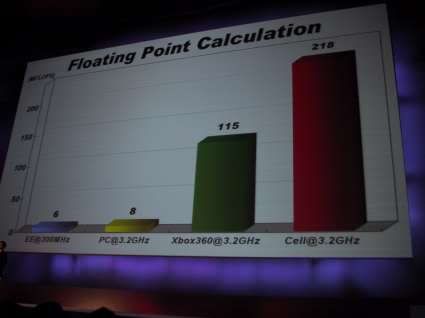
You are talking about PEAK performance. The PS2's Emotion engine had close to 3x the peak FLOPS of the PIII in the Xbox, but it used in-line processing similar to the Cell which is hard to obtain peak power.
How about lack of embedded DRAM, no unified memory structure, and a inferior NVIDIA GPU vs ATI GPU?
No ownage by either system. Each has it's strengths and weaknesses.


Suzuka Master
Joined: Jun 2001
Posts: 7,083
Likes: 0
From: Los Angeles, CA
Originally Posted by Zapata
unreal 2007
GTA
will debute with ps3. bg can eat it with the halo 3 threats. lol....GTA with online functionality......
GTA
will debute with ps3. bg can eat it with the halo 3 threats. lol....GTA with online functionality......
How about this?
http://news.teamxbox.com/xbox/8271/F...oming-to-Xbox/
Square games coming to Xbox and Xbox360
Suzuka Master
Joined: Jun 2001
Posts: 7,083
Likes: 0
From: Los Angeles, CA
Originally Posted by Moog-Type-S
Someone say HALO 3?!?!?!? 
"In next week's issue of Time Magazine--which features Gates holding the Xbox 360 on the cover--Gates mentioned plans for the release of the much-anticipated follow-up to the best-selling console shooter. In a parenthetical sidebar in the article, Time says the following:
"Note to the hard-core faithful: the next version of Halo will not, repeat not, be ready in time for the launch of Xbox 360. It will be part of the all-important second wave next spring. 'It's perfect,' Gates says, radiant with bloodlust. 'The day Sony launches [the new PlayStation], and they walk right into Halo 3.'"