


VTEC Explained - What is it? 3G Garage #L136


Thread Starter
CTS-V Import Slayer
iTrader: (2)
Joined: Jul 2005
Posts: 4,958
Likes: 18
From: Fishers, IN
VTEC Explained - What is it? 3G Garage #L136
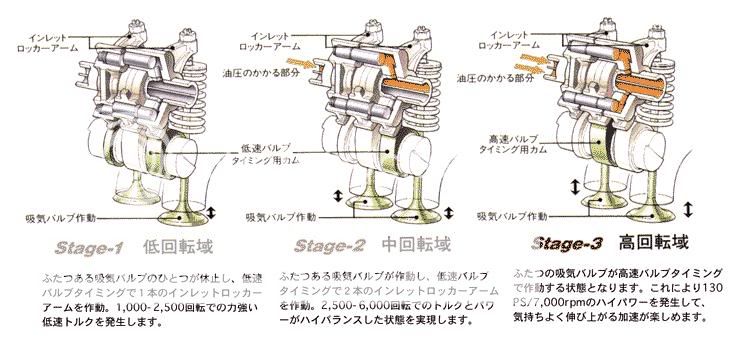
Here is a brief explanation of how V-tech works and what it is for the people who might not know.....
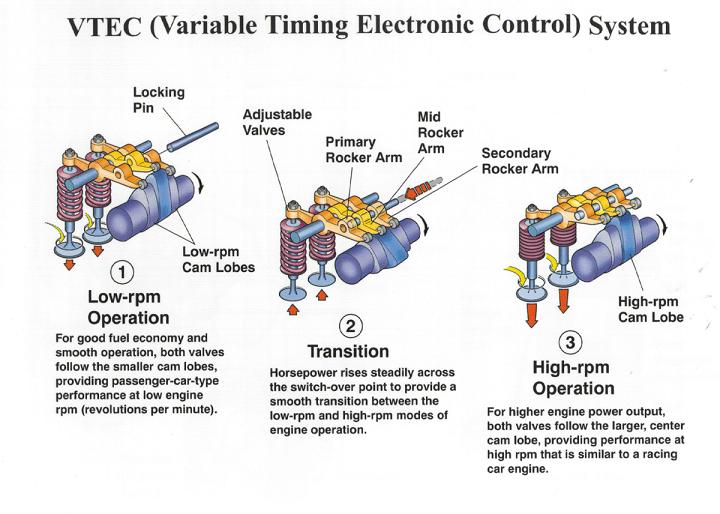
Taken from Acura Service Consultant Illustrated Technical Guide, copyright 2005 American Honda Motor Co., Inc.
Taken from Acura Service Consultant Illustrated Technical Guide, copyright 2005 American Honda Motor Co., Inc.




Red line...use it
Joined: Jun 2004
Posts: 138
Likes: 0
From: Boston
Very interesting. I always wondered how that worked. This shows dual intake valves. I assume the exaust is not on a VTEC cam?? I wonder how they get that pin in there. Must be some good timing and fast action.
Lets see 7000RPM. ==>420000 RPS ===> that yields 2.38 micro Seconds per revolution. Assuming they have only half that time while on the flat parts of the cam, that is 1.2 micro seconds...wow
Lets see 7000RPM. ==>420000 RPS ===> that yields 2.38 micro Seconds per revolution. Assuming they have only half that time while on the flat parts of the cam, that is 1.2 micro seconds...wow

Keep Right Except to Pass

Joined: Aug 2004
Posts: 2,411
Likes: 45
From: Kingstowne, VA
Originally Posted by CL Platano
I was ready to bash until I saw it was just a typo.
Three Wheelin'
Joined: Jul 2005
Posts: 1,665
Likes: 709
From: Vancouver, Canada
Originally Posted by 04TLMan
Very interesting. I always wondered how that worked. This shows dual intake valves. I assume the exaust is not on a VTEC cam?? I wonder how they get that pin in there. Must be some good timing and fast action.
Lets see 7000RPM. ==>420000 RPS ===> that yields 2.38 micro Seconds per revolution. Assuming they have only half that time while on the flat parts of the cam, that is 1.2 micro seconds...wow
Lets see 7000RPM. ==>420000 RPS ===> that yields 2.38 micro Seconds per revolution. Assuming they have only half that time while on the flat parts of the cam, that is 1.2 micro seconds...wow
Thread Starter
CTS-V Import Slayer
iTrader: (2)
Joined: Jul 2005
Posts: 4,958
Likes: 18
From: Fishers, IN
God you guys are ruthless ...sorry....typo. Hard to type Tec and not put the "H" out of habit. We write computer tech or PC tech, ect. too many times! Doh!
What is VTECH....lol.....itsnt that a baby carrier and infant odds and ends mfg! I think they make kiddie phones now too.....lol!
SORRY GUYS>>>MEANT WHAT IS VTEC! Doh!
...sorry....typo. Hard to type Tec and not put the "H" out of habit. We write computer tech or PC tech, ect. too many times! Doh!What is VTECH....lol.....itsnt that a baby carrier and infant odds and ends mfg! I think they make kiddie phones now too.....lol!
SORRY GUYS>>>MEANT WHAT IS VTEC! Doh!
Trending Topics
Thread Starter
CTS-V Import Slayer
iTrader: (2)
Joined: Jul 2005
Posts: 4,958
Likes: 18
From: Fishers, IN
Originally Posted by invincible569
If VTEC is so great, why dont other manufacturer's use it?
I know it has been out for a while and havent heard of any problems.
I know it has been out for a while and havent heard of any problems.

Instructor
Joined: Nov 2005
Posts: 112
Likes: 0
Originally Posted by MichaelBenz
I believe there is another company out there that does...they just call it something else, but principle is the same I believe. Cant remeber who it was though....it was an import though.
I just read this today:
The Spyder comes with a four-cylinder 162-horsepower engine in the GS version, or a 260-horsepower V-6 in the GT version. The engines use variable valve timing and lift control to increase power, and the GT is said to reach 60 m.p.h. in six seconds.
So maybe Mitsubishi?

Thread Starter
CTS-V Import Slayer
iTrader: (2)
Joined: Jul 2005
Posts: 4,958
Likes: 18
From: Fishers, IN
Originally Posted by chill_dog
Yes, it is MItsubishi...I forget what they call their system, though.


Registered User
Joined: Jan 2002
Posts: 2,298
Likes: 2
From: NY
Originally Posted by 04TLMan
Very interesting. I always wondered how that worked. This shows dual intake valves. I assume the exaust is not on a VTEC cam?? I wonder how they get that pin in there. Must be some good timing and fast action.
Lets see 7000RPM. ==>420000 RPS ===> that yields 2.38 micro Seconds per revolution. Assuming they have only half that time while on the flat parts of the cam, that is 1.2 micro seconds...wow
Lets see 7000RPM. ==>420000 RPS ===> that yields 2.38 micro Seconds per revolution. Assuming they have only half that time while on the flat parts of the cam, that is 1.2 micro seconds...wow
so the TL's cam looks like this

it has 5 lobes per cylinder, 3 for the intake, and 2 for exhaust, only the intake side has the extra high lift(VTEC) lobe. the exhaust still has 2 valves just as the intake side does
here is a dohc VTEC intake and exhaust cam

as you can see both cams have 3 lobes
works the same as the SOHC, but both intake and exhaust have the 3rd (VTEC) lobe
Three Wheelin'
Joined: Jul 2005
Posts: 1,665
Likes: 709
From: Vancouver, Canada
Who else uses VTEC?
Aside from the Japanese carmakers mentioned above, Ferrari uses VTEC, and they started doing that once Honda put the fear of God into them when they launched the NSX all those years ago. The first Ferrari that had a variable valve timing motor was the F355, and they still use them to this day.
In fact, come to think of it...Porsche uses a version of VTEC as well.
In fact, come to think of it...Porsche uses a version of VTEC as well.



Thread Starter
CTS-V Import Slayer
iTrader: (2)
Joined: Jul 2005
Posts: 4,958
Likes: 18
From: Fishers, IN
Originally Posted by F23A4
There are a couple of ways by which car manufacturer's vary the valve timing. The most well known system is the VTEC which is used on some of the Honda engines. Other systems which some of you might not have heard of are:
- VarioCam/VarioCam Plus which is used on some of the Porsche engines,
- MIVEC(Mitsubishi Innovative Valve timing and lift Electronic Control) which is used on the Mitsubishi engines,
- VVT-i(Variable Valve Timing with Intelligence) and now VVTL-i (Variable Valve Timing and Lift with Intelligence) which is being used on the current Toyota and some Lexus engines,
- VVL(Variable Valve Lift) which is used on the Nissan engines and also featured in the 350Z is the CVTCS (Continuously Variable Valve Timing System)
- VANOS(Variable Onckenwellen Steuerung) which is used in the BMW engines and also the Double VANOS system on the new 3 Series and they are many more similar systems used by manufacturers such as Ford, Lamborghini and even Ferrari.
Before you can appreciate how important valve timing is, you have to understand how it relates to engine operation. Remember that an engine is basically a glorified air pump and, as such, the most effective way to increase horsepower and/or efficiency is to increase an engine's ability to process air. There are a number of ways to do this that range from altering the exhaust system to upgrading the fuel system to installing a less-restrictive air filter. Since an engine's valves play a major role in how air gets in and out of the combustion chamber, it makes sense to focus on them when looking to increase horsepower and efficiency.
This is exactly what Honda, Toyota and BMW and quite a number of other manufacturer's have done in recent years. By using advanced systems to alter the opening and closing of engine valves, they have created more powerful and clean burning engines that require less fuel and are relatively small in displacement.
Before we take a look at each of these variable valve-timing systems, let's rehash how valve timing normally works. Until recently, a manufacturer used one or more camshafts (plus some pushrods, lifters and rocker arms) to open and close an engine's valves. The camshaft/camshafts was turned by a timing chain that connected to the crankshaft. As engine rpm's rose and fell, the crankshaft and camshaft would turn faster or slower to keep valve timing relatively close to what was needed for engine operation.
Unfortunately, the dynamics of airflow through a combustion chamber change radically between 2,000 rpm and 6,000 rpm. Despite the manufacturer's best efforts, there was just no way to maximize valve timing for high and low rpm with a simple crankshaft-driven valve train. Instead, engineers had to develop a "compromise" system that would allow an engine to start and run when pulling out of the driveway but also allow for strong acceleration and highway cruising at 70+ mph. Obviously, they were successful. However, because of the "compromise" nature of standard valve train systems, few engines were ever in their "sweet zone," which resulted in wasted fuel and reduced performance.
Variable valve timing has changed all that. By coming up with a way to alter valve timing between high and low rpm's, Honda, Toyota and BMW and many more manufacturer's can now tune valve operation for optimum performance and efficiency throughout the entire rev range.
Honda was the first to offer what it called VTEC in its Acura-badged performance models like the Integra GS-R and NSX (it has since worked its way into the Prelude and even the lowly Civic). VTEC stands for Variable Valve Timing and Lift Electronic Control. It basically uses two sets of camshaft profiles-one for low and mid-range rpm and one for high rpm operation. An electronic switch shifts between the two profiles at a specific rpm to increase peak horsepower and improve torque. As a VTEC driver, you can both hear and feel the change when the VTEC "kicks in" at higher rpm levels to improve performance. While this system does not offer continuously variable valve timing, it can make the most of high rpm operation while still providing solid drivability at lower rpm levels. Honda is already working on a three-step VTEC system that will further improve performance and efficiency across the engine rpm range.
The camshaft in a pushrod engine is often driven by gears or a short chain. Gear-drives are generally less prone to breakage than belt drives, which are often found in overhead cam engines.
Toyota saw the success Honda was having with VTEC (from both a functional and marketing standpoint) but decided to go a different route. Instead of the on/off system that VTEC employs, Toyota decided it wanted a continuously variable system that would maximize valve timing throughout the rpm range. Dubbed VVTi for Variable Valve Timing with intelligence (Is this a dig at Honda, suggesting their system isn't intelligent?), Toyota uses a hydraulic rather than mechanical system to alter the intake cam's phasing. The main difference from VTEC is that VVTi maintains the same cam profile and alters only when the valves open and close in relation to engine speed. Also, this system works only on the intake valve while VTEC has two settings for the intake and the exhaust valves, which makes for a more dramatic gain in peak power than VVTi can claim.
Ferrari has a really neat way of doing this. The camshafts on some Ferrari engines are cut with a three-dimensional profile that varies along the length of the cam lobe. At one end of the cam lobe is the least aggressive cam profile, and at the other end is the most aggressive. The shape of the cam smoothly blends these two profiles together. A mechanism can slide the whole camshaft laterally so that the valve engages different parts of the cam. The shaft still spins just like a regular camshaft, but by gradually sliding the camshaft laterally as the engine speed and load increase, the valve timing can be optimized.
Several other manufacturers, including Ford, Lamborghini and Porsche have jumped on the cam phasing bandwagon because it is a relatively cheap method of increasing horsepower, torque and efficiency. BMW has also used a cam phasing system, called VANOS (Variable Onckenwellen Steuerung) for several years. Like the other manufacturers, this system only affected the intake cams. But, as of 1999, BMW is offering its Double VANOS system on the new 3 Series. As you might have guessed, Double VANOS manipulates both the intake and exhaust camshafts to provide efficient operation at all rpm's. This helps the new 328i, equipped with a 2.8-liter inline six, develop 193 peak horsepower and 206 pound-feet of torque. More impressive than the peak numbers, however, is the broad range of useable power that goes along with this system.
Several engine manufacturers are experimenting with systems that would allow infinite variability in valve timing. For example, imagine that each valve had a solenoid on it that could open and close the valve using computer control rather than relying on a camshaft. With this type of system, you would get maximum engine performance at every RPM. Something to look forward to in the future!
To close these series of articles on camshafts, you can see that as the benefits of variable valve timing used on cams become more apparent to both consumers and manufacturers, you can expect to see it on just about every vehicle sold in the world. I suspect that in five years, variable valve timing will be like ABS or side-impact beams: only really cheap cars won't have it.
Taken from Streetracers Online article written by By: Abdul Rehman


Advanced
Joined: Oct 2005
Posts: 97
Likes: 0
From: San Jose, CA
Originally Posted by 04TLMan
Very interesting. I always wondered how that worked. This shows dual intake valves. I assume the exaust is not on a VTEC cam?? I wonder how they get that pin in there. Must be some good timing and fast action.
Lets see 7000RPM. ==>420000 RPS ===> that yields 2.38 micro Seconds per revolution. Assuming they have only half that time while on the flat parts of the cam, that is 1.2 micro seconds...wow
Lets see 7000RPM. ==>420000 RPS ===> that yields 2.38 micro Seconds per revolution. Assuming they have only half that time while on the flat parts of the cam, that is 1.2 micro seconds...wow


Pro
Joined: Nov 2005
Posts: 592
Likes: 0
From: FLorida

BMW 328i: 193 HP and 206 pound-feet of torque
Acura TL: 258 HP and 233 pound-feet of torque
From my understanding torque is what actually makes the car move?
Why does theirs increase while our decrease?
Kinda like all show (sound of Horsepower) and no go.
I need an explanation...I'm not saying I'm right!
Acura TL: 258 HP and 233 pound-feet of torque
From my understanding torque is what actually makes the car move?
Why does theirs increase while our decrease?
Kinda like all show (sound of Horsepower) and no go.
I need an explanation...I'm not saying I'm right!

wow.. this is very interesting.. thnx for posting..
from my experience.. i think it's kicks in at around 4,500RPMS... i have a 06 auto tho...
Originally Posted by SneakAussie
At what RPM does the transition take place in the TL?

Racer
Joined: Apr 2001
Posts: 461
Likes: 17
From: NJ
Originally Posted by Nandito28
BMW 328i: 193 HP and 206 pound-feet of torque
Acura TL: 258 HP and 233 pound-feet of torque
From my understanding torque is what actually makes the car move?
Why does theirs increase while our decrease?
Kinda like all show (sound of Horsepower) and no go.
I need an explanation...I'm not saying I'm right!
Acura TL: 258 HP and 233 pound-feet of torque
From my understanding torque is what actually makes the car move?
Why does theirs increase while our decrease?
Kinda like all show (sound of Horsepower) and no go.
I need an explanation...I'm not saying I'm right!
Pro
Joined: Nov 2005
Posts: 592
Likes: 0
From: FLorida
Originally Posted by SergeyM
I would not compare a modern TL 3.2 liter engine to the ancient 2.8 liter from BMW. The current M3 3.2 liter encine is a better example. It deliveres 333 hp and 265 pound-feet torque. Lots of hp not much of torqe. Same as Acura.
And how come in that instance (328i) torque surpassed the horsepower?

Burning Brakes
Joined: Jul 2005
Posts: 914
Likes: 0
From: SF bay area
Originally Posted by Nandito28
why can't torque be the same or around the same as Horse power?
And how come in that instance (328i) torque surpassed the horsepower?
And how come in that instance (328i) torque surpassed the horsepower?

Cruisin'
Joined: Jan 2006
Posts: 19
Likes: 0
Toyota's 3.5 liter 2GR-FE installed on Lexus IS350 has dual variable timing. All of the VTEC, MIVEC, CVCT regulate only the intake set of valves. 2GR-FE regulates both intake and exhaust valves making it the most advanced engine on the market right now (in my opinion). 306 hp @ 6,400 rpm [1], 277 lb-ft torque @ 4,800 rpm! at ULEV II emissions. Most of this contribution is dual stage direct fuel injections. Honda has to keep up.
I never took apart i-VTEC engine, because never changed a timing belt one (they have chains). Does it have exhaust valve regulated timing?
Honda has to keep up!
J32A4 would need DOHC i-VTEC heads to compete. 300 horse power and at least 250 lb-ft of torque.
I never took apart i-VTEC engine, because never changed a timing belt one (they have chains). Does it have exhaust valve regulated timing?
Honda has to keep up!
J32A4 would need DOHC i-VTEC heads to compete. 300 horse power and at least 250 lb-ft of torque.

Instructor
Joined: Jan 2006
Posts: 127
Likes: 0
Originally Posted by 04TLMan
Very interesting. I always wondered how that worked. This shows dual intake valves. I assume the exaust is not on a VTEC cam?? I wonder how they get that pin in there. Must be some good timing and fast action.
Lets see 7000RPM. ==>420000 RPS ===> that yields 2.38 micro Seconds per revolution. Assuming they have only half that time while on the flat parts of the cam, that is 1.2 micro seconds...wow
Lets see 7000RPM. ==>420000 RPS ===> that yields 2.38 micro Seconds per revolution. Assuming they have only half that time while on the flat parts of the cam, that is 1.2 micro seconds...wow
7000 RPM yields 116.66666....7 RPS and 420,000 RPH...it's too early for me to convert it into microseconds though...
if i'm wrong, someone please correct me
however, this is a great post and great info to have.

Thread Starter
CTS-V Import Slayer
iTrader: (2)
Joined: Jul 2005
Posts: 4,958
Likes: 18
From: Fishers, IN
Ron was nice enough to fix the pic links in here for you guys....this should about tell you everything you ever wanted to know about Vtec that you guys were mentioning in the other thread and provide an excellent venue to continue discussions specifically regarding this topic. Good info here....both pics and verbiage.
Thanks Ron! You da man!
Thanks Ron! You da man!

Thread
Thread Starter
Forum
Replies
Last Post
IBankMouse
1G TSX (2004-2008)
8
Jun 13, 2020 12:53 PM
