


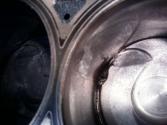
Video: Inside a V8 Engine at Idle Speed


Thread Starter
seizure force field!
iTrader: (1)
Joined: Aug 2006
Posts: 8,971
Likes: 115
From: Monkeytown
 only 800RPM's






Trending Topics


That was uncalled for...


Joined: Sep 2004
Posts: 7,288
Likes: 43
From: Toronto, Ontario
Think of how many millions of times those pistons travel up and down in the cylinder...
Say the average car revs at 2500 rpm while driving at speed. Say the average daily commute to work is 35 minutes, thats 87500 times the piston will travel up and down in that commute, multiply that by 2 to include the commute home and you get 175000. Multiply that by 260 (the number of "work" days in a year including holidays) and you get 45,500,000.
...and that's only the commute to work
Say the average car revs at 2500 rpm while driving at speed. Say the average daily commute to work is 35 minutes, thats 87500 times the piston will travel up and down in that commute, multiply that by 2 to include the commute home and you get 175000. Multiply that by 260 (the number of "work" days in a year including holidays) and you get 45,500,000.
...and that's only the commute to work
Think of how many millions of times those pistons travel up and down in the cylinder...
Say the average car revs at 2500 rpm while driving at speed. Say the average daily commute to work is 35 minutes, thats 87500 times the piston will travel up and down in that commute, multiply that by 2 to include the commute home and you get 175000. Multiply that by 260 (the number of "work" days in a year including holidays) and you get 45,500,000.
...and that's only the commute to work
Say the average car revs at 2500 rpm while driving at speed. Say the average daily commute to work is 35 minutes, thats 87500 times the piston will travel up and down in that commute, multiply that by 2 to include the commute home and you get 175000. Multiply that by 260 (the number of "work" days in a year including holidays) and you get 45,500,000.
...and that's only the commute to work


Registered Member
Joined: Jul 2004
Posts: 8,342
Likes: 163
From: Suburb of Manassas, VA
Think of how many millions of times those pistons travel up and down in the cylinder...
Say the average car revs at 2500 rpm while driving at speed. Say the average daily commute to work is 35 minutes, thats 87500 times the piston will travel up and down in that commute, multiply that by 2 to include the commute home and you get 175000. Multiply that by 260 (the number of "work" days in a year including holidays) and you get 45,500,000.
...and that's only the commute to work
Say the average car revs at 2500 rpm while driving at speed. Say the average daily commute to work is 35 minutes, thats 87500 times the piston will travel up and down in that commute, multiply that by 2 to include the commute home and you get 175000. Multiply that by 260 (the number of "work" days in a year including holidays) and you get 45,500,000.
...and that's only the commute to work
Let's do this with a single cylinder engine. There is one ignition stroke in 720 crankshaft degrees which means at 2500 RPM, that cylinder would fire 1250 times. With an 8-cylinder engine, simply multiple that by 8 and you have the number of firings in one minute at that RPM which is 10,000.
Now as for the pistons moving up and down in their respective cylinders, each piston makes two trips, one up and one down, for each complete crankshaft revolution. So again if we use the single cylinder engine example, we have two trips times 2500 RPM or 5000 trips per minute. With our 8-cylinder engine, that becomes (8 x 2) x 2500 or 40,000 "trips" up and down all eight cylinders in one minute at 2500 RPM!
These factors quickly give you an appreciation for the modern 4-stroke internal combustion engine. Really an amazing invention.


That was uncalled for...
Joined: Sep 2004
Posts: 7,288
Likes: 43
From: Toronto, Ontario
Actually, it's more than that. You are talking here about the ignition stroke. A V8 engine fires four cylinders for each complete revolution of the crankshaft. So at 2500 RPM, there are 10,000 ignition (or power) strokes per minute in a V8. The math can follow.
Let's do this with a single cylinder engine. There is one ignition stroke in 720 crankshaft degrees which means at 2500 RPM, that cylinder would fire 1250 times. With an 8-cylinder engine, simply multiple that by 8 and you have the number of firings in one minute at that RPM which is 10,000.
Now as for the pistons moving up and down in their respective cylinders, each piston makes two trips, one up and one down, for each complete crankshaft revolution. So again if we use the single cylinder engine example, we have two trips times 2500 RPM or 5000 trips per minute. With our 8-cylinder engine, that becomes (8 x 2) x 2500 or 40,000 "trips" up and down all eight cylinders in one minute at 2500 RPM!
These factors quickly give you an appreciation for the modern 4-stroke internal combustion engine. Really an amazing invention.
Let's do this with a single cylinder engine. There is one ignition stroke in 720 crankshaft degrees which means at 2500 RPM, that cylinder would fire 1250 times. With an 8-cylinder engine, simply multiple that by 8 and you have the number of firings in one minute at that RPM which is 10,000.
Now as for the pistons moving up and down in their respective cylinders, each piston makes two trips, one up and one down, for each complete crankshaft revolution. So again if we use the single cylinder engine example, we have two trips times 2500 RPM or 5000 trips per minute. With our 8-cylinder engine, that becomes (8 x 2) x 2500 or 40,000 "trips" up and down all eight cylinders in one minute at 2500 RPM!
These factors quickly give you an appreciation for the modern 4-stroke internal combustion engine. Really an amazing invention.
Interesting stuff.

Race Director


Joined: Jan 2007
Posts: 11,213
Likes: 174
From: Portland, Oregon




Thread
Thread Starter
Forum
Replies
Last Post
