


Rl Hid


Thread Starter
JDM FREAK
Joined: Mar 2003
Posts: 697
Likes: 0
Rl Hid
After converting my fog lights into 6000k HID, i found my headlight to be dim and produce poor lighting. So i checked with my dealer and they gave me Sylvania manufacture who build our RL bulbs. I called customer service, but they stated that 4300k is the maximum that they manufacture. In 05 RL, the igniter plugs into the bulb, and i'm considering Philips 6000K which i run on my bikes, but its igniter is built into the bulb
Does anyone know if i'll experience any problems if i attempt to change the HID into 6000k Phlips!!
Does anyone know if i'll experience any problems if i attempt to change the HID into 6000k Phlips!!

Safety Car


Joined: Jun 2006
Posts: 3,995
Likes: 148
From: San Antonio, TX
Originally Posted by Qatar
After converting my fog lights into 6000k HID, i found my headlight to be dim and produce poor lighting. So i checked with my dealer and they gave me Sylvania manufacture who build our RL bulbs. I called customer service, but they stated that 4300k is the maximum that they manufacture. In 05 RL, the igniter plugs into the bulb, and i'm considering Philips 6000K which i run on my bikes, but its igniter is built into the bulb
Does anyone know if i'll experience any problems if i attempt to change the HID into 6000k Phlips!!
Does anyone know if i'll experience any problems if i attempt to change the HID into 6000k Phlips!!
5k-5500 is the highest you can go without loosing light. 6k you are actually producing less light than what te 4300k would produce. Projectors spread the light out properly in the headlights. The Fogs with HID is producing distorted light because the lenses were not made for HID bulbs.
Info taken from my original post on hidplanet's forum. It can be applied here since I can manage it as time goes on.
*DISCLAIMER*
We are not responsible for your mechanical ability, and therefore can not be held liable for any mis intrepretation in the information provided to you.
NOTICE!!! Any website using this material without the author AND site administrators consent will be considered plagairism. If you are interested in using any of the info here contact me personally.
-------------------------------------------------------------------------------------------------
I took it upon my self to cover the bases so to speak so that you get a general idea of what all is involved with HID.
Class is in session...shall we start?
Bulbs
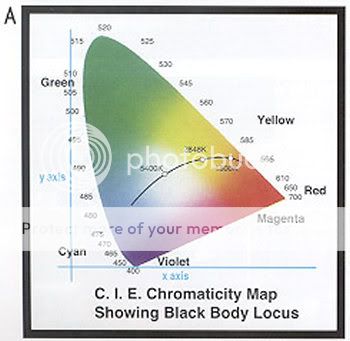
Ok, first off, lets start with the bulbs. The common mistake some people here is that all these high kelvin rated bulbs are the shizzle. Well, they couldn't be more wrong. The higher you go in kelvin, the less light and lumens you'll have. Pratically anything over 6k is really a waste if your at all concerned with your safety and brightness of lighting. So what is the best bulb out there then you ask? 4100-4300k. It has the most lumens out of all the HID bulbs produced. Thats why car manifacturers still use them today. Below is a graph showing you the variances of the light spectrum. As you can see, 4100k would be right where the "sweet spot" is on that chart. It produces near to the suns same kelvin thus giving you daylight-like output. Think of it like this, high kelvin bulbs would be like being out in the sun with sunglasses on vs a 4100k being in the sun w/o glasses on.
Also here is another good thing to know:
Yellow:
1500 k Candlelight
2700-2900 k Yellow painted fog halogen bulbs
-------------------------------
Yellowish white:
3200 k Sunrise/sunset
3200 k Premium H7 non painted halogen bulb
3400 k 1 hour from dusk/dawn
-------------------------------
White:
4100 k Philips/Osram OEM HID D2S
5500 k Bright sunny daylight around noon
----------------
Blueish white
5500-5600 k Electronic photo flash
6000 k Philips Ultinon HID D2S
6500-7500 k Overcast sky
-----------------
Blue:
9000-12000 k Blue sky
-----------------
Purple:
28000 Northern sky
12000-30000 k Ultra Violet light (black light)
Some important terms to know:
Watt- Measure of electrical power (w)
Volt- Measure of electrical charge (v)
Kelvin- Measure of color temperature (K)
Lumen- Measure of light brightness (lu)
Capsule- tecnically correct term for a HID "bulb".
Candela- Measure of light intensity (cd)
Ampere- Measure of electrical current
Cut-off- A distinctive line of light produced by the shield in a headlight that blocks light above a certain height in order to prevent blinding of other motorists.
Beam Pattern- The pattern of light that is projected onto the ground which includes angle of lateral dispersion, width and depth of illumination.
Capsule- Another term for an HID bulb. Some refer to HID bulbs as gas discharge capsules.
Optics- The lighting control assembly structured around the bulb, which effects the dispersion of light and it's characteristics to a great degree.
HID (High Intensity Discharge)= Gas Discharge
Halogen= Incandescence
So now that you know about kelvin and some aspects of the bulbs, you might be wondering why you hear the terms D2R or D2S. Well, to put it very simply to you, D2R is a HID bulb that was designed for HID reflector housings. It has a different base than a D2S and also has a painted portion on the bulb itself. Why is it painted you ask? The paint is there to block certain areas of the bulb that would cause excessive glare in the housing. Does the paint affect bulb performance? Yes. A 4100k D2R has slightly less lumen than a 4100k D2S. Can a D2R be converted to a D2S? Yes. You would have to make a notch in the base of the bulb to match that of a D2S. you would also need to delicatly remove the painted portion of the bulb so that it would be completely visible just like a D2S. So enough about a D2R ehh, lets talk about the D2S for a sec. The D2S was designed soley for a HID projector applications. They are completely clear and give out the most efficiency of the two. Thats pratically all there is in difference between those two bulbs Below are some pics of both.
D2R
D2S
Lets move on shall we...
Ballasts
Ok, it has come to my attention some people think that if you use 2 different ballasts on the same bulbs, that one will look different than the other. Is this true? No. A ballast is a ballast (performance wise) as long as we are talking about 35W ballasts. As long as each ballast has the same exact style of connectors, they both can be used in conjunction with each other.
However, most aftermarket HID kit suppliers usually end up making their own sort of connector thus no longer using the oem style D-type connector. Thus that means some HID kits out there that use these different types of connectors, will no longer be able to connecto to a standard D2R or D2S based bulb. They make these kits like that to be universal with their rebased bulbs. If you ever plan on retroing projectors and using oem products, you aftermakret kit balast WILL NOT work and you will either have to replace the ballasts with oem components or be brave and splice in a new plug and oem connector.
So now you may be asking yourself, "so what all does a ballast do in general"? Well, here is a little bit of info on how flouresent ballast work and their basic simplicity. The same somewhat applies to automotive ballast. Our automotive ballast take in your cars DC power and converts it to AC current.
Originally Posted by how stuff works.com
The simplest sort of ballast, generally referred to as a magnetic ballast, works something like an inductor. A basic inductor consists of a coil of wire in a circuit, which may be wound around a piece of metal. If you've read How Electromagnets Work, you know that when you send electrical current through a wire, it generates a magnetic field. Positioning the wire in concentric loops amplifies this field.
This sort of field affects not only objects around the loop, but also the loop itself. Increasing the current in the loop increases the magnetic field, which applies a voltage opposite the flow of current in the wire. In short, a coiled length of wire in a circuit (an inductor) opposes change in the current flowing through it (see How Inductors Work for details). The transformer elements in a magnetic ballast use this principle to regulate the current in a fluorescent lamp.
A ballast can only slow down changes in current -- it can't stop them. But the alternating current powering a fluorescent light is constantly reversing itself, so the ballast only has to inhibit increasing current in a particular direction for a short amount of time. Check out this site for more information on this process.
Magnetic ballasts modulate electrical current at a relatively low cycle rate, which can cause a noticeable flicker. Magnetic ballasts may also vibrate at a low frequency. This is the source of the audible humming sound people associate with fluorescent lamps.
Modern ballast designs use advanced electronics to more precisely regulate the current flowing through the electrical circuit. Since they use a higher cycle rate, you don't generally notice a flicker or humming noise coming from an electronic ballast. Different lamps require specialized ballasts designed to maintain the specific voltage and current levels needed for varying tube designs.
Ok, so now that you've read that, whats a electromagnet...
Originally Posted by how stuff works.com
An Electromagnet
An electromagnet starts with a battery (or some other source of power) and a wire. What a battery produces is electrons.
If you look at a battery, say at a normal D-cell from a flashlight, you can see that there are two ends, one marked plus (+) and the other marked minus (-). Electrons collect at the negative end of the battery, and, if you let them, they will gladly flow to the positive end. The way you "let them" flow is with a wire. If you attach a wire directly between the positive and negative terminals of a D-cell, three things will happen:
Electrons will flow from the negative side of the battery to the positive side as fast as they can.
The battery will drain fairly quickly (in a matter of several minutes). For that reason, it is generally not a good idea to connect the two terminals of a battery to one another directly. Normally, you connect some kind of load in the middle of the wire so the electrons can do useful work. The load might be a motor, a light bulb, a radio or whatever.
A small magnetic field is generated in the wire. It is this small magnetic field that is the basis of an electromagnet.
With that being said, you now know the basics of what all is going on inside a ballast. The DC power from your car is being turned into AC power to supply the charge needed to power up the HID bulbs. The ballast throws out 23k +/-1-2k of volts to the HID bulbs upon start-up often refered to as warm-up. This is when you seeing HID trun on and start to change colors and get brighter as they warm. This usually lasts only around 25 seconds or so on OEM ballast. Cheaper aftermarket ballast tend to warm-up longer thus causing premature bulb life loss.
Sometimes when people first get HID, they tend to show boat infront of their friends turning their HID off/on rapidly. Is this good some say? The answer is no. If you've ever seen HID turned off and on you would of noticed a 4100k turns redish-orange for a second. This is the bulbs way of saying OUCH! What happens is the bulbs have already created Xenon gas to for the light but hasn't cooled back into salts and then when the bulbs are turned back on, the ballast are sending out a start-up of 23k volts which IS NOT a good thing. The bulbs already had enough Xenon in them to supply light and didn't need the 23k shot to them. This kills bulb lifespan.
So you've learned about ballasts and bulbs now. Lets move on to the wiring now shall we....
Some people out there just aren't aware of the dangers with wiring HID straight off of your existing oem wiring. Should a relay be used to power HID, yes and always needs to be used. Why you ask perhaps? Your oem halogen equiped car was never designed or intended from the manufacturer to use or run high voltage/high current/ high amperage HID ballasts. Ballast draw a imense amount of amps upon start-up and could very seriosuly damage your wiring and not just at where its connected. We are talking serious damage to fuse boxes, ecu's, or worse could short and cause fires on very old cares that even have a hard enough time trying to power halogen. The reason why is, that when the ballast "demand" power, your car has to supply it from somewhere. Lets say its tapped into your oem headlight wire ok. Now you power up the ballasts, the draw current from your wiring, your wiring might not be up to the task so its needs help, t searches for a source and before you know it, you've now weakend not only one source but two now just to try and supply the ballast good clean power. This is why a relay harness is needed. A relay harness gets its power straight from the battery via relays. These relays are then wired to go to your ballasts now.
To understand how a relay works, go here:http://www.mgcars.org.uk/electrical/body_relays.html<----Excellent link
More about relays! http://www.bcae1.com/relays.htm
-or this one-
http://electronics.howstuffworks.com/relay1.htm<-------link
What a relay does:
A relay is a kind of "remote controlled switch".
From the inception of the electric starter, some kind of remote switch was required in order to provide the power to the starter motor without bringing the heavy, unwieldy wires to the dash and, as a result, making them longer with consequent voltage drop. Having a remote switch allows application and interruption of current to be done at the most electrically efficient point in the circuit, even if it is the most ergonomically least suitable position. At first, starter motors were operated by pulling on a cable which operated the switch, much in the same way that a bonnet (hood) latch is still actuated today.
The solenoids used for inertial engaged starter motors were effectively relays. A switch, sometimes operated by a key, could pass a small current to the solenoid which would move an actuator that would in turn engage a bigger switch capable of carrying the very large current the starter required. Later, pre engaged starter motors required that the solenoid had to do more work, throwing the pinion into the ring gear before making the electrical connection to the motor itself, and so its electric current requirements went beyond the capability of the ignition/starter switch. To overcome this limitation, a relay was used to remotely switch the solenoid. Indeed, the first relay fitted to MGB's was for this very purpose.
Basically, inside a relay there is a small electromagnet that requires, in most automotive relays, about 0.25 Amps to operate it. Once this small current is flowing, the electromagnet can pull-in (or if so configured, let-go) a switch capable, depending on the relay, of controlling many times that current, but usually from 30 Amps to 70 Amps. Not only does the relay deliver more power to the load than could be efficiently achieved with a dash or column switch and its associated wiring but the dash switch and wires can be smaller, lower cost and have longer life owing to the minimal heating and arcing that results from switching, carrying and interrupting only 1/4 Amp.
A basic bottom view diagram of an ISO relay that you would use for our applications.
Now that you know how a relay works, lets look at some diagrams to show you which way you need to wire your car.
*These diagrams are property of the FAQ so I do not take credit for their design*
**Special thanks to Herman, Eric, Vick and everyone else for supplying such a great database for everyone to use at the FAQ.**
**************http://faqlight.carpassion.info/**************
NOTE-You'll need to use a diode for cars that use H4, 9004 or 9007 type bulbs in this type application so that power isn't turned off to the HID once high beams are in use.
Ok so now you know a good bit or you should be up to speed on things. But lets go over a few terminlogy we use for the projectors out there....
Originally Posted by Civicsilover43
Ok, this is starting to get me irritated. Ok everyone is saying oh what is the e46 projector, is it the same as an m3 or what about the e55 is it the same as an e-class, Or what about the a6 is it the same as an rs6. And i know some are new comers and dont know much about the hid lingo or termonology, so this is why i am posting this. Ok let me set this straight:
Hella, stanley, bosch, valeo, Zkw, and kioto= They are all headlight and projector manufacturors.
E46= The current chassis code for the newer 99 to present 3-series models. Yes this does include the m3 because it is just a high performance 3 series coupe. In 99-01 they used low beam bosch projectors and in 2002-2004 they used bosch bi-xenon. But in the new 2005 models they use the new bi-xenon ZKW projector.
E55= the e55 is a high performance e-class mercedes benz sedan. This e-class family currently includes the e500 and e320, they all use the same projectors bi-xenon hella projectors. The mercedes "e55" projector is a different version of the hella bi-xenon than the audi's.
Rs6, a6= The rs6 is just a twin turbo v8 model of the audi a6 sedan and uses the exact same projectors as an audi a6. Now in the earlier years from 99-01 they used hella low beam projectors and in 2002-2004 they used hella bi-xenon projectors. In this forum the names for the newer bi-xenon projectors for the audis are the rs6 and a6 bi-xenon. The older low beams we call the a6 low beam because the audi rs6 was introduced in 2003? maybe 2002, and used the hella bi-xenon by then. The audi version is a different version of the hella bi-xenon, rather than say the e55.
7 series, e38 and e65, e60= The current Bmw 7 series sedans (e65) use the "e55 version" hella bi-xenon projectors. The older 7 series (e38) used the bosch low beam projectors. We just call them e38, e65, or 7 series bi-xenon depending on which car the projectors came from.
x5, e39, e60= The x5 is the Bmw sport utility vehicle that just happaned to use the same projectors as the 01-03 5 series sedan (e39). There is no such thing as an e39 bi-xenon projector because the e39's never came with bi-xenon. Now the older (e39s) 97-00 used the hella low beam projectors but were way different and werent seen in other cars. The 01-03 e39s got a facelift and different "angel eye" headlights with different projectors. The e39 bmw was made from 97-03. The e60 is the current 5 series updated sedan from 2004-present. They use the same version of hella bi-xenon projectors as the mercedes benz e-class "e55".
S2k, tl, tsx, fx and maxima= The honda s2000's came equipped with a powerful stanley/kioto made projector that hasnt been seen in any car so we called that projector the s2k. The tl came with a bi-xenon stanley made projector that hasnt been seen in any car so we called it the tl projector. The same with the Acura Tsx and the Infiniti fx45/fx35. But the Nissan Maxima uses a bi-xenon hella projector very similar to the "e55 hella bi-xenon" but has a different sheild. The a4.s4 uses a smaller version of the other valeo projectors. The saab uses a valeo bi-xenon and the cadillac and jaguars use the valeo projectors with a 3" lense.
Audi A4/S4, Valeo D1S/D2S, Valeo= Audi a4/s4 uses the Valeo xenon projectors. The Audi A4/s4 for the years 1999.5-2001 and S4 for the year 1999-2001 use a the D2S Valeo Projectors. In 2002 the Audi A4 switched to the new body style and changed the projectors from using a D2S type bulb to a D1S bulb, then later on the new s4 was added in 2004. The difference between the A4 and S4 is that the s4 is a performance version of the s4, much like the m3 of the 3-series. There are many versions of the valeo including the valeos with the large 3" lense and the valeo bi-xenon. The audi a4s that were eqipped with halogen got projectors that were an h7 version of the a4/s4 valeo d2s projectors.
You will probably be able to figure it out from here on. e39,e46,e38,s2k,tl,tsx,fx, these are all just names they have aquired because of the car they came euipped in. These are not the names that the manufacturors named them. It would be easier just to say "audi version of the hella bi-xenon" or "e38 version of the bosch low beam projector", Lol you know what i mean. Well I hoped this helped some people figure out our termonology on srtforums.

Thread Starter
JDM FREAK
Joined: Mar 2003
Posts: 697
Likes: 0
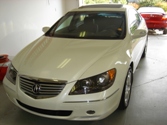
I have purchased Philips D2S 6000K Ultinon.
It costs $145.00 each and i should receive it within 10 days since its shipped from UK.
I'll post pictures once i install them and see if there's any difference at all in visibility.
It costs $145.00 each and i should receive it within 10 days since its shipped from UK.
I'll post pictures once i install them and see if there's any difference at all in visibility.
Trending Topics
Thread Starter
JDM FREAK
Joined: Mar 2003
Posts: 697
Likes: 0
Touge,
did you convert the entire high beam system (bulbs, ballast and igniter)
If you just changed the bulb, then it wouldn't look as blue as anentire HID conversion.
I thought the RL bulb temp was 4300k
did you convert the entire high beam system (bulbs, ballast and igniter)
If you just changed the bulb, then it wouldn't look as blue as anentire HID conversion.
I thought the RL bulb temp was 4300k
VIP
Joined: Mar 2003
Posts: 55
Likes: 0
From: Boise ID
Zenon bulbs get bluer as more hours are put on them. If what you are after is just the deeper color than go with a higher temperature bulb. But you will lose quite a bit of lumens because the only way to get anything bluer than 4500K is by tinting the bulb and this limits the light output. The temperature of the bulb has nothing to do with how bright it is. OEM will give the most light output and provide the best visibility. In my opinion, the RL has the best lights made, so why "Rice" them up with a tinted bulb. Now, there is a way to get more light output from an HID system, and that is to increase the wattage that the ballast supplies to the bulb. Before everyone starts asking questions about how to do this, all I can say is search the web. 
Burning Brakes
Joined: Sep 2006
Posts: 869
Likes: 3
From: NYC | Chofu-shi
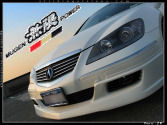
There might be a problem to disable the drl's ?, in another thread someone was saying the mid will warn you if you disable the drl module. I ended up ordering 4700k halogen bulbs for the high beams. This is a pic with my 4300k halogen fogs.

6000k sounds great, makes sure to take a pic
6000k sounds great, makes sure to take a pic
The Doctor
Joined: May 2000
Posts: 2,024
Likes: 2
From: Bellevue, WA
wow, those are 4300k halogen fogs? They look like your HID's! Which brand did you go with?
Originally Posted by Touge
There might be a problem to disable the drl's ?, in another thread someone was saying the mid will warn you if you disable the drl module. I ended up ordering 4700k halogen bulbs for the high beams. This is a pic with my 4300k halogen fogs.
6000k sounds great, makes sure to take a pic
6000k sounds great, makes sure to take a pic
Thread Starter
JDM FREAK
Joined: Mar 2003
Posts: 697
Likes: 0
Alright, i picked up my car hours ago and i can't be happier
The blubs emmit white light with blue tint, and visibility CANT be any BETTER.
i might be hyped up, but i definately can see better with those bulbs.
I'm surprised that technically as stated above, 4300k should perforfm better than 6000k, but trying is knowing to me.
i'll post pic's later
The blubs emmit white light with blue tint, and visibility CANT be any BETTER.
i might be hyped up, but i definately can see better with those bulbs.
I'm surprised that technically as stated above, 4300k should perforfm better than 6000k, but trying is knowing to me.
i'll post pic's later
Thread Starter
JDM FREAK
Joined: Mar 2003
Posts: 697
Likes: 0
well, over the few miles i drove from work, i realised that i didn't need my foglights on (for the first time since i urchased the car) and the light produced by the headlight is pretty equal if not better than the previous 4300k + hid fog light.
i took couple of pic's but they don't seem clear...


i took couple of pic's but they don't seem clear...


Thread
Thread Starter
Forum
Replies
Last Post
rp_guy
Member Cars for Sale
9
Jul 16, 2017 07:33 AM
