


K&N Filters


Thread Starter
Advanced
Joined: Sep 2006
Posts: 81
Likes: 1
K&N Filters
I remember at least one other poster that had an interest in a K&N filter for the RDX. K&N has a product request form at...
http://www.knfilters.com/products_needed/default.aspx
Any one else that is interested should put in a request. Maybe it will affect the speed at which they develop it. On the form, for engine size, put "2.3L".
http://www.knfilters.com/products_needed/default.aspx
Any one else that is interested should put in a request. Maybe it will affect the speed at which they develop it. On the form, for engine size, put "2.3L".

Diggin' the RDX!


Joined: Nov 2006
Posts: 351
Likes: 4
From: KC
Cool, thanks for the post. Will do. FWIW, I was on autoanything.com and found this listed for the RDX: http://www.autoanything.com/air-filt...A2579A0A0.aspx

Instructor
Joined: Jan 2007
Posts: 138
Likes: 1
From: Dallas
Originally Posted by dennarda
I remember at least one other poster that had an interest in a K&N filter for the RDX. K&N has a product request form at...
http://www.knfilters.com/products_needed/default.aspx
http://www.knfilters.com/products_needed/default.aspx
Three Wheelin'
Joined: Sep 2006
Posts: 1,855
Likes: 5
From: Virginia
Originally Posted by econman
Excuse my ignorance, but what are the virtues of K&N filters? Are they superior to Acura part or less expensive?

Cruisin'
Joined: Feb 2007
Posts: 23
Likes: 0
Originally Posted by Pacer
Cool, thanks for the post. Will do. FWIW, I was on autoanything.com and found this listed for the RDX: http://www.autoanything.com/air-filt...A2579A0A0.aspx
Instructor
Joined: Jan 2007
Posts: 138
Likes: 1
From: Dallas
Originally Posted by sasair
They allow increased air flow will still maintaining a decent level of filtering. Mostly by having a larger surface for the air to flow through. They are also cleanable so a single filter will last the life of the vehicle.
There are always pro's and con's of anything. So what are the major benefit-costs?

boostin'
Joined: Jan 2007
Posts: 175
Likes: 0
From: St. Louis, MO
If you just get the replacement K&N filter, the really only benefit is that it will last forever w/ maintenence cleaning; don't expect to get extra power out of it (had them in other cars in the past).
if you want the extra power, wait for an actual air induction kit to come out, but that will probably run atleast $200-$300
if you want the extra power, wait for an actual air induction kit to come out, but that will probably run atleast $200-$300
Trending Topics

07 RDX - Royal Blue/Ebony
Joined: Nov 2006
Posts: 570
Likes: 0
From: Wmsbg, VA
Originally Posted by RDX REX
if you want the extra power, wait for an actual air induction kit to come out, but that will probably run atleast $200-$300
boostin'
Joined: Jan 2007
Posts: 175
Likes: 0
From: St. Louis, MO
Originally Posted by c_hunter
I would not expect any intake mods to have a significant effect upstream of a turbocharger and intercooler. They dominate everything else in terms of pressurization and heating/cooling.
usually I thought intakes were great mods on stock turbocharged cars. My brother had a twin turbo Stealth, EVO, and an S4, and he put intakes on all of them and had great results
07 RDX - Royal Blue/Ebony
Joined: Nov 2006
Posts: 570
Likes: 0
From: Wmsbg, VA
Originally Posted by RDX REX
usually I thought intakes were great mods on stock turbocharged cars. My brother had a twin turbo Stealth, EVO, and an S4, and he put intakes on all of them and had great results
There are a couple aspects of intake tuning that matter; first would be reducing losses and increasing flow rate, the second would be dropping temperature. These are often addressed with less restrictive "cold air" intakes on normally aspirated cars. On a turbo, these mods would be upstream of the turbo. There is a large pressure increase across the intake compressor of the turbo, and intake improvements (reduced flow losses) upstream of the turbo will generally be small compared to the pressure rise of the turbo itself. There is also a large temperature rise across the turbo (due to the work of compression and the heat of the turbo housing itself) and a few degrees difference offered by a cold air intake gets lost here. The temperature drop back across the intercooler is where the cooling matters, and that's where temperature improvements should be made. Actually, flow improvements should be made in the intercooler too -- they can be quite restrictive and often have a lot of flow losses.
So on a turbo engine, the big payoff is the intercooler (and feeding cool air to the intercooler), then the turbo (or both together). The intake itself only comes into play when it becomes the limiting factor to feeding a larger turbo.
Did your brother dyno the engines? That is the only conclusive way to know how well the mods work.
By the way, there are similar issues with exhaust mods on turbo engines -- not as high a payoff as on normally aspirated cars because of the back pressure across the turbo.
Cruisin'
Joined: Feb 2007
Posts: 23
Likes: 0
Originally Posted by c_hunter
So on a turbo engine, the big payoff is the intercooler (and feeding cool air to the intercooler), then the turbo (or both together). The intake itself only comes into play when it becomes the limiting factor to feeding a larger turbo.
Did your brother dyno the engines? That is the only conclusive way to know how well the mods work.
By the way, there are similar issues with exhaust mods on turbo engines -- not as high a payoff as on normally aspirated cars because of the back pressure across the turbo.
Did your brother dyno the engines? That is the only conclusive way to know how well the mods work.
By the way, there are similar issues with exhaust mods on turbo engines -- not as high a payoff as on normally aspirated cars because of the back pressure across the turbo.
On a turbo car, though, it is such a high compression engine, little or no backpressure is beneficial for the turbo. Actually, when a turbo car has no exhaust on it (i.e. just a downpipe), it's flow is peak. Turbo cars need to breathe. Anyone who had had a turbo car in the past knows this.
Here are the facts:
1. RDX stock airbox is 95% closed, making it restrictive
2. Turbos need to breathe in (intake) and out (exhaust)
3. Cooler turbo and cooler air going into the turbo equals better performance
Here is an example: Try sucking enough air through a straw to breath (don't really do it or you will pass out
 ). Then try sucking air through a large diameter piece of tubing...much easier to flow the same amount of air. This same thing applies to our turbos. Make them work less to get the air and they will spool faster!
 This is what I suggest (when these options become available, of course): Replace the stock box with a short ram intake and place the filter in a prime location such as near a wheel well where it will get the most, direct, cold flowing air. Add a downpipe with an exhaust to release back pressure. In conjunction, these mods will help cool the turbo, create quicker spool up time, make less work for the turbo, and ultimately increase performance.
boostin'
Joined: Jan 2007
Posts: 175
Likes: 0
From: St. Louis, MO
Originally Posted by Boostin' Girl
In regards to exhaust mods, to say that they don't have as great an effect on turbo cars as naturally aspirated is wrong. Naturally aspirated engines work effectively on back pressure. When ricers put exhausts on their cars, they are putting a larger exhaust on which reduces back pressure. This, in turn, affects the engine output which actually ends up making their car slower.
On a turbo car, though, it is such a high compression engine, little or no backpressure is beneficial for the turbo. Actually, when a turbo car has no exhaust on it (i.e. just a downpipe), it's flow is peak. Turbo cars need to breathe. Anyone who had had a turbo car in the past knows this.
Here are the facts:
1. RDX stock airbox is 95% closed, making it restrictive
2. Turbos need to breathe in (intake) and out (exhaust)
3. Cooler turbo and cooler air going into the turbo equals better performance
Here is an example: Try sucking enough air through a straw to breath (don't really do it or you will pass out ). Then try sucking air through a large diameter piece of tubing...much easier to flow the same amount of air. This same thing applies to our turbos. Make them work less to get the air and they will spool faster!
This is what I suggest (when these options become available, of course): Replace the stock box with a short ram intake and place the filter in a prime location such as near a wheel well where it will get the most, direct, cold flowing air. Add a downpipe with an exhaust to release back pressure. In conjunction, these mods will help cool the turbo, create quicker spool up time, make less work for the turbo, and ultimately increase performance.
On a turbo car, though, it is such a high compression engine, little or no backpressure is beneficial for the turbo. Actually, when a turbo car has no exhaust on it (i.e. just a downpipe), it's flow is peak. Turbo cars need to breathe. Anyone who had had a turbo car in the past knows this.
Here are the facts:
1. RDX stock airbox is 95% closed, making it restrictive
2. Turbos need to breathe in (intake) and out (exhaust)
3. Cooler turbo and cooler air going into the turbo equals better performance
Here is an example: Try sucking enough air through a straw to breath (don't really do it or you will pass out
). Then try sucking air through a large diameter piece of tubing...much easier to flow the same amount of air. This same thing applies to our turbos. Make them work less to get the air and they will spool faster! This is what I suggest (when these options become available, of course): Replace the stock box with a short ram intake and place the filter in a prime location such as near a wheel well where it will get the most, direct, cold flowing air. Add a downpipe with an exhaust to release back pressure. In conjunction, these mods will help cool the turbo, create quicker spool up time, make less work for the turbo, and ultimately increase performance.

Instructor
Joined: Sep 2006
Posts: 209
Likes: 0
Originally Posted by Boostin' Girl
In regards to exhaust mods, to say that they don't have as great an effect on turbo cars as naturally aspirated is wrong. Naturally aspirated engines work effectively on back pressure. When ricers put exhausts on their cars, they are putting a larger exhaust on which reduces back pressure. This, in turn, affects the engine output which actually ends up making their car slower.
On a turbo car, though, it is such a high compression engine, little or no backpressure is beneficial for the turbo. Actually, when a turbo car has no exhaust on it (i.e. just a downpipe), it's flow is peak. Turbo cars need to breathe. Anyone who had had a turbo car in the past knows this.
Here are the facts:
1. RDX stock airbox is 95% closed, making it restrictive
2. Turbos need to breathe in (intake) and out (exhaust)
3. Cooler turbo and cooler air going into the turbo equals better performance
Here is an example: Try sucking enough air through a straw to breath (don't really do it or you will pass out ). Then try sucking air through a large diameter piece of tubing...much easier to flow the same amount of air. This same thing applies to our turbos. Make them work less to get the air and they will spool faster!
This is what I suggest (when these options become available, of course): Replace the stock box with a short ram intake and place the filter in a prime location such as near a wheel well where it will get the most, direct, cold flowing air. Add a downpipe with an exhaust to release back pressure. In conjunction, these mods will help cool the turbo, create quicker spool up time, make less work for the turbo, and ultimately increase performance.
On a turbo car, though, it is such a high compression engine, little or no backpressure is beneficial for the turbo. Actually, when a turbo car has no exhaust on it (i.e. just a downpipe), it's flow is peak. Turbo cars need to breathe. Anyone who had had a turbo car in the past knows this.
Here are the facts:
1. RDX stock airbox is 95% closed, making it restrictive
2. Turbos need to breathe in (intake) and out (exhaust)
3. Cooler turbo and cooler air going into the turbo equals better performance
Here is an example: Try sucking enough air through a straw to breath (don't really do it or you will pass out
). Then try sucking air through a large diameter piece of tubing...much easier to flow the same amount of air. This same thing applies to our turbos. Make them work less to get the air and they will spool faster! This is what I suggest (when these options become available, of course): Replace the stock box with a short ram intake and place the filter in a prime location such as near a wheel well where it will get the most, direct, cold flowing air. Add a downpipe with an exhaust to release back pressure. In conjunction, these mods will help cool the turbo, create quicker spool up time, make less work for the turbo, and ultimately increase performance.
 Anyone interested should email and call so they get enough interest and develop the parts.
Thread Starter
Advanced
Joined: Sep 2006
Posts: 81
Likes: 1
The K&N Filters site claims a 12 HP gain @ 5150 RPM for the Subaru WRX STi (i.e. a turbo engine) with nothing more than the replacement air intake system. They make no claims for their stock air filter replacements.
boostin'
Joined: Jan 2007
Posts: 175
Likes: 0
From: St. Louis, MO
Originally Posted by dennarda
The K&N Filters site claims a 12 HP gain @ 5150 RPM for the Subaru WRX STi (i.e. a turbo engine) with nothing more than the replacement air intake system. They make no claims for their stock air filter replacements.
There's gotta be some performance stuff in the works w/ tuners, a stock turbo car is a great platform to build on. I don't know how much boost the stock turbo and engine can take, but something like just a reflash that would change the boost curves can make a huge difference
07 RDX - Royal Blue/Ebony
Joined: Nov 2006
Posts: 570
Likes: 0
From: Wmsbg, VA
Originally Posted by Boostin' Girl
In regards to exhaust mods, to say that they don't have as great an effect on turbo cars as naturally aspirated is wrong. Naturally aspirated engines work effectively on back pressure. When ricers put exhausts on their cars, they are putting a larger exhaust on which reduces back pressure. This, in turn, affects the engine output which actually ends up making their car slower.
On a turbo car, though, it is such a high compression engine, little or no backpressure is beneficial for the turbo. Actually, when a turbo car has no exhaust on it (i.e. just a downpipe), it's flow is peak. Turbo cars need to breathe. Anyone who had had a turbo car in the past knows this.
Here are the facts:
1. RDX stock airbox is 95% closed, making it restrictive
2. Turbos need to breathe in (intake) and out (exhaust)
3. Cooler turbo and cooler air going into the turbo equals better performance
Here is an example: Try sucking enough air through a straw to breath (don't really do it or you will pass out ). Then try sucking air through a large diameter piece of tubing...much easier to flow the same amount of air. This same thing applies to our turbos. Make them work less to get the air and they will spool faster!
This is what I suggest (when these options become available, of course): Replace the stock box with a short ram intake and place the filter in a prime location such as near a wheel well where it will get the most, direct, cold flowing air. Add a downpipe with an exhaust to release back pressure. In conjunction, these mods will help cool the turbo, create quicker spool up time, make less work for the turbo, and ultimately increase performance.
On a turbo car, though, it is such a high compression engine, little or no backpressure is beneficial for the turbo. Actually, when a turbo car has no exhaust on it (i.e. just a downpipe), it's flow is peak. Turbo cars need to breathe. Anyone who had had a turbo car in the past knows this.
Here are the facts:
1. RDX stock airbox is 95% closed, making it restrictive
2. Turbos need to breathe in (intake) and out (exhaust)
3. Cooler turbo and cooler air going into the turbo equals better performance
Here is an example: Try sucking enough air through a straw to breath (don't really do it or you will pass out
). Then try sucking air through a large diameter piece of tubing...much easier to flow the same amount of air. This same thing applies to our turbos. Make them work less to get the air and they will spool faster! This is what I suggest (when these options become available, of course): Replace the stock box with a short ram intake and place the filter in a prime location such as near a wheel well where it will get the most, direct, cold flowing air. Add a downpipe with an exhaust to release back pressure. In conjunction, these mods will help cool the turbo, create quicker spool up time, make less work for the turbo, and ultimately increase performance.
You are oversimplifying it quite a bit -- I am a mechanical engineer with experience in fluid machinery design, and had a WRX which I modded. Most simple mods that people apply to turbo cars do not have a significant effect on the dyno. The mods that do will require re-mapping / re-programming the ECU. It's never as simple as an exhaust-only or intake-only mod. We need to make that distinction.
You need to understand that the pressure rise through the turbo compressor dominates the intake flow. The corresponding pressure drop across the exhaust turbine (which appears as back pressure to the engine, because work is being extracted from the exhaust flow) dominates the exhaust flow. Both of these effects are to the tune of "tens" of psi. Intake losses, friction effects, exhaust piping back pressure, etc are on the order of "tenths" of a psi, maybe a psi in total. You are correct that exhaust and intake mods have an effect, but compared to the turbo they are peanuts. This is where some engineering judgement comes into play in weighing the merits of the mods.
As far as the restrictive intake: if the RDX is not collapsing the stock air filter or intake plumbing by sucking it down like a juice box, then it's not restrictive to the point of being a problem for the amount of mass flow rate the turbo is providing to the engine. Your analogy with the straw is correct in general, but we are not talking about adding more ducting to the engine (say a straw versus a big pipe). We are talking about the existing intake with flow losses on the order of tenths of a psi compared to a turbo boost of tens of psi, for an engine that is tuned throughout (including the valves -- the ultimate flow restriction) for a particular flow rate.
As far as CAI: the thermodynamic effects of a few degF reduction of the intake air temperature is going to be alleviated when the air picks up many tens of degrees of heat going through the turbo. You would need to have the same cooldown at the IC for it to have an effect (ie, for the CAI cooling to "stick" going all the way into the engine). When people with turbo cars notice more power on a colder day, they are noticing the cool air effect at the intake *and* IC.
You are correct that intake/exhaust mods can affect the rate at which the turbo spools (and it works both ways -- my WRX actually spooled slower with a larger Prodrive exhaust). I won't argue that point. But the effect on raw horsepower/torque is dubious. If there is going to be a significant boost in power from any mod, it would have to be accompanied by ECU re-programming. As with the WRX, the big mods (higher Cobb stages) paired many mods with reprogramming. A bigger turbo is the biggest impact when paired with corresponding intake/exhaust mods.
Finally, think about all the people that gutted the stock WRX airbox (aka the snorkus), which contained an intake resonator (this tunes the standing wave pattern in the intake). This was done in a misguided effort to make the intake less restrictive and improve performance. Not only did it not have a positive effect, it actually reduced power because the resonator effect was gone. Yeah, it sounded cool and seemed to make sense, but Cobb had dyno data showing a slight power loss. If this seems counter-intuitive, it's because intake performance is much more complicated that just thinking about restriction. The air filter is a whole lot more restrictive than anything else in the intake -- it pretty much sets the pace.
Generally, Honda and Subaru engineers do a very good job ensuring that their turbo motors are optimized pretty well in terms of intake/exhaust plumbing. Unless you are changing to a larger turbo, or pairing many mods with a new ECU map, then I think individual tweaks are going to be trivial.
Diggin' the RDX!
Joined: Nov 2006
Posts: 351
Likes: 4
From: KC
Originally Posted by RDX REX
If you just get the replacement K&N filter, the really only benefit is that it will last forever w/ maintenence cleaning; don't expect to get extra power out of it (had them in other cars in the past).
if you want the extra power, wait for an actual air induction kit to come out, but that will probably run atleast $200-$300
if you want the extra power, wait for an actual air induction kit to come out, but that will probably run atleast $200-$300
What I REALLY like about their filters are the long life and no-worry/no-hassle factors. Econman, those are the main benefits. You clean them every 40 or 50k miles and then put them back in for the next round. If you factor in the $$ of a new conventional air filter every 20 to 30k (depending on driving conditions), your out-of-pocket cost can also be cheaper with a permanent filter like this. The K&Ns run about $32 to $45 from what I've seen.
Cruisin'
Joined: Jul 2007
Posts: 15
Likes: 2
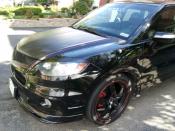
My RDX Modz
Hey what's up everyone? I just wanted to share somethings that I did to my RDX.
- customized K&N air intake system onto my RDX (from '01 Integra)
- customized fit Mugen front lip (from '01 Integra)
- blacked out stock RDX rims
- blacked out exhaust tips
- blacked out 1/2 of tail lights
- cut plastic insert from middle vent
- blacked out silver trim around ram-air vent
I'm going to black out the headlights next and post a do-it-yourself (w/pics) on this forum and I have a carbon fiber cold air intake that will be replacing the short arm I have on the RDX now. Another thing, the air intake made a big difference on the highway. Abit of lag off the line, but once the boost kicks in it pulls nice (Plus it sounds like Darth Vader due to the boost diverter). Pulls hard on stock RDX on highway.
Here some pics you can check out.
[IMG] [/IMG]
[IMG] [/IMG]
[IMG]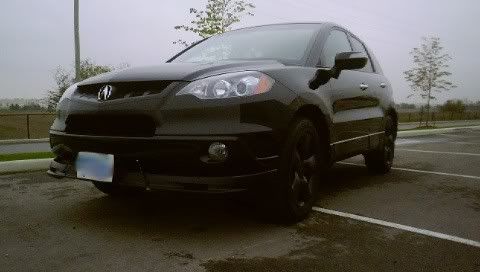 [/IMG]
Let me know what you think. Peace
- customized K&N air intake system onto my RDX (from '01 Integra)
- customized fit Mugen front lip (from '01 Integra)
- blacked out stock RDX rims
- blacked out exhaust tips
- blacked out 1/2 of tail lights
- cut plastic insert from middle vent
- blacked out silver trim around ram-air vent
I'm going to black out the headlights next and post a do-it-yourself (w/pics) on this forum and I have a carbon fiber cold air intake that will be replacing the short arm I have on the RDX now. Another thing, the air intake made a big difference on the highway. Abit of lag off the line, but once the boost kicks in it pulls nice (Plus it sounds like Darth Vader due to the boost diverter). Pulls hard on stock RDX on highway.
Here some pics you can check out.
[IMG]
[/IMG] [IMG]
[/IMG] [IMG]
[/IMG] Let me know what you think. Peace
Cruisin'
Joined: Jul 2007
Posts: 15
Likes: 2
My Modz II
Just wanted to let you guys know that the intake makes a nice difference. I had an extra intake and elbow from my '01 Integra kickin around, so I customized it to fit my RDX (about the 3rd week the RDX came out.) The customizing was more for the sensor. It has made a pretty big difference on the high-way, however, off the line there is abit of lag up to 3000 to 3500rpm then the boost hits nice (harder than stock.) I also drive without the VSA, so the RDX just wants to go. Here are some pics.
[IMG] [/IMG]
Here's what my front looks like.
[IMG][/IMG]
Like I said on another forum, I'm going to customize my carbon-fiber cold air-intake system to fit, instead of the short air. The Mugen lip is also from my Integra.
[IMG]
[/IMG] Here's what my front looks like.
[IMG]
[/IMG] Like I said on another forum, I'm going to customize my carbon-fiber cold air-intake system to fit, instead of the short air. The Mugen lip is also from my Integra.
boostin'
Joined: Jan 2007
Posts: 175
Likes: 0
From: St. Louis, MO
Originally Posted by DgDiamondz
Here's what my front looks like.
[IMG][/IMG]
Like I said on another forum, I'm going to customize my carbon-fiber cold air-intake system to fit, instead of the short air. The Mugen lip is also from my Integra.
[IMG]
[/IMG] Like I said on another forum, I'm going to customize my carbon-fiber cold air-intake system to fit, instead of the short air. The Mugen lip is also from my Integra.
Did you paint the grill yourself?

Pro
Joined: Dec 2007
Posts: 567
Likes: 3
I just came from the GTI MKV world (2006+ GTIs). Intakes didn't do much for us. Our power mods came from a less restrictive downpipe (stock exhaust was actually good), fuel pump, and proper ECU programming for the new DP and fuel pump. I would like to see a better flowing DP made for our RDX. If you notice, the CAT is right after the turbo. On the GTI, the stock DP had 2 CATS. One right after the turbo and one downstream. All DPs for the GTI removed the first CAT and just had one CAT downstream. Looking at pics of the stock RDX DP and the stock GTI DP, they are both restrictive.

Thread
Thread Starter
Forum
Replies
Last Post
rcs86
Car Parts for Sale
3
Aug 2, 2016 06:52 PM
