


Tire Size Question


Thread Starter
Pro
Joined: Sep 2002
Posts: 624
Likes: 0
From: Southern California
Tire Size Question
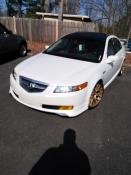
I'm getting new 18s, and im dropped 1.75-2" with H&R racing springs
what size tires do i get?
I used to run 215/35/19
do i get 225/40/18 or 215/40/18?
oh yeah rims will be for sale soon...i'll take pics and post specs they're 19" axis neo's
what size tires do i get?
I used to run 215/35/19
do i get 225/40/18 or 215/40/18?
oh yeah rims will be for sale soon...i'll take pics and post specs they're 19" axis neo's

Instructor
Joined: Jul 2004
Posts: 123
Likes: 0
From: DC
215/40/18 is the correct size. This is the closest to the original stock tire size.
http://www.eunos.com/tirecalc/
Use this to see for yourself.
http://www.eunos.com/tirecalc/
Use this to see for yourself.

Thread Starter
Pro
Joined: Sep 2002
Posts: 624
Likes: 0
From: Southern California
cool...so the first number means the thickness right?
i used to run 215s for my 19s and they last only a year before i need new ones, even tho i bought camber kits and spent a shitload of money on alignments
i used to run 215s for my 19s and they last only a year before i need new ones, even tho i bought camber kits and spent a shitload of money on alignments
Instructor
Joined: Jul 2004
Posts: 123
Likes: 0
From: DC
Originally Posted by rEmixnZZa
cool...so the first number means the thickness right?
i used to run 215s for my 19s and they last only a year before i need new ones, even tho i bought camber kits and spent a shitload of money on alignments
i used to run 215s for my 19s and they last only a year before i need new ones, even tho i bought camber kits and spent a shitload of money on alignments
My first pair of tires I had on my CL were Pirellis P Zeros. They were 225/45/17s with a tread wear of around 180. These are high performance tires and too much tire for our cars. What I mean by too much tire for our cars is that CL are not Porches or Ferraris. They didn't last long either because of the low tread wear number. I have Michelins now and they have a tread wear of 400 and they have lasted me over three years. Low tread wear numbers usually equal better grip but wear faster. You don't need a super sticky tread unless you plan on auto crossing allot. My Michelins have held up very well and stick just fine for me and my sometimes high speed driving. Don't go with a speed rating any less than and H. CLs can go a little over 130 mph but most people that own them don't drive over more than 130 mph for a few minutes or drive on the Autobahn for day to day driving. So H or V rating is just fine. I have pasted more tire info to help you with your quest.
Letter Rating Speed Rating
Q 99 mph
R 106 mph
S 112 mph
T 118 mph
U 124 mph
H 130 mph
V 149 mph
W 168* mph
Y 186* mph
SIZE: All tires sold in the United States must meet the size standards for bead shape, width, diameter and other parameters established by a recognized standardizing organization. World leaders among such organizations are the European Tire and Rim Technical Organization (ETRTO) and the U. S. Tire and Rim Association (T&RA). Both use a partially metric based system. Virtually all passenger tires on the market today use the rim and tire sizing, load and inflation system established by these bodies. All U. S. highway tires must also meet U. S. DOT standards as indicated by the letters 'D.O.T.' on the sidewall.
The several tire size designations in use today depend on when a vehicle was manufactured and whether it was domestic or imported. All tire-sizing systems used today provide information about a tire's dimensions. Among the most important for proper fitment is height, width and load carrying capacity.
P-metric: This is the United States version of a metric sizing system established in 1976. P-Metric passenger car tire sizes begin with "P", which simply means "Passenger".
Metric: This European tire sizing system is similar to P-Metric but does not use the "P" designator.
Alphanumeric: This system was established in 1968 and is based on the tire's load carrying capacity, correlated to its overall size. The tire's capacity and size are indicated by letter designations from "A" (smallest tire, lowest capacity) to "N" (largest tire, highest capacity). An example of an Alphanumeric tire size is BR78-13. "B" shows size/load, "R" indicates radial construction, "78" is the aspect ratio, and "13" is the wheel size in inches.
Numeric: This is the oldest standardized tire sizing system for passenger car tires. When this system was adopted, tire aspect ratios were either 92 or 82. For example, a 7.00-14 tire has a section width of 7 inches, a rim diameter of 14 inches and an aspect ratio of 92. The low profile equivalent size tire with an aspect ratio of 82 would be 7.35-14.**** Example: P215/65R15 89H
P PASSENGER (P-METRIC/NON-P-METRIC)
This indicates a passenger car tire. If the first character in the size designation is a "P", the tire is a "P-Metric" tire and is engineered to standards set by the T&RA (Tire and Rim Association). If there is no "P", the tire is engineered to ETRTO (European Tire and Rim Technical Organization) standards and is a metric tire. The standards set by T&RA and ETRTO have evolved together and are virtually interchangeable.
215 SECTION WIDTH
These numerals indicate the tire section width in millimeters. This is the dimension from sidewall to sidewall. A tire's section width will vary depending on the rim to which it is fitted. The section width will be larger on a wide rim and smaller on a narrow rim. Therefore, each tire is measured to specific rim width. (To convert millimeters into inches, divide by 25.4.)
65 ASPECT RATIO
This two-digit number indicates the tire's aspect ratio. It compares the tire's inflated section height, which is the distance from the bead to the tread, to its section width (maximum). An aspect ratio of 65 means that the tire's section height is 65% of the tire's section width. For clarity, the section width in millimeters is separated from the aspect ratio by a slash (/).
R CONSTRUCTION
This letter indicates the type of ply construction in the tire's casing or carcass. "R" means radial. "D" means diagonal, referring to bias ply tires. "B" means belted for belted-bias ply tires. Never mix radial tires with any other construction on a car.
15 RIM DIAMETER
The "15" indicates the rim diameter in inches. It is the diameter of the tire bead seat ledge in the rim. Most tires are built to inch standards for rim diameters. However, some tires are built to millimetric rim dimensions. Always match the tire's rim diameter to the wheel rim diameter. This is important for safety.
NOTE: A millimetric rim has a different shape than an inch rim; they are not interchangeable.
89H SERVICE DESCRIPTION
The service description is an alphanumeric combination, consisting of two parts, a number and a letter. In this example ì89î is the load index, which represents the load carrying capacity. (All passenger car tires in the US are also marked with their actual load limit in pounds). The letter part is the speed symbol, 'H,' in this example. This is the maximum speed for which the tire is rated at the load specified by the load index. In this example, 'H' means speeds up to 130 mph. Dunlop does not recommend the use of any of its products in excess of legal speed limits. Speed ratings do not necessarily imply that the performance (handling and grip) of the tire meet the performance standards implied by the ratings.. Dunlop designs tires to provide high performance levels commensurate with the higher speed ratings.
O.E. Rating: Tire speed ratings must exceed the maximum speed capability of the vehicle to which they are fitted. Not all tires sold in the US are speed rated, although many modern performance and luxury cars are equipped with speed rated OE tires. It is important to remember this when replacing the tires on your vehicle. Do not downgrade speed ratings from O.E. ratings.
NOTE: Speed Ratings — where applied are indicative of high performance characteristics based on European ECE 30 Indoor Wheel testing as performed by Dunlop and are not valid for damaged, altered, repaired, under-inflated, overloaded, excessively worn, or re-treaded tires. Dunlop does not recommend the use of any of its products in excess of legal speed limits.
SERVICE INDICATORS
Some tires carry additional markings related to service. An M&S or M+S designation means the tire is rated suitable by the manufacturer for mud and snow use. The guidelines are set by the Rubber Manufacturers Association (RMA) in the United States.
ALL-SEASON DESIGNATION
Is a marking which means that the tire meets M&S/M+S requirements without the drawbacks of noise and rolling resistance associated with the traditional deep-lug winter tires. The M&S/M+S designation means that the tire is suitable for normal all-weather driving applications. Tires that meet the requirements of the M& S designation have better winter traction compared to those without the M&S symbol.
Letter Rating Speed Rating
Q 99 mph
R 106 mph
S 112 mph
T 118 mph
U 124 mph
H 130 mph
V 149 mph
W 168* mph
Y 186* mph
* For tires with a maximum speed capability over 149 mph, tire manufacturers sometimes use the letters ZR. For those with a maximum speed capability over 186 mph, tire manufacturers always use the letters ZR.
 holy shit man!!!
Trending Topics
 I'm just trying to help you guys out. That way you are a more informed consumer.
Thread Starter
Pro
Joined: Sep 2002
Posts: 624
Likes: 0
From: Southern California
wow thanks a lot man
so tire size doesn't really affect how long the tires will last? instead it's the tread wear rating?
cuz the reason im downsizing from 19's to 18's is cuz my tires always die out so quickly Pirelli P7000(215/35/ZR19). I have no idea what the tread wear rating is...but I've always used those..been through a pair a year.
Pirelli's are no good for tread wear right? I might go with michelins this time...and 18s are generally cheaper anyways =P
so tire size doesn't really affect how long the tires will last? instead it's the tread wear rating?
cuz the reason im downsizing from 19's to 18's is cuz my tires always die out so quickly Pirelli P7000(215/35/ZR19). I have no idea what the tread wear rating is...but I've always used those..been through a pair a year.
Pirelli's are no good for tread wear right? I might go with michelins this time...and 18s are generally cheaper anyways =P
Thread Starter
Pro
Joined: Sep 2002
Posts: 624
Likes: 0
From: Southern California
oh and right now i'm lookin at michelin pilot XGT H4 - 225/40/18
treadwear rating of 400!
yay finally i can stop spending money on new tires lol
what brand/model do you guys have?
treadwear rating of 400!
yay finally i can stop spending money on new tires lol
what brand/model do you guys have?

Thread
Thread Starter
Forum
Replies
Last Post
nuldabz
3G TL Tires, Wheels & Suspension
3
Sep 3, 2015 05:49 PM
Mugen TSX
Eastern Canada
0
Sep 1, 2015 11:05 PM