When you click on links to various merchants on this site and make a purchase, this can result in this site earning a commission. Affiliate programs and affiliations include, but are not limited to, the eBay Partner Network.
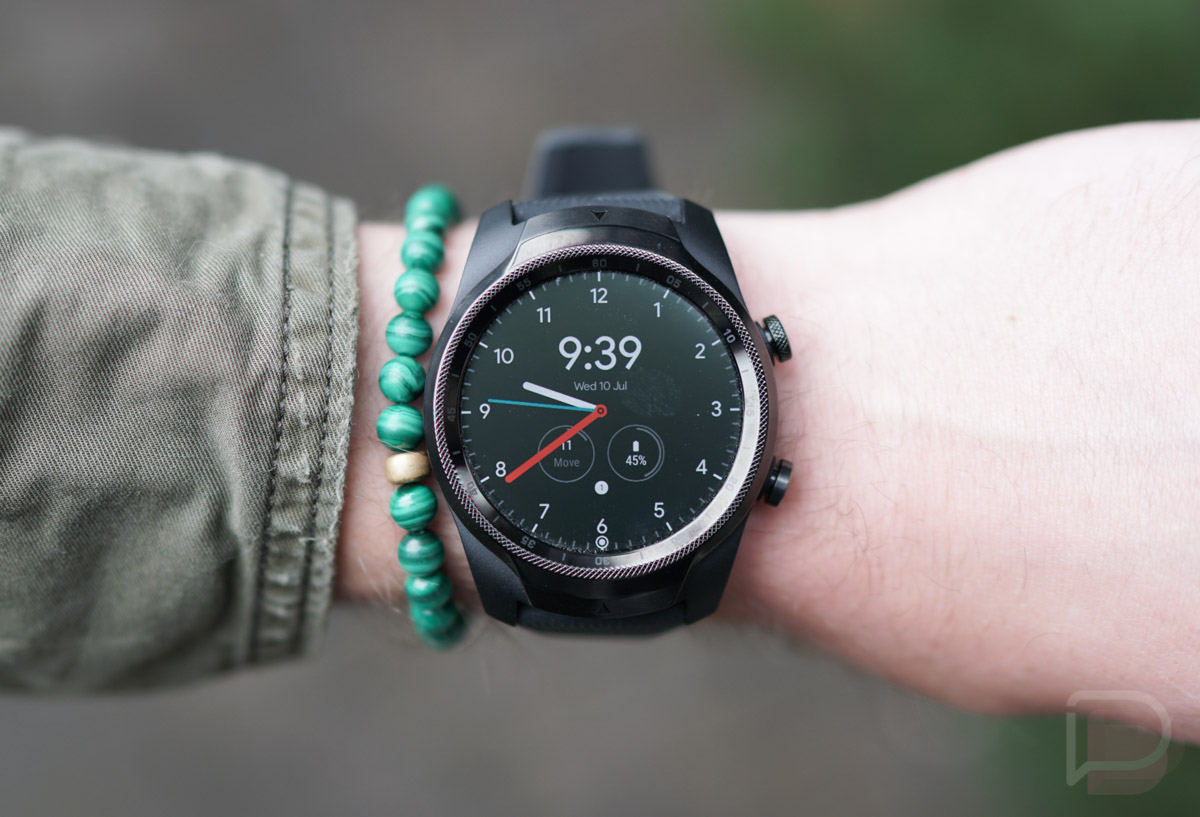
I could not find a thread on Google's Wear OS so started one since I just got my 1st smartwatch: TicWatch Pro 4G LTE. I was on the fence if I really even needed a smartwatch but decided to give it a try. So far I like it and it comes with 1 GB of RAM over 512 MB that most other Wear OS watches have.
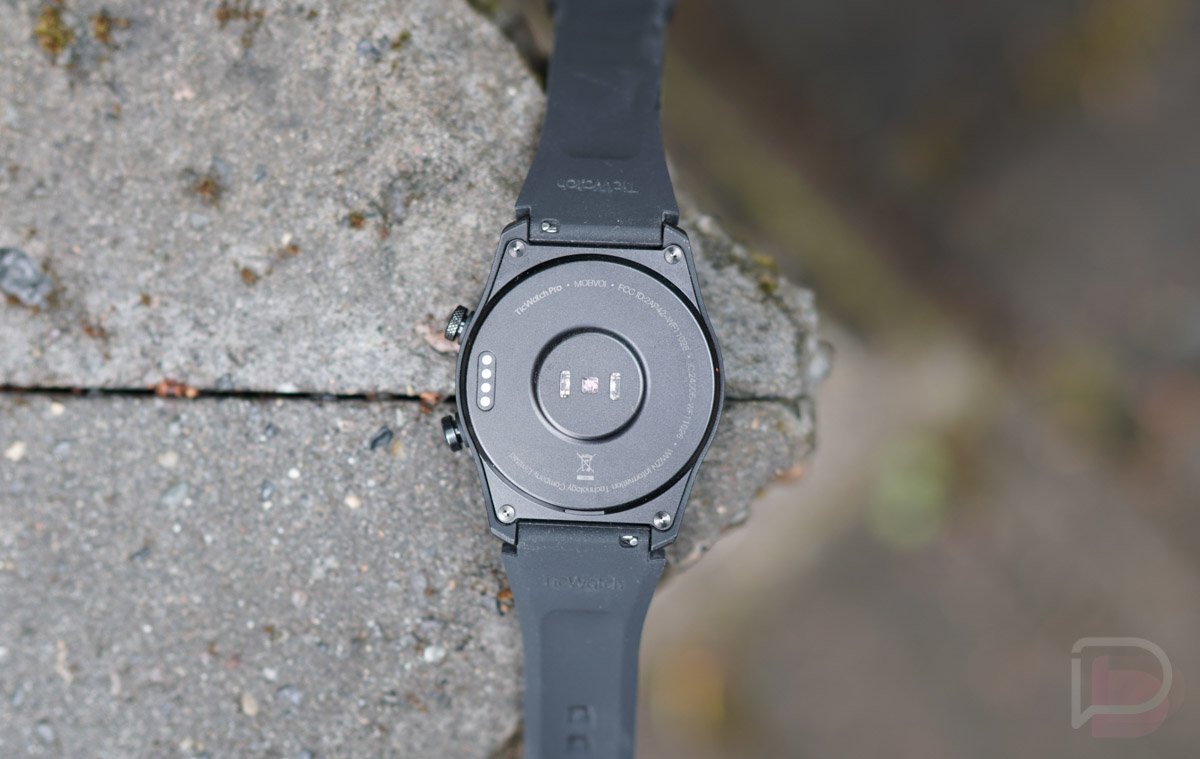
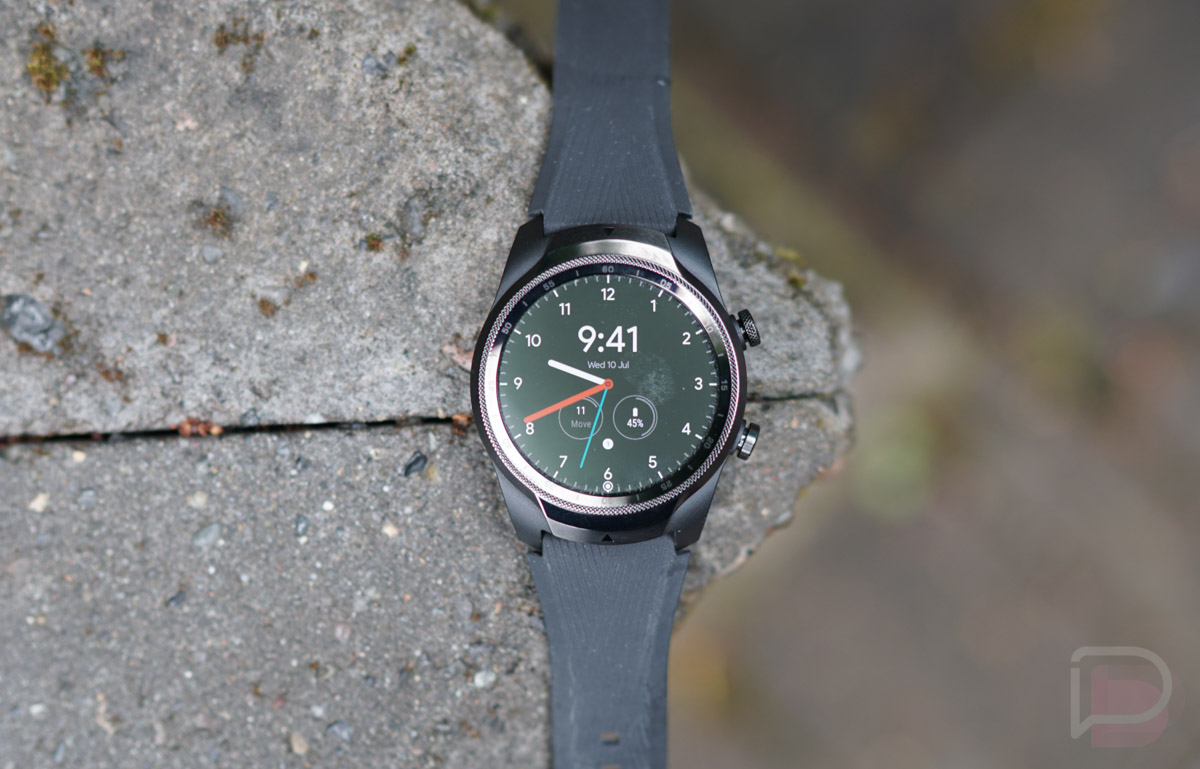
Mobvoi made their new TicWatch Pro 4G/LTE official this morning and since I’ve spent several days with 1 on the wrist, figured I’d share some additional thoughts on whether or not this could be your next Wear OS watch. While not a full review, because this is a re-release of a watch from a year ago, there’s stuff to talk about here.
What is the Mobvoi TicWatch Pro 4G/LTE?
The TicWatch Pro 4G/LTE is a re-release of the TicWatch Pro from last July, only now it has 4G LTE connectivity through Verizon, a full 1GB RAM, and a slightly lighter body. The rest of the specs are the same (processor, display, NFC, sensors, etc.) and the price tops out at $299. If you buy it during this 1st launch month, Mobvoi is slashing the price to $279.
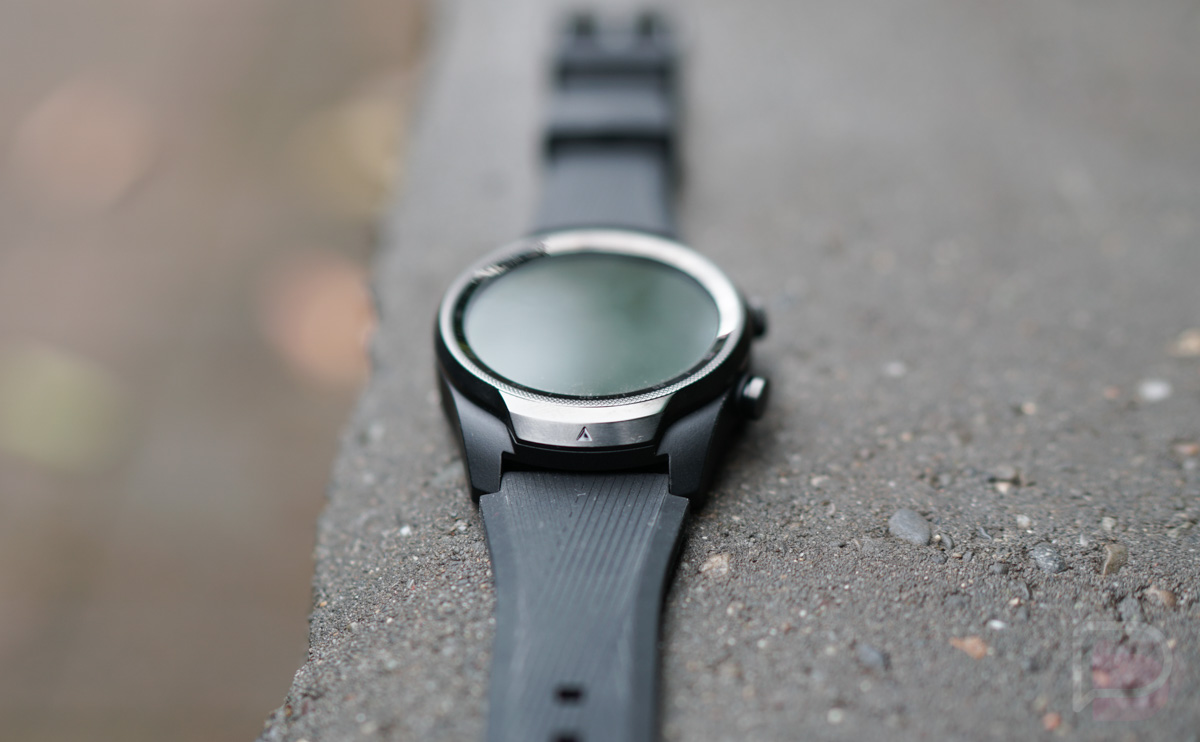
The big selling feature for this watch is the combo AMOLED and LCD display setup, where Mobvoi will let you use the AMOLED when you want a full Wear OS smartwatch experience or switch to the LCD to extend battery life up to 30 days and limit functionality.
All of the rest of the specs and launch details can be found right here.
It’s pretty fast for what it has
The TicWatch Pro 4G/LTE runs the ancient Snapdragon Wear 2100, not the newer Wear 3100. It’s wild to think that anyone would release a “brand new” product in 2019 with a processor inside that is that old. We complain about phones like the Moto Z3 when they are released with a year-old Snapdragon 800 series chip that still works fine, yet sort of shrug at watchmakers using chips that are 3 years old.
That said, this watch performs quite well and that’s likely due to the increase to 1GB RAM. I say that because if you’ve ever switched from a watch with 512MB RAM to 1GB, you’ll see an instant improvement while moving around the UI, opening apps, or attempting any tasks. This has been the case for years, dating back to the original TAG Heuer Connected that performed better than all others, thanks to its increase in RAM. The Montblanc Summit 2 has 1GB RAM too, and it’s much faster than the Fossil Sport, which has 512MB.
So yeah, this TicWatch Pro moves quickly to wake, to open menus, to run Google Assistant commands, and to jump into the few apps you might have on it. In terms of performance, this watch is perfectly fine.
It doesn’t have LTE yet
This is a weird bullet point to report to you, but Mobvoi ran into compliance issues with the LTE connection on this new watch, so it doesn’t actually have an LTE connection today. It won’t have 1 tomorrow or next week either. Instead, Mobvoi says they hope to have Verizon LTE on this thing in about a month. I guess we’ll see if that happens.
Until that happens, this is a close-to-$300 smartwatch running a 3-year old processor and with the same specs (outside of RAM) as a watch they released a year ago. That’s kind of a tough sell when you spell it out that way.
Display, size, battery life, and other notes
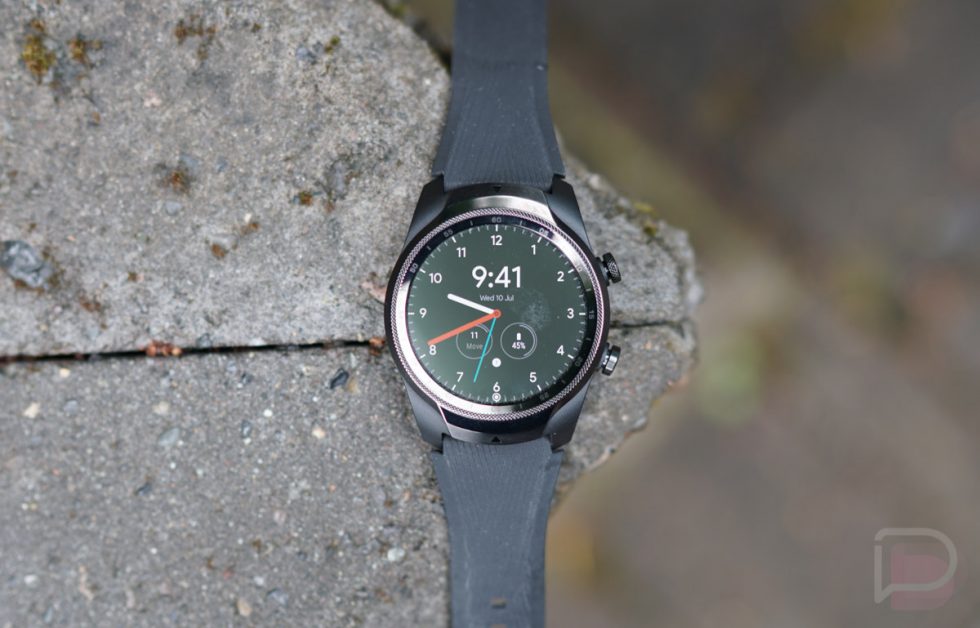
Display: The big 1.39″ AMOLED display on this watch is good unless you are outdoors. I feel like when you are, it’s tough to see, even with brightness cranked. On the flipside, when you have the LCD turned on to help with battery life, it’s impossible to see when it’s dark, so finding a middle ground of which watch mode to use can be difficult. But the AMOLED looks sharp at 400×400 and it’s big enough to really display content well.
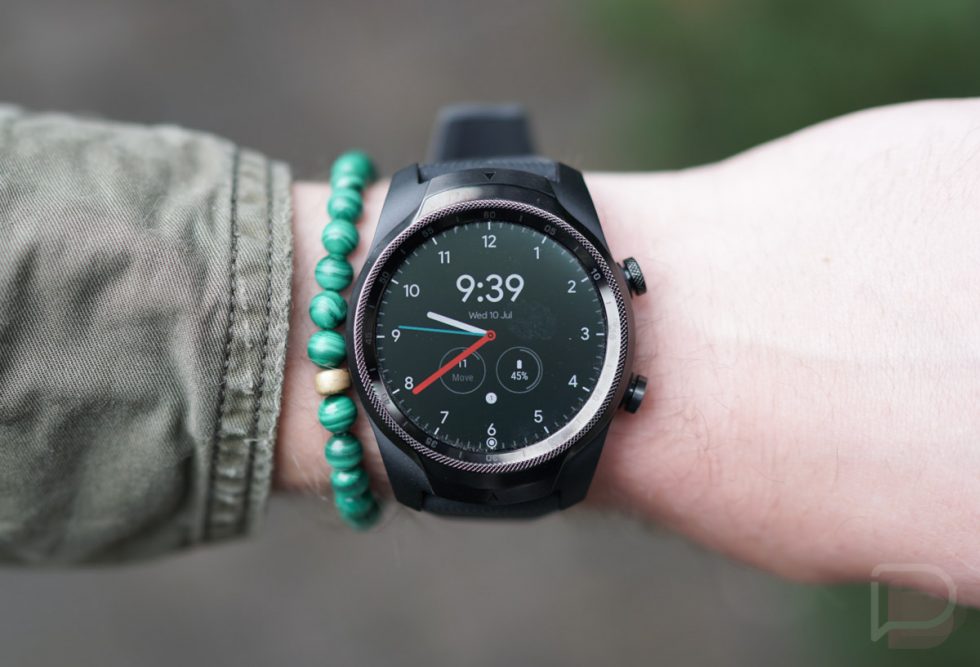
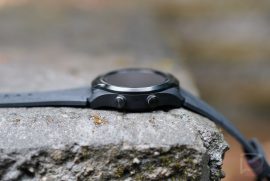
Case size: At 45mm, this watch isn’t small by any means. It’s both tall (12.6mm) and wide, so if you have smaller wrists, this might not be for you. I don’t mind the way it wears, though. Mobvoi has done a decent job with the included band and lugs to help it not overhang much or look awkwardly massive. Maybe the all-black on black exterior is helping there some. Either way, this is by no means a small watch, but it hasn’t been obnoxious to wear.
Battery life: Unlike most Wear OS watches, battery life on the TicWatch Pro 4G/LTE is good for more than a day. I can’t tell if that’s due to optimizations from Mobvoi or if I’m using watches less these days, but I go to bed most nights with 40% left. And today, as I sit here writing up this mini-review, I’m at 47% battery left without having touched a charger in 24 hours. I’m using the watch in AMOLED-only mode too, with an always-on display and constant heartrate monitoring, not that special LCD battery saver mode. Do keep in mind that this is WiFi-only battery, since this watch doesn’t have LTE turned on yet.
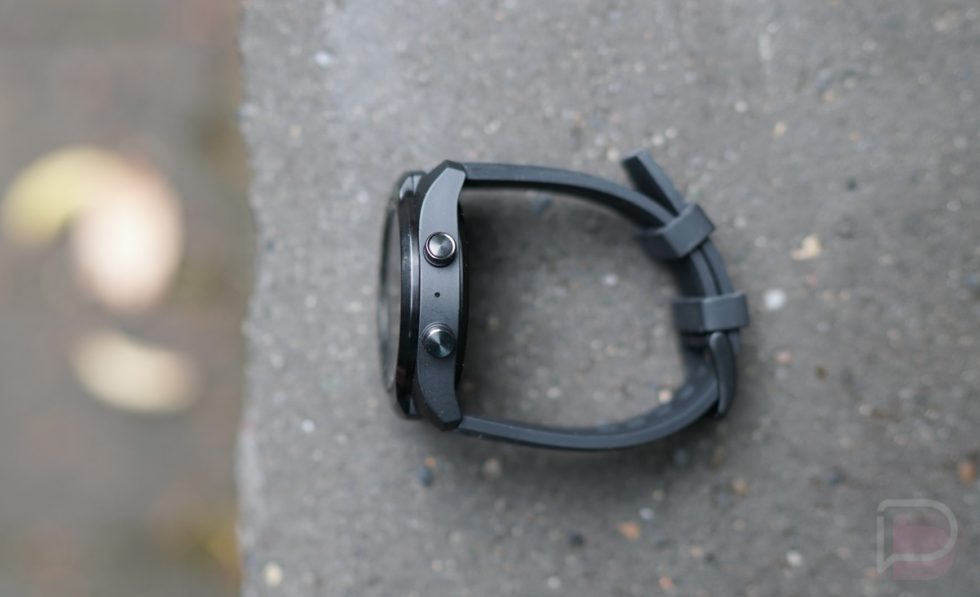
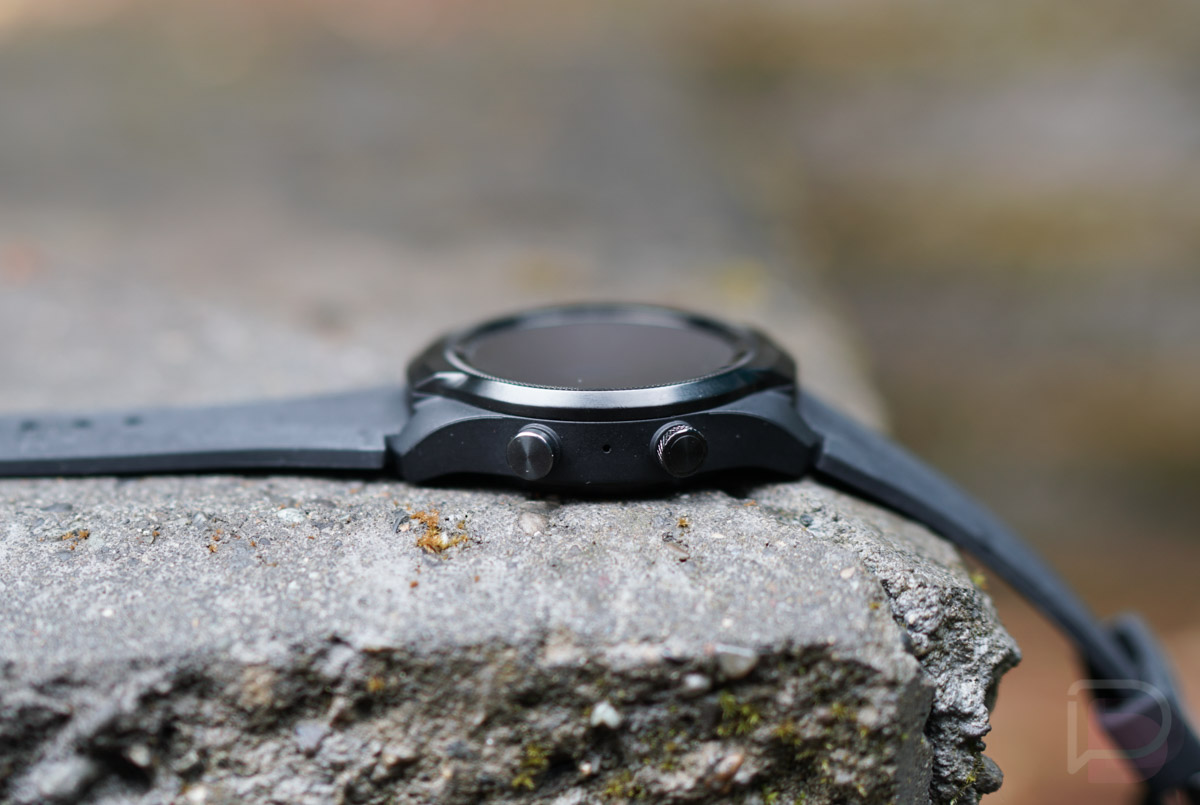
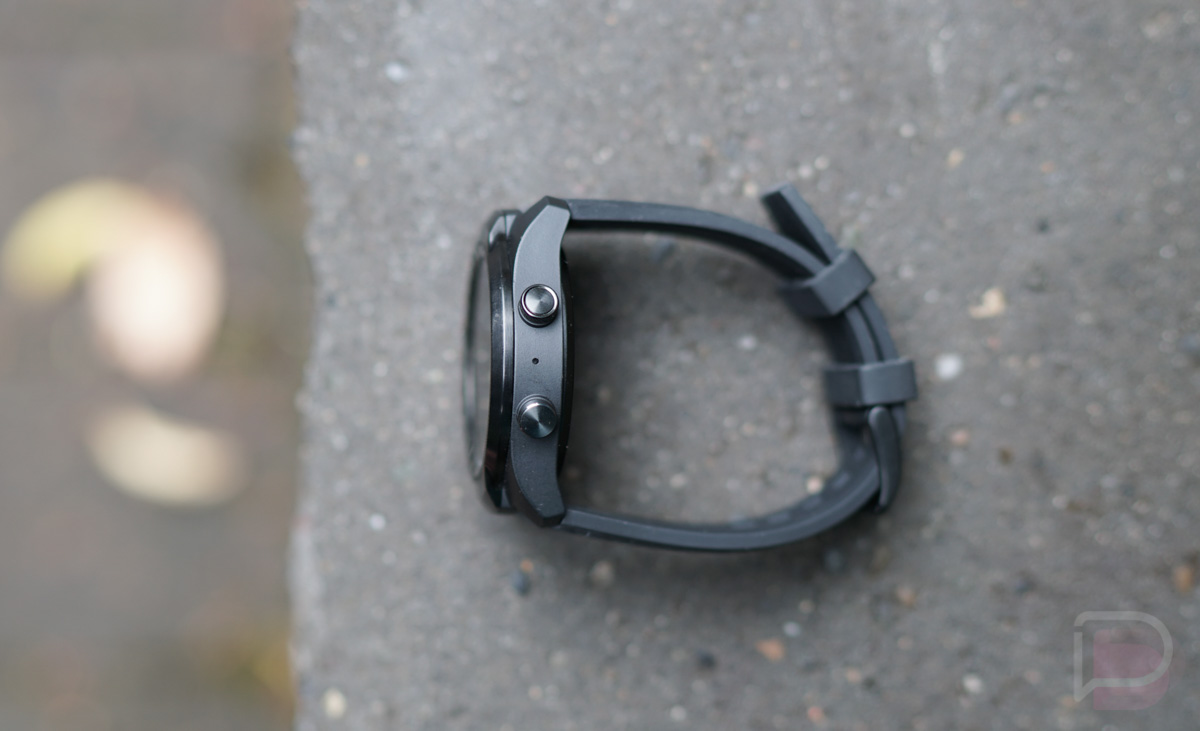
No rotating crown: Mobvoi has been slow to adopt the rotating crown that watches like the Summit 2 and Fossil Sport have included. That’s not a huge deal, as they do still feature two pushers for opening apps, but the rotating crown is a nice way to navigate a watch.
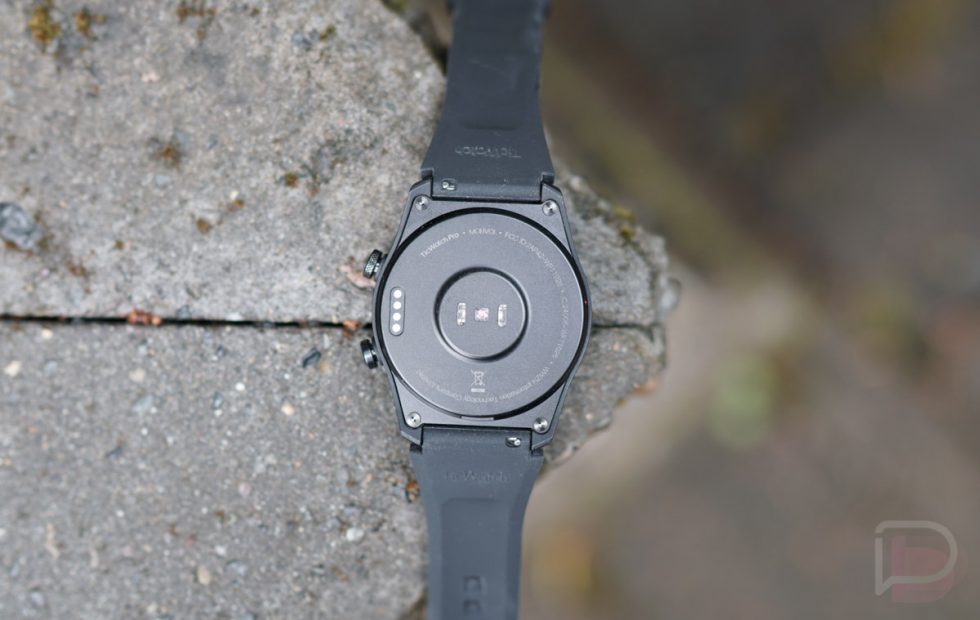
Health features: Mobvoi includes access to Google Fit, but they offer their own suite of fitness apps too. Their watches feature their own workout app, a more in-depth heartrate tracking app that shows your zones and history, and a general health experience. If you want a watch that caters more towards fitness and health rather than rely on Google’s bad Fit thing, this is a watch to consider.
Worth buying?
Telling anyone to go out and buy a Wear OS watch in 2019 is tough to do. That’s not because all Wear OS watches are complete garbage, it’s just that they run such ancient technology and are so far behind competitors, like the Apple Watch, that spending close to $300 on 1 seems insane.
However, the TicWatch Pro 4G/LTE is one of the better running and looking Wear OS watches available. After spending this past week with 1, by no means do I dislike this watch. In fact, I find it to be 1 of the few I’d point you towards if you were considering a Wear OS watch today. The health features, battery life, and performance are probably better than what you’ll get with the Fossil Sport. Assuming you can live with the size of it, yeah, it might be worth buying for those getting into some Wear OS fun. Personally, I’d only do it if there was a sizable discount available.
I really like that Wear OS supports all kinds of faces and some of the watches are quite stylish whereas the Apple Watch is a square, but the lack of updates from Google has been discouraging. Honestly, that's the ongoing problem at Google outside of Android in general.
Google Patent Showcases AI Vision-Based Wear OS Gestures
By Daniel Golightly May 18, 2020 Google appears to be looking to add a slew of new gestures to Wear OS, following sightings of a new patent awarded to the company by USPTO. Driven by an optical sensor and apparent underlying AI vision algorithms, the features would rely on gestures made by the user's hands. Specifically, that's the hand attached to the wrist that's currently wearing the smartwatch.
There are three gestures in total described by the patent via associated images. Those are a hold, release, and tap gesture. The implication is that users would be able to interact with just about every watch functionality without ever touching the screen.
Both of the first two gestures appear to be related. With the newly-patented technology, users can clench their fist to access a "hold" gesture. Then, they can release that grip to instantiate a "release" gesture. The tap gesture, if Google ever gets around to using the new technology, starts with an open palm. Then users tap their thumb together with their fingers before opening their hand again. That instigates a "tap" gesture.
Google is no stranger to gestures, even outside of Wear OS
Now, this new patent follows on a long history of added gestures and improvements for Google, including some in Wear OS. The latest features appear to most closely resemble the Google Pixel's Project Soli features. Namely, it relies on sensors to visually detect minute hand and finger motions. Only found on the Pixel 4 and 4 XL handsets in some regions, the feature allows for everything from music controls to device waking and more.
The key difference here is the use of a radar-based chipset for Project Soli, while the new patent is reportedly an optical sensor. But Google has been doing gestures for a long time on Wear OS too. In fact, the company added gesture support based on built-in hardware fairly early on. The most recent addition to that was functionality improvements to those in Wear OS 2.1.
Those early features relied mostly on sensing the motion of the wrist and the watch itself. The movements were tracked to allow simple navigation and selections but didn't allow for deeper navigation into sub-menus once an option was selected.
With the new gestures, Google could break Wear OS away from that drawback. Summarily, it could allow for deep navigation and control across apps and well beyond the main system menu. These new gestures would arguably be the most powerful when combined with those previous wrist-turning gestures — chiefly used for scrolling.
This is meant to be user-friendly across every wearable user
One of the key factors in this new patent is the fact that these gestures will work regardless of how the watch is worn. That's going to prove useful for a number of reasons. Not least of all, Google has still not released its own wearable. And not every Wear OS smartwatch wears the same.
The gestures are shown to work here regardless of whether the watch is worn higher or lower on the wrist. They'll also work if the watch is positioned on the inside of the wrist rather than the outside. That would, as long as an optical sensor is included by the OEM, make the features universally available.
Of course, there is a chance Google will go the Pixel route too and keep the feature exclusive. The search giant bought Fossil in early 2019. That was followed first by rumors and then a confirmation that it would buy Fitbit later in the year. The speculation around those purchases is that Google plans to compete directly in the hardware space. Google's latest wearable patent points to a new set optical sensor hand gestures
Qualcomm’s new Snapdragon 4100 features much-needed improvements for the next Wear OS watches
27 comments But is it too late to save Wear OS? By Chaim Gartenberg@cgartenberg Jun 30, 2020, 11:00am EDT Photo by Amelia Holowaty Krales / The Verge Qualcomm is announcing two new Wear OS processors today, the Snapdragon Wear 4100 Plus and the Snapdragon Wear 4100, the first major updates to its smartwatch platform since 2018. Qualcomm claims the new chips will have vastly improved speed, with a “significantly faster new processor,” and big jumps in performance for the GPU, memory, camera, and overall battery life.
They’re big promises, but put simply, Google’s Wear OS badly needs this kind of hardware overhaul. The last major revision to the Snapdragon Wear lineup, the Snapdragon Wear 3100, was a minor update to 2016’s Snapdragon 2100. In fact, given that the 2100 and 3100 have the exact same main processor, the debut of the 4100 marks the first concrete speed improvements for Wear OS in about four years. Finally, a faster processor for Wear OSThe biggest changes are in the processor, which is jumping from a 28nm process to a 12nm one, with four A53 CPU cores clocked at 1.7GHz replacing the 3100’s A7 cores (at just 1.1GHz), which Qualcomm says should deliver more than 85 percent faster performance. The GPU is now Adreno A504 (up to two and a half times faster than the 3100), along with faster memory. Qualcomm is taking a slightly different approach with the 4100 line, though. It’s actually shipping two SKUs to developers. The flagship model is the Snapdragon 4100 Plus, which (like the 3100 before it) is a hybrid platform that features the main SDM429w SoC, along with an updated version of the always-on QCC1110 co-processor that it introduced with the 3100. But for developers that don’t want or need to offer always-on features, Qualcomm will also offer a standard Snapdragon Wear 4100 model, which just offers the SDM429w SoC.
For the Snapdragon 4100 Plus, though, the QCC1110 co-processor — which handles the ambient display mode common to most modern smartwatches — is also getting some improvements. Those include the ability to display vastly more colors — as many as 64,000, up from the 16 colors that the 3100 could show — as well as support for new features when in “watch mode” like step tracking, continuous heart-rate tracking, alarms, haptic feedback, and more (which previously had to rely on the main processor).
The shift to the new 12nm CPU architecture (along with other, more technical improvements) also means that watches with a Snapdragon 4100 should see up to 25 percent better battery life. Qualcomm is already shipping its Wear 4100 and 4100 Plus chipsets to hardware manufacturers, with the first devices set to arrive in the coming months. Mobvoi has already announced that it’s working on a new TicWatch model that will feature the new chips, and Xiaotiancai is working on a kid-friendly smartwatch powered by the Wear 4100, too.
On paper, at least, these are the sorts of big improvements that Qualcomm needed to make to help boost the struggling Wear OS hardware ecosystem (which is almost entirely reliant on Qualcomm’s platform at this point) back into the competitive game.
But the smartwatch world is a very different place now than it was in 2016, when the last major improvements to Qualcomm’s processor arrived, or even 2018. Wear OS is largely dominated by fashion brands like Fossil, but the entire smartwatch ecosystem itself is dominated by Samsung’s Gear line and the Apple Watch. Wear OS looks very different in 2020Google’s own ambitions to make a flagship smartwatch are up in the air. The company’s recent announcement that it intends to purchase Fitbit for $2.1 billion may be a way for it to beef up its hardware division to make better Wear OS watches — or it may be for something else entirely.
After years of lackluster hardware and a seemingly apathetic Google when it comes to developing new Wear OS software features, the question is whether Qualcomm’s new chip is just too late for Google’s smartwatch experiment.
0The most important form factor Android operates on is phones, and yearly updates reflect that focus. Following the launch of Beta 2, Google today hosted an Android 11 AMA where they received a number of questions about other platforms. In talking about Wear OS, the company all but confirmed that Android 11 will be the next major wearable update.
Google starts by reiterating that it’s “very excited about wearable tech,” specifically name-checking smartwatches and fitness trackers. The answer then links to the “Investing in the Wear OS ecosystem” blog post published after the Fitbit deal was announced last November.
Under the hood, Wear OS was updated to Android 9 Pie in November 2018 with “System version H” following a developer preview that began earlier that year. It’s the current release to this day as watches receive security patches.
Android 10 was never discussed for Wear OS, and Google’s AMA responses today suggest that the platform is jumping straight to Android 11. You’re correct that the current version of Wear OS is based on Android 9, so you won’t be able to target all the Android 11 APIs from a wearable app yet, but we’re working on it. In addition to “we’re working on it,” another reply explicitly states how developers “will be able to access most Android APIs once Wear OS is based on Android 11.” That question also revealed Google’s interest in smart home and wearables: Glad to see the interest in bringing Device Controls API to Wear OS!
The intersection of wearables and home automation is super interesting and we’re excited about what can be done here in the future. Another answer revealed that Google “brought the Android and Wear OS teams even closer together.” One part of that is letting wearable developers take advantage of Kotlin and Jetpack.
More broadly, Google explained how Wear OS — along with Android Auto and TV — are “not tied to the operating system framework at all” to reflect how those markets are different from phones. For example, new features are usually introduced by updates — via the on-device Play Store — to the “Wear OS” app on watches. That’s a good thing – it allows us to have a different cadence of release cycles that adapts to the automotive, television, and smartwatch industries. Faster release cycles allow us to address new consumer needs that arise. That said, “some exciting stuff” is coming, with those platforms set to be the focus of the “Android Beyond Phones” week on August 10. Google last month already announced Android 11 for Android TV.
Google promises the next Wear OS update will launch apps up to 20 percent faster
14 comments Wear OS is still ticking
By Chaim Gartenberg@cgartenberg Aug 13, 2020, 3:34pm EDT Photo by Avery White for The Verge Wear OS will get its next substantial update this fall, and while it’s not as flashy as, say, the upcoming Android 11, it’s proof that Google hasn’t completely abandoned its wearable operating system yet. The new update promises to bring several new improvements to the platform, including speed improvements, easier pairing, and a new weather app.
The biggest change is a promise for CPU improvements, which Google says will offer up to 20 percent faster startup times for apps. Given that Google is also adding support for the upcoming Qualcomm Snapdragon Wear 4100 and 4100 Plus chipsets, the combination should result in a far snappier experience for future Wear OS devices.
Google is also promising updated UI elements that will offer “more intuitive controls for managing different watch modes and workouts” and a simpler process for pairing Wear OS watches to your phone, although it hasn’t shown off what either of those features will look like. Lastly, Google is promising a new weather app, which will arrive on Wear OS “later this year.” It’s designed to be easier to read at a glance and give hourly forecasts and weather alerts.
Mobvoi’s TicWatch Pro 3 announced with Qualcomm’s new Snapdragon 4100 chip
6 comments Promising faster performance and more battery life By Jon Porter@JonPorty Sep 24, 2020, 10:00am EDT The new smartwatch has a battery life of up to 45 days. Image: Mobvoi The TicWatch Pro 3 is the latest smartwatch from Mobvoi and the first Wear OS smartwatch to use Qualcomm’s new Snapdragon Wear 4100, which promises faster performance and better battery life. The new smartwatch also adds the ability to track blood oxygen levels, features apps like TicZen stress monitoring, and has a slimmer design. It’s available starting today for $299.99 (£289.99 / €299.99).
The Pro 3’s standout spec is the Snapdragon Wear 4100 processor, which is the first major update Qualcomm has made to its wearable chipset since 2018’s Wear 3100. According to Qualcomm, the new chipset’s CPU and memory is 85 percent faster, its GPU is 2.5 times faster, and it consumes around 25 percent less power. Mobvoi has paired the chip with 1GB of RAM, 8GB of storage, and a bigger 577mAh battery compared to the original TicWatch Pro. (There technically wasn’t a TicWatch Pro 2, though Mobvoi released minor updates for the original Pro.) The dual-display design returns from the TicWatch Pro. Image: Mobvoi The bigger battery combined with a more power-efficient chipset means Mobvoi is able to make big claims about the battery life of the TicWatch Pro 3. Like the original TicWatch Pro, the Pro 3 has two displays: an OLED and a low-power always-on FSTN display. The low power display sits on top and turns transparent when you’re using the main OLED display. You can toggle between the two with the flip of your wrist.
The company says you’ll get up to 72 hours from the watch’s smart mode, or as much as 45 days if you use it in its “Essential mode,” which uses its low-power display and turns off most of the watch’s smart features (not including sleep, heart rate, and blood oxygen saturation monitoring, which continue to run). Despite the bigger battery, the TicWatch Pro 3 ends up being a little slimmer than the original TicWatch Pro. There’s no LTE support like we saw with the TicWatch Pro LTE.
On the software side, Mobvoi is introducing a range of new apps with the TicWatch Pro 3. There’s TicOxygen to keep track of your blood oxygen saturation levels, TicZen for measuring your stress, and TicBreathe to help manage your stress levels if they get too high. TicHearing is a new app that detects when your environment might be getting dangerously loud. Mobvoi says its TicPulse app now has better heart rate tracking, and TicSleep now works while the watch is in its low-power Essential mode. The smartwatch can track a range of workouts. Image: Mobvoi TicExercise has also been updated and now supports over 10 workout modes. New modes include pool swimming, rowing, elliptical, mountain climbing, trail running, and aerobics, and Mobvoi says the watch can automatically identify which exercise you’re doing. The TicWatch Pro 3 has an IP68 water resistance rating, so you can take it into the pool with you, and it comes with a silicone wrist strap. We weren’t particularly fond of this fitness software back when we reviewed the TicWatch E2 and S2 because they didn’t offer much of an improvement over regular Google Fit, so we’ll see if these upgrades are enough to change our minds.
Of course, this being a Wear OS smartwatch, the TicWatch Pro 3 includes a standard range of Google features like support for Google Pay and Google Assistant.
While Apple’s smartwatches have felt polished and feature-complete for a few years now, their Wear OS competitors have struggled to directly compete. We’ll be putting the TicWatch Pro 3 through its paces in the coming weeks, so keep an eye out for our full review.
Google's Wear OS platform has had its fair share of ups and downs over the years—mostly downs. Perhaps the greatest issue has been slow progress on hardware. Most Google-powered watches sold right now use the Snapdragon Wear 3100, a two-year-old SoC built on the same 28nm process that the Snapdragon 800 from 2014 used. Qualcomm promised to finally address battery life and performance limitations with the new Snapdragon Wear 4100 chipset, and the TicWatch Pro 3 is the first Wear OS smartwatch to use it.
After using the TicWatch Pro 3 for a while, I can confidently say that the Wear 4100 is the hardware boost Wear OS has desperately needed for years. However, the TicWatch still isn't a perfect package.
Specs
Chipset Snapdragon Wear 4100 Storage 8 GB RAM 1 GB Display 454 x 454 circular AMOLED with Dual Display 2.0 Battery 577mAh, up to 72 hours in Smart Mode, up to 45 days in Essential Mode Dimensions 47 x 48 x 12.2mm, 42g Strap size 22mm Speaker Yes, 0.5W Connectivity Bluetooth 4.2, GPS, NFC, Heart rate sensor, Infrared sensor Water resistance IP68 Price $299.99 / £289.99 / €299.99 / ¥35,999
The Good
Hardware The Wear 4100 chipset and 60Hz screen creates a faster and smoother experience than any other Wear OS watch, on par with Samsung's wearables. Battery life It's easy to get multi-day battery life without turning basic features off. Essential Mode The ability to shut off most smartwatch components to get month-long battery life is still unique.
The Not So Good
Software Mobvoi has filled many of the functionality gaps in Google Fit, but Wear OS as a whole still needs some work. Design The TicWatch Pro 3 is fairly large, which not everyone is a fan of, and the lack of a dial or rotating bezel makes scrolling a pain. Dual Display The LCD screen used by default for the always-on display only shows the time and a step counter (no notifications). Thankfully, you can switch to using the AMOLED all the time. Price $300 is a lot for a smartwatch, especially one with Wear OS.
Design, hardware, what's in the box
The TicWatch Pro 3 is definitely a large watch, with a diameter of around 48mm and a depth of 12.2mm. That makes it slightly bigger than the Fossil Gen 5, 45mm Galaxy Watch3, Skagen Falster 3, and nearly every other smartwatch currently available for purchase. However, it's lighter than most other large watches, at just 42g. For comparison, the 41mm Watch3 is 49.2g, and the 45mm model is 53.8g. The lower weight helps the TicWatch feel less cumbersome, though it's still probably not a good option for people with smaller wrists.
From left to right: Galaxy Watch3, Ticwatch Pro 3, Skagen Falster 3
Mobvoi sent me the 'Shadow' color for review, which has a nice understated design. There are still numbers etched into the screen bezel, which isn't my favorite look, but they don't stand out as much as the numbers did on the original TicWatch Pro. There are two physical buttons on the side; the top one serves as the home button (holding it down will open Assistant), and the bottom key can be customized to open any application. The other side of the watch has a single speaker, so you can make voice calls or listen to responses from Google Assistant. My number one complaint with the TicWatch Pro 3 is that there is no physical dial for scrolling. The Galaxy Watch3 has a fantastic rotating bezel, most of Fossil's watches have a dial on the side, but the TicWatch has nothing. Scrolling through menus has to be done by swiping on the display, which is slower and results in more accidental taps.
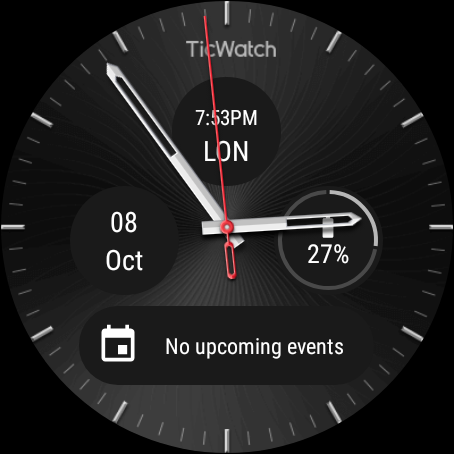
The most unique hardware feature is the 'Dual Display 2.0,' which gives the TicWatch two screen panels — a standard AMOLED screen on the bottom of the assembly, and an LCD on top that resembles what you would see on cheaper digital watches. You can either use the LCD screen as a replacement for the regular Wear OS ambient mode (which is the default behavior), or you can switch the TicWatch into 'Essential Mode,' which shuts down the smartwatch components entirely and just gives you the time and steps with the LCD screen. The TicWatch 3 supposedly lasts up to 45 days on a single charge in Essential Mode.
Dual Display 2.0
The second display is interesting, but I never found it particularly useful. The LCD screen isn't any more readable in direct sunlight than the regular AMOLED panel, and it doesn't show notifications, so you have to press the side button to fully wake the watch to see alerts or access media controls. I found this so annoying that I ended up reverting to the regular always-on screen functionality in Wear OS. Even when you don't use Dual Display, it creates a slight haze on the main AMOLED — most people probably wouldn't notice it, but it was obvious to me after using a Galaxy Watch3.
Mobvoi includes a single wrist strap in the box, which is made of silicone, but looks like a leather band — it looks fine, but I would have preferred separate leather and exercise bands in the box. You can replace it with any standard 22mm watch band, which is the same size the largest Galaxy Watch3 uses. There's also the USB charger (with no wall adapter) and a user manual in the box.
Software, performance, battery
The TicWatch Pro 3 runs a standard build of Wear OS. You can see notifications from your phone, track workouts away from your phone with the integrated GPS, use Google Pay, and ask Google Assistant questions. This is the first Wear OS watch I've tried in a long time that doesn't periodically fail to load responses from Assistant, which was a huge headache on other wearables.
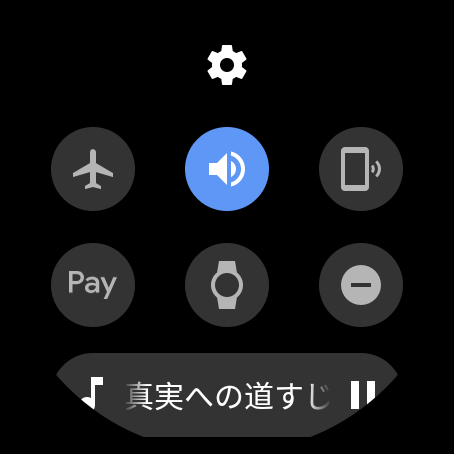
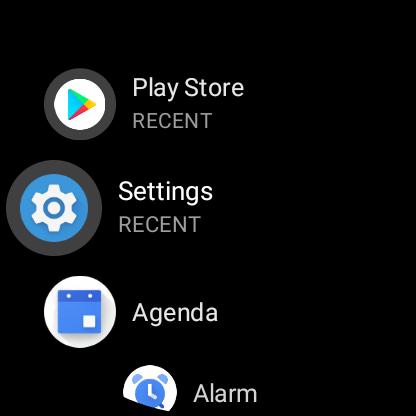
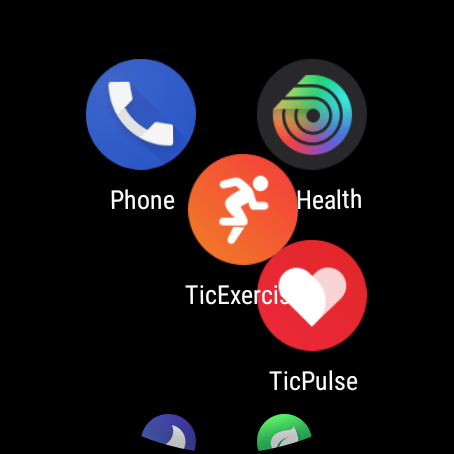
Mobvoi hasn't implemented anything like Fossil's battery modes or calling compatibility with iOS, but it has changed the app list to a grid of icons that you can move around. I'm not sure if this is an improvement, since you see the same number of icons on either design (and Wear OS already allowed you to pin apps to the top), but at least it's not a downgrade.
Left: Wear OS app switcher; Center, Right: Modified switcher on TicWatch
Most of the unique software features of the TicWatch are in the custom apps. Google Fit is so inadequate that Mobvoi has built its own 'TicHealth' software, comprised of apps for tracking physical activity, sleeping, and heart readings. However, you'll need to install the Mobvoi app on your phone to see most of the collected data, and there's no automatic workout detection. TicHealth's data can also be synced with Google Fit, Strava, and Runkeeper, if you want better integration with non-Mobvoi devices and services. You can also choose to ignore all of Mobvoi's apps and just use Google Fit.
Performance on the TicWatch 3 Pro is excellent. This is absolutely the fastest and most responsive Wear OS watch I've ever used, thanks to the Snapdragon Wear 4100 chip. It gives Samsung's Galaxy Watches a run for their money in that regard. The smoothness is also partially due to the higher refresh rate on the screen — while all Wear OS watches (that I'm aware of) run at 45Hz, the TicWatch 3 Pro operates at 60Hz. I still would have liked to see Mobvoi use the Wear 4100+ chip, which has a co-processor for even better battery life and a few added features, but the 4100 alone is a significant upgrade from the chips in other Wear OS devices.
Battery life is also a high point for the TicWatch. Most Wear OS watches last me around 2 days on a single charge, with everything on (NFC, GPS, always-on display, health tracking, etc.), but the TicWatch Pro 3 reached nearly 4 full days with the same usage. When I switched from Dual Display mode to the regular always-on display functionality, it dropped to around 3.5 days, but that's still impressive.
Unfortunately, the improved hardware on the TicWatch only highlights which parts of Wear OS can only be fixed by Google. Assistant finally works properly, and Wear OS still handles notifications well, but app support from both Google and independent developers have stagnated. When I set up the TicWatch for runs, I realized there's no official way to download music, now that Google Play Music is dead and YouTube Music doesn't have a Wear OS app yet. Wear OS also hasn't received a significant feature update since Tiles arrived in May 2019.
Should you buy it?
Mobvoi TicWatch Pro 3
8.5/10Yes, if you don't want a Galaxy Watch. The TicWatch Pro 3 proves that the Snapdragon Wear 4100 is a massive step forward for Wear OS watches. Samsung's Galaxy Watches are no longer the only options if you want an Android-compatible smartwatch with great performance and multi-day battery life. However, Google still needs to work on the software side of Wear OS if it wants to fully catch up with Samsung and Apple wearables.
The TicWatch 3 Pro is a capable smartwatch, but the Dual Screen functionality isn't as useful in real life (at least to me) as it might seem in advertisements. The price is also a bit high at $299.99. You can get a 40mm Galaxy Watch Active2 for
Last week, a significant Google Fit update for Android, iOS, and wearables was announced. Google is now detailing some of the improvements made to the Fit workout experience on Wear OS.
Workout tracking in Google Fit for Wear OS is getting a “simpler user experience and fresh new design.” It starts on the screen before you start an exercise. A new “flag” button at the bottom lets you set one of five Goals: Calories, Distance, Heart Points, Time, or Open Goal.
After setting, the goal appears front and center on a revamped stats screen. Everything is larger and better spaced out compared to before, with three lines that take up the entire screen. Your objective (in blue) is centered in the middle with the average time above and the total elapsed below. After each mile/kilometer, you’ll get a green-hued alert that features a split time and how you’re trending.
Swiping to the left shows your calories by default in the middle, but that can be cycled through steps, (clock) time, and Heart Points by tapping. At the very top of this screen is a heart rate zone monitor and BPM. Swiping the other direction provides quick access to media controls and settings during a workout. This includes enabling/disabling Touch Lock on watches running the latest H MR2 update. Accidental display taps are thus prevented, with control restricted to using the hardware buttons for pause, resume, and to switch screens. The Lock is disabled by holding down on the power button.
These workout changes will begin rolling out this week as an update to the Google Fit app on Wear OS.
While a previous report claimed that the upcoming OnePlus smartwatch wouldn’t be running Wear OS, the company’s CEO has come out to say otherwise. In an interview this week, Pete Lau has confirmed that the OnePlus smartwatch will be running Wear OS.
Update 12/18: Clarifying Pete Lau’s comments in this interview, OnePlus speaking to 9to5Google clarified that the company’s upcoming smartwatch is not confirmed to be running Wear OS at this point. Seeing Lau’s response, that does appear to be the case. Lau only confirmed that OnePlus was both working on a smartwatch and working with Google on Wear OS, but he did not say the two were related.
The article as follows has been left in tact based on what was originally shared in the Input interview.
Speaking to Input, Pete Lau directly confirmed that the company is working on a smartwatch, and that it will be running Wear OS.
In fact, Lau says that OnePlus is actually working directly with Google on the Wear OS smartwatch, and it goes beyond just a deal to use the search giant’s software. Lau says that OnePlus is working with Google to improve how Wear OS talks to Android phones and Android TV for better interoperability. It’s unclear exactly what this means, but apparently, it’s something Google is on board with.
Wear OS definitely has room to improve. What we’re trying to do is work with Google to try to improve the connectivity between the Wear OS ecosystem, Android TV, and Android smartphones to create this ability for better device interoperability across the ecosystems. This has been something looked at very positively from Google’s side as well, so this is the direction that we’re trying to develop, but we don’t have more than we can share on that right now.
As Input notes, this statement doesn’t really address the concern of fitness that is a place Wear OS is definitely lacking, but today’s EU approval of the Fitbit acquisition brings Google one step closer to being able to hugely improve its health/fitness offering.
Also, the idea of an Android OEM working with Google on the software ahead of launch isn’t some ridiculous thought. Going back to 2018, Nvidia worked directly with Google to make substantial changes to the Android TV Oreo update before the company would adopt that update on its popular Shield TV series. From the looks of it, OnePlus appears to be doing essentially the same.
It will be interesting to see what OnePlus and Google come together to make, as well as if it will have a positive effect on the rest of the Wear OS ecosystem.
Google, Samsung (and Fitbit) join forces for massive Wear OS update
Massive overhaul for Wear OS is on the way, courtesy of three behemoths of tech
Wareable is reader-powered. If you click through using links on the site, we may earn an affiliate commission. Learn more Tuesday
May 18, 2021
By James Stables @stablesjames The rumors are true. Google and Samsung have joined forces for a huge update for Wear OS – with Fitbit handling a new health and fitness experience for the platform.
All the chatter has been about the Samsung Galaxy Watch 4 running Wear OS – and indeed, the Samsung Galaxy Watch 4 will show off the new combined experience, with a unified platform that brings together Tizen and Wear OS technology. But this unified OS will be open for other manufacturers to use, just like the current Wear OS.
Let’s just start by saying that details are pretty light right now, with big promises and a lack of specifics. What’s more, some of the promised improvements are extremely mundane, but let’s not dampen an exciting day for Wear OS and wearables in general.
The unified Wear OS/Tizen (we suspect the lion’s share of this is Wear OS) brings a 30% increase in performance and loading times of apps.
There’s also improved battery life, but there’s no firm details on how long – but it seems two days max. However, Google used the example that “includes handy optimizations like the ability to run the heart rate sensor continuously during the day, track your sleep overnight and still have battery for the next day.” We told you to temper your excitement.
New features of the OS were also mentioned, with quick app switching with a double tap highlighted by Bjorn Kilburn, Director of Product Management, Wear.
Which brings us onto something we didn’t know. James Park, CEO of Fitbit which was acquired by Google, announced that Fitbit would be powering the fitness tracking experience on the new Wear OS. He highlighted “tracking health progress and on-wrist celebrations for motivation”, which leads us to believe the experience will be simple at first.
Park also announced that Fitbit would be launching “health watches based on Wear using Google’s ambient computing capabilities,” which means we should see Wear OS Fitbits in the next year.
There will be a bunch of “rebuilt apps” from the likes of Strava (above), Adidas Running and Spotify – and Google also announced a revamp of Google Pay, Google Assistant (about time) and the arrival of offline syncing for YouTube Music.
It’s been a lot to take in – and it’s certainly Wear OS playing catch up with the competition.
But it’s certainly going to be a big new chapter for Wear OS. Samsung injects serious momentum to the platform that will be sure to get developers fired up to improve the app ecosystem. And Fitbit tracking will also be a huge draw, especially if it too launches devices with Wear OS.
But there’s a lot we don’t know – and are working to find out. A big question will be will this roll back onto previous generations of Wear OS devices? We’ll update as we get that information – and follow developments as we go.
3 CommentsRumors have been around for quite some time regarding Samsung’s switch from Tizen to Google’s Wear OS, and in May, those rumors were confirmed when Google announced the platform’s revamp, and Samsung confirmed it was both adopting it and helping bring it to life. Today, Samsung is showing off its Wear OS experience, “One UI Watch.”
At an MWC event today, Samsung showed off its new Wear OS experience primarily to speak with developers regarding the updated platform. Samsung will call this new experience “One UI Watch,” obviously a play off of the company’s Android skin for Galaxy smartphones and tablets.
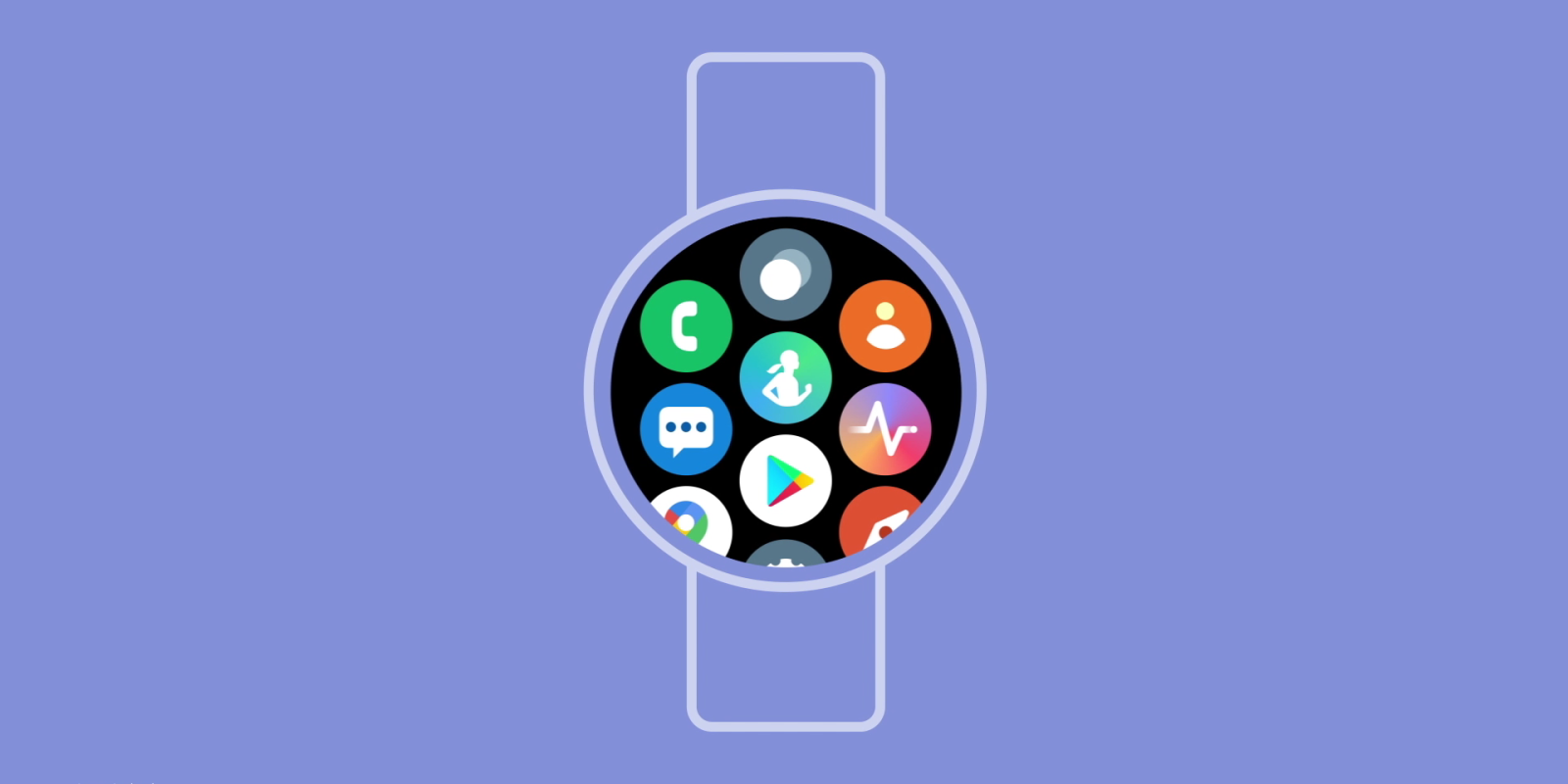
Samsung isn’t showing a ton of this new UI just yet, but there are a few key takeaways based on the videos shared. Firstly, that includes better communication between the smartwatch and your phone. If apps are installed on the phone and have a Wear OS counterpart, that app is automatically installed on your watch. That’s not unique to Samsung’s skin, though, and is present in Google’s version. Further, clock settings and alarms sync between the two devices, and the ability to block calls and texts will do the same. A revamped app drawer is also seen on this demo, which is completely new from what’s seen on Tizen-based Samsung watches, as well as Wear OS in its current form. It’s unclear if Google’s version of this platform will have the same app drawer.
A quick peek in the Settings app for One UI Watch also shows how Samsung’s design really permeates Wear OS. The Settings app is full of the same spacing, colors, and icons as the app found on Galaxy smartphones. The same applies to the Clock app.
In a second video, below, we can also see Samsung touting the addition of various Google apps on its smartwatch. Examples shown include Google Maps, YouTube Music, and Messages. This also gives us our best look to date at these apps, which first showed up around Google I/O. As promised, too, the YouTube Music app supports offline playback. Other apps shown here include Spotify, Calm, Adidas, MyFitnessPal, Lifesum, Facer, Bitmoji, and others. Samsung is positioning Google’s “app ecosystem” as a key part of One UI Watch and its switch to Wear OS in general. These apps, also, will be available for other Wear OS devices. The unified platform will open up new features and integrations with popular third-party apps available to download from Google Play directly on your Galaxy Watch. So, whether you’re a sports and fitness fanatic who wants to get more out of apps like Adidas Running, GOLFBUDDY Smart Caddie, Strava and Swim.com, a wellness seeker who wants to live a more balanced lifestyle with apps like Calm or Sleep Cycle, a music lover who revels in discovering new artists on Spotify and YouTube Music, or an intrepid explorer ready to roam with Google Maps—there’s something for everyone, thanks to a diverse range of partners. Finally, a 3rd clip shared by Samsung goes over an upcoming developer tool. The company is working on a way to speed up third-party watchface development, a sore point of Tizen watches. The tool will be available later this year to developers. Samsung has also confirmed that it will release a new Galaxy Watch “this summer” running this new platform. That’s almost certainly the Galaxy Watch 4 series we’ve been hearing so much about lately.





 Google: Android/Wear OS & SmartWatch News
 Kellen July 10, 2019 @iamkellex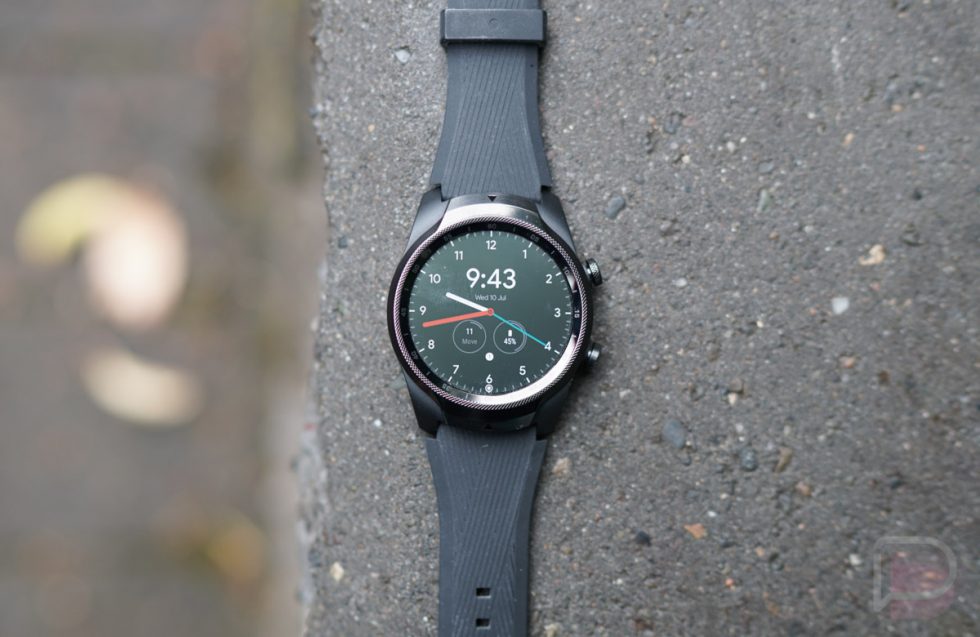


 Gestures
 Google appears to be looking to add a slew of new gestures to Wear OS, following sightings of a new patent awarded to the company by USPTO. Driven by an optical sensor and apparent underlying AI vision algorithms, the features would rely on gestures made by the user's hands. Specifically, that's the hand attached to the wrist that's currently wearing the smartwatch.
 Google's latest wearable patent points to a new set optical sensor hand gestures



/cdn.vox-cdn.com/uploads/chorus_image/image/67000038/akrales_190822_3612_0135.0.jpg) Photo by Amelia Holowaty Krales / The Verge Qualcomm is announcing two new Wear OS processors today, the Snapdragon Wear 4100 Plus and the Snapdragon Wear 4100, the first major updates to its smartwatch platform since 2018. Qualcomm claims the new chips will have vastly improved speed, with a “significantly faster new processor,” and big jumps in performance for the GPU, memory, camera, and overall battery life.
Photo by Amelia Holowaty Krales / The Verge Qualcomm is announcing two new Wear OS processors today, the Snapdragon Wear 4100 Plus and the Snapdragon Wear 4100, the first major updates to its smartwatch platform since 2018. Qualcomm claims the new chips will have vastly improved speed, with a “significantly faster new processor,” and big jumps in performance for the GPU, memory, camera, and overall battery life.:no_upscale()/cdn.vox-cdn.com/uploads/chorus_asset/file/20059087/1.jpg) Qualcomm is taking a slightly different approach with the 4100 line, though. It’s actually shipping two SKUs to developers. The flagship model is the Snapdragon 4100 Plus, which (like the 3100 before it) is a hybrid platform that features the main SDM429w SoC, along with an updated version of the always-on QCC1110 co-processor that it introduced with the 3100. But for developers that don’t want or need to offer always-on features, Qualcomm will also offer a standard Snapdragon Wear 4100 model, which just offers the SDM429w SoC.
Qualcomm is taking a slightly different approach with the 4100 line, though. It’s actually shipping two SKUs to developers. The flagship model is the Snapdragon 4100 Plus, which (like the 3100 before it) is a hybrid platform that features the main SDM429w SoC, along with an updated version of the always-on QCC1110 co-processor that it introduced with the 3100. But for developers that don’t want or need to offer always-on features, Qualcomm will also offer a standard Snapdragon Wear 4100 model, which just offers the SDM429w SoC.:no_upscale()/cdn.vox-cdn.com/uploads/chorus_asset/file/20059136/11._Qualcomm_Snapdragon_Wear_4100__Enhanced_Watch_Mode.jpg) Qualcomm is already shipping its Wear 4100 and 4100 Plus chipsets to hardware manufacturers, with the first devices set to arrive in the coming months. Mobvoi has already announced that it’s working on a new TicWatch model that will feature the new chips, and Xiaotiancai is working on a kid-friendly smartwatch powered by the Wear 4100, too.
Qualcomm is already shipping its Wear 4100 and 4100 Plus chipsets to hardware manufacturers, with the first devices set to arrive in the coming months. Mobvoi has already announced that it’s working on a new TicWatch model that will feature the new chips, and Xiaotiancai is working on a kid-friendly smartwatch powered by the Wear 4100, too. 9 to 5
/cdn.vox-cdn.com/uploads/chorus_image/image/67200479/awhite_20200305__3923_0035.0.jpg) Photo by Avery White for The Verge Wear OS will get its next substantial update this fall, and while it’s not as flashy as, say, the upcoming Android 11, it’s proof that Google hasn’t completely abandoned its wearable operating system yet. The new update promises to bring several new improvements to the platform, including speed improvements, easier pairing, and a new weather app.
Photo by Avery White for The Verge Wear OS will get its next substantial update this fall, and while it’s not as flashy as, say, the upcoming Android 11, it’s proof that Google hasn’t completely abandoned its wearable operating system yet. The new update promises to bring several new improvements to the platform, including speed improvements, easier pairing, and a new weather app.:no_upscale()/cdn.vox-cdn.com/uploads/chorus_asset/file/21758287/Screen_Shot_2020_08_13_at_2.42.28_PM.png) Lastly, Google is promising a new weather app, which will arrive on Wear OS “later this year.” It’s designed to be easier to read at a glance and give hourly forecasts and weather alerts.
Lastly, Google is promising a new weather app, which will arrive on Wear OS “later this year.” It’s designed to be easier to read at a glance and give hourly forecasts and weather alerts./cdn.vox-cdn.com/uploads/chorus_image/image/67461681/TWP3___Side.0.jpg) The new smartwatch has a battery life of up to 45 days. Image: Mobvoi The TicWatch Pro 3 is the latest smartwatch from Mobvoi and the first Wear OS smartwatch to use Qualcomm’s new Snapdragon Wear 4100, which promises faster performance and better battery life. The new smartwatch also adds the ability to track blood oxygen levels, features apps like TicZen stress monitoring, and has a slimmer design. It’s available starting today for $299.99 (£289.99 / €299.99).
The new smartwatch has a battery life of up to 45 days. Image: Mobvoi The TicWatch Pro 3 is the latest smartwatch from Mobvoi and the first Wear OS smartwatch to use Qualcomm’s new Snapdragon Wear 4100, which promises faster performance and better battery life. The new smartwatch also adds the ability to track blood oxygen levels, features apps like TicZen stress monitoring, and has a slimmer design. It’s available starting today for $299.99 (£289.99 / €299.99).:no_upscale()/cdn.vox-cdn.com/uploads/chorus_asset/file/21906505/TWP3___Layers.png) The dual-display design returns from the TicWatch Pro. Image: Mobvoi The bigger battery combined with a more power-efficient chipset means Mobvoi is able to make big claims about the battery life of the TicWatch Pro 3. Like the original TicWatch Pro, the Pro 3 has two displays: an OLED and a low-power always-on FSTN display. The low power display sits on top and turns transparent when you’re using the main OLED display. You can toggle between the two with the flip of your wrist.
The dual-display design returns from the TicWatch Pro. Image: Mobvoi The bigger battery combined with a more power-efficient chipset means Mobvoi is able to make big claims about the battery life of the TicWatch Pro 3. Like the original TicWatch Pro, the Pro 3 has two displays: an OLED and a low-power always-on FSTN display. The low power display sits on top and turns transparent when you’re using the main OLED display. You can toggle between the two with the flip of your wrist.:no_upscale()/cdn.vox-cdn.com/uploads/chorus_asset/file/21906507/TWP3___Weights.jpg) The smartwatch can track a range of workouts. Image: Mobvoi TicExercise has also been updated and now supports over 10 workout modes. New modes include pool swimming, rowing, elliptical, mountain climbing, trail running, and aerobics, and Mobvoi says the watch can automatically identify which exercise you’re doing. The TicWatch Pro 3 has an IP68 water resistance rating, so you can take it into the pool with you, and it comes with a silicone wrist strap. We weren’t particularly fond of this fitness software back when we reviewed the TicWatch E2 and S2 because they didn’t offer much of an improvement over regular Google Fit, so we’ll see if these upgrades are enough to change our minds.
The smartwatch can track a range of workouts. Image: Mobvoi TicExercise has also been updated and now supports over 10 workout modes. New modes include pool swimming, rowing, elliptical, mountain climbing, trail running, and aerobics, and Mobvoi says the watch can automatically identify which exercise you’re doing. The TicWatch Pro 3 has an IP68 water resistance rating, so you can take it into the pool with you, and it comes with a silicone wrist strap. We weren’t particularly fond of this fitness software back when we reviewed the TicWatch E2 and S2 because they didn’t offer much of an improvement over regular Google Fit, so we’ll see if these upgrades are enough to change our minds. Corbin Davenport
 Article Contents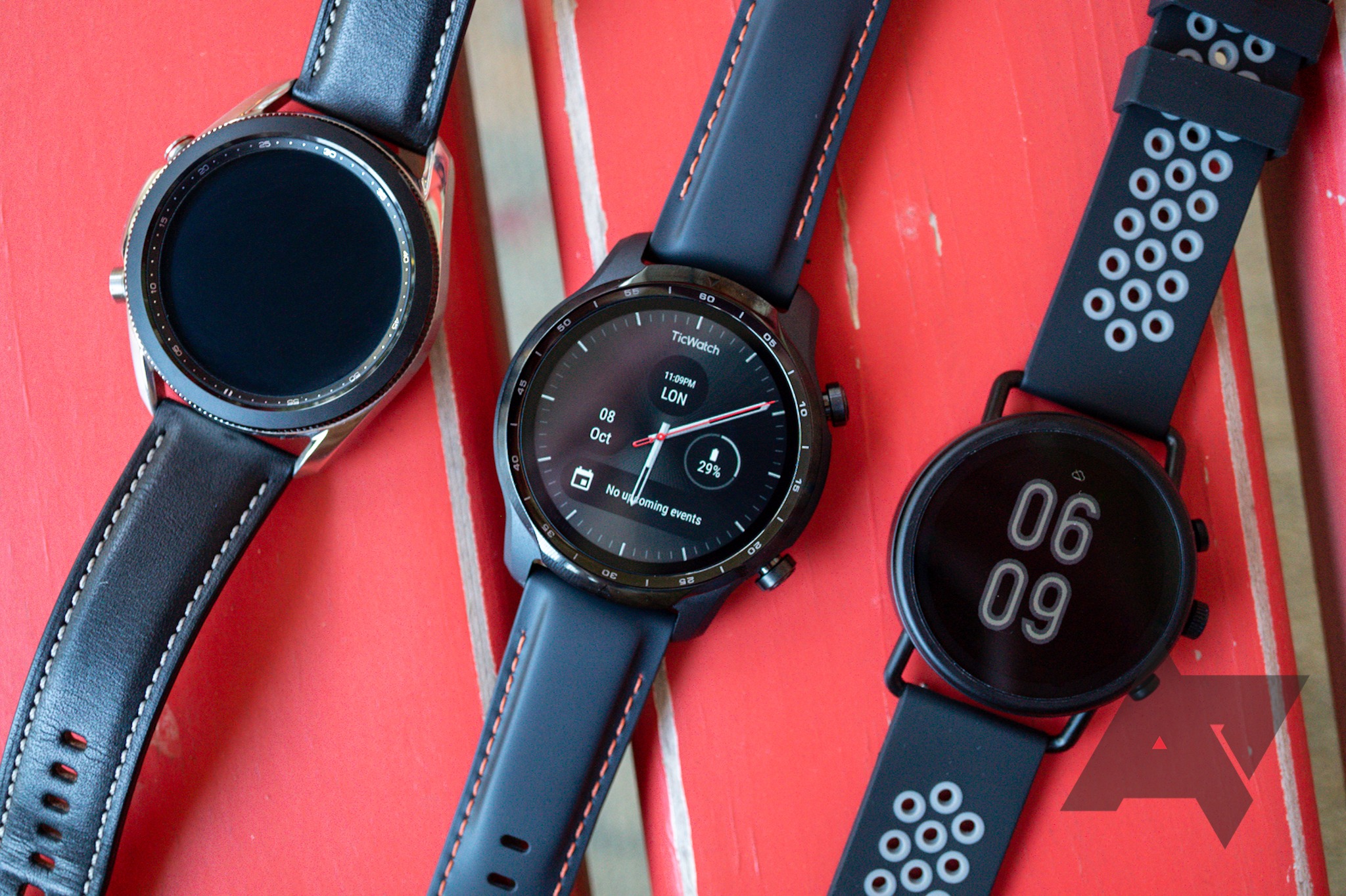

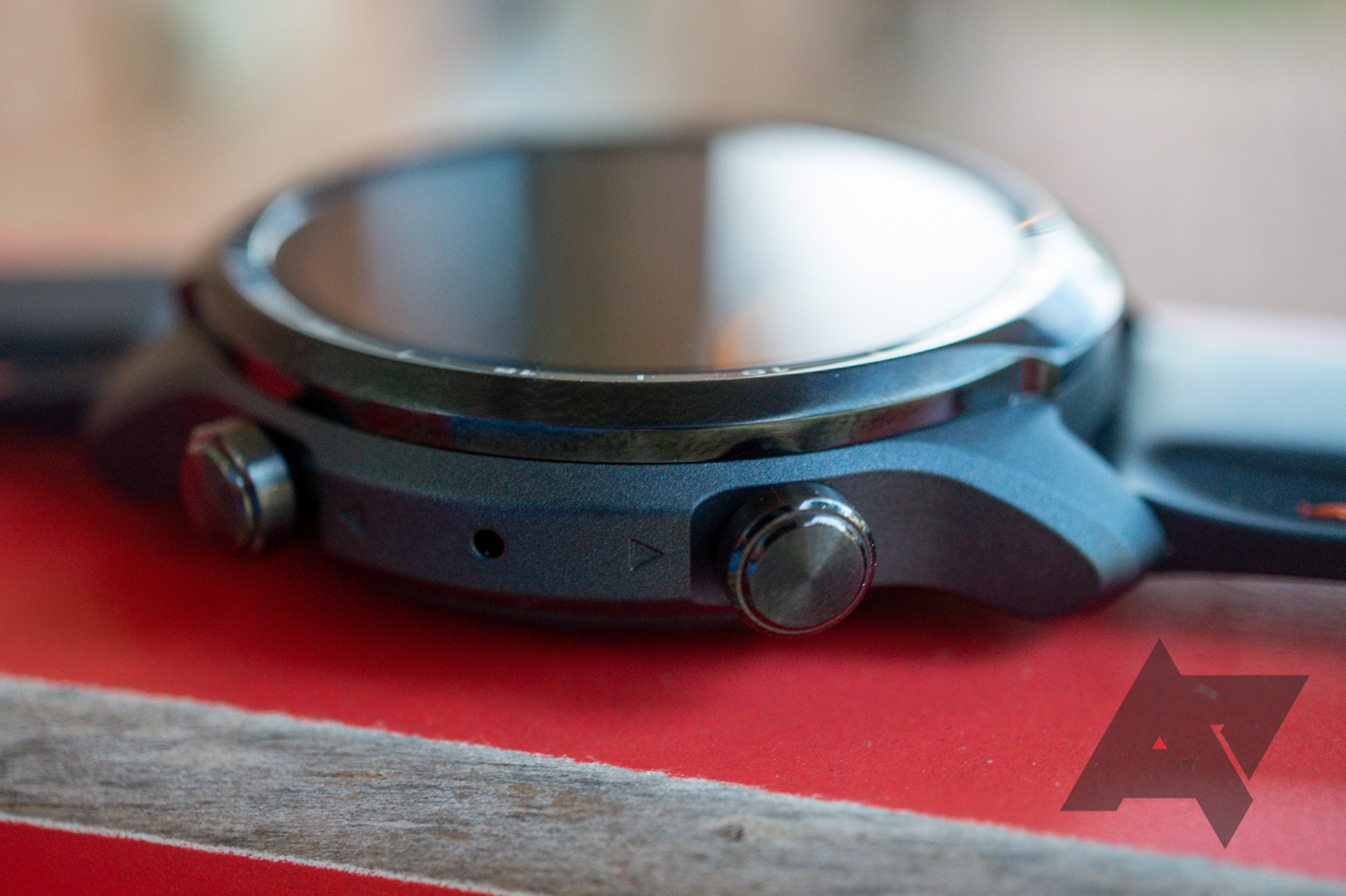
 My number one complaint with the TicWatch Pro 3 is that there is no physical dial for scrolling. The Galaxy Watch3 has a fantastic rotating bezel, most of Fossil's watches have a dial on the side, but the TicWatch has nothing. Scrolling through menus has to be done by swiping on the display, which is slower and results in more accidental taps.





 $50 less" />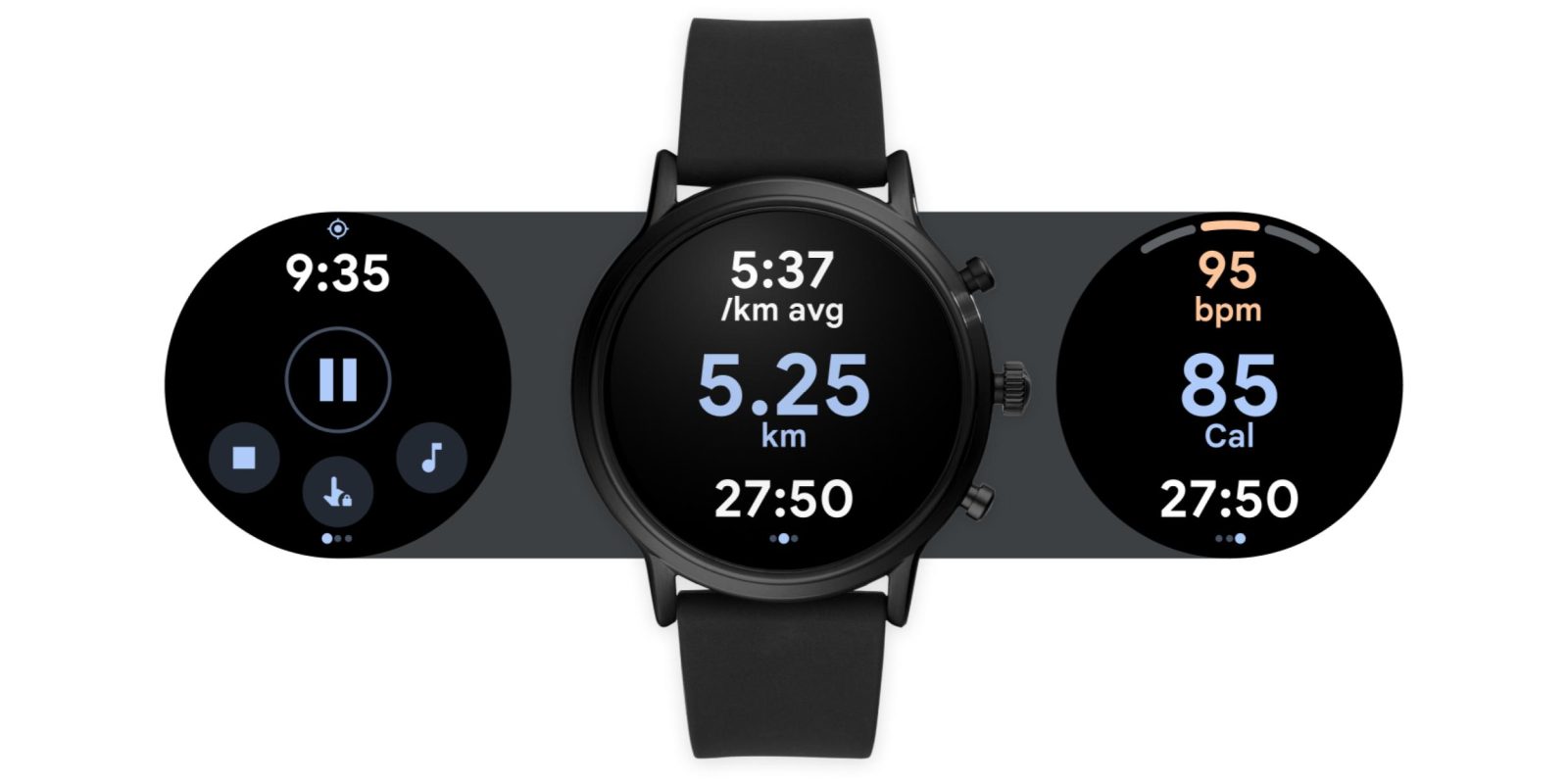


 Swiping the other direction provides quick access to media controls and settings during a workout. This includes enabling/disabling Touch Lock on watches running the latest H MR2 update. Accidental display taps are thus prevented, with control restricted to using the hardware buttons for pause, resume, and to switch screens. The Lock is disabled by holding down on the power button.


 One Plus


 9to5Google