When you click on links to various merchants on this site and make a purchase, this can result in this site earning a commission. Affiliate programs and affiliations include, but are not limited to, the eBay Partner Network.
have been using a 2013 highlander for late nights. been completely taken back, at least from a passenger perspective --really solid vehicle and the rear egress/seating feels like the car sits on an extended chasis. one of the few SUVs left that has a roomy/boxy interior with minimal d-pillar obstruction (although this seems to go away with the '14).
Last edited by ThermonMermon; Mar 28, 2013 at 02:44 PM.
Don't know if I want another Toyota from a dealer servicing perspective.
Might try Hyundai/Kia or a Mopar for our next SUV. The Pilot would be on our radar too, but my friend's '10 Pilot has had nothing but brake problems (a resounding theme with larger Hondas).
Don't know if I want another Toyota from a dealer servicing perspective.
Might try Hyundai/Kia or a Mopar for our next SUV. The Pilot would be on our radar too, but my friend's '10 Pilot has had nothing but brake problems (a resounding theme with larger Hondas).
Our dealer has been a really a good experience...of course I have always been covered under Toyota Care...So, we'll see how that ends up in another 6 months. But they are nice and treat us well...and the dealer is less than 5 minutes away.
I didn't want to stick with Toyota after the Prius but they made too good of an offer...if they were to do the same on another one when my lease is up, I might go for it again. BUT...I dont think that will be the case.
And I really love the Durango...even though the wife does not.
But the Highlander has proven to be a really nice ride we both like...there are worse things than getting another one.
I looked at the Hyundais and Kias very closely at the LA Autoshow. Kia doesnt make a big enough one yet...and I was not impressed with Hyundais interiors on the new Santa Fe. at all.
Yeah I like our Highlander, but I've been to three different dealers for service and they've all been way too busy to have any type of rapport with. No Toyota Care for us as the car is too old lol.
Infiniti OTOH isn't perfect, but my service advisor is always attentive and responsive. (Maybe b/c I worked for Nissan N/A when I bought it )
I'm leaning towards something Korean next go around. Warranties are hard to beat with those cars.
Toyota's Debut of 2017 Highlander Mid-Size SUV to Showcase Significant Performance Updates
Newly Developed Direct Shift 8-Speed Automatic Transmission
New 3.5-liter Direct Injection V6 Boosts Horsepower/Helps Increase MPG
New Available Stop and Start (S&S) Engine System
Standard Toyota Safety Sense
New Sportier SE Gas Model; Hybrid Trim Expands to Four Grades
Refreshed Exterior Styling
TORRANCE, Calif., March 14 - - Toyota will be debuting the significantly enhanced 2017 model year Highlander mid-size sport utility vehicle (SUV) on Wednesday, March 23 at the upcoming New York International Auto Show. The popular Highlander, receives an array of new and updated equipment and technology, inside and out, including a new Direct Shift 8-speed (8AT automatic transmission).
Highlander is a no-compromise mid-size three-row SUV that brings together the best in style, technology, comfort, capability, and safety. Its exterior design conveys both refinement and strength, which complements a refined interior that sets a high bar in its segment. The third-generation model, now entering its fourth year, offers room for up to eight, a choice of three powertrains and six model grades, including a new sporty SE model. The Highlander Hybrid adds two new grades, (LE and XLE) to its existing lineup of Limited and Platinum models for a total of four. All Highlander Hybrid models will continue to be all-wheel drive (AWD). The six Highlander gas models will continue to be (LE, LE Plus, XLE, SE, Limited and Limited Platinum) available in both front-wheel and AWD. It all adds up to the ideal family vehicle.
Greater Level of Performance
Performance will be enhanced in the 2017 Highlander gas models with the addition of the new Direct Shift 8AT (automatic transmission) that will be paired with a new 3.5-liter V6 Direct Injection Engine. The new transmission is more compact and will provide more transmission efficiency through its 8-speed gear range. The 8AT (Automatic Transmission) will be standard on all V6 Highlander gas models.
The new 3.5-liter Direct Injection V6 Engine will be available on all Highlander gas models and standard on all Hybrid grades. The new engine will generate significantly more horsepower, provide enhanced fuel efficiency, and deliver a more direct driving feel by expanding the lock up range.
In addition to Highlander, the new Direct Shift 8AT (automatic transmission) and 3.5-liter V6 Direct Injection Engine powertrain will be equipped in the 2017 model year Toyota Sienna van. In an effort to help conserve fuel, Highlander V6 models (excluding LE) will come standard with a new Stop and Start Engine System (S&S). While driving the Highlander, the S&S allows
the engine to shut off when the vehicle comes to a complete stop and restarts when the driver lifts their foot off of the brake pedal.
The standard powertrain on Highlander 4x2 LE gas models will remain the 2.7-liter 4-cylinder paired to a 6-speed automatic transmission. All Highlander Hybrid models will continue to receive the electronically-controlled continuously variable transmission (CVT).
Updated Luxury Look and Feel
The 2017 Highlander and Highlander Hybrid will receive tasteful styling enhancements that will continue to turn heads. The changes start with a new upper and lower front grille design for all grades. Each grade will be distinguished by different grille finishes that will also carry into the headlamp housing. The grille on all LE, LE Plus and XLE grades will receive a silver painted finish, while Limited and Platinum grades will receive a painted chrome finish. From behind, the rear taillights will receive a sleeker redesign. A chrome trim garnish will also be added on the rear bumper of Limited and Platinum models.
Highlander will receive three new exterior colors, including Celestial Silver Metallic, Toasted Walnut Pearl, and, exclusively on the new SE, Salsa Red Pearl. Interior updates include a new brown leather interior that will be available on the Limited Platinum grade. Charging personal devices will be more efficient as all Highlanders will add four USB ports for a total of five.
For those looking for a Highlander with all the bells and whistles but require added passenger seating, the premium Limited and Limited Platinum grades will offer buyers the choice of second-row captain's chairs (providing seating for seven), or second-row bench seats that will expand capacity to eight people.
Sporty New SE Grade
For a touch of sportiness, Highlander will now be available in the new SE model. It starts on the outside with unique 19-inch aluminum alloy wheels, tuned suspension for a sportier ride, and a sporty dark paint treatment to the front grille, which is also incorporated into the headlamp housings and roof rails.
Inside, the SE will stand apart from all other Highlander models with unique black leather-trimmed seats with silver stitching and pattern seat inserts, a black front tray, and matching dash and door inserts.
Toyota Safety That Makes Sense
The 2017 Highlander will come standard with Toyota Safety Sense P (TSS), a new multifeature advanced safety package anchored by automated pre-collision braking. TSS bundles cutting edge safety technologies including Pre-Collision System (with Forward Collision Warning and automatic emergency brake), Lane Departure Alert, Automatic High Beams, Pedestrian Pre-Collision System and Dynamic Radar Cruise Control.
The Pedestrian Pre-collision System (PCS) uses a camera and radar to detect objects ahead of the vehicle. When the system determines there is a possibility of collision it prompts the driver to brake with an audio and visual alert. If the driver notices the hazard and brakes, the system provides additional braking force. If the driver fails to brake in a set time, the system automatically applies the brakes, reducing speed in order to prevent or mitigate the collision. Lane Departure Alert (LDA) uses a camera to detect visible lane markings. If the system determines that the vehicle is starting to deviate from the lane, LDA alerts the driver and will provide steering assist to help get the vehicle back into its lane. Automatic High Beam (AHB) helps enhance forward visibility during nighttime driving. It uses a and then automatically switches between high beams and low beams so as not to dazzle other drivers.
The Highlander XLE grade will also adopt blind spot monitor as standard equipment.
To help make parking easy and safe, the 2017 Highlander Limited Platinum grade will come standard with a Bird's Eye View Camera with Perimeter Scan. This Toyota technology employs four cameras that are mounted on the front, the side mirrors and rear of the vehicle to project a panoramic view of the vehicle's surroundings on the central touch display monitor. The system offers drivers assistance when parallel parking, and when pulling in and out of parking spaces. The Bird's Eye View Monitor system also debuts a Toyota-first feature called Perimeter Scan, which provides a live rotating 360-degree view around the vehicle, helping the driver to see potential obstacles.
Toyota Motor Manufacturing, Indiana (TMMI) in Princeton, Ind., which employs over 4,000 American workers, assembles all Highlanders and exports them to 12 countries. The 2017 Highlander and Highlander Hybrid will begin arriving at Toyota showrooms in the fall of 2016.
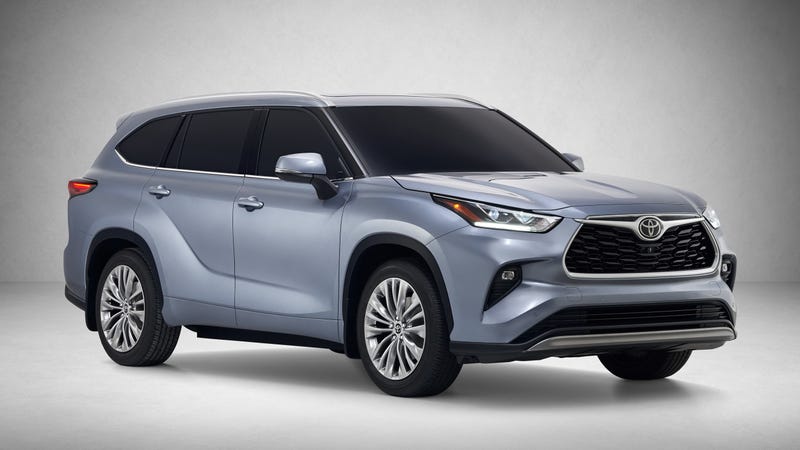
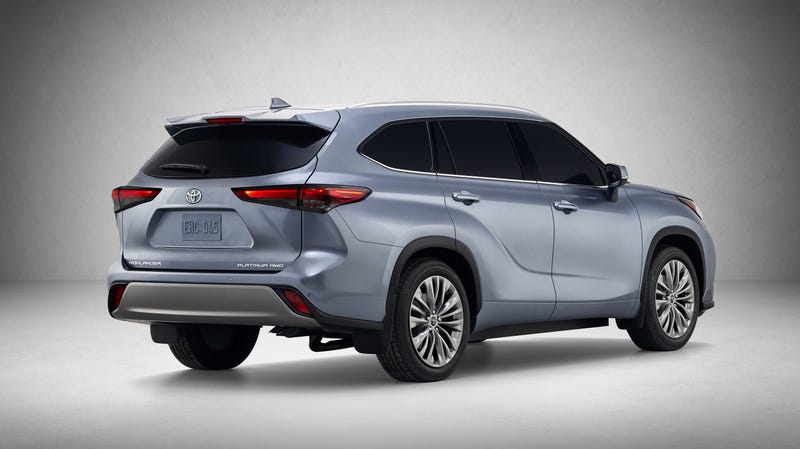
The 2020 Toyota Highlander is clearly trying hard to look tough, but, whatever. The design is inoffensive. What’s cool about this car is its efficiency, in a couple senses of the word–the Hybrid version now claims 34 mpg(!) in combined driving. That’s not a lot of gasoline to lug eight people around.
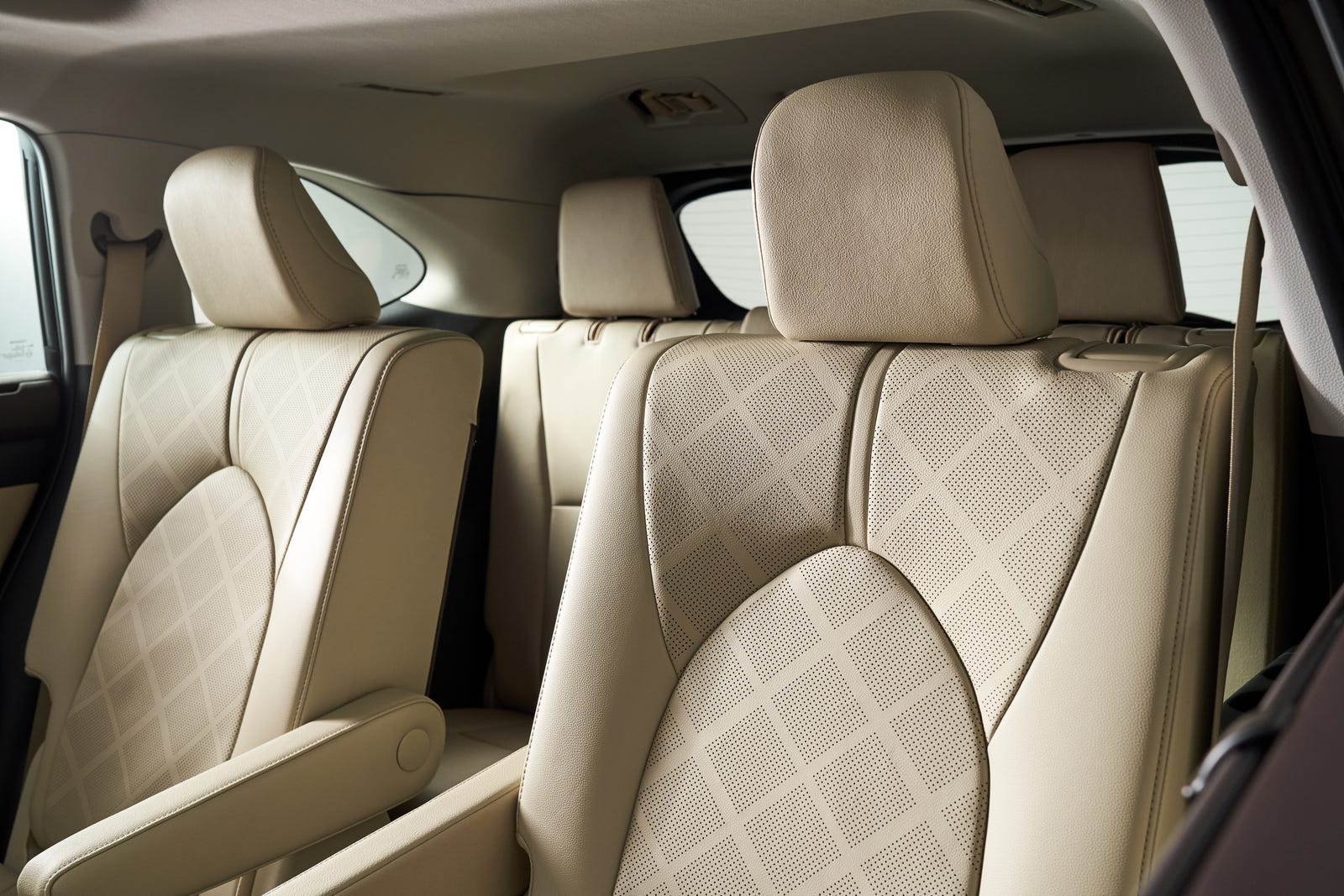
The outgoing Highlander Hybrid hit 28 mpg in combined highway and city driving, making the 2020 model a pretty significant step upward in fuel economy. Highlanders have three rows of seating and while lower-trim variants seat eight with a middle bench, the nicer ones will have captain’s chairs for a little more comfort at the cost of one seat.
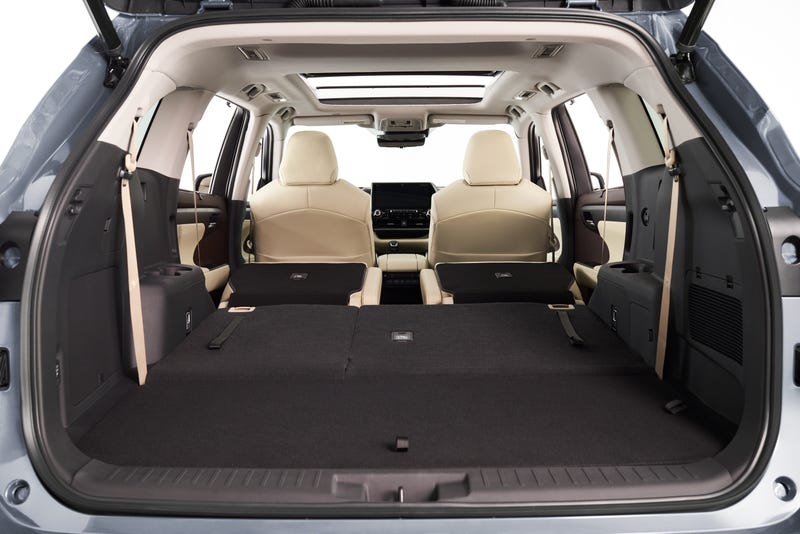
The new Highlander can stash 16.1 cubic feet of whatever behind the third row, and its cargo capacity expands to 73.3 cubic feet if you fold all the back seats down according to the preliminary spec sheet.
The standard 3.5-liter Dual VVT-i V6 engine, which turns out a factory-stated 295 horsepower and 263 lb.-ft. of torque, claims 22 mpg in combined driving but will feel a little swifter than the electric-assisted model. The Hybrid, which is clearly the spec to get, is propelled by a 2.5-liter DOHC VVT-i four-cylinder engine paired with two electric motors making a reported 240 total HP.
Either powertrain can be ordered with front or all-wheel drive.
But if you want to use your Highlander to tow things, you’re going to want the V6, which can have a towing package that includes a heavy-duty radiator, engine oil cooler and improved fan to be able to pull 5,000 pounds.
As far as convenience tech, a suite of safety tools like pre-collision warnings, automatic high beams, radar cruise control, and something new for the Highlander called Lane Tracing Assist which is Toyota’s name for lane-keeping.
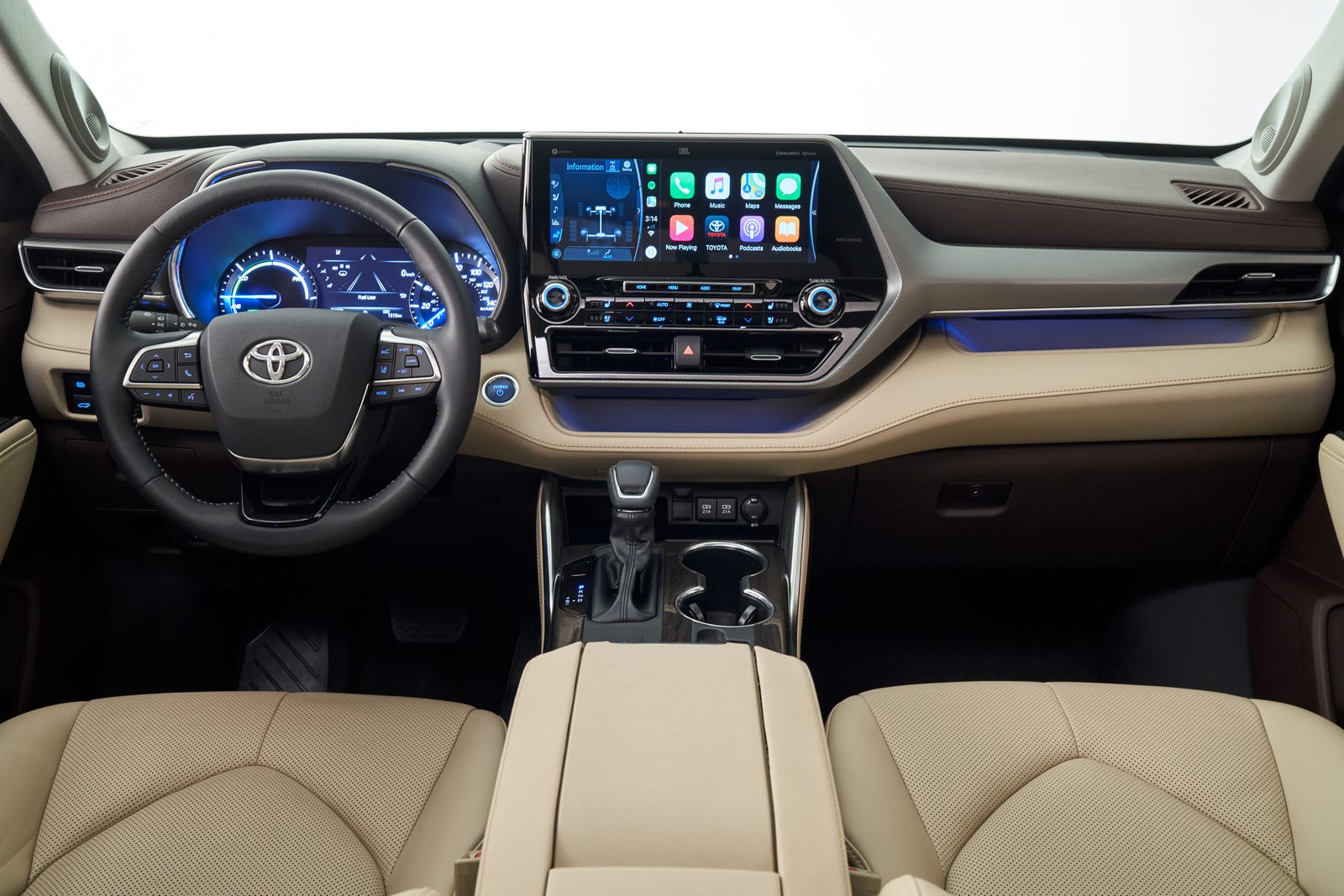
The Platinum trim, which is the finest finery a Highlander can be kitted out with, will have an expansive 12.3-inch touchscreen for infotainment functions, finally taking Toyota out of the in-car display stone ages I hope.
Lesser Highlanders (there can not, contrary to popular belief, Only Be One,) get eight-inch screens.
I’m pretty tepid on the new 2020 Highlander’s looks. It seems like it’s caught in an awkward adolescent stage somewhere on a transition from “truck” to “station wagon,” but I’m excited at the idea of a large seven or eight-passenger car hanging out with mpgs in the mid-30s.
If parents are going to keep insisting on getting substantial SUVs and crossovers for their families’ convenience, at least their fuel consumption and driving costs can be curtailed a bit.
In the Toyota world, the XSE badge signals a drive on the sporty side with specially tuned handling suspension, unique exterior styling, and exclusive interior trim. For 2021, and for the first time in its 20-year history, the Highlander family SUV gets the XSE treatment. The fourth-generation Highlander, just introduced for 2020 and built on the Toyota New Global Architecture, offers the ideal platform for an athletic transformation.
Designed for people who need SUV practicality but really miss driving sport sedans, the Highlander XSE combines bold exterior design with more agile driving reflexes. Positioned between the XLE and Limited grades, the 2021 Highlander XSE is briskly motivated by a 295-horsepower 3.5-liter V6 that's teamed with an eight-speed automatic transmission. It's available with either front-wheel drive or Dynamic Torque Vectoring All-Wheel Drive.
In addition to being able to send up to 50 percent of torque to the rear wheels, this advanced AWD system can control the left/right torque distribution to the rear wheels for a more engaging driving experience. In addition, the Multi-Terrain Select feature, controlled by a dial on the center console, allows the driver to adjust drivetrain responses to prevailing road and weather conditions.
The Toyota Highlander XSE handles curves as well as its design takes compliments. In addition to exclusive machined-faced 20-inch wheels with black accents, the XSE model is equipped with higher-rate springs and rear stabilizer bar, and the shock absorbers have been re-tuned for lower friction. Electric power steering has also been re-tuned for a sportier steering feel. These carefully calibrated new parts boost handling agility for the XSE while preserving Highlander's renowned ride comfort.
To make the XSE grade, Highlander received a bumper-to-bumper style makeover. The front fascia, grille, and lower spoiler are exclusive to this model and impart a more aggressive stance. The restyled upper grille joins a much larger lower air intake integrated into the new bumper, with a spoiler below that. Unique headlamps feature black accents and light-strip DRLs.
In profile, unique rocker panels add an edgy accent to the Toyota Highlander XSE's sculpted lines. Around back, there's a shocker: the first-ever exposed dual-tip exhaust on a Highlander - and chromed, no less. Black roof rails, mirror caps, and window moldings dial up the subtle cool factor.
Inside, the Toyota Highlander XSE rocks black Softex-trimmed seats with fabric inserts, while ambient lighting and carbon-fiber finish on the instrument panel sets the mood. A striking two-tone red and black leather-trimmed interior with red-stitched instrument panel is available and is sure to incite a bit of carpool envy.,
The 2021 Highlander XSE comes ready to take on all devices with Android Auto, Apple CarPlay, Amazon Alexa compatibility, as well as five USB ports and an all access 3-month trail of SiriusXM®.
The Toyota Highlander XSE will also offer an available Premium Audio 1200-Watt, 11-speaker JBL sound system with dynamic navigation, breathing new life into old hair bands.
Toyota anticipates that about 12 percent of Highlander buyers will opt for this edgier family hauler.
Toyota has announced a recall for select 2020 Toyota Highlanders. On models with a 3.5.-liter V6 engine, the Engine Control Unit (ECU) might have an error that could cut off the fuel supply during start-stop. The recall, which affects up to 38,810 vehicles, is expected to start April 24, 2020.
Toyota filed an official Defect Information Report with the National Highway Traffic Safety Administration (NHTSA) on March 19, 2020, declaring an issue with the ECU on certain 2020 Highlanders. These Highlanders have a start-stop feature that shuts the engine down and restarts it while a vehicle is temporarily stopped. Due to a programming error in the ECU, the fuel system might malfunction during start-stop, and the gas might not make it to engine.
No fuel means no go, so Toyota issued a safety recall due to the risk of the vehicle stalling out while in use. Toyota states, "Whether the issue in each case will lead to a vehicle stall while driving at higher speeds depends on the driving patterns and vehicle conditions." Should this occur, the Highlander will make an audible chime, and many warning indicators will show up on the dash.
Lucky for Toyota, the fix does not require any physical part replacement. Toyota will notify affected customers and will reflash the ECU to remove the error. For more information, visit NHTSA Campaign No. 20V162000.
Designed for people who need SUV practicality but really miss driving sport sedans, the Highlander XSE combines bold exterior design with more agile driving reflexes.
Those people will continue to miss driving sport sedans lol.
Sporty SUVs are going to be a regular part of automotive nomenclature now, aren't they? Like VIN number, or ATM machine.
Or you could buy a wagon. Or a hatch. But no - because America
They have been for some time now. And its funny because I used to be judge about SUVs like you, but then I needed one. Then, I had a 3 row and got rid of it...then I realized how helpful a 3 row can be and got another...a sporty one. And I was able to haul all the gear I needed to or kids...and I could still have my cake and it, too as a driver. Sadly, I sold that one, too, for many reasons...but we still a super sporty SUV with my wife's car, and its one of the best driver's cars on the market, imo.
They have been for some time now. And its funny because I used to be judge about SUVs like you, but then I needed one. Then, I had a 3 row and got rid of it...then I realized how helpful a 3 row can be and got another...a sporty one. And I was able to haul all the gear I needed to or kids...and I could still have my cake and it, too as a driver. Sadly, I sold that one, too, for many reasons...but we still a super sporty SUV with my wife's car, and its one of the best driver's cars on the market, imo.
Different needs for different people.
Absolutely, they can be very useful. I have not done it myself either, but I witnessed how much easier it is putting a baby seat in an SUV vs. a sedan.
The Stelvio is a fantastic driver's car from what I have read. I helped my sister shop for an SUV, and ultimately helped her decide on her Macan. It really surprised me when I test drove it, and I took the opportunity to get behind the wheel of it several times since then. Driving it doesn't feel like an SUV at all. I would be more than happy to daily a real sporty SUV like the Stelvio or Macan.
I am just a bit salty that in my little sports car, it is hard to see around/past towering SUVs and trucks. Inconvenient when inching along in traffic at best, borderline dangerous sometimes at worst. Maybe I just need to get a taller vehicle.
Originally Posted by Sarlacc
And a Highlander will never be sporty no much how much lipstick you put on it.
The Highlander has a pretty solidly entrenched reputation to shed, being a FWD-based, 3-row SUV. You never know
I would say something about the Durango and its reputation 20 years ago, but then I quickly remembered the R/T came with a 5.9 back then very different.
To clarify, I am in no way bashing SUVs and crossovers. Realized a long time ago that Americans love them and they aren't going anywhere, I just prefer hatches. My sister prefers SUVs, and she's happy with hers.
Absolutely, they can be very useful. I have not done it myself either, but I witnessed how much easier it is putting a baby seat in an SUV vs. a sedan.
The Stelvio is a fantastic driver's car from what I have read. I helped my sister shop for an SUV, and ultimately helped her decide on her Macan. It really surprised me when I test drove it, and I took the opportunity to get behind the wheel of it several times since then. Driving it doesn't feel like an SUV at all. I would be more than happy to daily a real sporty SUV like the Stelvio or Macan.
I am just a bit salty that in my little sports car, it is hard to see around/past towering SUVs and trucks. Inconvenient when inching along in traffic at best, borderline dangerous sometimes at worst. Maybe I just need to get a taller vehicle.
A lot of the Stelvio guys cross shopped the Macan as well and said its no contest from a drivers perspective...Stelvio. The Macan carries the Porsche prestige and more tech goodies I think. And yeah, it was hard to go back to a small sedan. Hard to see around corners with all the cars, etc. Sitting up higher in a SUV definitely makes that more tolerable.
Originally Posted by Costco
The Highlander has a pretty solidly entrenched reputation to shed, being a FWD-based, 3-row SUV. You never know
I would say something about the Durango and its reputation 20 years ago, but then I quickly remembered the R/T came with a 5.9 back then very different.
I had a highlander...granted in 2012...solid suv, my wife loved it. I thought it was the more boring driving vehicle in the world. comfy chair with 4 wheels. I'd drive this new XLE just to compare...but its still no sporty SUV in my eyes. Doesn't check all the boxes of a making more power, or even having paddles or sport tuned ECU/transmission. It''ll probably still be a vanilla ride that can a corner better.
That 5.9 was fast in a straight line. I wouldn't call the 1st/2nd Durangos sporty...they are still very much trucks and drive like them. I do miss my RT though.
A lot of the Stelvio guys cross shopped the Macan as well and said its no contest from a drivers perspective...Stelvio. The Macan carries the Porsche prestige and more tech goodies I think. And yeah, it was hard to go back to a small sedan. Hard to see around corners with all the cars, etc. Sitting up higher in a SUV definitely makes that more tolerable.
I had a highlander...granted in 2012...solid suv, my wife loved it. I thought it was the more boring driving vehicle in the world. comfy chair with 4 wheels. I'd drive this new XLE just to compare...but its still no sporty SUV in my eyes. Doesn't check all the boxes of a making more power, or even having paddles or sport tuned ECU/transmission. It''ll probably still be a vanilla ride that can a corner better.
That 5.9 was fast in a straight line. I wouldn't call the 1st/2nd Durangos sporty...they are still very much trucks and drive like them. I do miss my RT though.
Here's the kicker, my sister doesn't give a damn about driving dynamics. She's the type of person that thinks "it's a new car, it probably drives fine"
I suggested the Stelvio in the batch of suggestions, but she immediately dismissed it due to the styling. I personally like it - same goes for all the current Alfas, actually
Brand prestige and styling were key. Interior design too. I persuaded her to opt for the sport seats
I actually threw in the Highlander too just to see. Turned down so quickly.
Here's the kicker, my sister doesn't give a damn about driving dynamics. She's the type of person that thinks "it's a new car, it probably drives fine"
I suggested the Stelvio in the batch of suggestions, but she immediately dismissed it due to the styling. I personally like it - same goes for all the current Alfas, actually
Brand prestige and styling were key. Interior design too. I persuaded her to opt for the sport seats
I actually threw in the Highlander too just to see. Turned down so quickly.
It's funny. I think the Stelvio is not a good looking SUV, its also very unique amongst a sea of vanilla. Macans here are a dime a dozen. Stelvios are probably more common here than most other places...but still not as common.
The 2023 Toyota Highlander arrives with a 2.4-liter turbocharged four-cylinder to replace the naturally aspirated 3.5-liter V6. The new engine makes 265 horsepower (198 kilowatts) and 309 pound-feet (419 Newton-meters) of torque, versus 295 hp (220 kW) and 263 lb-ft (357 Nm) from the outgoing powerplant.
Toyota notes that the fuel economy for the Highlander with the new turbo engine remains the same as the V6 engine but with lower NOx, NMOG, and CO2 emissions. The 5,000-pound (2,268-kilogram) also carries over from the six-cylinder mill.
The Limited and Platinum grades of the 2023 Highlander now have a pair of 12.3-inch displays. Previously, there was a 7.0-inch screen in the instrument cluster. The tech supports dual Bluetooth phone connectivity, wireless Apple CarPlay, and wireless Android Auto. These trim levels also receive standard power-folding side mirrors.
The larger displays are optional on the XLE and XSE trim levels. These models come with a 7.0-inch display in the instrument cluster and an 8.0-inch monitor for the infotainment. These trim levels now offer an optional hands-free power liftgate.
For the L and LE grades, the 7.0-inch screen for the instruments replaces the previous 4.2-inch monitor there.
The revised interior also has a re-located wireless charging pad that's now on a shelf in front of the infotainment screen.
The Highlander Hybrid has no powertrain changes. The 2.5-liter four-cylinder and two motor-generators make a total of 243 horsepower (181 kilowatts). It returns 36 miles per gallon combined fuel economy and can tow up to 3,500 pounds (1,588 kilograms).
The Highlander comes with the Toyota Safety Sense 2.5+ system. It includes a pre-collision system with pedestrian detection, adaptive cruise control, lane departure alert with steering assist, lane tracing assist, road sign assist, and automatic high beams. The LE grade and above have blind-spot monitoring and rear cross-traffic alert. The Limited and Platinum have front and rear parking assist with automatic braking. A 360-degree camera system is optional for the Limited and standard on the Platinum model.
Toyota isn't yet offering any pricing info for the 2023 Highlander.
Striking style, everyday versatility, and battery electric efficiency, that's the all-new 2027 Toyota Highlander. With a stunning new look inside and out, and seating for up to seven, the latest Highlander is the all-electric Toyota built to carry the whole crew. It is also Toyota's first three-row battery-electric vehicle (BEV) for the U.S. market and the first BEV assembled in America.
"This new Highlander is designed to be a stylish, high-tech leader in the midsize SUV segment," said David Christ, group vice president of marketing for Toyota. "Its sleek new look, spacious interior, and cutting-edge technology, make it a great addition to Toyota's growing lineup of BEV's."
The new Toyota Highlander's modern new look features clean lines, broad fenders, full-length LED daytime running lights, and flush door handles for an aerodynamic appeal. Inside, a tech-forward cabin with a large 14-inch touchscreen, 12.3-inch driver's display, customizable ambient lighting, and ample device charging in every row give it comfort and convenience. It will also have an available fixed glass panoramic roof that will be the largest in the Toyota lineup, adding an open, bright feeling to the cabin.
The 2027 Highlander will have a Battery Electric powertrain standard and be available in two grades, the well-appointed XLE or the top-of-the-line Limited. The XLE grade will be available in front- or electronic all-wheel drive (FWD or AWD); XLE FWD models will have a 77.0-kWh battery, standard; XLE AWD models will have a choice of 77.0-kWh or 95.8-kWh battery. The Limited grade will have AWD and 95.8-kWh battery, standard. AWD equipped models will also have features like Multi-Terrain Select and Crawl Control. All grades will have the latest in safety and entertainment, with Toyota Safety Sense 4.0 (TSS 4.0) and Toyota Audio Multimedia, standard.
Designed to provide a comfortable space for the whole crew, the 2027 Highlander has a spacious interior with three-row seating for up to seven when equipped with an available bench seat. Its cabin has an elevated feel, with standard SofTex®-trimmed seating, soft-touch materials on the dash and doors, and customizable interior lighting to set the mood. Heated front seats come standard, with ventilated front seats and heated second row seats available. When extra space is required, the third-row folds flat for a rear cargo area with more than 45 cubic feet of storage.
At the forefront of technology, the new Toyota Highlander can also serve as a mobile power source with vehicle-to-load (V2L) technology, a first for a Toyota model sold in the United States. This technology can potentially power appliances, like at a tailgate party, or serve as a power backup at home in case of an outage. It also complements Toyota's Charge Assist and ECO Charge features, which are designed to give Highlander the capability to charge during lower-rate times or when energy may be created from renewable resources. Additional details on these capabilities and accessories will be available at a later date.
A standout characteristic of BEV's is their fun-to-drive nature, thanks to a low center of gravity and the instant torque that electric motors can deliver. So, Toyota engineers focused on designing an all-electric Highlander that is both efficient and powerful. "Our goal with the new Highlander was to develop a BEV that fits customers' lives and brings a smile to their faces with sharp acceleration feel and a quiet ride," said Highlander chief engineer Yoshinori Futonagane. To accomplish that aim, the new Highlander has 338 net combined system horsepower and a satisfying 323 lb.-ft. max torque on AWD equipped models. FWD equipped models have 221 net combined system horsepower and 198 lb.-ft. max torque.
The 2027 Highlander joins the Toyota bZ, bZ Woodland, and C-HR models as the fourth BEV in Toyota's lineup. Altogether, Toyota will soon offer 22 different models equipped with electrified powertrains. The 2027 Highlander will be assembled in the United States at Toyota's manufacturing facility in Georgetown, Kentucky, with batteries sourced in America from Toyota's newly opened 13.9-billion-dollar battery assembly plant in Liberty, North Carolina and a supplier partner. Sales of the new Highlander are expected to begin in late 2026, continuing into early 2027.
Highlander Through the Years
The Toyota Highlander has been an integral part of many families' lives for more than 25 years. First revealed at the New York International Auto Show in April 2000, the first-generation 2001 Toyota Highlander used a modified version of the same unibody platform used on the Toyota Camry. At the time, this innovation set it apart from other SUVs since a body-on-frame design was the norm for trucks and sport utility vehicles. As Toyota's first step into the midsize unibody SUV category, the Highlander had good road manners, a spacious interior, and rugged style that was appealing to customers.
The Highlander Hybrid model was revealed in 2005 for the 2006 model year and was the Toyota brand's first hybrid-powered SUV. Additionally, it was the second Toyota model after the Prius to offer a hybrid powertrain. The model quickly earned honors, like an "Automotive Excellence" award from Popular Mechanics in 2006 and a "Top Pick" from Consumer Reports in the Midsize SUV category in 2007.
The Second-Generation Highlander was introduced soon thereafter and featured a more refined exterior design, improved interior materials, and advanced safety features like a rearview camera and an optional navigation system. It was also the first generation assembled in the U.S., with Highlanders first rolling off the line at Toyota Motor Manufacturing Indiana (TMMI) in Princeton, Indiana in 2009.
Over the years, the Toyota Highlander evolved in size and style and took on a refined crossover SUV appearance. The third-generation model, revealed in 2013, brought a more aggressive design and a suite of active safety technologies and advanced driver-assistance features that included Toyota Safety Sense. The fourth-generation model was revealed in 2019 with a more spacious interior, an upgraded hybrid powertrain, and accentuated body lines along the doors and fenders. The 2027 model kicks off the model's fifth generation and carries forward Highlander's push to continually evolve its style, everyday usability, elevated comfort, and efficiency.
Distinctive Design
When Toyota designers and engineers set out to reinvent Highlander as a battery electric vehicle, they wanted to make a model that captured a sense of sophisticated adventure. To achieve this, they coined the term "Best Experience Vehicle" with a focus on building a new Highlander that helps support efficient, safe and comfortable travel for the family.
"Our design mission was to create a new Highlander that pursued the robust proportions of an SUV while also capturing the sophisticated, high-tech aspects of all-electric performance," said Chief Designer Masayuki Yamada. "To accomplish that goal, we designed a model that balanced aerodynamics, interior space, and capability so it is equally suited for elegant urban or outdoor enthusiast lifestyles."
The 2027 Highlander is built on a modified Toyota Next Generation Architecture-K (TNGA-K) platform that was newly developed to house Highlander's high-capacity battery and maximize passenger space. The platform also uses underfloor covers on the front and back end to benefit underfloor airflow as well as front and rear spats to minimize air turbulence generated around the tires. Measures taken to minimize noise and vibration include noise absorbing material on the front and rear door trim, front pillar, wheel wells, roof, and underfloor. Acoustic glass on the front windshield and front side glass is also used.
Toyota's designers also changed the proportions of Highlander to achieve a modern look and confident stance by lowering its overall height and increasing its width and wheelbase. The overall height of 67.3 inches lowers the roofline by 0.8 inch versus the outgoing model; overall width increased to 78.3 inches for an added 2.3 inches; and the wheelbase becomes 120.1 inches, up from 112 inches. Altogether, the new exterior dimensions allowed designers to give the model a planted, agile appearance, with the wheels set closer to the corners, while also maximizing interior space.
From the front, the new Highlander emphasizes Toyota's signature hammerhead design with the use of slim daytime running lights (DRL) that are housed separately from the main headlights. The linear-shaped DRL is integrated into the vehicle's front end for a look that evokes strength and simplicity with broad surfaces, a thick sweptback grill, and geometric bumper corners that encompass the headlamps for a modern impression.
The sophisticated appeal continues along the side of the vehicle. The new Toyota Highlander's profile sweeps rearward from the front end through a sleek, tapered cabin with large windows. Its front and rear end have broad fenders that exude confidence and drivability. Along the side, smooth door panels complement the broad fenders to emphasize its robust image and semi-flush door handles with a newly adopted electronic latch, a rear spoiler that is smoothly integrated into the rear pillar, and black painted window trim that gives it a simple-yet-refined style.
Available exterior paint colors on the new Highlander further its expressive nature. Single tone colors include the all-new Spellbound, along with Wind Chill Pearl, Heavy Metal, Everest, Reservoir Blue, and Midnight Black Metallic. Two tone paint combinations are also available, pairing Spellbound, Wind Chill Pearl, Heavy Metal, or Everest with a black roof. Interior colors are clean and modern, with Black, Portobello, and an all-new Misty Gray available.
Elevated Interior
On the inside, the all-new Toyota Highlander aims to create a comfortable cabin by giving it an open feeling, refined comfort, and tech-forward design. The cockpit is driver-focused and centers around an LED digital gauge cluster with customizable settings, temperature controls with adjustability via hard buttons, and a large slim bezel touchscreen. A Head Up Display (HUD) is available. Ambient lighting is standard, with 64 different color choices to set the perfect mood for a night out on the town. It is also thoughtfully integrated into the Safe Exit Assist system with ambient lights on the doors that will flash in case of an issue.
Seating is made of durable materials and stylish patterns that add beauty to the interior. All grades will have new-look SofTex-trimmed seating with heated first row seating standard. The Limited grade adds unique textured patterns, front seat ventilation function, and second row heat. Second-row captain's chairs come standard, with an available bench seat for the XLE AWD grade. The third-row seat provides ample room for two adults and is easily accessible via an electronically assisted one-touch fold button on the second-row seats.
The interior space is thoughtfully fashioned to help maximize usability. The center console has a standard dual Qi wireless charging tray that is cleverly angled to prevent slipping and is trimmed in a synthetic-suede material. The USB-C chargers are also located throughout the cabin, with ports located on the rear of the front seats for second row passengers and on the rear window ledges for the third row. Rear HVAC controls, accessible on the rear of the center console, are easily within reach for second row passengers. Rear window shades are also available for a more private sense of space.
Storage is also cleverly designed. The multi-function center console features a small item storage tray, cup holders, and an under-tray storage, with the console storage box providing an additional place for valuables. Storage slots for tablets and/or phones in the standard second row console, and third row cupholders provide thoughtful places for passengers to stash electronics. Ample cup holders are placed throughout, with 18 total locations. A standard hands-free power liftgate provides easy access to the rear cargo area. When extra storage is required, folding the third-row flat is as simple as pulling a lever on the rear seats.
Electrifying Efficiency
Within the 2027 Toyota Highlander lineup, customers will be able to choose from driving range and battery options that best fit their needs, options include:
XLE FWD with 77.0-kWh battery with a manufacturer-estimated 287-mile total driving range rating
XLE AWD with 77.0-kWh battery with a manufacturer-estimated 270-mile total driving range rating
XLE AWD with 95.8 -kWh battery with a manufacturer-estimated 320-mile total driving range rating
Limited AWD with 95.8 -kWh battery with a manufacturer-estimated 320-mile total driving range rating
It will have a standard North American Charging System (NACS) port that is compatible with thousands of Level 3 DC charging stations nationwide. Under ideal conditions when using DC fast charging, it is capable of charging from 10% to 80% battery capacity in around 30 minutes. For added charging flexibility, it will also have Level 1 and Level 2 AC charging; a dual-voltage 120V/240V charging cable is included.
A Battery Preconditioning feature is also equipped. This system is designed to bring the battery to an optimal temperature for DC fast charging, which can enable faster charging. This feature can be activated manually using system settings or can be automatically activated through an active Drive Connect trial or subscription by setting the navigation system to a fast-charging station. It will also have Plug & Charge capability, an industry standard protocol that allows automatic identification, authentication, and authorization on selected charging networks, reducing the need for multiple mobile charging applications.
Advanced Technology
The 2027 Highlander also receives the latest-generation Toyota Audio Multimedia. Developed in North America in partnership with Toyota Motor North America and Toyota Connected North America, the updated infotainment system features AT&T 5G network connectivity and an intuitive, smartphone-like design that offers customizable widgets on its new home screen. It also has enhanced embedded Voice Assistant functions that enable faster responses to "Hey Toyota" prompts.
Paired with the touchscreen display, the Toyota Audio Multimedia system will provide customers with choice thanks to standard wireless Apple CarPlay® and Android Auto™ compatibility, and simultaneous dual Bluetooth® phone connectivity.
The new system also has enhanced entertainment with the introduction of SiriusXM® with 360L® and newly available integrated streaming with Spotify® (separate subscriptions required). The native turn-by-turn navigation now displays full screen on the digital gauge cluster, a first for Toyota Audio Multimedia.
The 2027 Toyota Highlander also has a standard built-in Drive Recorder, a dashcam-style feature that utilizes the vehicle's exterior cameras to capture 20-second clips of both manual and triggered events when operating.
The 2027 Highlander also comes with a host of Connected Services trials that include Drive Connect with Intelligent Assistant, Cloud Navigation with 3D Maps and Destination Assist; Safety Connect and Service Connect. Customers can also use the Toyota mobile application to stay connected to their Highlander with Remote Connect, which also enables remote charging capabilities to check charging status, start/stop charging when the vehicle is already plugged in and even edit charging schedules The Toyota app also provides an easy-to-use map to find charging station locations near you or along your route, making it easier than ever for customers to managing their charging needs.
Safety & Convenience
The 2027 Toyota Highlander comes with the recently updated Toyota Safety Sense (TSS 4.0) system. The new version of Toyota's standard active safety suite and convenience technologies brings updates to its hardware and detection capabilities and has the following features:
Pre-Collision System with Pedestrian Detection (PCS w/PD) is designed to help detect a vehicle, pedestrian, bicyclist or motorcyclist and provide an audio/visual forward-collision warning under certain circumstances. If you don't react, the system is designed to provide automatic emergency braking.
Full-Speed Range Dynamic Radar Cruise Control (DRCC) is an adaptive cruise control system that is designed to be set at speeds above 20 mph. DRCC uses vehicle-to-vehicle distance control to help maintain a preset distance from the vehicle ahead.
Lane Departure Alert with Steering Assist (LDA w/SA) detects lane markings or the road's edge at speeds above 30 mph. LDA w/SA is designed to provide an audible/visual warning if an inadvertent lane departure is detected. If no corrective action is taken, Steering Assist is designed to provide gentle corrective steering for lane-keeping assistance.
Automatic High Beams (AHB) are designed to detect headlights of oncoming vehicles and taillights of preceding vehicles. AHB automatically toggles between high and low beams as appropriate.
Lane Tracing Assist (LTA) is designed to help keep the vehicle in the center of a lane. LTA assists the driver with steering control while DRCC is in use.
Road Sign Assist (RSA) uses the forward-facing camera to recognize specific road signs such as speed limits and stop signs. RSA provides road sign information to the driver via the Multi-Information Display.
Proactive Driving Assist (PDA) uses the vehicle's camera and radar, when system operating conditions are met, to provide gentle braking and/or steering to support driving tasks such as distance control between your vehicle and a preceding vehicle
In addition to TSS 4.0, the 2027 Highlander is equipped with Toyota's Star Safety System, which includes Enhanced Vehicle Stability Control (VSC), Traction Control (TRAC), Electronic Brake-force Distribution (EBD), Brake Assist (BA), Anti-lock Braking System (ABS) and Smart Stop Technology (SST). Front and Rear Parking Assist with Automatic Braking (PKSB) is also standard. Other available convenience technologies include Panoramic View Monitor and Advanced Park.
The 2027 Toyota Highlander also has great standard convenience features like a rear seat reminder system, backup camera with dynamic gridlines, smart key with push button start, Blind Spot Monitor with Rear Cross-Traffic Alert, Tire Pressure Monitor System (TPMS) with direct pressure read-out and individual tire location alert, and Hill Start Assist Control.








 )
)
















 very different.