


Fiat World Mathematical Model


Thread Starter
werd

Joined: Feb 2002
Posts: 15,079
Likes: 16
 Fiat World Mathematical Model
This is a bit technical, but by far the best case/theory/analysis for deflation I've yet to read.
Not stagflation, not hyperinflation - deflation.
---
In a fiat world, money is printed into existence by the central bank - in the United States the Fed. Given there is nothing backing up this money, it is inherently worthless. However, one can think of as real. It was printed (even if only electronically), therefore it exists.
In addition to the previously mentioned money supply, fractional reserve lending allows credit to be extended by banks and financial institutions on top of that inherently worthless money. Indeed, banks and financial institutions have leveraged credit to base money at ratios of 30-1, 50-1 or even higher.
It's pretty amazing if you think about it: Credit is extended with 30-50 times leverage on inherently worthless paper.
Ponzi Financing
Borrowers have to pay interest on the amount borrowed. However, the interest and the debt cannot possibly be paid back except by an ever expanding Ponzi scheme of lending. That scheme can last only as long as everyone believes the debt can be paid back and the market value of that debt keeps rising.
It's a faith based system in which banks extend loans and hold the credit on the books (or in many cases off the books in various structured instruments). The banks are thought of as being well capitalized as long as the value of credit on the books in relation to their reserves meets some ridiculously low minimum set by the Fed.
This is how the system works, using the term "works" loosely.
Day of Reckoning
The day of reckoning comes when asset prices start falling, defaults soar, and the value of credit on the books starts plunging. That day of reckoning has arrived.
And if leverage is high enough, as it was with Bear Stearns and Lehman, the institutions are wiped out overnight. Citigroup (C), Bank of America (BAC), Fannie Mae (FNM), Freddie Mac (FRE) and AIG are essentially in the same position of Lehman except the taxpayers via the Treasury are funding the bailouts.
Deflation Economics
Conditions today are essentially the same as during the great depression. I talked about this in Humpty Dumpty On Inflation (http://globaleconomicanalysis.blogsp...inflation.html). When I wrote that piece, I listed 15 conditions one would expect to see in deflation and the score was a perfect 15-15. I recently added a 16th: bank failures. Click on link to see the conditions table.
Those who stick to a monetary definition of inflation pointing at M2, M3, MZM, or base money supply, as well as definitions that involve prices are selecting a definition of inflation that makes absolutely no practical sense.
It is the destruction of credit, coupled with the fact that what the Fed is printing is not even being lent that matters, not some Humpty-Dumptyish academic definition that has no real world application!
I have long been arguing that we are in deflation based on the following definitions: Inflation is a net expansion of money and credit. Deflation is a net contraction of money and credit. In both definitions, credit needs to be marked to market.
Mathematical Model
I can express the above mathematically.
Fm = Fb + MV(Fc)
Fm = Fiat Money Total
Fb = Fiat Monetary Base
Fc = Fiat Credit, the amount of credit on the balances sheets of institutions in excess of Fb
MV(Fc) is the market value Fc
Inflation is an expansion of Fm
Deflation is a contraction of Fm
If only base money was lent out (no fractional reserve lending), MV(Fc) would equal zero. The equation ensures we do not double count credit in Fm.
MV is a function of time preference and credit sentiment (ie. Belief that one can be paid back). As long as that belief was high, banks were willing to lend.
Because (at the moment) Fc (credit) dwarfs Fb (base money), the system can only hold together as long as there is belief credit can be paid back and as long as there are not defaults. Needless to say, the perceived belief that Fc can be paid back is under attack, both by rising defaults, and by sentiment. That is why MV(Fc) is collapsing.
In other words, the mark to market value of credit is contracting faster than base money is rising.
What About Deposits?
Some may point out that base money is not the only real money out there. Deposits are real.
Actually most deposits are fiction, borrowed into existence via an accounting entry and lent out with the miracle of fractional reserve lending time and time again. Moreover, savings accounts have zero reserve requirements and the bulk of checking accounts which are supposed to be available on demand are swept nightly into savings accounts so that they too can be lent out.
However, the FDIC guarantees those deposits up to the FDIC limit, now at $250,000 per account. Because of FDIC it might seem that deposits up to the guarantee limit should be accounted for in the above equation. One could do that by adjusting the right side of the equation to allow for FDIC guarantees. This would result in a peculiar formula of adding credit extended with 30-50 times leverage on inherently worthless paper to guarantees promised on that which does not really exit.
From a practical standpoint however, the economy seems to be acting as if base money and FDIC guarantees are irrelevant and the only thing that matters is the market value of credit.
Let's explore why that is using a magical printing press as an example.
Magical Printing Press
Assume for a moment you invent a magical printing press. Your machine can print hundred dollar bills so good that the US Treasury cannot distinguish them them from the real thing. The bills are perfect in every way. Now assume you print $5 trillion worth of those bills and bury them in your back yard. Is this inflation? Surely not. Would it be inflation if $5 trillion in bills were spent and entered the economy? You bet. The key then is not how much the Fed prints, the key is how much of that money makes its way into the economy.
Please consider this audio with Austrian Economist Frank Shostak on Mises (http://mises.org/multimedia/mp3/inte...09-30-2008.mp3) on September 30, 2008 discussing recent actions by the Fed.
Will this printing create [price] inflation? This is dependent very much on what money will do next. If banks will not lend and banks sit on that cash forever and ever like the great depression because the risk is too high and the banks do not know if the lending will end up in good assets or bad assets, and because banks are in so many bad assets now they probably will not lend at all.
That is the observation that Murray Rothbard made, that during the Great Depression that banks have chosen not to lend because the risk of accumulating bad assets was far to high. So they were sitting on massive reserves. That is what is developing right now.
A good example is what happened in Japan in 2001-2002 where the Bank of Japan pumped 300% at one stage and lending continued to collapse. I expect similar things to happen here. If lending will not increase we can conclude this will not be inflationary.
I agree whole heartedly with Shostak and suggest we are following the Japanese model. This has been my thesis for years.
Don't Ask, Don't Sell Policy
The Fed tries to hide the contraction in the market value of bank credit by its Don't Ask, Don't Sell policy. See Fed and BOE Shell Games to Bailout Insolvent Banks (http://globaleconomicanalysis.blogsp...o-bailout.html) for more discussion of the aggregator bank shell game and the Don't Ask, Don't Sell policy.
Many point out that base money is rising at an amazingly high rate. However, as we have seen, base money is irrelevant until the money is lent. The key issue is that the market value of credit is collapsing at an amazing rate.
This is deflation.
One can choose to say in strict Austrian terms there is no deflation because money supply is rising. However, the money supply theory falls flat on its impractical face when it comes to accurately explaining what is happening in the real world.
The inflation model simply does not fit. Conditions one would expect to see during inflation, stagflation, hyperinflation, and disinflation are nowhere to be found.
The US shows 16 symptoms of deflation for the simple reason deflation is at hand.
Confusion due to delays?
Steve Saville chimes in on the The Inflation-Deflation Debate (http://www.kitco.com/ind/saville/feb032009.html) with a thesis that suggests there are lengthy and variable time delays between changes in the monetary trend and changes in prices. Let's take a look.
For many years we have been expecting inflation (growth in the supply of money) and nothing but inflation as far as the eye can see, but there have been times, such as the past 12 months, when we have felt more affinity with deflation forecasters than with most other inflation forecasters. The reason is that monetary inflation, when measured correctly, was minimal during the first half of 2008 and during the two preceding years, thus setting the stage for a US$ rebound and large price declines in the investments that had been bid up to astronomical heights.
Based on our observation, a lot of confusion on the inflation/deflation issue is caused by the lengthy and variable time delays between changes in the monetary trend and changes in prices. It will often be at least 2 years before the effects of a major change in the monetary trend start to become apparent in the prices of commodities and everyday goods and services. Consequently, during the first 2 years of a new monetary inflation cycle the outward evidence will often point to deflation (even though the inflation threat is rising), and for 2 years following the END of an inflation cycle it will seem as if the inflation threat is growing (even though it is falling). ...
Current Situation
We agree with much of the analysis presented by the well-known deflationists. The main point of contention revolves around the ability of the monetary authorities (the Fed and the Treasury in the US) to keep the total supply of money growing. Our view has been, and continues to be, that the Treasury-Fed tag team has the power to promulgate monetary inflation under almost any economic circumstances and will use this power. The bond market could eventually impose a practical limitation on the government's ability to inflate because increasing the money supply becomes counter-productive once the bond market begins to anticipate rapid currency depreciation, but if price-related evidence continues to favour the deflation view over the coming year then this limitation will not arise anytime soon.
The case is not yet closed, but the evidence presented to date supports our view. For example, the monetary base has expanded at an astronomical pace over the past five months. Mike Shedlock has attempted to counter this by pointing out that a sharp increase in the adjusted monetary base (AMB) also occurred during the early 1930s, but the St. Louis Fed's updated long-term chart of the AMB shows that the recent increase has been many times greater than anything during the 1930s. In any case, the overall monetary situation today could hardly be more different to the early 1930s. During the early 1930s the Fed increased the monetary base, but the total supply of money plunged.
Discussion On Points Of Contention
I agree wholeheartedly with Steve Saville that the Fed can print money at will. However, getting banks to lend is another thing indeed as the following chart of Reserve Bank Credit (http://research.stlouisfed.org/fred2/series/RSBKCRNS) shows.
Reserve Bank Credit
Link to chart: http://1.bp.blogspot.com/_nSTO-vZpSg...ank+Credit.png
Simply put, the Fed cannot force banks to lend or consumers and businesses to borrow. Congress can force the issue with TARP funds and other so-called "stimulus" measures. Then again, writeoffs of bad loans are going to increase at a massive rate, especially credit card defaults and foreclosures in conjunction with rising unemployment.
What About The Lag Theory?
Saville states "a lot of confusion on the inflation/deflation issue is caused by the lengthy and variable time delays between changes in the monetary trend and changes in prices."
Another way of phrasing Saville's theory is that growth in credit (and prices) follows the creation of money, with a lag. This is the money multiplier model.
Money Multiplier Lag Theory Is False
Please consider commentary from Steve Keen’s Debtwatch, Roving Cavaliers of Credit (http://www.debtdeflation.com/blogs/2...liersofcredit/).
Two hypotheses about the nature of money can be derived from the money multiplier model:
1. The creation of credit money should happen after the creation of government money.
2. The amount of money in the economy should exceed the amount of debt, with the difference representing the government’s initial creation of money.
Both these hypotheses are strongly contradicted by the data.
Testing the first hypothesis takes some sophisticated data analysis, which was done by two leading neoclassical economists in 1990.
If the hypothesis were true, changes in M0 should precede changes in M2.
Their empirical conclusion was just the opposite: rather than fiat money being created first and credit money following with a lag, the sequence was reversed: credit money was created first, and fiat money was then created about a year later:
“There is no evidence that either the monetary base or M1 leads the cycle, although some economists still believe this monetary myth. Both the monetary base and M1 series are generally procyclical and, if anything, the monetary base lags the cycle slightly."
Thus rather than credit money being created with a lag after government money, the data shows that credit money is created first, up to a year before there are changes in base money. This contradicts the money multiplier model of how credit and debt are created: rather than fiat money being needed to “seed” the credit creation process, credit is created first and then after that, base money changes.
Solid Evidence Credit Is Created First
Solid evidence that credit is created first and reserves later can be found by reviewing Fannie Mae’s and Freddie Mac’s Financial Problems, an article written July 15, 2008 (http://assets.opencrs.com/rpts/RS22916_20080715.pdf).
To make certain that the GSEs have adequate funds to cover potential losses, OFHEO (like all financial regulators) imposes capital requirements. At the end of 2007, the two GSEs had a $24.8 billion surplus over the regulatory capital requirement of $58.4 billion; they had a surplus of $50.8 billion over the risk-based capital requirement of $38.8 billion.
These amounts can be compared with the combined retained mortgages portfolios of $1.434 trillion and the $3.501 trillion in MBS that the GSEs guaranteed for a total of $4.934 trillion.
The regulatory capital surplus amounted to 0.50% of the $4.934 trillion and 1.03% of the risk-based capital surplus. If the GSEs were to face losses in excess of their income by these percentages, they would be forced to either reduce their capital requirements by selling mortgages and MBS from their portfolios or to raise new capital from investors.
The Secretary of the Treasury is authorized to lend the GSEs $2.25 billion each, but this is more a symbolic amount than a total solution. Based on Fannie Mae’s issuance of $1.588 trillion in short term debt in 2007, the $2.25 billion would have lasted less than 12.5 hours. Based on the $598.6 billion issued of short term debt that Freddie Mac issued in 2007, the $2.25 billion would have lasted just under 33 hours.
Fannie Mae's capital surplus was 0.50% on close to $5 trillion in assets. In other words, Fannie extended credit at will with virtually no reserves behind it. The Treasury provided reserves later, after Fannie and Freddie imploded.
Base Money Yet Again
Steve Saville points out that recent increase in base money has been many times greater than anything during the 1930s. Steve is correct as the following chart shows.
Link to chart: http://3.bp.blogspot.com/_nSTO-vZpSg...00-h/ambsl.png
Note that the pattern leading up to the great depression and the pattern before the latest spike are nearly identical. There is no other similar pattern on the chart. And most certainly the recent spike as Saville points out is unprecedented.
Base money is indeed soaring. However, so is debt.
USA Money Stock Measures and Debt
Here are some more charts and commentary courtesy of Steve Keen’s Debtwatch.
Click for chart: http://2.bp.blogspot.com/_nSTO-vZpSg...00-h/Keen1.png
Measured on this scale, Bernanke’s increase in Base Money goes from being heroic to trivial. Not only does the scale of credit-created money greatly exceed government-created money, but debt in turn greatly exceeds even the broadest measure of the money stock—the M3 series that the Fed some years ago decided to discontinue.
Click for chart: http://2.bp.blogspot.com/_nSTO-vZpSg...00-h/keen2.png
Bernanke’s expansion of M0 in the last four months of 2008 has merely reduced the debt to M0 ratio from 47:1 to 36:1 (the debt data is quarterly whole money stock data is monthly, so the fall in the ratio is more than shown here given the lag in reporting of debt).
To make a serious dent in debt levels, and thus enable the increase in base money to affect the aggregate money stock and hence cause inflation, Bernanke would need to not merely double M0, but to increase it by a factor of, say, 25 from pre-intervention levels. That US$20 trillion truckload of greenbacks might enable Americans to repay, say, one quarter of outstanding debt with one half—thus reducing the debt to GDP ratio about 200% (roughly what it was during the DotCom bubble and, coincidentally, 1931)—and get back to some serious inflationary spending with the other (of course, in the context of a seriously depreciating currency). But with anything less than that, his attempts to reflate the American economy will sink in the ocean of debt created by America’s modern-day “Roving Cavaliers of Credit”.
I agree with Steve Keen in regards to money vs. credit, with credit being far more important, at the present time. Furthermore, rising unemployment is only going to exacerbate the problems of imploding credit. Expect to see massively rising credit card defaults, foreclosures, and walk-aways, all on account of unemployment that is soaring.
Finally, it is important to consider the role of attitudes going forward. Attitudes affect the willingness of consumers to take on debt and banks to extend it.
Attitudes
* Boomers are heading into retirement. A significant portion of their retirement plan (home prices) has already been wiped out. Another portion of boomer retirement plans is being wiped out in the stock market crash. Toy accumulation is out. Fears of insufficient saving is in.
* Boomers will be traveling and spending less than they planned.
* A secular shift to frugality and risk aversion in all age groups has begun. Signs are everywhere.
* The lend to securitize model at banks is dead. So are toggle bonds where debt is paid back with more debt, and a myriad of other financial wizardry schemes.
* Children who have seen their parents wiped out in bankruptcy or foreclosed on are going to have a completely different attitude towards debt than their reckless parents did. Expect to see more frugality from parents and their children alike.
What About Zimbabwe?
In Zimbabwe, credit does not exist. You simply cannot walk into a bank and get a loan. Nor would anyone in their right mind deposit money in a Zimbabwe bank as part of a saving program. The money would be worthless in a month.
In the US credit is not being extended for a different reason. Banks are not afraid of being paid back with cheaper dollar, banks are afraid they will not be paid back at all. Cash is being hoarded by banks and consumers alike. This is the opposite of what happened in the Weimar Republic and what is happening now in Zimbabwe.
Global Stimulus Kicker
There is yet another kicker to this model. And that kicker is the Eurozone, the UK, Japan, and essentially every county on the planet is all attempting some sort of stimulus plan or other. This is bound to cause a major distortion at some point, as no country has anything remotely close to an exit strategy for this. What kind of distortion and when cannot be certain because we are indeed in uncharted territory, worldwide.
Political Will vs. Consumer Psychology
What happens next depends somewhat on the political will of the central banks and politicians. However, it depends more on the psychology of the borrowers. If consumers and businesses refuse to spend and instead pay back debts (or default on them along with rising unemployment), the picture simply is not inflationary, at least to any significant decree.
The credit bubble that just popped exceeded that preceding the great depression, not just in the US but worldwide. Thus, it is unrealistic to expect the deflationary bust to be anything other than the biggest bust in history. Those looking for hyperinflation or even strong inflation in light of the above, are simply looking at the wrong model.
At some point the market value of credit will start expanding again, but that is likely further down the road, and weaker in scope than most think.
Mike "Mish" Shedlock
http://globaleconomicanalysis.blogspot.com
http://globaleconomicanalysis.blogsp...cal-model.html
Not stagflation, not hyperinflation - deflation.
---
In a fiat world, money is printed into existence by the central bank - in the United States the Fed. Given there is nothing backing up this money, it is inherently worthless. However, one can think of as real. It was printed (even if only electronically), therefore it exists.
In addition to the previously mentioned money supply, fractional reserve lending allows credit to be extended by banks and financial institutions on top of that inherently worthless money. Indeed, banks and financial institutions have leveraged credit to base money at ratios of 30-1, 50-1 or even higher.
It's pretty amazing if you think about it: Credit is extended with 30-50 times leverage on inherently worthless paper.
Ponzi Financing
Borrowers have to pay interest on the amount borrowed. However, the interest and the debt cannot possibly be paid back except by an ever expanding Ponzi scheme of lending. That scheme can last only as long as everyone believes the debt can be paid back and the market value of that debt keeps rising.
It's a faith based system in which banks extend loans and hold the credit on the books (or in many cases off the books in various structured instruments). The banks are thought of as being well capitalized as long as the value of credit on the books in relation to their reserves meets some ridiculously low minimum set by the Fed.
This is how the system works, using the term "works" loosely.
Day of Reckoning
The day of reckoning comes when asset prices start falling, defaults soar, and the value of credit on the books starts plunging. That day of reckoning has arrived.
And if leverage is high enough, as it was with Bear Stearns and Lehman, the institutions are wiped out overnight. Citigroup (C), Bank of America (BAC), Fannie Mae (FNM), Freddie Mac (FRE) and AIG are essentially in the same position of Lehman except the taxpayers via the Treasury are funding the bailouts.
Deflation Economics
Conditions today are essentially the same as during the great depression. I talked about this in Humpty Dumpty On Inflation (http://globaleconomicanalysis.blogsp...inflation.html). When I wrote that piece, I listed 15 conditions one would expect to see in deflation and the score was a perfect 15-15. I recently added a 16th: bank failures. Click on link to see the conditions table.
Those who stick to a monetary definition of inflation pointing at M2, M3, MZM, or base money supply, as well as definitions that involve prices are selecting a definition of inflation that makes absolutely no practical sense.
It is the destruction of credit, coupled with the fact that what the Fed is printing is not even being lent that matters, not some Humpty-Dumptyish academic definition that has no real world application!
I have long been arguing that we are in deflation based on the following definitions: Inflation is a net expansion of money and credit. Deflation is a net contraction of money and credit. In both definitions, credit needs to be marked to market.
Mathematical Model
I can express the above mathematically.
Fm = Fb + MV(Fc)
Fm = Fiat Money Total
Fb = Fiat Monetary Base
Fc = Fiat Credit, the amount of credit on the balances sheets of institutions in excess of Fb
MV(Fc) is the market value Fc
Inflation is an expansion of Fm
Deflation is a contraction of Fm
If only base money was lent out (no fractional reserve lending), MV(Fc) would equal zero. The equation ensures we do not double count credit in Fm.
MV is a function of time preference and credit sentiment (ie. Belief that one can be paid back). As long as that belief was high, banks were willing to lend.
Because (at the moment) Fc (credit) dwarfs Fb (base money), the system can only hold together as long as there is belief credit can be paid back and as long as there are not defaults. Needless to say, the perceived belief that Fc can be paid back is under attack, both by rising defaults, and by sentiment. That is why MV(Fc) is collapsing.
In other words, the mark to market value of credit is contracting faster than base money is rising.
What About Deposits?
Some may point out that base money is not the only real money out there. Deposits are real.
Actually most deposits are fiction, borrowed into existence via an accounting entry and lent out with the miracle of fractional reserve lending time and time again. Moreover, savings accounts have zero reserve requirements and the bulk of checking accounts which are supposed to be available on demand are swept nightly into savings accounts so that they too can be lent out.
However, the FDIC guarantees those deposits up to the FDIC limit, now at $250,000 per account. Because of FDIC it might seem that deposits up to the guarantee limit should be accounted for in the above equation. One could do that by adjusting the right side of the equation to allow for FDIC guarantees. This would result in a peculiar formula of adding credit extended with 30-50 times leverage on inherently worthless paper to guarantees promised on that which does not really exit.
From a practical standpoint however, the economy seems to be acting as if base money and FDIC guarantees are irrelevant and the only thing that matters is the market value of credit.
Let's explore why that is using a magical printing press as an example.
Magical Printing Press
Assume for a moment you invent a magical printing press. Your machine can print hundred dollar bills so good that the US Treasury cannot distinguish them them from the real thing. The bills are perfect in every way. Now assume you print $5 trillion worth of those bills and bury them in your back yard. Is this inflation? Surely not. Would it be inflation if $5 trillion in bills were spent and entered the economy? You bet. The key then is not how much the Fed prints, the key is how much of that money makes its way into the economy.
Please consider this audio with Austrian Economist Frank Shostak on Mises (http://mises.org/multimedia/mp3/inte...09-30-2008.mp3) on September 30, 2008 discussing recent actions by the Fed.
Will this printing create [price] inflation? This is dependent very much on what money will do next. If banks will not lend and banks sit on that cash forever and ever like the great depression because the risk is too high and the banks do not know if the lending will end up in good assets or bad assets, and because banks are in so many bad assets now they probably will not lend at all.
That is the observation that Murray Rothbard made, that during the Great Depression that banks have chosen not to lend because the risk of accumulating bad assets was far to high. So they were sitting on massive reserves. That is what is developing right now.
A good example is what happened in Japan in 2001-2002 where the Bank of Japan pumped 300% at one stage and lending continued to collapse. I expect similar things to happen here. If lending will not increase we can conclude this will not be inflationary.
I agree whole heartedly with Shostak and suggest we are following the Japanese model. This has been my thesis for years.
Don't Ask, Don't Sell Policy
The Fed tries to hide the contraction in the market value of bank credit by its Don't Ask, Don't Sell policy. See Fed and BOE Shell Games to Bailout Insolvent Banks (http://globaleconomicanalysis.blogsp...o-bailout.html) for more discussion of the aggregator bank shell game and the Don't Ask, Don't Sell policy.
Many point out that base money is rising at an amazingly high rate. However, as we have seen, base money is irrelevant until the money is lent. The key issue is that the market value of credit is collapsing at an amazing rate.
This is deflation.
One can choose to say in strict Austrian terms there is no deflation because money supply is rising. However, the money supply theory falls flat on its impractical face when it comes to accurately explaining what is happening in the real world.
The inflation model simply does not fit. Conditions one would expect to see during inflation, stagflation, hyperinflation, and disinflation are nowhere to be found.
The US shows 16 symptoms of deflation for the simple reason deflation is at hand.
Confusion due to delays?
Steve Saville chimes in on the The Inflation-Deflation Debate (http://www.kitco.com/ind/saville/feb032009.html) with a thesis that suggests there are lengthy and variable time delays between changes in the monetary trend and changes in prices. Let's take a look.
For many years we have been expecting inflation (growth in the supply of money) and nothing but inflation as far as the eye can see, but there have been times, such as the past 12 months, when we have felt more affinity with deflation forecasters than with most other inflation forecasters. The reason is that monetary inflation, when measured correctly, was minimal during the first half of 2008 and during the two preceding years, thus setting the stage for a US$ rebound and large price declines in the investments that had been bid up to astronomical heights.
Based on our observation, a lot of confusion on the inflation/deflation issue is caused by the lengthy and variable time delays between changes in the monetary trend and changes in prices. It will often be at least 2 years before the effects of a major change in the monetary trend start to become apparent in the prices of commodities and everyday goods and services. Consequently, during the first 2 years of a new monetary inflation cycle the outward evidence will often point to deflation (even though the inflation threat is rising), and for 2 years following the END of an inflation cycle it will seem as if the inflation threat is growing (even though it is falling). ...
Current Situation
We agree with much of the analysis presented by the well-known deflationists. The main point of contention revolves around the ability of the monetary authorities (the Fed and the Treasury in the US) to keep the total supply of money growing. Our view has been, and continues to be, that the Treasury-Fed tag team has the power to promulgate monetary inflation under almost any economic circumstances and will use this power. The bond market could eventually impose a practical limitation on the government's ability to inflate because increasing the money supply becomes counter-productive once the bond market begins to anticipate rapid currency depreciation, but if price-related evidence continues to favour the deflation view over the coming year then this limitation will not arise anytime soon.
The case is not yet closed, but the evidence presented to date supports our view. For example, the monetary base has expanded at an astronomical pace over the past five months. Mike Shedlock has attempted to counter this by pointing out that a sharp increase in the adjusted monetary base (AMB) also occurred during the early 1930s, but the St. Louis Fed's updated long-term chart of the AMB shows that the recent increase has been many times greater than anything during the 1930s. In any case, the overall monetary situation today could hardly be more different to the early 1930s. During the early 1930s the Fed increased the monetary base, but the total supply of money plunged.
Discussion On Points Of Contention
I agree wholeheartedly with Steve Saville that the Fed can print money at will. However, getting banks to lend is another thing indeed as the following chart of Reserve Bank Credit (http://research.stlouisfed.org/fred2/series/RSBKCRNS) shows.
Reserve Bank Credit
Link to chart: http://1.bp.blogspot.com/_nSTO-vZpSg...ank+Credit.png
Simply put, the Fed cannot force banks to lend or consumers and businesses to borrow. Congress can force the issue with TARP funds and other so-called "stimulus" measures. Then again, writeoffs of bad loans are going to increase at a massive rate, especially credit card defaults and foreclosures in conjunction with rising unemployment.
What About The Lag Theory?
Saville states "a lot of confusion on the inflation/deflation issue is caused by the lengthy and variable time delays between changes in the monetary trend and changes in prices."
Another way of phrasing Saville's theory is that growth in credit (and prices) follows the creation of money, with a lag. This is the money multiplier model.
Money Multiplier Lag Theory Is False
Please consider commentary from Steve Keen’s Debtwatch, Roving Cavaliers of Credit (http://www.debtdeflation.com/blogs/2...liersofcredit/).
Two hypotheses about the nature of money can be derived from the money multiplier model:
1. The creation of credit money should happen after the creation of government money.
2. The amount of money in the economy should exceed the amount of debt, with the difference representing the government’s initial creation of money.
Both these hypotheses are strongly contradicted by the data.
Testing the first hypothesis takes some sophisticated data analysis, which was done by two leading neoclassical economists in 1990.
If the hypothesis were true, changes in M0 should precede changes in M2.
Their empirical conclusion was just the opposite: rather than fiat money being created first and credit money following with a lag, the sequence was reversed: credit money was created first, and fiat money was then created about a year later:
“There is no evidence that either the monetary base or M1 leads the cycle, although some economists still believe this monetary myth. Both the monetary base and M1 series are generally procyclical and, if anything, the monetary base lags the cycle slightly."
Thus rather than credit money being created with a lag after government money, the data shows that credit money is created first, up to a year before there are changes in base money. This contradicts the money multiplier model of how credit and debt are created: rather than fiat money being needed to “seed” the credit creation process, credit is created first and then after that, base money changes.
Solid Evidence Credit Is Created First
Solid evidence that credit is created first and reserves later can be found by reviewing Fannie Mae’s and Freddie Mac’s Financial Problems, an article written July 15, 2008 (http://assets.opencrs.com/rpts/RS22916_20080715.pdf).
To make certain that the GSEs have adequate funds to cover potential losses, OFHEO (like all financial regulators) imposes capital requirements. At the end of 2007, the two GSEs had a $24.8 billion surplus over the regulatory capital requirement of $58.4 billion; they had a surplus of $50.8 billion over the risk-based capital requirement of $38.8 billion.
These amounts can be compared with the combined retained mortgages portfolios of $1.434 trillion and the $3.501 trillion in MBS that the GSEs guaranteed for a total of $4.934 trillion.
The regulatory capital surplus amounted to 0.50% of the $4.934 trillion and 1.03% of the risk-based capital surplus. If the GSEs were to face losses in excess of their income by these percentages, they would be forced to either reduce their capital requirements by selling mortgages and MBS from their portfolios or to raise new capital from investors.
The Secretary of the Treasury is authorized to lend the GSEs $2.25 billion each, but this is more a symbolic amount than a total solution. Based on Fannie Mae’s issuance of $1.588 trillion in short term debt in 2007, the $2.25 billion would have lasted less than 12.5 hours. Based on the $598.6 billion issued of short term debt that Freddie Mac issued in 2007, the $2.25 billion would have lasted just under 33 hours.
Fannie Mae's capital surplus was 0.50% on close to $5 trillion in assets. In other words, Fannie extended credit at will with virtually no reserves behind it. The Treasury provided reserves later, after Fannie and Freddie imploded.
Base Money Yet Again
Steve Saville points out that recent increase in base money has been many times greater than anything during the 1930s. Steve is correct as the following chart shows.
Link to chart: http://3.bp.blogspot.com/_nSTO-vZpSg...00-h/ambsl.png
Note that the pattern leading up to the great depression and the pattern before the latest spike are nearly identical. There is no other similar pattern on the chart. And most certainly the recent spike as Saville points out is unprecedented.
Base money is indeed soaring. However, so is debt.
USA Money Stock Measures and Debt
Here are some more charts and commentary courtesy of Steve Keen’s Debtwatch.
Click for chart: http://2.bp.blogspot.com/_nSTO-vZpSg...00-h/Keen1.png
Measured on this scale, Bernanke’s increase in Base Money goes from being heroic to trivial. Not only does the scale of credit-created money greatly exceed government-created money, but debt in turn greatly exceeds even the broadest measure of the money stock—the M3 series that the Fed some years ago decided to discontinue.
Click for chart: http://2.bp.blogspot.com/_nSTO-vZpSg...00-h/keen2.png
Bernanke’s expansion of M0 in the last four months of 2008 has merely reduced the debt to M0 ratio from 47:1 to 36:1 (the debt data is quarterly whole money stock data is monthly, so the fall in the ratio is more than shown here given the lag in reporting of debt).
To make a serious dent in debt levels, and thus enable the increase in base money to affect the aggregate money stock and hence cause inflation, Bernanke would need to not merely double M0, but to increase it by a factor of, say, 25 from pre-intervention levels. That US$20 trillion truckload of greenbacks might enable Americans to repay, say, one quarter of outstanding debt with one half—thus reducing the debt to GDP ratio about 200% (roughly what it was during the DotCom bubble and, coincidentally, 1931)—and get back to some serious inflationary spending with the other (of course, in the context of a seriously depreciating currency). But with anything less than that, his attempts to reflate the American economy will sink in the ocean of debt created by America’s modern-day “Roving Cavaliers of Credit”.
I agree with Steve Keen in regards to money vs. credit, with credit being far more important, at the present time. Furthermore, rising unemployment is only going to exacerbate the problems of imploding credit. Expect to see massively rising credit card defaults, foreclosures, and walk-aways, all on account of unemployment that is soaring.
Finally, it is important to consider the role of attitudes going forward. Attitudes affect the willingness of consumers to take on debt and banks to extend it.
Attitudes
* Boomers are heading into retirement. A significant portion of their retirement plan (home prices) has already been wiped out. Another portion of boomer retirement plans is being wiped out in the stock market crash. Toy accumulation is out. Fears of insufficient saving is in.
* Boomers will be traveling and spending less than they planned.
* A secular shift to frugality and risk aversion in all age groups has begun. Signs are everywhere.
* The lend to securitize model at banks is dead. So are toggle bonds where debt is paid back with more debt, and a myriad of other financial wizardry schemes.
* Children who have seen their parents wiped out in bankruptcy or foreclosed on are going to have a completely different attitude towards debt than their reckless parents did. Expect to see more frugality from parents and their children alike.
What About Zimbabwe?
In Zimbabwe, credit does not exist. You simply cannot walk into a bank and get a loan. Nor would anyone in their right mind deposit money in a Zimbabwe bank as part of a saving program. The money would be worthless in a month.
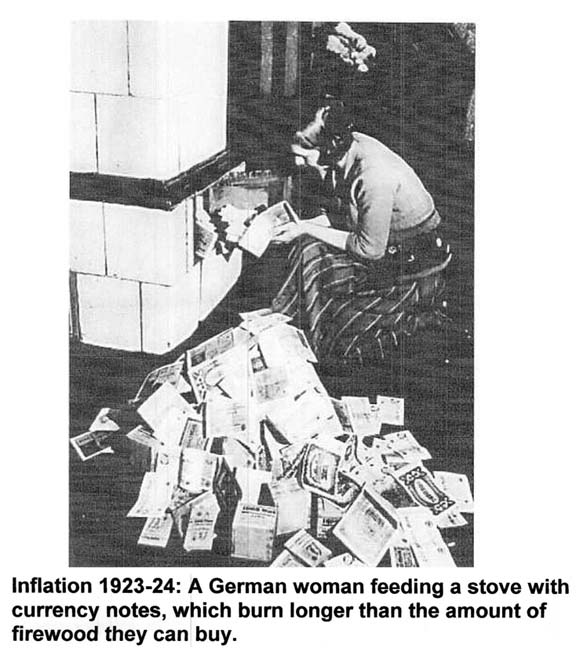
In the US credit is not being extended for a different reason. Banks are not afraid of being paid back with cheaper dollar, banks are afraid they will not be paid back at all. Cash is being hoarded by banks and consumers alike. This is the opposite of what happened in the Weimar Republic and what is happening now in Zimbabwe.
Global Stimulus Kicker
There is yet another kicker to this model. And that kicker is the Eurozone, the UK, Japan, and essentially every county on the planet is all attempting some sort of stimulus plan or other. This is bound to cause a major distortion at some point, as no country has anything remotely close to an exit strategy for this. What kind of distortion and when cannot be certain because we are indeed in uncharted territory, worldwide.
Political Will vs. Consumer Psychology
What happens next depends somewhat on the political will of the central banks and politicians. However, it depends more on the psychology of the borrowers. If consumers and businesses refuse to spend and instead pay back debts (or default on them along with rising unemployment), the picture simply is not inflationary, at least to any significant decree.
The credit bubble that just popped exceeded that preceding the great depression, not just in the US but worldwide. Thus, it is unrealistic to expect the deflationary bust to be anything other than the biggest bust in history. Those looking for hyperinflation or even strong inflation in light of the above, are simply looking at the wrong model.
At some point the market value of credit will start expanding again, but that is likely further down the road, and weaker in scope than most think.
Mike "Mish" Shedlock
http://globaleconomicanalysis.blogspot.com
http://globaleconomicanalysis.blogsp...cal-model.html

I feel the need...
Joined: May 2004
Posts: 14,957
Likes: 515
From: Motown
The credit bubble that just popped exceeded that preceding the great depression, not just in the US but worldwide. Thus, it is unrealistic to expect the deflationary bust to be anything other than the biggest bust in history. Those looking for hyperinflation or even strong inflation in light of the above, are simply looking at the wrong model.
At some point the market value of credit will start expanding again, but that is likely further down the road, and weaker in scope than most think.
At some point the market value of credit will start expanding again, but that is likely further down the road, and weaker in scope than most think.
Its a good argument. But I think the missing link is that there is no precedent for the world's biggest debtor hiding significant liabilities off balance sheet. Like I said, when we get to the other side of this abyss, who knows what the value of a paper dollar will be.

I feel the need...
Joined: May 2004
Posts: 14,957
Likes: 515
From: Motown
Fed to Buy $300 Billion of Longer-Term Treasuries
No comment from the peanut gallery from the Fed Watchers here? 
Pretty bold action today by Uncle Ben, this is a game changer and if this is round one of quantitative easing -- better stock up on those wheelbarrows!
$300 billion in 2-10yr treasury's
$750 billion in Agency Mortgage Backed Securities (in addition to the $500 billion already announced)
$300 billion in Agency Debt
Holy Schnickey!!!
http://www.bloomberg.com/apps/news?p...N64&refer=home
Pretty bold action today by Uncle Ben, this is a game changer and if this is round one of quantitative easing -- better stock up on those wheelbarrows!
$300 billion in 2-10yr treasury's
$750 billion in Agency Mortgage Backed Securities (in addition to the $500 billion already announced)
$300 billion in Agency Debt
Holy Schnickey!!!
http://www.bloomberg.com/apps/news?p...N64&refer=home


Instructor
Joined: Oct 2006
Posts: 183
Likes: 2
Thread Starter
werd
Joined: Feb 2002
Posts: 15,079
Likes: 16
Dollar Rally Crumbles as Fed Ramps Up Printing Press
March 19 (Bloomberg) -- The rally that pushed the dollar to the highest levels since 2006 is in danger of crumbling as the Federal Reserve starts buying Treasuries and ramps up its purchases of mortgage debt, adding to a flood of greenbacks.
“The implications of today’s Fed decision are unambiguous,” currency strategists at Citigroup Inc. wrote in a research report within a half hour of the Fed’s decision yesterday. The dollar “should weaken,” they said.
Fed policy makers said yesterday they plan to buy as much as $300 billion of U.S. government bonds and step up purchases of mortgage bonds, expanding the central bank’s balance sheet by as much as $1.15 trillion. The extra supply of dollars threatens to overwhelm investors just as the budget deficit swells.
The trade-weighted Dollar Index, which tracks the currency’s performance against the euro, yen, pound, Canadian dollar, Swiss franc and Swedish krona, tumbled 2.7 percent to 84.595, its biggest one-day drop since 1971. That pushed its decline to 5.6 percent since reaching 89.62 on March 4, the highest in almost four years.
It fell yesterday by the most in nine years versus the euro, to $1.3474, and traded at $1.3631 as of 12:01 p.m. in London. The dollar dropped today against Japan’s currency to a three-week low of 94.72 yen.
“Sell the dollar!” said Scott Ainsbury, a portfolio manager who helps manage about $12 billion in currencies at New York-based hedge fund FX Concepts Inc. “This is huge, huge. It’s equivalent to the Plaza accord. This is the last thing they have in the closet, and they used it a bit early.”
Rally Reversal
In 1985, the U.S., U.K., France, Japan and West Germany agreed at New York’s Plaza Hotel to coordinate the devaluation of the dollar against the yen and the deutsche mark.
The Dollar Index started to slide in 2005 on concern about the widening current-account deficit and reached a record low in the first quarter of 2008 as credit market losses mounted following the crash of the subprime mortgage market.
It then rallied in the second half of last year as the global recession spurred demand for haven assets such as Treasury bills. Rates on bills fell below zero percent in December. UBS AG currency strategist Benedikt Germanier in Stamford, Connecticut, said he is sticking with his forecast for the dollar to trade at $1.30 per euro over the next month.
‘Pretty Big’
Yields on 10-year Treasuries declined the most since 1962 after the Fed said it would concentrate purchases in notes due from two to 10 years. The central bank is expanding its quantitative easing policy, which already includes agency and mortgage debt, to more than $1.85 trillion in securities.
“We’ve been selling dollars and we’re now adding to that short,” said Jim McCormick, Citigroup Inc.’s London-based global head of currencies. “The Fed program announced last night is pretty big both in terms of magnitude and breadth.”
McCormick said the dollar may fall to $1.40 against the euro.
The purchases will bolster concern that inflation will accelerate as borrowing costs fall, said Jessica Hoversen, a foreign exchange analyst with MF Global Ltd. in Chicago.
‘Dollar is Done’
“The Fed is basically financing our deficit by buying the debt issued by the Treasury,” she said. “If the Obama administration pushes through another stimulus package, the dollar is done.”
President Barack Obama is seeking Congressional approval for a $3.55 trillion budget for the year starting in October that would increase spending by 32 percent to kick start the economy. Goldman Sachs Group Inc. estimates the U.S. will almost triple debt sales this fiscal year ending Sept. 30 to a record $2.5 trillion.
The euro will probably rise to $1.3590 in two weeks provided it holds above $1.3330 through March 20, Hoversen predicted. It may rally above $1.39 “sooner than we think,” Citigroup analysts Tom Fitzpatrick in New York and Shyam Devani in London wrote in a research note yesterday.
Trading patterns also suggest the dollar is poised to weaken. Europe’s common currency took 26 days to break through $1.3117 on Dec. 11, before appreciating to the 200-day moving average above $1.47, the Citigroup analysts wrote. Yesterday’s break occurred 27 days after the euro established a resistance level on Feb. 9, suggesting it may “explode” higher, they wrote.
The euro, the Norwegian krone and the Australian dollar will outperform as those nations’ central banks hold out longer against the temptation to print money, said Dale Thomas, head of currencies at Insight Investment Management, which oversees about $121 billion in assets.
‘Timing Difference’
“All the major central banks may end up in the same position,” London-based Thomas said. “The way we look to play it is to see which goes the first and which one lags, and try to explore the timing difference between the two.”
Central banks are grappling with how to steer their economies when interest rates are already close to zero.
The Bank of England is buying government bonds and corporate debt to unlock trading in frozen credit markets and stimulate the economy. The Bank of Japan is snapping up government notes and making subordinated loans to banks, and the Swiss National Bank is selling francs to prevent gains against the euro.
Fed policymakers have committed to buy or lend against everything from corporate debt, mortgages and consumer loans to government bonds as they try to end the seizure in credit markets.
The extra yield relative to benchmark interest rates that investors demand to own debt backed by consumer loans has soared amid concern that defaults will climb.
Bond Spreads Wide
Spreads for top-rated bonds backed by auto loans are trading at about 300 basis points more than the one-month London interbank offered rate compared with 65 basis points in January 2008, JPMorgan Chase & Co. data show. One-month Libor, a borrowing benchmark, is currently 0.55 percent. A basis point is 0.01 percentage point.
“We cannot rule out that this will place additional pressure on other central banks to follow suit,” wrote David Woo, the global head of foreign-exchange strategy at Barclays Capital in London. “Should this turn out to be the case, deflationary concerns in the market may begin to give way to longer-term worries about monetary inflation.”
http://www.bloomberg.com/apps/news?p...YeY&refer=home
March 19 (Bloomberg) -- The rally that pushed the dollar to the highest levels since 2006 is in danger of crumbling as the Federal Reserve starts buying Treasuries and ramps up its purchases of mortgage debt, adding to a flood of greenbacks.
“The implications of today’s Fed decision are unambiguous,” currency strategists at Citigroup Inc. wrote in a research report within a half hour of the Fed’s decision yesterday. The dollar “should weaken,” they said.
Fed policy makers said yesterday they plan to buy as much as $300 billion of U.S. government bonds and step up purchases of mortgage bonds, expanding the central bank’s balance sheet by as much as $1.15 trillion. The extra supply of dollars threatens to overwhelm investors just as the budget deficit swells.
The trade-weighted Dollar Index, which tracks the currency’s performance against the euro, yen, pound, Canadian dollar, Swiss franc and Swedish krona, tumbled 2.7 percent to 84.595, its biggest one-day drop since 1971. That pushed its decline to 5.6 percent since reaching 89.62 on March 4, the highest in almost four years.
It fell yesterday by the most in nine years versus the euro, to $1.3474, and traded at $1.3631 as of 12:01 p.m. in London. The dollar dropped today against Japan’s currency to a three-week low of 94.72 yen.
“Sell the dollar!” said Scott Ainsbury, a portfolio manager who helps manage about $12 billion in currencies at New York-based hedge fund FX Concepts Inc. “This is huge, huge. It’s equivalent to the Plaza accord. This is the last thing they have in the closet, and they used it a bit early.”
Rally Reversal
In 1985, the U.S., U.K., France, Japan and West Germany agreed at New York’s Plaza Hotel to coordinate the devaluation of the dollar against the yen and the deutsche mark.
The Dollar Index started to slide in 2005 on concern about the widening current-account deficit and reached a record low in the first quarter of 2008 as credit market losses mounted following the crash of the subprime mortgage market.
It then rallied in the second half of last year as the global recession spurred demand for haven assets such as Treasury bills. Rates on bills fell below zero percent in December. UBS AG currency strategist Benedikt Germanier in Stamford, Connecticut, said he is sticking with his forecast for the dollar to trade at $1.30 per euro over the next month.
‘Pretty Big’
Yields on 10-year Treasuries declined the most since 1962 after the Fed said it would concentrate purchases in notes due from two to 10 years. The central bank is expanding its quantitative easing policy, which already includes agency and mortgage debt, to more than $1.85 trillion in securities.
“We’ve been selling dollars and we’re now adding to that short,” said Jim McCormick, Citigroup Inc.’s London-based global head of currencies. “The Fed program announced last night is pretty big both in terms of magnitude and breadth.”
McCormick said the dollar may fall to $1.40 against the euro.
The purchases will bolster concern that inflation will accelerate as borrowing costs fall, said Jessica Hoversen, a foreign exchange analyst with MF Global Ltd. in Chicago.
‘Dollar is Done’
“The Fed is basically financing our deficit by buying the debt issued by the Treasury,” she said. “If the Obama administration pushes through another stimulus package, the dollar is done.”
President Barack Obama is seeking Congressional approval for a $3.55 trillion budget for the year starting in October that would increase spending by 32 percent to kick start the economy. Goldman Sachs Group Inc. estimates the U.S. will almost triple debt sales this fiscal year ending Sept. 30 to a record $2.5 trillion.
The euro will probably rise to $1.3590 in two weeks provided it holds above $1.3330 through March 20, Hoversen predicted. It may rally above $1.39 “sooner than we think,” Citigroup analysts Tom Fitzpatrick in New York and Shyam Devani in London wrote in a research note yesterday.
Trading patterns also suggest the dollar is poised to weaken. Europe’s common currency took 26 days to break through $1.3117 on Dec. 11, before appreciating to the 200-day moving average above $1.47, the Citigroup analysts wrote. Yesterday’s break occurred 27 days after the euro established a resistance level on Feb. 9, suggesting it may “explode” higher, they wrote.
The euro, the Norwegian krone and the Australian dollar will outperform as those nations’ central banks hold out longer against the temptation to print money, said Dale Thomas, head of currencies at Insight Investment Management, which oversees about $121 billion in assets.
‘Timing Difference’
“All the major central banks may end up in the same position,” London-based Thomas said. “The way we look to play it is to see which goes the first and which one lags, and try to explore the timing difference between the two.”
Central banks are grappling with how to steer their economies when interest rates are already close to zero.
The Bank of England is buying government bonds and corporate debt to unlock trading in frozen credit markets and stimulate the economy. The Bank of Japan is snapping up government notes and making subordinated loans to banks, and the Swiss National Bank is selling francs to prevent gains against the euro.
Fed policymakers have committed to buy or lend against everything from corporate debt, mortgages and consumer loans to government bonds as they try to end the seizure in credit markets.
The extra yield relative to benchmark interest rates that investors demand to own debt backed by consumer loans has soared amid concern that defaults will climb.
Bond Spreads Wide
Spreads for top-rated bonds backed by auto loans are trading at about 300 basis points more than the one-month London interbank offered rate compared with 65 basis points in January 2008, JPMorgan Chase & Co. data show. One-month Libor, a borrowing benchmark, is currently 0.55 percent. A basis point is 0.01 percentage point.
“We cannot rule out that this will place additional pressure on other central banks to follow suit,” wrote David Woo, the global head of foreign-exchange strategy at Barclays Capital in London. “Should this turn out to be the case, deflationary concerns in the market may begin to give way to longer-term worries about monetary inflation.”
http://www.bloomberg.com/apps/news?p...YeY&refer=home
Trending Topics

Moderator Alumnus
Joined: Jan 2001
Posts: 37,312
Likes: 337
From: SoCal
No comment from the peanut gallery from the Fed Watchers here?
Pretty bold action today by Uncle Ben, this is a game changer and if this is round one of quantitative easing -- better stock up on those wheelbarrows!
$300 billion in 2-10yr treasury's
$750 billion in Agency Mortgage Backed Securities (in addition to the $500 billion already announced)
$300 billion in Agency Debt
Holy Schnickey!!!
http://www.bloomberg.com/apps/news?p...N64&refer=home
Pretty bold action today by Uncle Ben, this is a game changer and if this is round one of quantitative easing -- better stock up on those wheelbarrows!
$300 billion in 2-10yr treasury's
$750 billion in Agency Mortgage Backed Securities (in addition to the $500 billion already announced)
$300 billion in Agency Debt
Holy Schnickey!!!
http://www.bloomberg.com/apps/news?p...N64&refer=home
What do you think? Should that have been done?

The sizzle in the Steak
Joined: Nov 2001
Posts: 71,436
Likes: 1,877
From: Southern California
 We have plenty of money...we can fix it....pay no heed to the naysayers!
Thread Starter
werd
Joined: Feb 2002
Posts: 15,079
Likes: 16
NO!
http://www.reuters.com/article/usDol...93633020090319
MOSCOW, March 19 (Reuters) - China and other emerging nations back Russia's call for a discussion on how to replace the dollar as the world's primary reserve currency, a senior Russian government source said on Thursday. Russia has proposed the creation of a new reserve currency, to be issued by international financial institutions, among other measures in the text of its proposals to the April G20 summit published last Monday.
Calls for a rethink of the dollar's status as world's sole benchmark currency come amid concerns about its long-term value as the U.S. Federal Reserve moved to pump more than a trillion dollars of new cash into the ailing economy late Wednesday.
Russia met representatives of China, India and Brazil ahead of the G20 finance ministers meeting last week, as the big emerging powers seek to up their influence on decision-making globally. Their first ever joint communique did not mention a new currency but the source said the issue was discussed.
Calls for a rethink of the dollar's status as world's sole benchmark currency come amid concerns about its long-term value as the U.S. Federal Reserve moved to pump more than a trillion dollars of new cash into the ailing economy late Wednesday.
Russia met representatives of China, India and Brazil ahead of the G20 finance ministers meeting last week, as the big emerging powers seek to up their influence on decision-making globally. Their first ever joint communique did not mention a new currency but the source said the issue was discussed.

So I was sitting at a bar this afternoon watching the Maryland/Cal game and the guy I was sitting next to was talking about this and attempting to explain it to me.
Basically, the way I understand it, the Fed is trying to introduce inflation to create yet another bubble to get us out of the recession and avoid deflation across the board (not just in the housing market). The problem is, we won't know if it works or if it fails until it is too late to do anything about it. Sounds pretty scary. And all the while yesterday everyone was bitching about a few million in bonuses at AIG.
Basically, the way I understand it, the Fed is trying to introduce inflation to create yet another bubble to get us out of the recession and avoid deflation across the board (not just in the housing market). The problem is, we won't know if it works or if it fails until it is too late to do anything about it. Sounds pretty scary. And all the while yesterday everyone was bitching about a few million in bonuses at AIG.

Safety Car


Joined: Feb 2004
Posts: 4,389
Likes: 490
From: Houston, Texas
Not quite trying to create inflation. It's called "quantitative easing." The fed is trying to create e-money by literally boosting the money supply and encouraging banks to lend again.
This is because the fed has already dropped interest rates to near zero. The fed is trying to jumpstart lending and this is only measure it can take.
The problem is not with the money supply. The banking sector needs reassurance and help cleaning up their assets. But when all you have is a hammer, everything looks like a nail...
And yes, this could lead to huge inflation and it could happen very rapidly. This is uncharted waters we are going here.
This is because the fed has already dropped interest rates to near zero. The fed is trying to jumpstart lending and this is only measure it can take.
The problem is not with the money supply. The banking sector needs reassurance and help cleaning up their assets. But when all you have is a hammer, everything looks like a nail...
And yes, this could lead to huge inflation and it could happen very rapidly. This is uncharted waters we are going here.

Iro Ridg .308
Joined: Jan 2005
Posts: 1,241
Likes: 9
From: CA, IL, IN
https://acurazine.com/forums/showpos...5&postcount=14
I feel the need...
Joined: May 2004
Posts: 14,957
Likes: 515
From: Motown
Clearly the powers that be think so. I understand the whole systemic risk issue, yada yada. But in my humble opinion, the answer is quite simply allowing time to heal wounds and allow consumers to repair their tattered balance sheets and relearn how to save and invest.
Clearly banks have plenty of illiquid assets, but that doesn't mean all of them are bad or that all borrowers will default, bubbamarktl notwithstanding. Helicopter Ben wants to reflate the system to prevent deflation from gaining momentum, I understand that risk too. But again, the assets must clear to their real price -- we cannot artificially support asset prices.
Clearly banks have plenty of illiquid assets, but that doesn't mean all of them are bad or that all borrowers will default, bubbamarktl notwithstanding. Helicopter Ben wants to reflate the system to prevent deflation from gaining momentum, I understand that risk too. But again, the assets must clear to their real price -- we cannot artificially support asset prices.
I feel the need...
Joined: May 2004
Posts: 14,957
Likes: 515
From: Motown
Federal Reserve Slaps Paper Over the Cracks
The problem with desperate measures: They can end up stoking fear, not confidence.
http://online.wsj.com/article/SB1237...oo_hs&ru=yahoo
Obviously a positive reaction to today's toxic asset purchase plan, let's see if the rally holds in the days ahead... I still think the Obamanomic Stagflation trade is on.
http://online.wsj.com/article/SB1237...oo_hs&ru=yahoo
Obviously a positive reaction to today's toxic asset purchase plan, let's see if the rally holds in the days ahead... I still think the Obamanomic Stagflation trade is on.
I feel the need...
Joined: May 2004
Posts: 14,957
Likes: 515
From: Motown
Fed to Start Purchasing Treasuries to Unfreeze Credit
The Federal Reserve starts purchasing long-term Treasuries today, aiming to bring down borrowing costs by employing tools last used in the 1960s.
The first operation in the $300 billion effort is targeted on notes maturing from February 2016 to February 2019, the New York Fed Bank said in a statement yesterday. In the coming eight days, the central bank plans to buy debt maturing between March 2011 and February 2039, according to the tentative schedule.
The Fed joins central banks in the U.K. and Japan in extraordinary purchases of government debt, broadening efforts to unfreeze credit and end the recession after cutting the benchmark interest rate close to zero. The Fed’s purchases may ultimately be overwhelmed by new government borrowing to finance a budget deficit projected at $1.5 trillion this year.
“Over the short-term, the Fed purchases of Treasuries will lower rates, but the need to issue over $2 trillion in securities over the next 18 months will make this less than effective,” said Mark MacQueen, who helps oversee $7 billion as co-founder of Sage Advisory Services Ltd. in Austin, Texas.....
The first operation in the $300 billion effort is targeted on notes maturing from February 2016 to February 2019, the New York Fed Bank said in a statement yesterday. In the coming eight days, the central bank plans to buy debt maturing between March 2011 and February 2039, according to the tentative schedule.
The Fed joins central banks in the U.K. and Japan in extraordinary purchases of government debt, broadening efforts to unfreeze credit and end the recession after cutting the benchmark interest rate close to zero. The Fed’s purchases may ultimately be overwhelmed by new government borrowing to finance a budget deficit projected at $1.5 trillion this year.
“Over the short-term, the Fed purchases of Treasuries will lower rates, but the need to issue over $2 trillion in securities over the next 18 months will make this less than effective,” said Mark MacQueen, who helps oversee $7 billion as co-founder of Sage Advisory Services Ltd. in Austin, Texas.....
I feel the need...
Joined: May 2004
Posts: 14,957
Likes: 515
From: Motown
A Night with the Bears...

I feel the need...
Joined: May 2004
Posts: 14,957
Likes: 515
From: Motown
Inflation Doves Put Faith in Output-Gap Religion
It always ends up at the same place. Any discussion of inflation -- what it is, what causes it -- comes back to that never-ending debate between money and the output gap.
First, some background. The late Nobel laureate Milton Friedman is remembered for many things, among them his oft- quoted observation that inflation is “always and everywhere a monetary phenomenon.”
If the central bank creates more money than the public wants to hold, the public will spend it, bidding up the prices of goods and services. When too much money chases too few goods and services, the result is a rise in the price level, or inflation.
It’s easy to lose sight of Friedman’s axiom nowadays. Central bankers often talk about higher oil prices and rising wages as if these price increases cause inflation rather than reflect it.
The other theory of inflation, popular among Keynesian economists and Phillips Curve advocates, is something called the output gap, or the difference between the economy’s actual and potential output.....
First, some background. The late Nobel laureate Milton Friedman is remembered for many things, among them his oft- quoted observation that inflation is “always and everywhere a monetary phenomenon.”
If the central bank creates more money than the public wants to hold, the public will spend it, bidding up the prices of goods and services. When too much money chases too few goods and services, the result is a rise in the price level, or inflation.
It’s easy to lose sight of Friedman’s axiom nowadays. Central bankers often talk about higher oil prices and rising wages as if these price increases cause inflation rather than reflect it.
The other theory of inflation, popular among Keynesian economists and Phillips Curve advocates, is something called the output gap, or the difference between the economy’s actual and potential output.....
I feel the need...
Joined: May 2004
Posts: 14,957
Likes: 515
From: Motown
Fed’s Fisher Says Averting Deflation Should Be a Leading Focus
Dallas Federal Reserve President Richard Fisher said concern over falling prices, not inflation, should be the focus for policy makers over the next few years.
“Presently, the risk is deflationary job destruction,” Fisher said today in remarks prepared for a speech in Beijing. “For as far ahead as I trust my forecasting ability -- that is to say, the next couple of years -- the problem with regard to maintaining price stability most certainly is not inflation.”
Fisher dissented five times against easing of monetary policy in 2008 because of concern over higher prices, giving him the reputation as the most “hawkish” U.S. policy maker, he said. Consumer prices fell 0.4 percent in March from a year before, marking their first decline over a 12-month period since 1955, the Labor Department said.
Fisher’s concern over falling prices parallels his view that the economy’s performance remains “grim.” He repeated his forecast that the U.S. unemployment rate, now 8.5 percent, may exceed 10 percent by year’s end.....
“Presently, the risk is deflationary job destruction,” Fisher said today in remarks prepared for a speech in Beijing. “For as far ahead as I trust my forecasting ability -- that is to say, the next couple of years -- the problem with regard to maintaining price stability most certainly is not inflation.”
Fisher dissented five times against easing of monetary policy in 2008 because of concern over higher prices, giving him the reputation as the most “hawkish” U.S. policy maker, he said. Consumer prices fell 0.4 percent in March from a year before, marking their first decline over a 12-month period since 1955, the Labor Department said.
Fisher’s concern over falling prices parallels his view that the economy’s performance remains “grim.” He repeated his forecast that the U.S. unemployment rate, now 8.5 percent, may exceed 10 percent by year’s end.....
I feel the need...
Joined: May 2004
Posts: 14,957
Likes: 515
From: Motown
The Aftermath of Financial Crises
* Paper prepared for presentation at the American Economic Association meetings in San Francisco, Saturday, January 3, 2009 at 10:15 am. Session title: “International Aspects of Financial Market Imperfections.”
http://www.economics.harvard.edu/fil..._Aftermath.pdf
Cliffs: Even recessions sparked by financial crises do eventually end, albeit almost invariably accompanied by massive increases in government debt.
http://www.economics.harvard.edu/fil..._Aftermath.pdf
Cliffs: Even recessions sparked by financial crises do eventually end, albeit almost invariably accompanied by massive increases in government debt.
I feel the need...
Joined: May 2004
Posts: 14,957
Likes: 515
From: Motown
36 South Starts Hyperinflation Bet After Black Swan
36 South Investment Managers Ltd., whose Black Swan Fund gained 234 percent in 2008, is raising money for a new hedge fund, betting that government efforts to pump money into economies could result in hyperinflation.
The Excelsior Fund targets returns that will be five times the average annual rate of inflation of the Group of Five economies -- France, Germany, Japan, the U.K. and the U.S. -- should the rate exceed 5 percent, Jerry Haworth, co-founder of the firm, said yesterday. Raising $100 million for the fund would be a “good” amount, he said.
“There is a sharply increased risk of greater than 5 percent inflation starting from now,” Haworth said in a telephone interview from London. “We are in the lag period between when the seeds of inflation are sown and when their off- spring, that is higher prices, are evident for all to see.”
U.S. President Barack Obama is selling record amounts of debt to try to end the steepest U.S. recession in 50 years, while Japanese Prime Minister Taro Aso has unveiled three stimulus packages worth 25 trillion yen ($261 billion) since taking office in September. Governments around the world selling record amounts of debt may devalue currencies against assets and spark inflation.....
The Excelsior Fund targets returns that will be five times the average annual rate of inflation of the Group of Five economies -- France, Germany, Japan, the U.K. and the U.S. -- should the rate exceed 5 percent, Jerry Haworth, co-founder of the firm, said yesterday. Raising $100 million for the fund would be a “good” amount, he said.
“There is a sharply increased risk of greater than 5 percent inflation starting from now,” Haworth said in a telephone interview from London. “We are in the lag period between when the seeds of inflation are sown and when their off- spring, that is higher prices, are evident for all to see.”
U.S. President Barack Obama is selling record amounts of debt to try to end the steepest U.S. recession in 50 years, while Japanese Prime Minister Taro Aso has unveiled three stimulus packages worth 25 trillion yen ($261 billion) since taking office in September. Governments around the world selling record amounts of debt may devalue currencies against assets and spark inflation.....

Thread
Thread Starter
Forum
Replies
Last Post
mlody
5G TLX (2015-2020)
85
Dec 4, 2019 02:11 PM
CLOSED: 3G Acura TL Model Car(Blue)
bluetl04
Non-Automotive & Motorcycle Sales
12
Aug 16, 2016 02:49 PM
