When you click on links to various merchants on this site and make a purchase, this can result in this site earning a commission. Affiliate programs and affiliations include, but are not limited to, the eBay Partner Network.
Pretty decent short article about the history of US Minivans.
It is missing the GM FWD minivan project that used IIRC the FWD X-platform (Citation). A former colleague was a mechaincal engineer at GM and worked on that. They had a handful of running prototypes that drove around GM proving grounds and occasionally went on public roads. GM could have beaten Chrysler to market by a few years had they gone ahead with it.
Nice read.
I also take note on Iacocca's version of the minivan's origin is disputed.
Seen too many of those 60's VW Hippie Minivan's in Hippie California.
Marketing a higher upscale family version he did but those 60's vans saw a lot of chics on beds in the rear and bummper stickers of "if this van is rocking ... dont try knocking"
The first photo of the original Dodge/Plymouth minivan is of one with faded paint, lots of rust on the hood & roof, etc. Couldn't the authors have used a photo of a minivan in nicer shape?
Couldn't read the entire article since I'm at work.. but my dad had both Honda Odyssey and Toyota Sienna not long ago. I thought these minivans were so very comfortable and just so roomy to haul anyone and anything. Didn't like the way Sienna drove but loved the feeling of Odyssey. It was just like driving an Accord.
The 1G Previa was also mid-engined, not common for a minivan
Okay, so supercar is a stretch. A big stretch. But if you want a mid-engined, supercharged, rear-wheel-drive ride with 50/50 weight distribution that seats eight people, you have to go Previa. The stock egg-shaped van could be had with a 2.4-liter supercharged inline four good for 160 horsepower stock. Oddly, the supercharger is engaged on-demand by an electromagnetic clutch system based on input from the ECU. Kind of like Mad Max’s supercharger switch. The supercharged versions were saddled with a slushbox, but the early models were available with a five-speed manual transmission. A gearhead could, with proper motivation, mate the manual with the SC engine to make, well, a kinda-fun minivan. A Stanceworks.com forum member who goes by the handle “shawnthemonster” decided to take a different tack with his Previa. He slammed the thing within an inch of its life, gave it independent rear suspension to get adjustable camber in the rear, and slathered the whole thing in red and black paint. So, okay, it’s not a high-performance machine and it probably rides like Fred Flintstone’s car, but it looks great.
Yep. I seriously hauled SO MUCH STUFF in a Odyssey. It's so awesome. You can put a little mattress in the back too.
+1
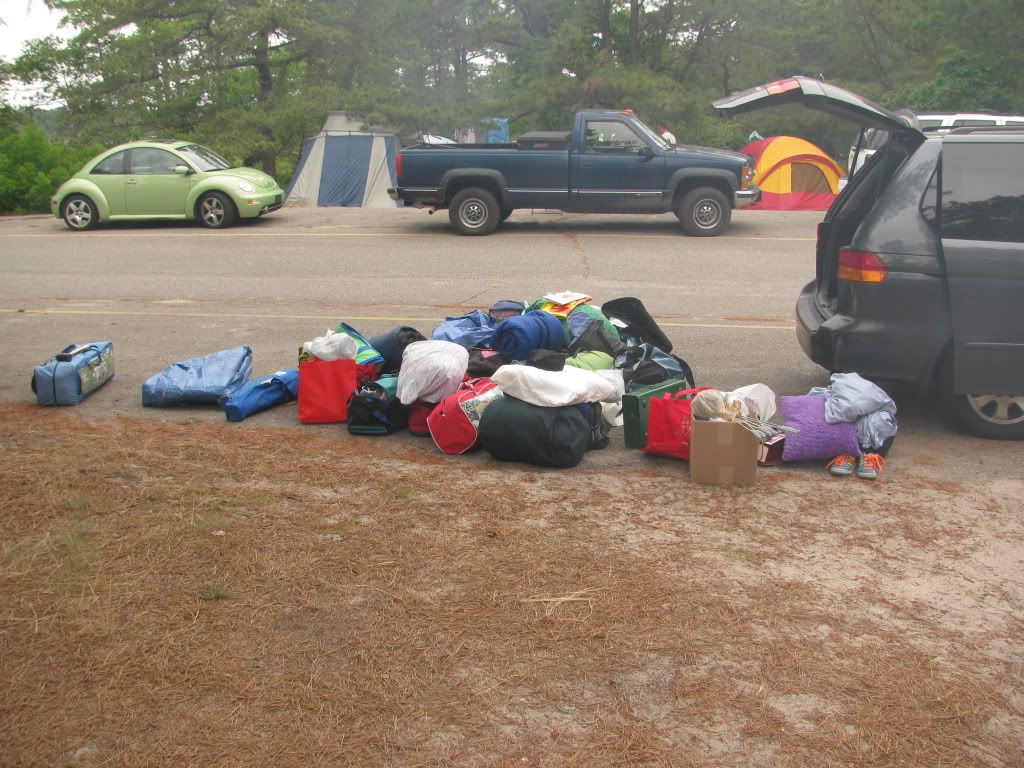
All of this camping stuff fit into the back of a 2G Ody with all three rows of seats for passengers. That little area where the 3rd seat fold into adds a decent amount of space.
My friend worked on a Previa though... freaking hated it. I took a glance at the underside.... belt drive setup in the front of the car under the hood, connected to the mid-mounted engine via a shaft, somewhat like the Comptech superchargers on transverse Honda V6s.
I used to own a 96 Villager and later a 00 Quest. Though I had the Murano and Maxima at the time, the Quest was our primary vehicle as the Murano and Max couldn't come anywhere near its utility.
When the Quest was totaled a couple of years ago the MDX had to takeover family minivan duty. Even though the MDX has seating for seven, its back "row" is far less comfortable than that of the Quest.
If I had to go back to a minivan (which is not in our plans), I'd get a well cared for used 3G Odyssey EX-L w/Navi. It really does drive like an Accord.
^ I wanted to get a 2G Ody, but my wife wanted a 1G Pilot and since it was her vehicle we got the Pilot. We've had 8 in our Pilot on occasions and the last row is pretty cramped. Quite a few neighbors and friends have 2G and 3G Ody, one just traded their 3G Ody for a 4G. It's impossible to beat a minivan for versatility.
Back in the 80's when Porsche had their Rothman's rally team racing 959's, they had a few chase support VW vans. The Porsche engineers 'fitted' them with 911 flat six's from their racing department and improved the suspension and brakes also from other Porsche bits and pieces they had. Road and Track had a small article on them. Handling wasn't the best but both they could really move.
That Previa looks nice.
Originally Posted by ThermonMermon
Okay, so supercar is a stretch. A big stretch. But if you want a mid-engined, supercharged, rear-wheel-drive ride with 50/50 weight distribution that seats eight people, you have to go Previa. The stock egg-shaped van could be had with a 2.4-liter supercharged inline four good for 160 horsepower stock. Oddly, the supercharger is engaged on-demand by an electromagnetic clutch system based on input from the ECU. Kind of like Mad Max’s supercharger switch. The supercharged versions were saddled with a slushbox, but the early models were available with a five-speed manual transmission. A gearhead could, with proper motivation, mate the manual with the SC engine to make, well, a kinda-fun minivan. A Stanceworks.com forum member who goes by the handle “shawnthemonster” decided to take a different tack with his Previa. He slammed the thing within an inch of its life, gave it independent rear suspension to get adjustable camber in the rear, and slathered the whole thing in red and black paint. So, okay, it’s not a high-performance machine and it probably rides like Fred Flintstone’s car, but it looks great.
^ I wanted to get a 2G Ody, but my wife wanted a 1G Pilot and since it was her vehicle we got the Pilot. We've had 8 in our Pilot on occasions and the last row is pretty cramped. Quite a few neighbors and friends have 2G and 3G Ody, one just traded their 3G Ody for a 4G. It's impossible to beat a minivan for versatility.
This sounds familiar. I'm leaning towards wanting a minivan, but the wife wants no part of it. She prefers the crossovers instead. Right now the most likely candidates are the Mazda CX-9 and the Dodge Durango. What I like about the minivans, would most likely be an Odyssey or Sienna, is the amount and versatility of cargo space, better accessibility to third row, sliding doors, better ride, and slightly better mpg.
My wife just can't get over the negative stigma of minivans and also prefers the driving position of SUV's/Crossovers. She even borrowed her boss's fully loaded Sienna, and although she was impressed with it, didn't know if she wanted to own one. In the end, it'll be her vehicle, and her happiness outweighs the minivan's positive attributes. I just need to figure out how to show her she'd be more happy with a minivan.
That was virtually identiacal to my situation. About a decade ago my daughters were 6/9 and we needed something with more room than the 1G Legend.
My wife wanted a Durango initially and I wanted a 2G Ody. She could not she driving a minivan and hated the stigma. I just hated Chrysler products.
We considered the 1G MDX since it came out first but then the 1G Pilot was announced and we both liked the Pilot.
We had some friends with 2G Ody's and I loved the way it drove more like a big Accord than other minivans I had driven. Also alot of space and plenty of seating.
Our Pilot although not as big has been great, very versatile, low costs of ownership, very easy to drive, very maneuverable, great visibility,.... I could go on and on.
It was her vehicle so we settled on the Pilot and it's worked out great. Having seating for 8 is also nice as we use the 3rd row of seats about 1-2 times a month. We actually squeezed 8 people into it a few times, once on a 120 mile trip (all kids were in the back).
I can understand your situation, I wanted a minivan but also realized it was her vehicle so we compromised on the Pilot and that decision turned out to be good.
Originally Posted by jayhawk815
This sounds familiar. I'm leaning towards wanting a minivan, but the wife wants no part of it. She prefers the crossovers instead. Right now the most likely candidates are the Mazda CX-9 and the Dodge Durango. What I like about the minivans, would most likely be an Odyssey or Sienna, is the amount and versatility of cargo space, better accessibility to third row, sliding doors, better ride, and slightly better mpg.
My wife just can't get over the negative stigma of minivans and also prefers the driving position of SUV's/Crossovers. She even borrowed her boss's fully loaded Sienna, and although she was impressed with it, didn't know if she wanted to own one. In the end, it'll be her vehicle, and her happiness outweighs the minivan's positive attributes. I just need to figure out how to show her she'd be more happy with a minivan.
Back in the 80's when Porsche had their Rothman's rally team racing 959's, they had a few chase support VW vans. The Porsche engineers 'fitted' them with 911 flat six's from their racing department and improved the suspension and brakes also from other Porsche bits and pieces they had. Road and Track had a small article on them. Handling wasn't the best but both they could really move.
That Previa looks nice.
Couldn't find the actual van but here is a model.
This had a 300+HP flat six taken out of a racing 911 and beefed up brakes and suspension.
All of this camping stuff fit into the back of a 2G Ody with all three rows of seats for passengers. That little area where the 3rd seat fold into adds a decent amount of space.
I've done the exact same with my dad's 2D Ody. 7 passengers + all camping gear. We've hauled so much stuff in it in the past 12 years, it's ridiculous. Most reliable vehicle that we've EVER owned, plus it's fun to drive. I remember once my dad had gotten it up to 115 mph on a trip to Vegas. It still had more power and behaved like it was only going 60.
It's now time to find a suitable replacement and the only two vehicles my dad will even consider is a new Odyssey Touring Elite or a new Acura MDX.
he's going to be disappointed. the Odyssey for the past 2 gens have lost that athletic feel of the 2nd gen Odyssey. my sister had a 2nd gen, that thing hauled ass. 0-60 in 8 seconds is pretty good for a minivan back then. the newer ones don't have that same kind of pull.
The Atlantic by Ian Bogost / Sep 18, 2024 at 1:27 PM
The minivan dilemma: It is the least cool vehicle ever designed, yet the most useful. Offering the best value for the most function to a plurality of American drivers, a minivan can cart seven passengers or more in comfort if not style, haul more cargo than many larger trucks, and do so for a sticker price roughly a quarter cheaper than competing options. Even so, minivan sales have been falling steadily since their peak in 2000, when about 1.3 million were sold in the United States. As of last year, that figure is down by about 80 percent. Once sold in models from more than a dozen manufacturers, the minivan market now amounts to four, one each from Chrysler, Honda, Toyota, and Kia.
On account of the dilemma, a minivan is typically purchased under duress. If you live in a driving city, and especially if you have a family, a minivan conversation will eventually take place. Your older, cooler car—perhaps your Mini Cooper or your spouse’s Honda CR-V—will prove unfit for present purposes. Costco cargo, loads of mulch, sports equipment, and holiday loot all need a place to go. The same is true of car seats, which now are recommended for children as old as 7. And so, before too long: “Maybe we should get a minivan.”
This phrase is uttered with an air of resignation. The minivan was popular, but it was never cool, not even in its youth, during the 1980s. Now it’s middle-aged: The first of its type came out in ’83, which makes the minivan an elder Millennial, and it’s no more attuned than your average 41-year-old to recent trends. But why, exactly, has it earned so much derision through the years? And why was the minivan replaced, almost altogether, by the SUV?
The minivan arrived, way back when, as a savior. When Chrysler, under the former Ford chief Lee Iacocca’s direction, first conceived of the design in the late 1970s, Americans who wanted room to cart more kids and goods had only a couple of options. One was the land-yacht-style station wagon, perhaps in avocado green with faux-wood paneling. Lots of kids could pile onto its bench and jump seats, while the rear storage, accessible by hatch, allowed for easy loading. These cars were somewhat functional, but they didn’t seem that safe. The suburban family’s other choice was the full-size van—a big, boxy transport or utility vehicle. The gas for these was also pricey, and their aesthetic felt unsuited to domesticity. By cultural consensus, vans were made for plumbers, kidnappers, or ex–Special Forces domestic mercenaries.
Chrysler’s minivan would steer clear of those two dead ends, and carry American families onto the open roads toward, well, youth soccer and mall commerce. It really did bring innovation: ample seating organized in rows with easy access, the ability to stow those seats in favor of a large cargo bay, a set of sliding doors, and smaller features that had not been seen before, such as the modern cupholder. And it offered all that at an affordable price with decent fuel economy.
Pickup was quick. In the first year after introducing them, Chrysler sold 210,000 Dodge Caravans and Plymouth Voyagers, its initial two models. Overall minivan sales reached 700,000 by the end of the decade, as the station wagon all but disappeared. But the new design also generated stigma: As the child of the station wagon and the service van, the minivan quickly came to represent the family you love but must support, and also transport. In a nation where cars stood in for power and freedom, the minivan would mean the opposite. As a vehicle, it symbolized the burdens of domestic life.
That stigma only grew with time. In 1996, Automobile magazine called this backlash “somewhat understandable,” given that the members of my generation, who were at that point young adults, had “spent their childhoods strapped into the backseat of one.” Perhaps it was childhood itself that seemed uncool, rather than the car that facilitated it. In any case, minivans would soon be obsolesced by sport utility vehicles. The earliest SUVs were more imposing than they are today: hard-riding trucks with 4×4 capabilities, such as the Chevrolet Suburban and the Jeep Wagoneer. These were as big as or even bigger than the plumber-kidnapper vans of the 1970s, and they got terrible gas mileage, cost a lot of money, and were hard to get in or out of, especially if you were very young or even slightly old. Yet the minivan’s identity had grown toxic, and for suburban parents, the SUV played into the fantasy of being somewhere else, or doing something better.
The SUV’s promise was escape from the very sort of family life that the minivan had facilitated. In 2003, TheNew York Times’ John Tierney recounted how the new class of vehicles had taken over. “The minivan became so indelibly associated with suburbia that even soccer moms shunned it,” he explained. “Soon image-conscious parents were going to soccer games in vehicles designed to ford Yukon streams and invade Middle Eastern countries.” At the same time, the SUVs themselves were changing. The minivan had been built from parts and designs for a car, not a van. SUV manufacturers followed suit, until their vehicles were no longer burly trucks so much as carlike vehicles that rode higher off the ground and had a station-wagon-style cargo bay. Few even had more seats than a sedan. As the early minivans were to vans, so were these downsized SUVs to the 4x4s that came before them.
Functionally, the minivan is still the better option. It is cheaper to buy and operate, with greater cargo space and more seating and headroom. Still, these benefits are overshadowed by the minivan’s dreary semiotics. Manufacturers have tried to solve that problem. When my family reached the “Maybe we should get a minivan” milestone, I noticed that some models of the Chrysler Pacifica now offered, for a premium, blacked-out chrome grills and rims. But to buy a poseur “sport van,” or whatever I was meant to call this try-hard, cooler version of the uncool minivan, struck me as an even sadder choice.
Beyond such minor mods, the industry hasn’t really done that much to shake away the shame from the minivan’s design. I suspect that any fix would have to be applied at the level of its DNA. The minivan was the offspring of the wagon and the van. To be reborn, another pairing must occur—but with what? Little differentiation is left in the passenger-vehicle market. Nearly all cars have adopted the SUV format, a shoe-shaped body with four swinging doors and a hatch, and true 4x4s have been all but abandoned. Perhaps the minivan could be recrossed with the boxy utility van, which seems ready for its own revival. This year, Volkswagen will begin selling a new electric version of its microbus, one of the few direct precursors to the minivan that managed to retain an association with the counterculture despite taking on domestic functions.
However it evolves, the minivan will still be trammeled by its fundamental purpose. It is useful because it offers benefits for families, and it is uncool because family life is thought to be imprisoning. That logic cannot be overcome by mere design. In the end, the minivan dilemma has more to do with how Americans think than what we drive. Families, or at least vehicles expressly designed for them, turned out to be lamentable. We’d prefer to daydream about fording Yukon streams instead.

















 .
.