When you click on links to various merchants on this site and make a purchase, this can result in this site earning a commission. Affiliate programs and affiliations include, but are not limited to, the eBay Partner Network.
Lexus has dropped a teaser video glimpsing the brand's first fully electric vehicle to be sold in the U.S. Called the Lexus RZ, it features the angular styling we've come to expect from Toyota's luxury marque, but underneath the sheetmetal we're probably getting a foundation we've seen quite a bit of in recent weeks.
That's because the Lexus RZ is a third version of the battery-electric crossover co-developed by Toyota and Subaru, recently unveiled as the confusingly named Toyota bZ4X (it always requires a double check of the alphanumeric sequence) and the much better named Subaru Solterra.
All three are built on the e-TNGA platform that will underpin several EV models. However, the Lexus RZ signals a more significant departure from the bZ4X and Solterra, whose differences were quite limited. They looked almost indistinguishable, the only things setting them apart being a mild reshape of the front fasica and taillights, painted wheel arch cladding on the Toyota, and an option for a single-motor 2WD drivetrain on the bZ4X.
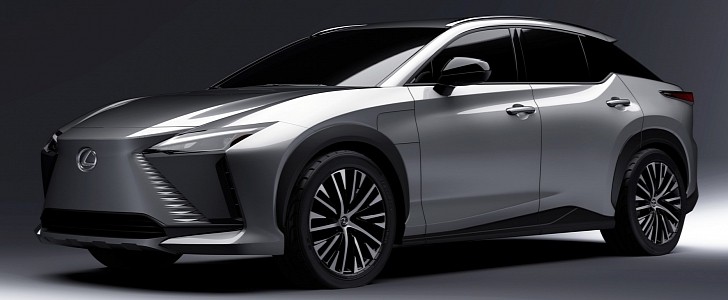
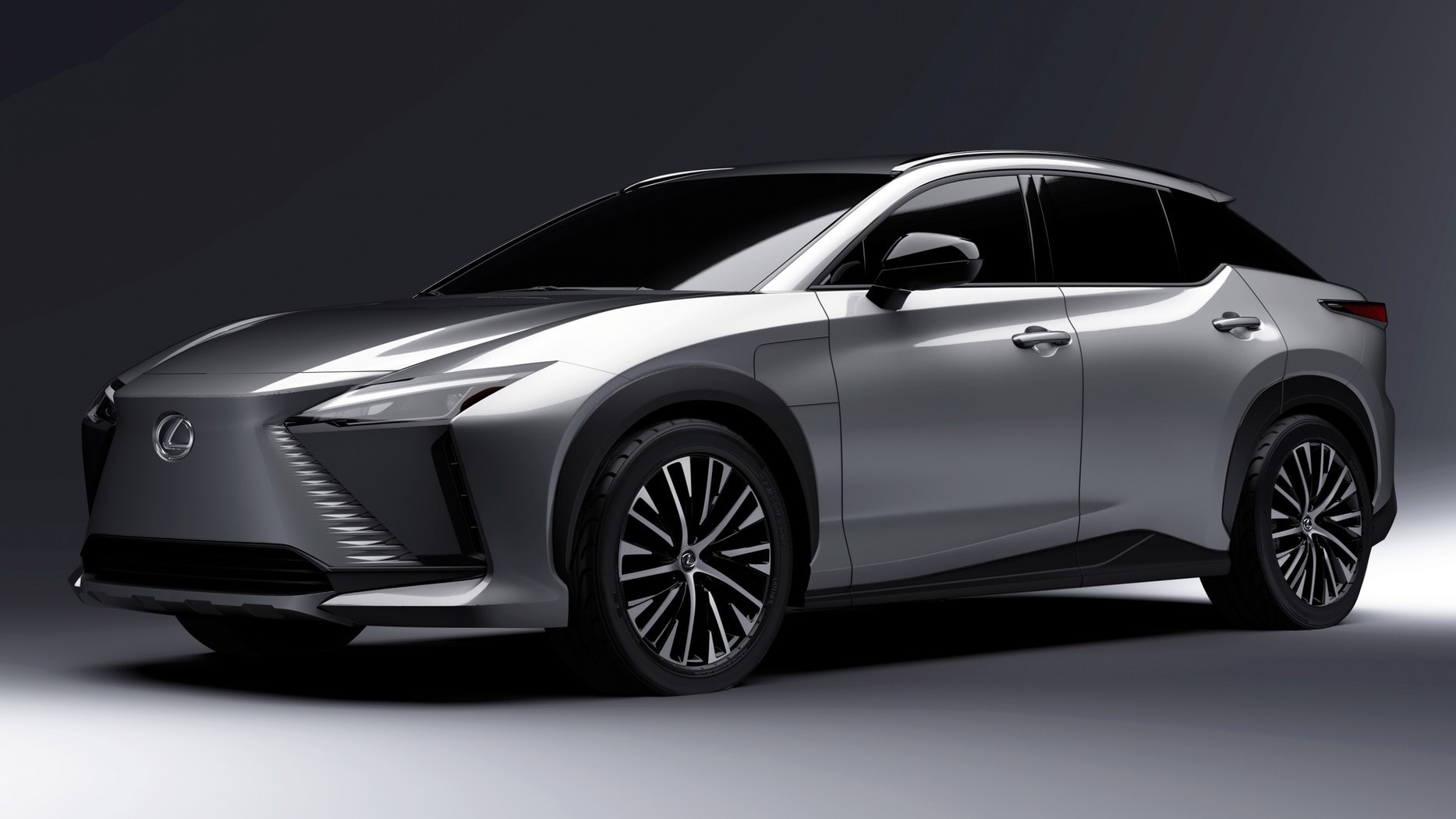
The Lexus, on the other hand, seems to wear completely new sheetmetal. Right away, the lack of gray cladding around the wheel wells is apparent. There still appears to be some, but much slimmer than that of the bZ4X and Solterra. A strong character line flows from the leading edge of the front wheel arch to the rear door, where it's picked by another upturned character line leading into a blacked out C-pillar.
Naturally, the front features a large Lexus spindle grille shape (there doesn't appear to be an actual open radiator intake, unnecessary for an EV) and unique headlights branded with "L" fishhook DRLs. The rear offers a much sleeker appearance as well, with slim taillights that don't droop downward into the bodywork. A solid light bar features the word "Lexus" printed across rather than the traditional L-in-a-circle logo.
No details or interior images were shown, but we'd guess that the cabin is quite a bit nicer than the decent but run-of-the-mill cockpit of the bZ4X and Solterra. Lexus has stated it will not offer the single-motor option. However, its Direct4 all-wheel-drive system is a departure from Subaru's, and the Lexus is said to be capable of 402 horsepower and 442 pound-feet of torque. Those figures completely blow the bZ4X and Solterra out of the water.
The RZ is scheduled for an official debut in the first half of 2022.
Badge engineering episodes have an interesting characteristic: they tend to happen more between different partnering companies than with multiple brands from the same automaker. In other words, no company would dare to sell the same car with a different badge. The most recent example of that is the RZ 450e, Lexus version for the Toyota bZ4X.
45 photos
Lexus released new images of its future electric car after talking about its 2021 global sales. It was used as an example of the company’s focus on electric vehicles. The plan is to have a full lineup of BEVs (battery electric vehicles) by 2030 so that all Lexus’s sales will be for electric cars in China, Europe, and the U.S. By 2035, the brand wants to be fully electric globally. Koji Sato – Lexus’ CEO – said that the RZ 450e would spearhead that process in spring 2022.
Just have a look at these new pictures of Lexus’s future EV and try to find anything that reminds you of the bZ4X. Perhaps the A-pillar, and we’re not even sure about that. The proportions resemble the Toyota EV, but that’s pretty much all that seems to connect them. Underneath the new sheet metal, everything must be quite the same.
Now have a look at the Subaru Solterra. You’ll struggle to tell it is a Subaru without looking at its badges and some other minor differences in plastic components. Dynamic behavior may be tuned to something we would expect a Subaru to present. However, that is a difference only people that get behind the wheel of both the Solterra and the bZ4X will be able to tell if they have this kind of nuanced and properly calibrated perception.
Expect the Lexus to present the same impressive battery pack warranty of 90% after ten years or 240,000 km (150,000 mi), whichever comes first. Offering a more extensive warranty just because the RZ 450e will be a premium car would not make sense, especially considering the 71.4-kWh battery pack will be pretty much the same.
Although Lexus did not release the RZ 450e’s technical specifications, they should be pretty similar to those of the bZ4X (or Solterra, whatever). The electric Toyota is 4.69 meters (184.7 inches) long, 1.86 m (73.2 in) wide, 1.65 m (65 in) tall (counting its antenna), and has a wheelbase of 2.86 m (112.6 in), with a trunk of 452 liters (16 cubic feet).
The main difference between them should relate to weight. Being a premium car, the RZ 450e should be heavier. In an electric vehicle, that’s a disadvantage, and the bZ4X did pretty well in that regard: it weighs 1,920 kilograms (4,233 pounds) for the FWD and 2,005 kg (4,420 lb) for the AWD, which makes it a surprisingly light electric SUV.
Lexus will reveal its production RZ electric SUV on April 20, the company announced Tuesday, steering well clear of April Fool's Day with a teaser package that would be right at home in Elon Musk's Twitter feed. And yes, there's a yoke. If it weren't for the fact that we already knew about the Lexus RZ, coupled with confirmation from Toyota that the bZ4X's yoke is the real deal, we'd be highly suspicious of this early-April announcement from a traditionally conservative manufacturer. Welcome to 2022, when none of that really seems to matter anymore.
We already suspected that the RZ was based on Toyota's bZ4X, so the indication of an available yoke is not that surprising, really. In the Toyota, it's paired to a variable-ratio, steer-by-wire system. Toyota says it also improves steering feel and ensures road and tire vibrations don't make their way to the driver. The latter seems obvious since there's no physical connection between the wheel and road, but whether that makes for an "improvement" in steering feel is not something with which we're inclined to automatically agree.
Lexus offered no further info apart from the reveal date and time (6 a.m. EDT April 20) and these new teaser photos. The psychedelic lighting job on the car seems a bit on-the-nose for something debuting on 4/20, but again, this isn't a Tesla, so clearly somebody just thought it would look cool. Fortunately, we have the bZ4X's spec sheet to go on. The 4,232-pound Toyota is powered by a single electric motor with 201 horsepower or a dual-motor setup with 214 horses (107 per motor). Clearly, getting all-wheel drive into the equation mattered more than performance, as Toyota says it'll still take 7.7 seconds for the bZ4X to hit 60.
Regardless of motor count, the bZ4X gets a 71.4-kilowatt-hour lithium-ion battery pack said to deliver about 310 miles of maximum driving range in the front-wheel-drive model and 285 miles in the all-wheel-drive version based on the Japanese testing cycle. It's not outrageous to think the RZ might get a more potent powertrain, but we'll just have to wait and see what Lexus has in store.
The Lexus RZ 450e isn't supposed to debut until April 20, but some screenshots from Japan may have revealed the production EV's look. Unsurprisingly, they look pretty close to the official concept images we've seen before. In some ways toned down for production, in other ways amped up.The images appear to have been leaked in a Japanese Discovery Channel promo, which users at RZforums.com screen captured. The screenshots show a burnt orange-colored RZ driving on a test course in Japan.
The inescapable dress-up comes in the form of a black hood that emphasizes the Lexus spindle grille. Though it's been in use for over 10 years now, it remains a controversial piece of Lexus design. It works better on some cars than others, but in the case of the RZ the company seems to want to double down on accentuating its lines.
On the other hand, the concept's body-colored nose seems to have been replaced with a black section where the grille might have resided on a internal combustion car. This lets the RZ maintain a semblance of grille without actually having one. The result is a more traditional-looking face than the Mirai-esque concept schnoz. It should be noted that the production car wears a black roof as well, which the concept does not.
Overall, the Lexus RZ's styling departs further from the Subaru Solterra and Toyota bZ4X upon which it is based. While those two are nearly indistinguishable from one another, the Lexus has unique sheetmetal as evinced by its surfacing, C-pillar treatment, and more. Perhaps as the biggest relief to some, the RX eliminates the black cladding on the front fenders for body-colored wings.
The Toyota bZ4X is powered either by a single electric motor with 201 horsepower or a dual-motor, all-wheel-drive configuration with 214 horses. Both choices use a 71.4-kilowatt-hour lithium-ion battery that gets, in the Japanese testing cycle, 310 miles of range in front-drive and 285 miles in all-wheel-drive. The Lexus might get a performance boost, but we won't know until April 20 at the latest.
Lexus was surprisingly generous in the build up to the RZ's reveal as the teaser campaign pretty much showed the whole thing. Nevertheless, we've been waiting for this day to come and discover all the details about the fancier alternative to the Toyota bZ4X. As you can see, it's more than just swapping badges and calling it a day since the upmarket version has its own visual identity.
Where should we start? There's significantly less plastic body cladding compared to the bZ4X and the other sister model, Subaru's Solterra. The greenhouse is different since there's no fixed glass aft the rear doors. Instead, Lexus decided to put a glossy black panel to enable the "floating roof" effect. Speaking of which, all the pillars are black, and so are the side mirrors mounted lower on the doors than they are on the mechanically related SUVs.
A closer inspection shows the headlights have a different shape and the upper character lines are unique to the RZ. We could say the same about the wheel design housed within shiny black arches. Moving at the back, Lexus' version has the sleekest derrière of the trio and a fresh take on the dual-piece roof spoiler compared to the equivalent Toyota and Subaru EVs. Those two have badges on the tailgate whereas the luxury alternative proudly carries "LEXUS" lettering above the center of the light bar.
Stepping inside, the 2023 RZ has the familiar yoke, but the dashboard behind it is exclusive to Lexus’ dedicated electric SUV. For example, the digital instrument cluster is positioned at a normal distance from the driver rather than being mounted further back as it’s the case on the bZ4X and Solterra. The 14-inch touchscreen is bigger than the 12.3-inch infotainment of the other two models. It appears there are fewer quick shortcuts on the center console where the air vents sit above the display rather than below.
We're fairly certain some will find the start/stop button's location a bit unusual, sitting to the left of the central air vents. Speaking of which, the side vents are arranged horizontally instead of vertically and the "floating" console between the seats has fewer controls than what you'll find inside the Toyota and Subaru models. Overall, the RZ's cabin seems a tad nicer to sit in.
Much like the Solterra, the RZ is an all-wheel-drive-only affair, and uses a setup labeled as "Direct4." However, the 450e packs more punch courtesy of a front-mounted electric motor with 150 kW and a rear e-motor with 80 kW. Combined, the two push out 230 kW, which works out to 308 horsepower. It represents a significant bump of 93 hp over the Subaru and the AWD-equipped Toyota bZ4X with their total output of 215 hp.
While the lesser electric SUVs have 249 pound-feet (336 Newton-meters), the RZ bumps those figures to 321 lb-ft (435 Nm). The 71.4-kWh battery pack is carried over and Lexus estimates it has enough juice for 225 miles (362 kilometers). For the sake of comparison, the AWD-equipped bZ4X can cover 228 miles in the XLE trim and 222 miles if you step up to the Limited. It’s the same story with the Solterra, offering 228 miles for the Premium model and 222 miles for the Limited and Touring.
The range depends on the trim level because the more expensive models have extra equipment, thus making them slightly heavier. More importantly, the upper-spec versions ride on larger wheels. In Lexus’ case, the estimated 225-mile is applicable to the US-spec RZ featuring 18-inch alloys.
The 2023 RZ 450e is scheduled to go on sale in North America towards the end of the year. Pricing details have yet to be disclosed, but you’ll be paying more than you would for a $44,080 bZ4X XLE with AWD. We’ll remind you the Toyota in the better-equipped Limited trim with dual motors retails for $46,700. That tells us a fully loaded RZ could hit the $50,000 mark before incentives.
Fully loaded at 50k? Someone is being overly optimistic. NX450h+ is already 57k USD for the F-Sport, and this car is closer in size to the RX. Think Model Y price.
Other than the non-opening sunroof, I would be all over this as a replacement for my RX. Range is "adequate" for me. Everything else looks typical Lexus.
Fully loaded at 50k? Someone is being overly optimistic. NX450h+ is already 57k USD for the F-Sport, and this car is closer in size to the RX. Think Model Y price.
Other than the non-opening sunroof, I would be all over this as a replacement for my RX. Range is "adequate" for me. Everything else looks typical Lexus.
This car is triplet of the bz and Solterra...its a lower wagon sized vehicle about the same size as an Outback. So, not competing with the RX.
My dad would actually love this thing, especially with that price point. He'd honestly probably go with the Toyota or Subaru version because he's cheap but this is right in the ballpark of what he's looking for in an EV. No need for outright speed or fart noises, just something that's reliable and drives well with good range.
The RZ 450e is Lexus' first model to be developed as a BEV from the outset. The intention is not simply to deliver the benefits of zero emission, all-electric driving, but to capture the potential of BEVs to reinvent the driving experience. To help achieve this, the car has undergone extensive track testing and refinement at the Shimoyama Centre in Japan, soon to be Lexus' new global headquarters.
It is not a vehicle that simply adopts battery electric power in place of a conventional engine; it goes much further to realise the exciting potential of new technologies that enhance performance and driving pleasure, true to the Lexus Electrified philosophy.
Chief Engineer Takashi Watanabe said: "The RZ has been developed with the aim of creating a uniquely Lexus BEV that feels secure to ride in, is pleasing to the touch and is exhilarating to drive. Our vision is to use electrification technology as a means to enhance fundamental vehicle performance, so that we can continue to pursue driving pleasure for all future generations."
First and foremost, the RZ is a Lexus, retaining all the fine qualities of performance and craftsmanship associated with the brand. The company has leveraged its wealth of vehicle electrification experience to deliver the benefits of a BEV with the essential refinement and driving experience that are unique to its brand.
The RZ also marks the first application of Lexus' new e-Axles, compact motor units used front and rear that work in conjunction with new DIRECT4 all-wheel electronic drive torque control. High-quality handling and responsiveness are secured with a dedicated new electric vehicle platform, which brings excellent body rigidity, a low centre of gravity and a long wheelbase. A powerful lithium-ion battery unit is fully integrated in the chassis, beneath the cabin floor, its quality finely controlled to ensure performance is maintained long-term.
The platform and battery electric drivetrain also open up new freedoms in design. The exterior reinterprets the signature Lexus spindle shape in the vehicle's body, while the interior is a light and open space that is both simple and luxurious, expressing Lexus Omotenashi hospitality and Takumi craftsmanship.
With its zero-emission performance, the RZ will help Lexus in its progress towards carbon neutrality and a sustainable mobility society. Here, the focus is not just on the car's performance on the road; it embraces its entire lifecycle, from parts procurement, manufacturing and ownership through to eventual disposal. Already new methods have been adopted at Lexus' Motomachi factory, the RZ production centre, in the processes that produce the highest emissions.
Looking beyond its market introduction, the RZ is set to offer an enhanced driving experience with an optional by-wire steering system. Lexus' new One Motion Grip, currently under development, will provide easier and even more precise steering without sacrificing important feedback from the road surface.
EXTERIOR DESIGN
Building a car on an all-new battery electric platform opened up new design opportunities and the freedom to create a look that sets the Lexus RZ 450e apart from other vehicles. At the same time, its styling is an evolution of Lexus "Next Chapter" design, embracing themes that can be seen in other new Lexus models, such as the RX.
The basic theme was seamless, emotional design inspired by the experience of driving a BEV. The RZ is instantly recognisable as both a Lexus and a BEV, with proportions that reflect its dynamic character.
The new, dedicated BEV platform and electric powertrain give the RZ a lower centre of gravity and allow for a lower nose profile. This is the starting point for a silhouette that flows through a smooth cabin section to a rearward peak in the roofline, giving more head room (67 mm) for rear seat passengers. A sleek horizontal door axis accentuates the long wheelbase and the large diameter 18 and 20-inch wheels are pushed out to the corners, expressing a wide stance and the low centre of gravity.
The RZ measures 4,805 mm long, with a 2,850 mm wheelbase and short overhangs - 995 mm front, 960 mm rear. Overall height is 1,635 mm and the width is 1,895 mm (excluding door mirrors). In terms of external dimensions and footprint, the model sits between Lexus' mid-size NX and large RX crossover models.
In side view, the design creates volume around the front wheels, illustrating the power in the front axle, while the rear wheels are pushed back to give a "torqueful" look. The doors have contrasting forms and striking surface treatments, creating a seamless visual sweep from front to rear.
As with the recently launched all-new RX, the design sees the familiar spindle grille shape more deeply integrated into the complete frontal design, generating a stronger three-dimensional effect. As the electric powertrain requires less cooling airflow than a combustion engine, the familiar grille has been dispensed with. The area is instead finished in the car's body colour, while the position of the slim headlamps and the blacking out of the bumper corners add emphasis to the central spindle shape, establishing a distinctive Lexus BEV look.
The new-design headlight units are unified with the spindle body. Ultra-slim, they accentuate the Lexus L-motif of the daytime running lights, while the principal headlight lamps and turn indicators are made less prominent.
The rear presents a cool, high-tech look with a split roof spoiler that extends the design's rearward flow and contributes to the car's stable performance.
The elongated LED light bar across the width of the car has become a hallmark feature of Lexus design. Here it wraps around the muscular rear quarters with a geometric pattern and has an exceptionally thin centre section that throws the new LEXUS script on the back door into sharp relief. The rear track is widened to 1,627 mm (+15 mm vs front track), further emphasising the car's planted look.
Aerodynamic features
Aerodynamic measures were a key focus in achieving a low drag coefficient (0.263 Cd) that would contribute to the car's energy efficiency.
The cabin shape has been optimised to gain smooth airflow on the outside and comfort inside. The belt moulding sits flush with the bodywork to help regulate the flow of air and keep the car stable. The rear spoiler design contributes to handling and stability in straight-line driving and cross-winds without producing drag. The back door is also shaped to adjust the angle of airflow from the roof, reducing drag and contributing to the driver's sense of the car being in firm contact with the road.
A fully covered under floor is another drag-reducing factor, the front section with a dimpled surface that helps maintain stability at high speeds and rear featuring fins that direct airflow rearwards from the wheels. The small front grille aperture features shutters that close automatically when cooling air flow into the motor compartment isn't required.
Lexus will delay its drive-by-wire steering yoke for the electric RZ SUV because Lexus says it wants to perfect the steering system before launch. Yushi Higashiyama, the assistant chief engineer of the Lexus RZ, told CarBuzz that the drive-by-wire steering yoke setup needs some final refinement that may take a year or longer. The system may show up for Lexus around 2025, but it's not clear if it'll make its way to the U.S. then, although they wouldn't be alone.
Tesla's steering yoke drew complaints for feeling awkward and uncomfortable during big hand-over-hand motions. There's a reason why most car companies use steering wheels. However, Lexus fit its yoke with a widely variable drive-by-wire system with a maximum of 300 degrees of steering motion. Because the steering yoke physically can't turn around completely, the driver never has to go hand-over-hand, making it far easier and more comfortable to use. However, to make the steering feel natural with such little available motion, it needs to have a variable steering ratio that makes it easy to navigate at slow speeds but isn't twitchy at high speeds.
At low speeds, very little yoke movement applies a lot of steering to the front wheels to make parking lots and other low-speed maneuvers easier to navigate. Higher speeds require more yoke movement to apply less steering to the wheels for better stability. The issue that arises with such a variable ratio is that the ratio can change suddenly, which can feel unusual. That's balance is what Lexus is working on so that it feels natural for drivers in all situations.
Until then, the Lexus RZ is going to have a normal steering wheel with a conventional electric power steering rack. There's currently no word for when the RZ will get the yoke and its variable drive-by-wire steering rack in the U.S., however their plan is to launch in other markets in 2025.
Lexus set tongues wagging when it revealed a 402-horsepower RZ Sport concept at the 2023 Tokyo Auto Salon, but at the international launch of the all-electric Lexus RZ, the brand dashed our hopes of whether such a concept might spawn a production RZ F Sport variant. CarBuzz spoke to Lexus Product Marketing manager Sakiko Aono to see whether an expansion of the current lineup was in the cards, but Aono indicated that this is not part of the brand's current plans. The RZ will continue to be offered in just two trims with the same battery and range.
However, Aono did not provide comment on whether a less-powerful single-motor variant was in the works, after CarBuzz discovered a trademark with the EUIPO and USPTO last year for an RZ 300e model.
But if Lexus doesn't want to wow buyers with performance variants, then how successful does it expect the RZ to be with such a slim lineup?
As it turns out, Lexus isn't planning on the RZ being a volume seller. Lexus confirmed to us that it expects the first year of sales to be rather slow, predicting only 4,900 units to be shifted on American soil and a little more than 30,000 examples expected to find new homes worldwide. By contrast, the automaker managed to sell more than 96,000 examples of the RX SUV in 2022. And that was in the US alone.
After seeing the pricing for the new EV, we're not surprised that Lexus has low expectations. The entry-level RZ 450e Premium AWD starts at $59,650, while the RZ 450e Luxury AWD costs a minimum of $65,150. Worse still, the vehicle does not qualify for tax credits because it is built in Japan rather than North America.
With high prices and not a lot of diversity in the range, it seems that the first Lexus EV to be sold in America will be a hard sell. But we think that Toyota is simply playing coy and will intensify its efforts to expand its appeal soon enough. After all, Lexus has been cautious and held back on launching the RZ with its yoke steering, wanting to develop the tech until it's perfect rather than simply being acceptable.
While its Toyota cousin, the bZ4X, aims for mainstream appeal, the RZ targets a more discerning buyer. That's why it forgoes the X-Mode off-road driving mode system from the bZ4X, as the brand feels it doesn't suit the typical profile of a Lexus buyer.
This pragmatic approach from the luxury automaker could benefit the brand in the long run if it successfully launches EVs that work for its buyers' needs rather than requiring continuous recalls and fixes because it was chasing lofty performance figures.
Lexus first revealed information about the updated RZ a few months ago, and now we have U.S.-specific details about the changes coming to this luxury EV SUV for the new model year. The 2026 Lexus RZ for our shores boasts additional power for the base model, a new 402-hp RZ550e F Sport trim level, and longer range thanks to battery updates. It also now has a NACS charging port, meaning it can use Tesla Superchargers for DC fast-charging. But the RZ's biggest new feature—the steer-by-wire system with a yoke controller replacing the traditional steering wheel—won't be coming to the U.S. market.
Lexus confirmed to Car and Driver that the steer-by-wire system will not yet be available in the U.S.-spec RZ. We previously drove this system in a prototype in 2023, and it will be offered in the Europe-spec RZ, but we don't have a timeline for when or if it will reach U.S. models.
Otherwise, the base front-wheel-drive trim is now the RZ350e, and it has 221 hp. That's 20 hp more than the previous RZ300e, and it now claims 300 miles of range, a significant uptick from the previous 266-mile rating. The all-wheel-drive RZ450e has the same 308 hp as before, but its range is up too, now an estimated 260 miles compared with 220 miles before. All 2026 RZs will have the NACS (North American Charging Standard) charging port, and Lexus says it will be able to charge from 10 percent to 80 percent in 30 minutes.
The new top model is the RZ550e F Sport, and it has a dual-motor setup with 402 horsepower, which Lexus says will get it to 60 mph in 4.1 seconds. This model has a slightly larger battery pack—77 kWh compared with 75 kWh for the other models—but the least range of the bunch, at an estimated 225 miles. It also has styling tweaks and a new "manual-shift" M Mode meant to mimic the shifts of a conventional transmission in a gas car.
Lexus hasn't yet released pricing, but it says that the 2026 RZ will arrive in the U.S. later this year. It will likely start at around $45,000 and rise above $60,000 for the RZ550e F Sport.




 45 photos
 45 photos