When you click on links to various merchants on this site and make a purchase, this can result in this site earning a commission. Affiliate programs and affiliations include, but are not limited to, the eBay Partner Network.
It must be hard to follow up the McLaren F1—a car with the most iconic three-seater arrangement with a literal gold-plated engine compartment—but Gordon Murray is giving it a shot. The $2.6 million GMA T.50 celebrates Murray’s 50 years designing cars, and it’s bringing a giant fan mounted to its butt to the party
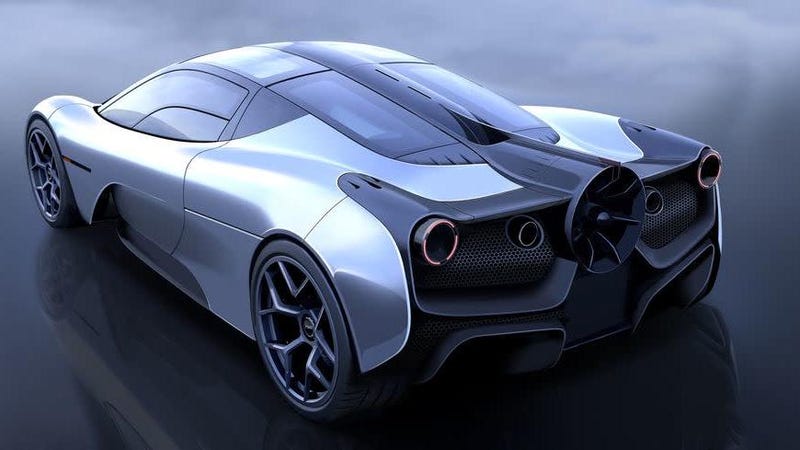
This is our first good look at the T.50, and it’s a glory shot render of the rear-end design treatment showing off all the real estate that massive cooling fan takes up.The car copies the trident seating layout of the F1, and the rest of the car is surprisingly old-world as well, with Murray going so far as to tell Car And Driver the T.50 sets out to be the “last great analog supercar.”
Murray’s definition of “analog” is a four-liter naturally-aspirated V12 gloriously linked to a six-speed manual transmission, with a claimed peak output of around 700 horsepower revving to a whopping 12,000 rpm in one of the two engine settings. From Car And Driver:
There will also be two engine modes: one that moves torque lower down, and, as Murray put it, “runs out at what we call Ferrari revs, so around 9500 rpm.” Murray says the more aggressive setting is “the one for when you say to your mate, ‘Do you want to hear 12,000 rpm going through the tunnel?’ “
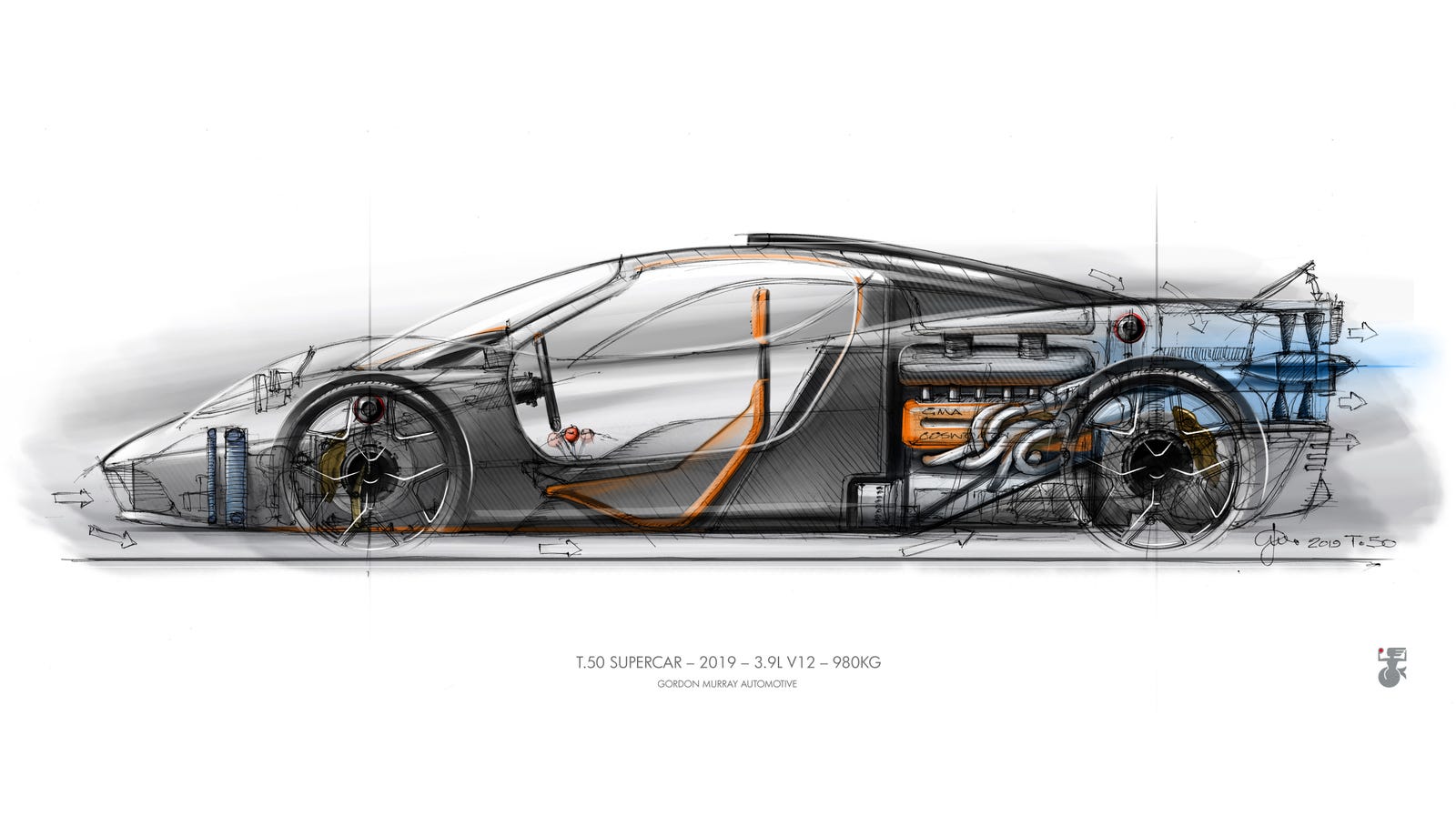
Cosworth’s work on the engine is said to be totally different from the naturally-aspirated V12 it has going in the Aston Martin Valkyrie, and has resulted in a powerplant Murray claims is 132 pounds lighter than the powerplant of the McLaren F1.
So then what’s the fan for? Inspired by Murray’s own 1978 BT46B Formula One “fan car” with a similar setup, it’s for d0wnforce. And cooling. But also downforce. As much of it as you want:
“Normally, diffuser air won’t follow anything more than a gradient of about 7.5 degrees. It just separates, so your diffuser shape has to be gentle,” Murray explained. “Every designer on the planet would love to have a very aggressive diffuser like this, but the air will just say ‘No, thanks,’ and you end up with a pool of stagnant air where the diffuser has stalled, and the flow will just do its usual thing.”
The electric fan is used to suck the dirty air from this disrupted boundary layer away from the top of the diffuser. “Once that’s out of the way, the air has to follow the surface,” Murray said. “At lower speeds you can generate much more downforce because the fan does the work. It’s not literally sucking the car down, but it is creating a much more efficient diffuser.”
The T.50's is a 48-volt electric fan, so less powerful than the old F1 car design, but will still get the job done with three modes; auto adjusts fan speed to shift downforce on the car automatically, high downforce mode increases downforce overall by about 30 percent, and the automatic braking mode applies full downforce to help bring the car to a stop a claimed 30-feet shorter from 150 mph than without it. I hope this sounds like the reverse thrusters when a plane lands. The fan also creates a “virtual longtail” at speed, reducing drag by about 10 percent, claims Murray.
Murray claims the customers he sought for the 100 road-legal versions of the T.50 mostly demanded a manual when offered a paddle-shift, and so far only one customer had an issue with the six-speed. There’s also plans for 25 track versions with a sequential gearbox.
The car is set to cost around $2.6 million and deliveries should begin in 2022. American cars have to enter the country under “show and display” restrictions. Murray, when complaining about the skyrocketing price of original McLaren F1s, said he hopes the T.50 offers buyers something they’re more comfortable thrashing to death. Check out the full conversation over at Car And Driver.
Since this fan is more for the diffuser and less about literally sucking the car to the ground, I wonder if it fixes the issue with rocks. You know, how older cars that used fans for downforce used to launch rocks out behind them?
You've heard the legends of the McLaren F1—we all have. How Professor Gordon Murray, CBE designed it as the ultimate road car and inadvertently created a supercar so game-changing that it locked down four of the top five finishing spots at McLaren's first 24 Hours of Le Mans in 1995. There was never a car like it before, and there hasn't been one since, but there's about to be, because Murray's startup Gordon Murray Automotive just confirmed that it'll launch the F1's spiritual successor, the T.50, this coming May 2020.Like its progenitor, the T.50 will be a three-seater that positions its driver front and center. Directly to their rear will be a naturally aspirated V-12, not a BMW this time around, but a 4.0-liter Cosworth GMA, which can rev to 12,100 rpm and produce as much as 700 horsepower intermittently. As the T.50 is more about driver engagement than setting records, its transmission won't be one of those instant-shifting dual-clutch automatics, but an old-school manual; an H-pattern six-speed. While the T.50's torque output falls almost 150 pound-feet short of the F1's, its rev range is much broader, and its curb weight almost 350 pounds lighter, meaning the T.50 should be able to match with its predecessor in a straight line.
In the corners, there may not be any street-legal car capable of keeping pace with the T.50, as Murray says it "will have the most advanced and most effective aerodynamics ever seen on a road car." He refers, of course, to the combination of active aerofoils and a 16-inch fan that sucks air from underneath the T.50, pulling it to the tarmac. Murray designed a similar system for the 1978 Brabham BT46B Formula 1 car, which was banned after one race, and that should tell you everything you need to know about how the T.50 will corner.
Straight-line and declarative performance get their own gains too, as the system can generate a "virtual long tail" to reduce drag or do the opposite to improve braking performance. These systems were designed with the help of Formula 1 team Racing Point, which will test a model fo the T.50 in its wind tunnel next year, and whose owner has been linked to an Aston Martin buyout in recent days.
Each T.50 will cost more than $2.6 million before taxes, and most of the 100 cars have already been reserved. Deliveries commence in January of 2022, but hopefully, we won't have to wait until then to hear its 4.0-liter V-12 at 12 grand.
In the AZ Motorsports History thread, there's a YouTube video of Murray talking about the T50 and it's development and upcoming public release
Speaking of which, the Cosworth-made V-12 will produce 654 hp and 344 lb-ft of torque. In today's supercharged world that may not sound world-bending, but you haven't heard the weight figure. Because the engine spec sheet lists the T.50 as having 663 hp per metric tonne, we know that this car will weigh in at under 2200 pounds. That makes it over 100 pounds lighter than an ND miata, with over three times the power and a 12,100 RPM redline.
2150-Pound T.50 Supercar Much Better Than McLaren F1, Says Man Who Designed Both
Murray has been doing alot of press this week with the T.50
The T.50 should be quite a driver's car, so far I've seen nothing on the S/W and electronics so I'm assuming they'll be minimal for driver aids?
A fresh addition to the growing list of things the coronavirus pandemic has denied us: the first look at Gordon Murray’s forthcoming T.50 hypercar. The three-seater was meant to be officially unveiled earlier this month, but the global pandemic has pushed that back until August. But while we will need to wait to see its final form, more details have been released—including confirmation that it will be the lightest supercar of all time, weighing just 980 kg, or 2160 pounds.
Clearly inspired by the McLaren F1—which Murray also designed—the T.50's specification list is pretty much all highlights. It will have a central driving position, a naturally aspirated V-12, and a manual gearbox, as well as active aerodynamics using a powerful 48-volt electric fan. But when Car and Driver spoke to Murray earlier this week, he said he regards the car's light weight as the most significant achievement.
"We have spent hours on what we call a 'mass track' every week, all the different disciplines of the car—chassis, suspension, body— saving weight wherever we can," he explained. "We really do track it down to nuts and bolts. The target was to get under 1000 kg, and we’re going to do even better than that."
The 1000-kg target was also the original one for the McLaren F1, with Murray admitting that plan was stymied by the use of a larger than anticipated 6.1-liter BMW V-12 engine, and also the use of iron brakes after it proved to be impossible to make carbon-ceramic discs work with the available technology. The F1 ended up weighing 2579 pounds, which was remarkably light even by the standards of its time but which Murray says he always regarded as a disappointment.
Weight has been carefully saved almost everywhere, from optimizing the size of individual bolts and fasteners rather than using off-the-shelf items, to larger assemblies. "It's 31 years since I picked up the pencils to start drawing the F1, and stuff has moved on dramatically," Murray said. The T.50’s Cosworth-built V-12 is set to be around 154 pounds lighter than the F1’s BMW V-12 and its X-Trac gearbox 21 pounds lighter than the transmission in its illustrious predecessor.
The T.50's glass is thinner than typical, its central driver’s seat weighs just 15 pounds, and the two flanking passenger seats are under seven pounds each. Murray says his team has been able to trim mass even when he didn't think they could. "I said to the guys, 'I designed the pedals on the F1, I did the stress analysis, and you’re not going to get any weight out of that,' but we had a look at the whole thing again, materials and technology, and we got 300g [0.7 pound] out of it, and 800g [1.8 pounds] out of the gearchange mechanism by using a lot more titanium."
Despite weighing less than a Miata, the T.50 will be powered by what is set to be one of the most powerful naturally aspirated engines ever fitted to a road car: a Cosworth-developed 4.0-liter V-12 that will make 650 horsepower—a modest increase over the F1's 618 hp—but it will have a completely different character. The F1's BMW engine revved to a limiter set at 7500 rpm, whereas the T.50 will soar to a motorcycle-like 12,100 rpm. The T.50's engine is set to weigh less than 400 pounds, making it the lightest roadgoing V-12 ever made. And while the forthcoming Cosworth-crafted V-12 in the Aston Martin Valkyrie will be a brawnier 6.5-liter 1000-hp unit, it won’t rev as high as the T.50.
Like most race engineers, Murray always prefers to increase performance by losing mass rather than increasing power. The T.50's active aero system, using a 48-volt electric fan to remove the disrupted boundary layer within the car’s diffusers and therefore dramatically increase their efficiency, is the product of similar thinking. The whole system including fan motor and ducting weighs less than 27 pounds, but it also gives the ability to vary the amount of downforce being generated. That, in turn, saves the weight of adjustable dampers or heave springs to fight against unwanted high-speed aero loads.
Although COVID-19 has delayed the launch of the T.50, Murray says development remains on schedule and the sales process has continued through video conferencing. Around 75 of the full run of 100 cars are now spoken for, and that’s despite the need for buyers to front a deposit of about $738,000, with a final price of about $2.5 million. Murray says he is surprised at the relative youth of many of the buyers, with around 40 percent younger than 45. "They consistently tell me the same thing," Murray says: "they were teenagers with the F1 on a poster on their bedroom wall but by the time they had a successful business the F1 was $15 million and they couldn’t find one anyway. This is their F1—and they're getting it at an 85 percent discount, that’s one way of looking at it!"
While he is still justifiably proud of the McLaren F1, Murray is also adamant that the T.50 is going to be superior.
"This car will deliver—and this is a promise—the driving experience of an F1, but better, better in so many ways," he said. "The F1 is still a great driver's car, but this thing is going to be on another level altogether with what we’ve done. We've fixed the things we knew were wrong with the F1.
"I'd say in some areas the T.50 will be almost as big a leap forward from the F1 as the F1 was from the cars that had gone before it."
I have never wanted to win the lottery more than today. 12,000 rpm redline is absolutely insane.
LITERALLY nothing else like it out there these days. At least on paper and through pictures, absolutely worthy of continuing the heritage of the F1. You can see so much of it in this car, I love it.
Gordon Murray Automotive has unveiled its T.50 supercar in full for the first time, showing the finished exterior and interior design and confirming its ground-breaking technical specifications. The T.50 has been engineered to be the purest, lightest, most driver-centric supercar ever.
Improving on his acclaimed McLaren F1 "in every conceivable way", Professor Gordon Murray CBE is leading the team that will begin building customer versions of the 986kg supercar in January 2022. Justifying its £2.36m (before taxes) price tag, the T.50 promises to deliver an unsurpassed driving experience. It is powered by a 100% bespoke 3.9-litre, 663PS V12 engine that revs to a record-breaking 12,100rpm, and features the most advanced and effective aerodynamics ever seen on a road car - aided by a 400mm rear-mounted fan.
The global premiere is the first time the clean lines of the exterior and the driver-focused interior have been seen. From his first ballpoint sketches, to every engineering and design detail, Murray has led the Gordon Murray Automotive team and briefed and overseen suppliers to drive the project forward at an unrelenting pace. Murray's design for T.50 was the 50th in a prestigious line of race and road cars he's penned over his illustrious 50-year career - both reasons combining to name the car T.50.
The most dominant characteristics of the T.50 exterior design are its purity and balance, free from the wings, skirts and vents that adorn most modern-day supercars. The clean surfaces are enabled by the most advanced and effective aerodynamics ever seen on a road car, resulting in deliberately simple, beautiful lines and a timeless appearance.
The purity of the silhouette is broken dramatically when the pair of dihedral doors rise up and forwards, coming to rest high above the passenger cabin. Inside, the driver-centric approach is plain to see - from the central, jet fighter-like driving position, to the aerospace-grade primary and secondary controls arranged in an 'ergonomic bubble' around the driver.
Quality of materials, the utmost precision, and simplicity of visuals define the whole car, but nowhere is this more evident than inside the cockpit. British suppliers are responsible for every major component throughout the interior, as well as every facet of the car's exquisitely-engineered underpinnings - an attribute insisted upon by Murray who was determined the T.50 would be a true British sports car.
From the record-breaking V12 engine, and best lightweight transmission, to the world-first aerodynamic package and the feather-light titanium throttle pedal, every element is 100% bespoke and crafted by a British company that leads in its field. Murray pushed each supplier to their limits to deliver ingenuity, the highest quality and of course new levels of lightness.
With a vision that the car, and every element of its componentry, would be considered 'engineering art', Murray set out to create a vehicle that surpassed all others, fostering new levels of pride and connection among owners. Every T.50 customer has the opportunity to meet Murray to discuss their car and personalise it inside and out. Part of this process includes a seat, steering wheel and pedals 'fitting' session - personalised to every owner - that will ensure the T.50 is ergonomically perfect and individualised for each discerning customer.
The T.50 mission - Driving perfection
At the heart of T.50 ethos is the ultimate, sensory-rich driving experience, which all starts with the central driving position. The 'jet-fighter' style seating position affords an unhindered view out of the cabin, offering the type of pure driving experience usually associated with a single-seater race car layout.
Murray insists that the engine contributes to at least 50% of a great driving experience. With this in mind, Murray set out to create the greatest ever V12. The bespoke Cosworth GMA unit hits the mark as the world's highest revving, fastest responding, most power dense, and lightest road-going V12. In terms of aural enjoyment, the T.50 raucous 12,100rpm redline will certainly deliver on wow-factor. The car also features Direct Path Induction Sound - a system pioneered on the McLaren F1 and refined on the T.50 to channel the sound of the throttle-induced induction growl into the cabin.
A cold-air ram induction intake sits immediately above the driver's head, and carefully crafted carbon fibre panels in the roof act as a loudspeaker, amplifying engine sound within the cabin. The system is actuated by throttle angle and not revs, meaning the T.50 is quiet and refined on part throttle, growing louder as the throttle opens.
Inside the cabin, all of the T.50's ergonomically-placed analogue controls are beautifully weighted. From communicative steering, which delivers pinpoint accuracy, to the weighting of the six-speed manual transmission and titanium throttle pedal, the engineering focus has always been on driving perfection.
During testing, the manual H-pattern gearchange motion and weighting was honed meticulously. Signed-off personally by Murray, the T.50 provides 'the ultimate gearchange' - a tactile short throw with a narrow cross gate for smooth, crisp, satisfying gearchanges.
The T.50's kerb weight of 986kg makes it the lightest supercar of the modern era, lower than the average supercar weight by almost a third. Thanks to the focus on lightweighting, the car offers unparalleled levels of agility, responsiveness and driver focus. The T.50 is a car that is created to be 'alive' at normal road speeds, not only when the revs climb past 10,000rpm. It will entertain and engage on low-speed daily trips, as well as when driving on the open road just for the thrill of it.
With minimal interference from driver aids the driving experience is left to shine - importantly, ESP and traction control, can be disabled entirely. The technologies that do influence performance - for example, the six aero modes enabled through active and interactive fan-assisted aerodynamics - enhance rather than numb the drive experience. The 400mm rear-mounted fan expands the car's performance capabilities significantly versus an ordinary ground-effect supercar. In partnership with the active rear spoilers and interactive diffusers, the fan helps to increase downforce by 50% (in Braking Mode 100% more downforce is generated); reduce drag by 12.5%; add around 50PS to the car's output, in combination with ram-air induction; and cut braking distance by 10m from 150mph.
Sitting prominently at the rear of the car, the fan is just one example of 'engineering art' on the T.50. Another, about which Murray feels passionately, is the engine. Murray detests carbon or plastic engine covers so, upon raising the twin gullwing openings that span the rear half of the car, the Cosworth GMA V12 engine sits proudly on display with its cam covers, primary exhaust manifolds and inlet trumpets all taking centre stage.
It is Murray's pride in perfection that has shaped every facet of the T.50. Calling the exterior styling "a return to beauty" the clean lines and visual balance seek to deliver a timeless design that will help the T.50 age gracefully, a fresh and lasting celebration of motoring engineering - the ultimate analogue supercar.
Commenting on the journey so far, Murray said: "For the past 18 months, the T.50 team has lived and breathed the ethos of the car, accomplishing everything we set out to achieve and more. I couldn't be happier with the car and the team - they're by far the best I've ever worked with."
Chassis and body - carbon fibre throughout achieves rigidity and lightness
The chassis and body of the T.50 are entirely constructed from high-grade carbon fibre. Creating inherent stiffness and torsional rigidity, the carbon fibre plays an important role in making T.50 the world's lightest supercar.
Murray: "With the design of our T.50 supercar, we are taking the same focused approach that was applied to the design of the McLaren F1. Thanks to modern materials and 30 years of development, we have been able to deliver a far better all-round car in the T.50, while setting its weight at just 986kg, a full 150kg lighter than the F1."
At the core of the T.50 is a lightweight carbon fibre monocoque. It has been constructed by UK-based company Formaplex and features novel, cutting-edge part-bonded carbon fibre an aluminium honeycomb core. This construction method gives the T.50 exceptional structural rigidity, which benefits handling, agility and ride comfort.
The intrinsic strength of carbon fibre ensures exceptional occupant safety in the event of a crash. The carbon fibre panels feature precisely engineered deformable areas and the car also uses an F1-style 'passenger safety cell'. The rigidity and torsional strength negate the need for additional bracing or reinforcement - another area of weight-saving.
The exterior body panels are also constructed from cutting-edge carbon fibre - including the front clam, the sculpted doors and the car's rear panels. Remarkably, the T.50's body, including the carbon monocoque and all body panels, tips the scales at less than 150kg.
The Cosworth GMA V12 engine and manual Xtrac gearbox are also semi-structural, being mounted to the chassis. The powertrain is attached using an inclined axis shear mounting system (IASA). The engine sits on anti-vibration mounts to prevent unwanted noise and vibration entering the cabin, while enabling the effective management of braking, acceleration and cornering forces. This saves 25kg of chassis weight at the rear of T.50, compared to a traditional engine mounting system.
Completing the lightweight structure is an ultra-lightweight windscreen, which is 28% thinner than a standard glass windscreen.
Aerodynamics - the most advanced aerodynamics of any road car
Murray: "We were focused on achieving the purest possible form for the T.50, an objective we've achieved through world-first engineering innovations and active underbody aerodynamics."
The T.50 takes road-car aerodynamics to entirely new levels, with Murray rewriting the rule book to significantly enhance the supercar's ground-effect capabilities. To achieve unmatched aerodynamic performance, the car's rear-mounted 400mm fan rapidly accelerates air passing under the car, forcing it through active boundary-layer control ducts that form part of the rear diffuser.
Through the application of two automatic and four driver-selected aero modes, the T.50 is capable of increasing downforce by 50%; reducing drag by 12.5%; adding around 50PS to the car's output in combination with ram-air induction; and cutting braking distance by 10m from 150mph.
The fan and its associated ducting system improve on conventional ground-effect systems by actively managing both underbody and overbody airflow. This boundary layer control ensures the most effective interaction of airflow on top of, and below the car, balancing drag and downforce at all speeds.
This same fan-assisted aerodynamic enhancement was first used for the road on Murray's F1 supercar. Few realise that two fans had been employed to pull air from under the car as these, far smaller, fans were hidden beneath each of the F1's rear haunches.
The underbody airflow system not only enhances performance, but also allows purity of design for the car's upper surfaces. Air flows over the top of the car undisturbed by unsightly vents, ducts, or flaps. The fan interacts with a pair of active spoilers at the rear, which can contribute to downforce or reducing drag, as required.
The fan is driven by a lightweight 48-volt motor, spinning at up to 7,000rpm. The unit's design and underbody ducting does away with the need for a 'skirt' - like that used by Murray's Formula One BT46B Fan Car. Vertical inlet ducts fitted with filters ensure no road debris can pass through the fan.
The T.50 features six different aero modes that optimise performance for different scenarios to balance traction and outright performance. The fan aero system has six modes - two are automatic (Auto and Braking), the remaining four (High Downforce, Streamline, V-Max Boost and Test Mode) are driver selectable:
'Auto Mode' is the car's default setting. In this mode, the T.50 operates like an ordinary supercar with passive ground-effect downforce.
'Braking Mode' automatically deploys the rear spoilers to their maximum (+45 degree) angle when high levels of deceleration are required. The fan also operates simultaneously at high speed while the diffuser valves open. This function can double downforce, enhancing stability and grip, and shortening the 150mph-to-0mph braking distance by a full 10 metres. If sudden deceleration is required, and when aerodynamics could influence stopping distance, Braking Mode overrides all other modes.
'High Downforce Mode' is driver selectable and delivers enhanced traction - in this mode, the rear spoilers deploy at +10 degrees, diffuser valves open, and the fan spools up to increase downforce by 50%.
'Streamline Mode' cuts drag by 12.5% and boosts straight-line speed while also reducing fuel consumption and downforce. In this mode, the rear spoilers deploy to -10 degrees reducing base suction and drag. The diffuser valves close partially, stalling the diffuser and reducing downforce, which saves wheel travel to make the car more comfortable and efficient. It also sets the fan to operate at high speed, drawing air from the top deck to minimise drag while extending the trailing wake of the car, creating a 'virtual longtail' and producing 15kg of thrust.
'V-Max Boost' is the most extreme T.50 mode. It uses the characteristics of Streamline Mode, then uses the car's 48-volt integrated starter-generator to drive the fan - freeing up power to the driveshaft. Combined with the ram-air induction, this boosts power to 700PS for short bursts of acceleration.
'Test Mode' operates when the car is stationary and is driver-selected. The fan spools up to its maximum 7,000rpm, the twin rear spoilers cycle through their full range of movement and the diffuser ducts / valves progressively open and close before returning to their rest position.
Monitoring the level of static and underbody pressure provided by the combined fan and diffuser system is possible via an interior gauge - displayed on the left-hand dashboard screen.
Design - purity enabled through engineering
Murray: "Next-level aerodynamics allow us to avoid the current supercar trend for exaggerated wings, vents and ducts. I was determined to create a clean and pure shape that would remain timeless, ensuring the T.50 will still look fresh in 30 years."
The most dominant characteristics of the T.50 design are purity and balance. Enabled by the most advanced and effective aerodynamics ever seen on a road car, the exterior of the T.50 indulges Murray's preference for simple, timeless lines and clean surfaces. The design does not rely on wings, vents, or ducts to emphasise its performance capabilities. Instead the eye is drawn to the compact, balanced proportions and driver-centric symmetry.
Stylistically, the T.50 is far from drama-free. The remotely-released dihedral doors rise up and forwards creating a striking visual impact, as well as easing ingress and egress even in tight parking spaces. These doors are joined by a pair of glass-topped gullwing rear openings that hinge along the spine of the T.50 to reveal the V12 powertrain - crucially free form covers - making it easy to view and to access for maintenance.
Also revealed, running alongside the engine bay on either side of the car are a pair of 90-litre vertical-load luggage compartments. With all four doors open, revealing two-thirds of the car's interior, the T.50 looks other worldly - like a predatory winged insect preparing for flight. Both the right and left-hand doors and engine cover doors can be opened remotely via the key.
As with every element of the T.50, the importance of the driver is very much evident in the styling. One of the car's most noticeable design features highlights the central driving positing and natural balance that confers. A central line runs from the nose-mounted mermaid badge and continues into the cabin, over the instrument binnacle and bisecting the driver's seat and continuing up the rear bulkhead. Outside, the line is mirrored by a tiny spine that runs from the base of the ram-air intake to the top edge of the fan housing at the rear.
This line emphasises the car's symmetry and innate balance. From the front, a pair of the latest, high-intensity LED headlights offer a clear nod of recognition to Murray's iconic F1. Each headlight features a pair of deep-set, horizontally aligned rings that operate as daytime-running lights and indicator lights. The centre of each ring features the dipped and main-beam lights bettering the previous industry-leading supercar headlight for reach and throw by 15%.
A heat sink and series of slits beneath and above the headlights circulate air around each fitting to cool the unit. Many manufacturers hide this cooling function, whereas Murray played to his ideal of creating 'engineering art' by turning this functional requirement into a distinctive styling element.
Following the central line up and over the sharply raked windscreen leads the eye to a roof-mounted ram-air induction inlet, which feeds the V12 and adds extra horsepower as the supercar gathers speed. Front to back, the roof is glazed either side of the central spine creating an incredibly spacious feeling interior and a sleek exterior appearance. As the spine falls towards the rear of the car the glazing continues, affording a glimpse of the V12 engine beneath its carbon fibre air box.
The rear deck is heavily sculpted to aid airflow towards the active spoilers. From the rear glazing, air flows beneath the rear deck to assist engine oil cooling - in streamline mode this air is channelled and ejected by the rear-mounted fan. The black inlet contrasts with the painted body and merges with the black fan housing that protrudes dramatically above the level of the rear deck and out beyond the trailing lip of the twin active spoilers that sit either side of the 400mm fan outlet.
Flanking the fan body are dual 80mm diameter exhaust outlets that sit within a black grille featuring an elongated-hexagon pattern that spans the full width of the rear end. At the rearmost outer corners of the car, circular red LED tail-lights draw the eye with their 3D transparent forms reflecting light outwards to create a stylish focal point. These units also act as rear turn indicators.
The profile of the T.50 is distinguished by the radiator exit duct behind the front wheel, the split side windows and the forged aluminium alloy wheels (19-inch front / 20-inch rear). Each side of the car also carries the name of the automotive division's sister company: 'Gordon Murray Design' the business responsible for all of the car's design and engineering.
In terms of overall proportions, the T.50 is extremely compact. Its 4,352mm length and 1,850mm width belie the generous interiors space, with room for three occupants and up to 288 litres of belongings. The addition of rear-view cameras (to be finalised during the next stage of the development process) will add no extra width and allow the car to avoid the weight, drag and unsightly clutter of external mirror housings. A third camera will sit in the centre spindle of the fan, providing a perfect rear view for reverse parking.
The Gordon Murray Automotive 'mermaid badge' sits proudly on the nose of the T.50. The company's 'new' badge is probably the oldest automotive logo in the world. It has been in use by the Murray family since the 12th century. Also, acknowledging his family's Scottish heritage, the blue, red and green colouring is the Murray clan tartan.
Engine - The greatest road-car V12 ever made
Murray: "To be truly remarkable, an engine needs to have the right characteristics: highly-responsive, an amazing sound, engaging torque delivery, free-revving, and it has to be naturally aspirated. For all those reasons, the engine in the T.50 was never going to be anything other than a V12."
The 3.9-litre T.50 engine delivers maximum power (663PS) at 11,500rpm, on its way to a 12,100rpm redline. The Cosworth GMA V12 not only promises screaming high-end power, it is also extremely tractable for everyday driving. The maximum torque figure of 467Nm is produced at 9,000rpm, while the pick-up is a record-breaking 28,400 revs per second.
The T.50 has the highest power density (166PS-per-litre) of any road-going V12. It is also the lightest ever made thanks to a combination of exceptional design and lightweight materials (aluminium, steel and titanium) resulting in a total engine weight of just 178kg.
The meticulously designed and engineered powerplant draws upon the immense experience of Cosworth and Murray himself. It is the most engaging, characterful and driver-focused V12 engine ever produced.
Layering Murray's depth of knowledge with Cosworth's immense expertise in high-performance engines is what takes the T.50 V12 to another level. The name Cosworth is synonymous with racing - from Formula One, to rally, to IndyCar - as well as production of some of the most admired and successful supercar engines in the world.
With a focus on driver engagement, the T.50's engine will be the highest-revving and most responsive naturally-aspirated engine ever fitted to a production road car. The V12 engine revs freely to a road-car record of 12,100rpm. Measured in revolutions gained per second, the T.50 will pick-up revs at 28,400 revs per second enabling it to hit its redline from idle in just 0.3 of a second.
Fed by a roof-mounted cold-air ram induction inlet, the T.50 powerplant delivers 71% of its peak torque from 2,500rpm, with its maximum (467Nm) achieved at 9,000rpm. This usability, and the outright performance of the engine is coupled to another major achievement: the Cosworth GMA unit produces the highest power density of any naturally aspirated road car engine - 166PS-per-litre.
Packing this amount of power into the world's lightest road car V12 (just 178kg) required yet more innovation from Murray and the Cosworth team. To achieve Murray's weight target, the block is made from a high-strength aluminium alloy and the connecting rods, valves and clutch housing are titanium.
Focusing again on the driving experience, Murray strived for the engine to have very compact external dimensions and the lowest possible centre of gravity. Here, reducing the F1's 125mm crank height was the goal, a feat more than achieved by the Cosworth team - the T.50's crank sits just 85mm from the bottom of the engine.
This accomplishment contributes in a very meaningful way to the dynamics of the T.50. The low centre of gravity means less pitch during cornering and braking, less squat and dive, plus better transient handling, meaning the T.50 will remain composed and balanced even at the extremes of performance.
Beneath the car's two rear gullwing openings, Murrays motorsport heritage influences the appearance of the Cosworth GMA V12. Inspired by race car engines, it uses gear-driven ancillaries for lightness, with the added benefit of a clean and uncluttered engine bay. Murray was determined that the engine should be devoid of unsightly belts. All of the ancillaries are carefully positioned out of sight leaving the block heads, primary exhaust manifolds and inlet trumpets centre stage.
As well as effectively being an engineering work of art, T.50's engine is semi-structural, providing much of the rigidity and weight saving found in a race car, without compromising driver comfort and cabin refinement. The semi-structural layout saves weight and increases stiffness while avoiding the noise, vibration and harshness penalties typically found with fully structural units, which increase cabin noise and hamper ride comfort.
As part of the early development process, the Cosworth team surpassed efficiency and emissions requirements and completed plans for two engine maps. These driver-selectable modes ensure the T.50 is not only the ultimate driver's car, but is equally at home as a GT or a daily driver. While the engine offers usability and high-performance in either mode, 'GT mode' limits revs to 9,500rpm and with 600PS available, making the car even easier to drive around town.
If the driver selects 'Power mode', the full breadth of the car's ability is unleashed, utilising all 663PS, and accessing the engine's full 12,100rpm rev range. In this mode in particular, it promises to be one of the best sounding road car engines ever made - achieved partly through the extensive rev-range, but also influenced by the car's Direct Path Induction Sound engineering, which channels the sound of the fabulous V12 into the cabin.
The T.50's power and traction can be controlled by an electronic stability programme (ESP) and traction control system. With the driver aids engaged, the systems allow a progressive driving experience, while providing the driver greater confidence to explore the car's limits in all weather conditions. Importantly, both systems can be switched off entirely should talented drivers want to fully explore the car's capabilities.
Transmission - bespoke and lightweight - the ultimate gearshift
Murray: "The car's six-speed H-pattern manual transmission is a tribute to Xtrac's skill, continuing our focus on driver engagement. The gearchange motion and weighting was honed meticulously until we achieved the perfect end result. The outcome is a narrow cross gate and a short throw. It delivers slick, crisp gearchanges - truly a joy for the driving enthusiast."
Being totally bespoke, it was possible to optimise every component of the gearbox for weight. Remarkably, the Xtrac team created a super-strong but extremely light aluminium housing that was cast at just 2.4mm thickness - resulting in a gearbox that not only met strict packaging requirements within the car, but also weighed in at just 80.5kg.
The transmission features five close ratios, geared for acceleration, with a longer sixth ratio for cruising. Reverse is selected having first flicked the red 'lockout' switch set next to the titanium gear lever.
Vehicle Dynamics - a focus on lightweight
Murray: "Weighing just 986kg, the T.50 undercuts the average supercar weight by almost a third. A heavy car can never deliver the dynamic attributes of a lighter car - even if it has the same power to weight ratio. While it is possible to disguise a heavy car's dynamic capabilities with complex active suspension and sophisticated electronics, the agility, responsiveness and reward of a lightweight vehicle simply cannot be matched."
In designing the T.50, Murray applied one of his core supercar philosophies, reversing the traditional focus on power-to-weight, to instead consider the vehicle's 'weight-to-power' ratio. In the T.50, every 100PS has to propel just 150kg of car, whereas for the typical supercar (1,436kg with 693PS) the weight it has to shift is 40% higher, at 207kg. It is this weight-to-power calculation that drives the development of the T.50, with every component designed and engineered to achieve the lowest possible weight.
Powered by its 663PS V12 engine, the lightweight T.50 sets a challenging benchmark for rival supercars. To match the T.50's 672PS/tonne, the typical 1,436kg supercar would need almost 300PS more power. But the 963PS required to match the T.50 on paper would add cost, complexity, and require larger, heavier components to handle the extra power.
Avoiding the weight-gain spiral caused by chasing top speeds and highest power output figures, Murray benchmarked the lowest possible weight for every component, right down to individual nuts and bolts. A key area where weight was minimised is the T.50's fully carbon fibre monocoque and body panels, which total less than 150kg. Inside, three racing-inspired seats are also constructed using carbon fibre, with the centrally positioned driver's seat and the passenger seats that flank it having a combined weight of just 13kg.
Throughout the early development process, weekly 'weight watchers' meetings at Gordon Murray Automotive scrutinised the weight of every component. Even the diameter and length of approx. 900 fixings was optimised to cut weight, taking account of the forces to which each would be exposed.
For the Gordon Murray Automotive team, no saving in weight was too insignificant, their focus on lightweighting has been unwavering. Every innovation, every iterative improvement supports the lightweighting strategy that helps create the purest, lightest, most driver-focused supercar ever.
This central mission promoted simplicity of construction and no compromise was tolerated, no expense was spared. The low total weight of the car means that the T.50 can use forged aluminium alloy double-wishbone rising rate suspension front and rear, with no additional interference required from heavy electric or hydraulic suspension components. The steering system is similarly pure, the simple rack-and-pinion setup is unassisted at speed, with the aim of ensuring a truly engaging driver feel, while there is low speed power assistance (LSPA) for parking.
The suspension and steering works in partnership with the Michelin Pilot Sport 4 S tyres (235 / 35 R 19 at the front and 295 / 30 R 20 at the rear). Chosen by Murray to avoid costly replacement of bespoke rubber and specified for superior all-round performance, the Michelin tyres are another weight-saving move as they can be far smaller and narrower than a typical supercar tyre due to the sprightly weight of the T.50.
T.50's body and chassis are constructed almost entirely from carbon fibre, which ensures incredible stiffness, such that no additional bracing is required in the car. The structural stiffness ensures optimum handling, agility and ride comfort.
The T.50 also boasts race-car levels of agility and driver focus thanks to its low centre of gravity - afforded, primarily, by its semi-structural engine, which sits low in the chassis and delivers a very low polar moment of inertia.
Another of consideration for the vehicle's dynamics was minimising un-sprung mass. Here, Murray applied a host of tactics that combine to keep weight down. The wheels, hubs, and suspension arms are all ultra-lightweight. The wheels are forged from a lightweight blend of aluminium alloy (front 7.8kg, rear 9.1kg), as are the suspension uprights and wishbones. While, for ultimate weight saving, the car's hubs and bearing carriers mimic those of an F1 car, with a single locking nut, dramatically reducing the amount of material needed for their construction.
The T.50 is braked using the latest-generation Brembo six-piston air-cooled aluminium alloy Monobloc callipers on the front and four-piston air-cooled aluminium alloy Monobloc callipers on the rear. Optimum stopping power, and further weight saving, is ensured by pairing them with Brembo carbon ceramic brake discs (front 370mm x 34mm / rear 340mm x 34mm). The latest Brembo advancements enable these discs to be smaller than similarly-powered vehicles that don't benefit from this newly-released technology. The car is also equipped with an anti-lock braking system.
The T.50's braking setup will be subject to a rigorous testing and real-world fine-tuning regime during the forthcoming development period. The final outcome will be the ultimate braking system for the enthusiastic driver, with low levels of servo assistance making 'heel-and-toe' gear changes easy and natural. The carbon ceramic discs are calibrated to engage progressively and with a firm pedal feel - and will also naturally resist fade and a 'long' pedal during enthusiastic driving and repeated deceleration from high speeds.
Interior - a jet fighter cockpit for three
Murray: "Everything about the interior starts with the driver - the central driving position is the clearest demonstration of this approach. Building on this starting point, every control is arranged within easy reach of the driver. Purity of design was our goal, with the utmost quality applied to every element. The cabin is spacious and refined, making the T.50 exceptionally capable of traversing continents in comfort."
From the outside looking in, the T.50 appears to be a single seater racing car. With intentional focus on the driver, Murray specified the driver's seat to stand out in a vivid colour, while the two passenger seats that flank it are trimmed to blend in with the rear bulkhead.
As the dihedral doors lift, they present a wide opening that grants easy access to the cabin for driver and passengers. The design of the carbon fibre monocoque moves the need for torsion beams from the centre of the passenger compartment to the outside of the chassis, meaning the floor is free from obstruction.
Each customer will have a personalised seat fitting during the specification process, at the same time adjusting the steering wheel height and reach, and fine tuning the set-up of the pedal box.
In keeping with much of the rest of the car, each pedal is an engineering work of art. Milled from solid aluminium for strength and lightness and laser-etched with the T.50 name, the clutch and brake pedals both feature a web-like pattern to save weight and provide an anti-slip surface. The accelerator pedal is crafted from solid titanium to deliver the lightest, strongest pedal that delivers ultimate control and sensitivity to the driver.
To the right of the driver, the titanium gearstick sits on an arm that extends alongside the driver's seat. The underside of the arm 'floats' above the cabin floor to reveal the expertly-crafted titanium gearchange mechanism.
The arm itself features a number of controls including the drive mode selector, infotainment rotary control, and most importantly a centrally-positioned engine start / stop button, sheathed beneath an anodised red jet fighter-style 'missile switch' cover. At the frontmost tip of the arm is an individually laser-etched chassis plate denoting the vehicle build number.
Once seated in the central driving position, the three-spoke carbon fibre steering wheel is pleasingly narrow-rimmed to afford a firm grip and transmit abundant feedback. Behind the wheel, a left- and right-hand paddles enable the driver to sound the horn or flash the headlights without taking their hands off the wheel. There are no touchscreens and no stalk controls - even the indicators are operated by thumb-buttons on the steering wheel's horizontal spokes.
Every control is analogue, every display is designed for functional clarity, every primary and secondary control switch is satisfyingly tactile and ergonomically positioned for ease of use.
Front and centre in the driver's view is a large (120mm) analogue, flood lit rev counter - its needle milled from aluminium. Either side of the steering wheel, three aerospace-grade aluminium rotary switches are positioned within easy reach. On the right, the switches control the heating / ventilation and air conditioning, while to the left the two lower controls are for wipers and lights. The top-left dial is the most intriguing and unique - marked with a graphic of the T.50 fan, this configures the four driver-selectable aero modes.
Everyday usability - the ultimate supercar that's easy to live with
Murray: "Comfortable, refined, spacious and easy to drive - not a typical description for a supercar with the capabilities, power or driver focus of the T.50. I've designed this car to be used every day, with almost 300 litres of luggage and storage space, a premium stereo, and excellent air conditioning. From its exceptional visibility and compact footprint to ease of ingress and egress, the T.50 rewrites the supercar rule book for usability."
The Gordon Murray Automotive team evaluated ease of access to the T.50 at length. More than 40 people of all ages and sizes took part in an assessment of a range of different seating permutations. The car's dihedral doors were chosen to enhance the ease of getting in and out, while the sill of the carbon tub sits low to the ground and the flat cabin floor is free from obstructions across the full width of the car.
Once inside, visibility out is excellent, in no small part due to the central driving position. The car's compact proportions mean that its footprint is comparable to that of an average C-segment hatchback, making it easy to park and place on narrow roads or in urban environments.
Passengers have a large amount of usable storage space, with a combined 30 litres of interior stowage across five compartments - one above each passenger's footrest, another under each passenger seat, plus one behind the driver's headrest. Set within the left and right rear haunches of the car are vertical-load luggage compartments, each with around 90 litres of capacity - comfortably swallowing a flight case each side. When carrying three passengers, the luggage capacity totals 228 litres. However, by using a specially made suitcase that is sculpted to the shape of the passenger seat, two occupants can enjoy 288 litres of luggage / storage space.
In terms of daily use, the T.50 is quiet and easy to pilot. The engine map has two states of tune, one 'Power Mode' for maximum revs and the full 663PS, and a 'GT Mode' that limits revs to 9,500rpm and power to 600PS - ideal for urban commutes or relaxed touring.
Ensuring comfort and practicality around town, the T.50 has a 120mm front and 140mm rear ride height allowing it to easily clear speed bumps and other road furniture without damaging the car's bodywork or causing discomfort.
Technology - all the driver essentials, no driver distractions
Every display in the T.50 is simple. White graphics on a plain black background ensure ease of use and quick recognition for the driver with minimal distraction. Even the rear-view displays are optimised for the driver, offering a better field of vision than mirrors and weighing significantly less.
Delivering a premium audio experience was a key element of the T.50 brief. Here Murray stuck to his key principals for the car; lightweight, highest-quality and British. Again, bucking industry trends, Murray enlisted high-end audio specialists Arcam to create a 700W nominal 10-speaker 100% bespoke sound system for the T.50.
Aligning with the car's lightweight characteristics, the whole system weighs just 3.9kg and connects wirelessly to the driver's phone to stream audio. The T.50 also uses Android Auto / Apple Car Play for all Bluetooth phone and navigation functions - which are displayed on the infotainment screen to the right of the rev counter.
Customer experience - the return of a true supercar owner's experience
T.50 buyers have received bespoke and personalised service, from the first expression of interest and throughout the purchase, specification and manufacturing process. That same approach will continue for the duration of their ownership.
During the car's development, owners have been given first sight of vehicle designs, engineering milestones and project updates. Moving closer to the car's 2022 manufacturing date, customers will be invited to set up their car to fit them perfectly, while customisation of colours and interior will allow individualisation of the strictly limited 100 T.50 models.
Murray has met or spoken to every buyer and will hand over every car collected from the Gordon Murray Automotive's UK customer reception centre. Around the world T.50 owners will have access to a service network in the UK, US, Japan, and Abu Dhabi - with a 'flying technician' service supporting these and all other markets.
Throughout the build of their car at Gordon Murray Automotive's UK production base, customers will be kept informed of the status of their car and will have the option to visit their car during the build. Following collection, owners will be offered tailored experiences to continually enhance their ownership of the world's most driver-centric supercar.
Watched the entire video. The active aero on the T.50 is ingenious and not just a nod to Murray's distant past but an optimization. So cool.
Engine is just spectacular. I don't understand the engine pickup speed Murray was describing, but in comparison to the F1, it sounds impressive.
Not a single piece of plastic. That aside, the T.50's entire design philosophy just screams of a no-compromises approach. The pure, unadulterated epitome of a driver's car.
I am not religious in the slightest, but I would worship Gordon Murray if he were a religious deity. I'm a goddamn simp for Murray.
Watched the entire video. The active aero on the T.50 is ingenious and not just a nod to Murray's distant past but an optimization. So cool.
Engine is just spectacular. I don't understand the engine pickup speed Murray was describing, but in comparison to the F1, it sounds impressive.
Not a single piece of plastic. That aside, the T.50's entire design philosophy just screams of a no-compromises approach. The pure, unadulterated epitome of a driver's car.
I am not religious in the slightest, but I would worship Gordon Murray if he were a religious deity. I'm a goddamn simp for Murray.
The F1 is now my 2nd favorite car of all time.
Yeah, Murray is a absolute genius especially since he transcinded from F1 cars to road cars ironically called the F1.
He ranks up there with great F1 designers such as Colin Chapman, Frank Dernie, Patrick Head, John Barnard, Adrian Newey, Rory Bryne and Aldo Costa.
Saw him a few times in the Detroit Grand Prix garage area in the '80's when he was at Brabham.
Originally Posted by 00TL-P3.2
McLaren F1 + McLaren 570S + Brabham BT46
Definitely looking forward to seeing this thing hit the streets.
+1, also excited to see how the T50 performs.
FWIW, Murray did not work on the 570S.
He had left McLaren in the mid 2000's after the McLaren/Mercedes SLR car design and then formed his GMA company.
My favorite Murray creations would be
McLaren F1 + Brabham/BMW BT52 + McLaren MP4/4*
* - technically Steve Nichols was the designer and Murray was the Technical Director
Last edited by Legend2TL; Aug 4, 2020 at 04:25 PM.
Wow....it reads like the ultimate enthusiast dream car.....absolutely incredible. To me this is more impressive than the vast majority of modern/recent supercars.....
I would love to hear more about the semi-structural engine and how that fan magic works.
Wow....it reads like the ultimate enthusiast dream car.....absolutely incredible. To me this is more impressive than the vast majority of modern/recent supercars.....
I would love to hear more about the semi-structural engine and how that fan magic works.
Murray explains the fan in the first video that Legend posted today (35 mins)
Maybe you are aware, but the fan played a part in making that original Brabham F1 "fan car" so dominant, that these sorts of aero devices illegal in F1.
Basically every supercar and hypercar these days uses varying amounts of downforce to enable higher cornering speeds. The downside of more downforce is that it is also increased drag, which will hurt straight-line acceleration at higher speeds, in addition to top speed.
I've never driven a car fast enough to really experience it but he also mentions too much downforce will result in squirrelly handling at high speeds due to the reduced travel. The beauty of the fan system is that it is flexible. It will also reduce drag, and even increase downforce at low speeds. This car doesn't have any canards, huge splitters, or wings thanks to how well the system works.
FWIW, Murray did not work on the 570S.
He had left McLaren in the mid 2000's after the McLaren/Mercedes SLR car design and then formed his GMA company.
Murray explains the fan in the first video that Legend posted today (35 mins)
Maybe you are aware, but the fan played a part in making that original Brabham F1 "fan car" so dominant, that these sorts of aero devices illegal in F1.
Basically every supercar and hypercar these days uses varying amounts of downforce to enable higher cornering speeds. The downside of more downforce is that it is also increased drag, which will hurt straight-line acceleration at higher speeds, in addition to top speed.
I've never driven a car fast enough to really experience it but he also mentions too much downforce will result in squirrelly handling at high speeds due to the reduced travel. The beauty of the fan system is that it is flexible. It will also reduce drag, and even increase downforce at low speeds. This car doesn't have any canards, huge splitters, or wings thanks to how well the system works.
Finally got around to watch that lunch video. Wow. SOme very nice info.
But I hope we'll learn even more from what the fan does. The "host" kinda went over things fairly quickly...maybe I'm too used to savageese-style ultra deep dives....but I was wanting to know all the different aspects and how that fan worked....BUT I also imagine that may be a patent/pending(?) thing where GMA may want to keep some of the mechanisms proprietary.
Duuuude, guys. Watch this NOW. It's a 50min deeper-dive into it and there are some FASCINATING trivia and info and he gives alot more info on how that fan works.
My personal highlights:
The original Brabham fan F1 car was insanely effective and Murray said one of the lies that someone (was he a driver? Not sure....someone with way more F1 knowledge can correct me on this) told to Formula One to ban it was that it could've sucked up debris and caused a hazard (which he claims it wouldn't have sucked up anything that big at all) and it was super crude
The current fan-assisted active aerodynamic mechanism works to suck air from underneath the car via specifically designed/engineered aero ducts/tunneling to create additional downforce when under hard braking and other specific situations, eliminating the need for gaudy bodywork that interfered with the smooth/simple lines of the car. He said there would've been need to add front splitters and a wing, etc.
At high speed/top speed, the fan along with the smaller spoiler piece creates a "longtail" effect to improve/reduce aero drag and helps with allowing more suspension travel and less draggy/downforce at speed
No other car company can do this fan aerodynamic stuff because apparently it is extremely complicated to achieve and in general this kind of car cannot be replicated due to bean counters and committees
The McLaren F1 actually had 2 small fans sucking air with specific tunneling effects that increased downforce by 5% - little known fact that many were not aware. Apparently this is detailed in Driving Ambitions on pg 84 (WTF, this book is like $300-400 on amazon/eBay......)
There is no belt-driven mechanism anywhere in the car. The A/C, electricals, the fan, and alternator are powered by an Integrated Starter Generator coupled directly to the Cosworth motor developed by Cosworth. It is a 48V system that also works with a 12V battery as well and is designed for max weight savings and packaging as much as possible
Extremely low CoG for the Cosworth motor....usually Mid-engined cars has higher CoG as it gets to the rear and the piston travel is only like 85mm which further lowers rotating mass/CoG
Carbon fiber used in appropriate places to save weight, Murray hates carbon fiber wheels or carbon trim or gaudy things that modern supercars use thesedays
Wheels are only 19", Murray hates big wheels that seem to be just for show/cool-factor
Simple dash design, no plastic on the insides, no gimmicky touch screen or funky dash....regular gauge
Infotainment is basically run off your smart phone....
No specific numbers target....ie, he doesn't care about hitting 0-60 or a top speed....all about the drive.
Due to the engine able to rev at 28,400 RPM/sec, down shifting will be assisted by auto-rev matching and they imply that in quick down shifts human reaction may not be able to rev-match manually due to the sheer speed of how fast the RPM of the motor can change (aka can you heel-toe fast enough to blip it before the RPM drops too lowfor the down gear?)
Wet weight of only 980kg...less than 2200lbs....more power to weight than majority of supercars
I confess I didn't read up as much about Murray as before (not to this level of detail of listening to hour long interviews with him at least) and the more I am looking into this man in-depth and listening to his thought process....he is a damn human race treasure. He someone embodies the ultimate car enthusiast without coming off as snobby/gate-keeping somehow.......
Anyone have a cheap/free copy of Driving Ambition to lend me?
Murray says he is surprised at the relative youth of many of the buyers, with around 40 percent younger than 45. "They consistently tell me the same thing," Murray says: "they were teenagers with the F1 on a poster on their bedroom wall but by the time they had a successful business the F1 was $15 million and they couldn’t find one anyway. This is their F1—and they're getting it at an 85 percent discount, that’s one way of looking at it!"
Welp, wish I were that successful.
Being able to afford a 2.5M car under age 45? Must be nice.I was a bit younger when the McLaren F1 was being actively produced/sold but still....lucky people.
The wheel and tire choice was a little amusing to me. Getting shafted with proprietary tires on the Testarossa and later with Bugattis and the F1.
Not much choice when designing something to exceed 220 mph I guess, especially given the time.
I kinda chuckled when one of the videos panned to show the Pilot Sport 4S tires. I can say that I have the same tires as the T.50
Interesting.
Could it be maybe to allow for more accessibility/driveability? The question sounds ridiculous for a car that 99.99% of the world will never drive and at a cost of effectively around $3M USD....but maybe it's easier for owners to source and then put on tires than having to wait weeks or months for specialty made tires?
The most ridiculous chain of events was when it came time for Weiner to replace the tires. He says it only cost $7,000 for the rubber itself, which is exorbitant, but not out of the question by supercar standards; however, the car then had to be shipped from Weiner's home in Georgia to a racetrack in the Carolinas, which cost several grand. Then a driver had to be hired, an ambulance put on retainer, and insurance paid so the car could be calibrated on the new tires--hence the need for the racetrack. All this brought the final cost of replacing your tires, even if they're completely unused, up to a ridiculous $50,000.
Sure, a typical F1 owner probably has an 9-digit net worth, if not higher... still ridiculous for tires. IIRC the Veyron cost was in the tens of thousands too, in rubber alone.
Oops, I forgot to mention but yeah the impression I got from the video was that Murray didn't want to have a unique-to-the-T.50 tire, nor did he want to use some uncommon tire sizes, either. The PS4S is a somewhat common high-performance summer tire, and comes in a broad variety of sizes.
Really goes with the ethos of making his cars daily-drivable.
Oh yeah I remember watching that guy's Vinwiki video on his F1 owning experience....50k for tires, lol. I think he also said that McLaren quoted something like 120k for the fuel cell replacement.
I watched some Manny Khoshbin youtube vids and IIRC he said Veyron tires were like ridiculous too like 40k or something for a set, and apparently Chirons are lot cheaper with using more standard tire/wheel sizes.
And then I think he said an oil change (annual service) is basically 20k on a Veyron.
Recently he mentioned that the battery tender/charge maintainer on his McLaren P1 is kaput and said I think the replacement was like $30k.......
Absolutely insane level of wealth of these kinds of car owners......must be nice....
The engine is a damn work of art. A masterpiece. I'll fight anybody who says otherwise.
I chuckled when Murray said he made the decision to make the valve covers out of magnesium instead of carbon, even though they were half a kg heavier, or whatever.
The 48VDC electrical system is pretty novel esspecially not having any drive belts anywhere.
The A/C compressor is driven by a electric motor in the front.
he first thing you may notice about the GMA-Cosworth V12 is that its beautiful titanium exhaust headers are angled upwards instead of pointing towards the floorpan like on your car. That's because the T.50 is using such steep, aggressive diffusers that the piping with the four catalytic convertors have no choice but to proudly aim for the sky. The next visible curiosity is the complete lack of belt-driven accessories. This packaging (and durability) miracle was made possible by the Integrated Starter Generator (ISG), which operates at 48 volts to act not only as the high-rev starter and the alternator but also as the energy source of the rear fan and the A/C compressor at the front of the car.
Gordon Murray was never going to build a halo car powered by anything other than a naturally-aspirated V12. He considers a 65-degree twelve-cylinder to have perfect primary and secondary balance, which is crucial when the engine is a load-bearing semi-structural element of the chassis. According to him, V12s also make the best noise, along with enough low-end torque to work well at any speed. The T.50's bespoke Cosworth offers 71 percent of its peak torque from as low as 2,500 rpm.
Initially, Murray wanted a 3.3-liter V12. However, to make the T.50 faster than a McLaren F1 with such a small engine, the T.50 needed to drop its wet weight to around 1,984 pounds. Since that wasn't gonna happen, the team settled for a 3,994cc, all-alloy DOHC with dry sump lubrication and a compression ratio of 14:1.
As you've probably heard by now, this 392-pound jewel of a V12 revs to 12,100 rpm, producing up to 690 horsepower when the ram-air induction is engaged with the fan's V-Max Boost mode. In 1998, the McLaren F1's 6.1-liter S70/2 V12 sourced from BMW Motorsport pushed it to a record of 240.1 mph, but only after its redline was raised to 8,500 rpm.
Weighing 2,160 pounds with its 3.9-liter V12, the GMA T.50 has a better power-to-weight ratio than a McLaren P1 GTR.
COSWORTH
A 65-degree V12.
28,400 RPM Per Second
12,100 rpm from idle happens in .3 seconds, which means this engine's pickup speed is at 28,400 RPM per second. That sort of throttle response is unheard of from a road car engine, let alone one verified for at least 50,000 miles. However, the achieved figure is by no coincidence. Murray, the engineer who compares the rev-profile of turbocharged engines to "watching paint dry," told Cosworth that his V12 needs to rev higher than his previous record holder, the Light Car Company's Rocket, which features a 1000cc Yamaha bike engine redlining at 11,500 RPM.
After putting the crank as low as 3.34-inches from the bottom of the pan, Cosworth went for titanium valves and connecting rods, gear-driven cams, four throttle bodies, variable valve timing on both inlet and exhaust, and 12 individual 12-volt coils. However, to achieve such speeds, they also needed a very low-inertia triple-plate carbon silicone and titanium clutch with virtually no flywheel to speak of, which in this case is fitted for life. The clutch housing is also made of titanium.
392 pounds for 690 horsepower.
The famously rev-happy BMW V12's pickup speed in the McLaren F1 is around 10,000 rpm per second. With almost triple that pace from idle to redline, let's not forget that with its clutch engaged, the T.50 comes with an equally rapid, nearly instantaneous decay. This means to make its six-speed manual transmission work, GMA's halo car will feature a carefully calibrated rev-matching software that will blip the throttle just enough for the opportunity of a perfect shift.
When it comes to more recent motorsport-derived offerings, I wanted to learn about the throttle response of the Mezger engine tweaked by Williams Advanced Engineering for the Singer DLS, as well as Porsche's latest 4.0-liter naturally-aspirated flat-six in the back of the GT3, GT3 RS and Speedster models. While Singer couldn't give me a figure, Porsche told me that "from idle to 9,000 rpm, [the 4.0] should take less than a second."
That's close enough to a 1993 McLaren F1's, yet far-far away from a 2022 GMA T.50's. Still, in terms of pickup speed per dollar, hats off to Weissach!
No flywheel, with that sort of revving... rev matching must be a pain.
I remember the HUGE backlash towards Nissan for the rev-matching capability on the 370Z back in the day. Wonder what they'd say about the T.50 having it
When Gordon Murray first announced his McLaren F1 successor, the T.50, he said his company would build 100 road cars, and 25 track-only versions. The road car debuted a month ago, and today, GMA is giving us our first preview of the race car, tentatively called the T.50S. It's wild. "If you think I had fun on T.50, wait until you see this one," Murray tells Road & Track. "I haven't had the constraints I had on 50 with trying to keep the car really absolutely pure and balanced. This time we're driven totally by performance and in particular, aero. So it's a pretty serious motor.
"I promise you one thing. It's not a poncy little variant of T.50 with a wing on the back and a different color."...
Gordon Murray is a Professor who, in 2019, was made a Commander of the British Empire by Prince William. He is a serious man. And this is a very, very serious car. And yet, the big man can’t resist a little smile when telling TopGear.com about his latest efforts.
“I’ve had a double amount of fun, really,” he says, unable to contain a grin, “just going crazy on the body and the aero. It looks pretty outrageous.”
It is. Meet the car codenamed T.50s – a racing version of the T.50 supercar. “If you take the McLaren F1 as an example, the T.50s is more ‘GTR’ than ‘LM’,” says Murray. “We’ve gone right through the motor car and it’s been driven by performance and aero.
“It’s pretty outrageous.” There’s that word again.
So, at its core, there rests the same carbon monocoque from the road-going T.50, but Murray’s team have changed the body panels and every element of the chassis in a bid to save weight. “It’s coming out at 890kg… which is quite ridiculous. That is literally a Lotus Elise,” he says, again with another smile. Yup, it’s also 94kg lighter than the already featherweight T.50 supercar. Any lighter and it’d need to be tied down.
Though we suspect keeping it stuck onto the track is as simple as gunning the throttle. Enter the 1.7-metre wide delta wing mounted on the rear of the car; a wing that echoes the front wing design of Murray’s 1983 Brabham BT52 Formula One car.
Together with a new ground-effect underbody aerofoil, front splitter, adjustable diffusers and the T.50’s existing fan, the T.50s is able to generate… 1,500kg of downforce. Let that number roll around your head for a while. “We had one run where we got up to 1,900kg at top speed,” Murray tells us, “but we had to back it off a little bit because we haven’t got huge tyres on the car.” Indeed, the tyres are wider than the T.50, but not massive – they still run Michelin Cup Sport 2s on forged magnesium wheels.
There’s a neat party trick – if you enjoy partying in long tunnels, of course – as Murray confirms “the aerodynamics are so effective that the T.50s would be capable of driving upside down, and could do so at as little as 175mph”.
There are no driving modes to speak of – just the one, which we’re calling ‘flat out’. It operates in high downforce mode at all times. “When you get in this thing and turn the ignition on, the fan comes on running at 7,000rpm and stays there,” he says. You’ll also spot the fin, said to better cornering efficiency and stability, and cleaning/channelling the air towards the delta wing. Pity this air, because there’ll be a lot of it being controlled. And used – the T.50’s 3.9-litre naturally-aspirated Cosworth V12 has been properly reworked to extract yet more power and torque. There are revised cylinder heads, new cams, a higher compression ratio and a new free-flow exhaust system.
All in, the T.50s develops more than 700bhp, and up to 720bhp at high speed thanks to the ram-air induction system up top. It’ll still rev to 12,100rpm, and we’re promised “it’s going to sound good, too”. The engine is matched to a new six-speed Xtrac gearbox with paddles, replacing the T.50’s manual gate.
Indeed, step inside, and – though we can’t see it at this early stage – we’re told it’s been totally stripped back. The central driving position remains (now a lightweight carbon fibre seat with a six-point harness), but the right-hand side passenger seat has been removed to allow the fitment of “a GTR-style switch panel, and extinguisher system and some electrical control boxes”, leaving only one passenger seat on the left.
Out goes the air-con. And the infotainment. And the storage compartments. And the carpets and instrumentation. The steering wheel is now a rectangular F1-style rim, and the only buttons left are traction and launch control.
We ask if the T.50s is Murray letting the T.50 supercar off the leash. “That’s exactly what it is. I’ve gone, ‘how wild can we go?’. This is not a tarted-up road car with a wing on the back. It’s a pretty serious machine.” Though, there’ll still be time for some fun. “I’d like every single car to be different,” says Murray. “Not just in spec and outrageous colour schemes to go with the outrageous body, but also giving personal attention to each driver.”
And thus, each T.50s customer will get a ‘Trackspeed’ pack that includes set-up, training, racing and support, with each car tailored exactly to the customer’s spec. “If they don’t want that much downforce, we can knock it off and adjust the aero balance. The idea is we have an ongoing relationship with each track or racecar owner. Up until we get a race series, we organise events and track days, and [customers of the T.50s] become sort of a ‘GTR family’.” Murray’s already been in touch with Stéphane Ratel of the SRO to potentially create a ‘GT1’ race series. “It wants to be driven, and people deserve to hear it going around the circuit too,” he adds.
The only chance the majority of us will ever see one, anyway. Just 25 of these T.50s racers are being built, each one will cost £3.1m (before taxes, so a little over £3.7m a pop). And… more than half of the run of 25 cars has already been accounted for, before anyone has even seen a pic.
“Prototyping starts next year, and the production runs straight after T.50, in the same facility,” Murray tells us. “So T.50 is 2022, and we’ll build these cars in the first quarter of 2023.” Plenty of time to practice your serious driving face, then.














 but he also mentions too much downforce will result in squirrelly handling at high speeds due to the reduced travel. The beauty of the fan system is that it is flexible. It will also reduce drag, and even increase downforce at low speeds. This car doesn't have any canards, huge splitters, or wings thanks to how well the system works.


