


KN_TL's Rebuild/Turbo Install thread


Wow time flies by.
Garage is together, most everything is in the new house.
Left off with the crank and pistons installed. Got the oil pump, water pump and rear cover on the engine. Should be able to check valve clearance in the next couple days.
Garage is together, most everything is in the new house.
Left off with the crank and pistons installed. Got the oil pump, water pump and rear cover on the engine. Should be able to check valve clearance in the next couple days.


Instructor
Joined: Feb 2011
Posts: 174
Likes: 22
I wondered when you were going to do an update. Glad to see your back on it.
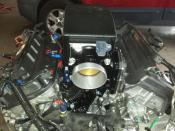




Very nice man!
You just happen to use the same brand of tape I use for all my engine builds HAHA
Are the heads machined or rebuilt? Just asking because I noticed the cam journals have some light scuffing in the lower region on more than one of them. Also, why are you running j30 heads?....just curious.
You just happen to use the same brand of tape I use for all my engine builds HAHA
Are the heads machined or rebuilt? Just asking because I noticed the cam journals have some light scuffing in the lower region on more than one of them. Also, why are you running j30 heads?....just curious.

J30 heads have smaller combustion chamber 86mm vs 89mm. He will get a bump in compression ratio.
Very nice man!
You just happen to use the same brand of tape I use for all my engine builds HAHA
Are the heads machined or rebuilt? Just asking because I noticed the cam journals have some light scuffing in the lower region on more than one of them. Also, why are you running j30 heads?....just curious.
You just happen to use the same brand of tape I use for all my engine builds HAHA
Are the heads machined or rebuilt? Just asking because I noticed the cam journals have some light scuffing in the lower region on more than one of them. Also, why are you running j30 heads?....just curious.
And yes, I am boosted.
So I should ask....how much do you estimate I lose with these heads?
Last edited by KN_TL; May 24, 2015 at 01:22 PM.
But yeah, you would definitely be limited in the amount of boost you would be allowed before encountering a knock threshold. Not to mention the smaller chamber diameter (86mm) opposed to the bore diameter (89mm) creating a poor environment for the combustion process itself. Think about that 1.5mm lip hanging over the edge on both sides.
I'd first confirm that the heads actually have an 86mm chamber because though I'm sure they do, I've never messed with the j30 heads. But I have measured j30a heads from a 6g Accord and they had the 86mm chambers so that's why I feel its safe to assume these do too.
Trust me they do have 86mm combustion. I fucked up my compression ratio in my j30a5 build instead of gaining 0.3. I lost 0.3 and am at 9.6x to 1. So time for me to look into boosting
It's really more of a question of what you would GAIN in regards to compression ratio. Lol.
But yeah, you would definitely be limited in the amount of boost you would be allowed before encountering a knock threshold. Not to mention the smaller chamber diameter (86mm) opposed to the bore diameter (89mm) creating a poor environment for the combustion process itself. Think about that 1.5mm lip hanging over the edge on both sides.
I'd first confirm that the heads actually have an 86mm chamber because though I'm sure they do, I've never messed with the j30 heads. But I have measured j30a heads from a 6g Accord and they had the 86mm chambers so that's why I feel its safe to assume these do too.
But yeah, you would definitely be limited in the amount of boost you would be allowed before encountering a knock threshold. Not to mention the smaller chamber diameter (86mm) opposed to the bore diameter (89mm) creating a poor environment for the combustion process itself. Think about that 1.5mm lip hanging over the edge on both sides.
I'd first confirm that the heads actually have an 86mm chamber because though I'm sure they do, I've never messed with the j30 heads. But I have measured j30a heads from a 6g Accord and they had the 86mm chambers so that's why I feel its safe to assume these do too.




Team Owner
Joined: Mar 2006
Posts: 20,172
Likes: 1,818
From: Bakersfield
---Responses for IHC---
On timing belt stress caused by horsepower: A few points to validate my explanation would be that the timing belt is simply a means of transferring 'mechanical energy' to various areas of the engine and when this energy increases, so does the stress applied to the belt. Stress from higher acceleration rates in the engines speed and also from the enormous chamber pressures (especially FI motors) are probably the two biggest factors. This stress is all put back into the belt usually between the crankshaft and the cam gears which is why you will see some boosted engines bust off an idler pulley in extreme cases. Also, a quick Google search reveals many performance oriented timing belts are rated by its horsepower handling capability.
On oil squirters and running higher boost: Flexer pretty much summed it up. Technically speaking (again), the heat that CAN BE removed from the piston and even the rings, could easily enable one engine to run slightly more boost or even timing (FI and NA motors) especially if the heat removed is substantial. Isn't that after all why they are added in the first place: to effectively remove heat for gaining power by some fashion (ie: increasing compression ratio)? So again, though it's not a direct means of being able to run higher boost levels, can anyone argue against a theory not only easily understood in its explanation but also supported by so many manufacturers and people? Engine building, after all, is based off of everyone's theories and what works best for whatever reasons. There is no Official Engine Building Rulebook to abide by. As far as I can remember, most of the worlds best engine builders became just that because they decided to take a different approach to the common ways of doing what it is they do.
KN_TL, I agree with the member above who made the statement about learning the hard way due to trying to save a few bucks. That's great advice. You put fourth all the effort, time, money into this motor and when something breaks that cost a fraction of what everything else did, its a lesson learned the absolute hardest way.
A perfect example of this would be of a short stroke engine I built back when 70's Chevy trucks were still cool and I went skimpy on some aftermarket head gaskets. One of the gaskets failed and leaked coolant into two cylinders unknowingly while driving. Both cylinders hydrau-locked and trashed my brand new TRW pistons....UGH! It was the a ONLY part of the build I skimped on and it came back and stole my glory.
On timing belt stress caused by horsepower: A few points to validate my explanation would be that the timing belt is simply a means of transferring 'mechanical energy' to various areas of the engine and when this energy increases, so does the stress applied to the belt. Stress from higher acceleration rates in the engines speed and also from the enormous chamber pressures (especially FI motors) are probably the two biggest factors. This stress is all put back into the belt usually between the crankshaft and the cam gears which is why you will see some boosted engines bust off an idler pulley in extreme cases. Also, a quick Google search reveals many performance oriented timing belts are rated by its horsepower handling capability.
On oil squirters and running higher boost: Flexer pretty much summed it up. Technically speaking (again), the heat that CAN BE removed from the piston and even the rings, could easily enable one engine to run slightly more boost or even timing (FI and NA motors) especially if the heat removed is substantial. Isn't that after all why they are added in the first place: to effectively remove heat for gaining power by some fashion (ie: increasing compression ratio)? So again, though it's not a direct means of being able to run higher boost levels, can anyone argue against a theory not only easily understood in its explanation but also supported by so many manufacturers and people? Engine building, after all, is based off of everyone's theories and what works best for whatever reasons. There is no Official Engine Building Rulebook to abide by. As far as I can remember, most of the worlds best engine builders became just that because they decided to take a different approach to the common ways of doing what it is they do.
KN_TL, I agree with the member above who made the statement about learning the hard way due to trying to save a few bucks. That's great advice. You put fourth all the effort, time, money into this motor and when something breaks that cost a fraction of what everything else did, its a lesson learned the absolute hardest way.
A perfect example of this would be of a short stroke engine I built back when 70's Chevy trucks were still cool and I went skimpy on some aftermarket head gaskets. One of the gaskets failed and leaked coolant into two cylinders unknowingly while driving. Both cylinders hydrau-locked and trashed my brand new TRW pistons....UGH! It was the a ONLY part of the build I skimped on and it came back and stole my glory.
Quicker engine acceleration (revving) increases timing belt stress as the belt has to accelerate the cams but most turbo engines aren't known for their super crisp throttle response. Using a lightweight flywheel and/or pulley would necessitate a stronger timing belt if this were significant.
Power has no effect on timing belt stress. The bottom end handles the stresses of additional power. The belt is totally unaware whether it's making 100hp or 1,000hp. The exhaust valves open toward the end of the power stroke when most of the energy should be spent assuming timing is not too retarded. Additionally you have boost pressure trying to help open the intake valves. Boost actually reduces timing belt stress. This is why high boost turbo engines tend to float valves easier and sometimes require stiffer springs. The additional back pressure on the backside of exhaust valves doesn't hurt either.
High rpm is usually a non factor. Most valvetrains require less power to spin at high rpm than low rpm. We used to have a setup used to break in cams before the engine was fired. The valvetrain is fully assembled and is spun with an electric motor at various rpm. Current draw was consistently less at 3,500rpm than at 500 rpm. I believe Google would agree in most cases.
The most stress your timing belt will ever see is revving in neutral because the engine will never accelerate as quickly in gear.
In theory, sure, squirters can allow more boost due to piston cooling. In practice it's not measurable if it's there at all. Squirters can be beneficial for piston reliability during extended full throttle runs but not for power.
Detonation or worse, preigniton does not occur from a piston being hot. It's from hot spots, something that's hot enough to ignite the air/fuel in the combustion chamber which is higher than the melting point of aluminum. If the piston is hot enough to cause detonation you have much bigger problems like rebuilding the engine. On the flip side a cooler piston means lower thermal efficiency. Will the lower thermal efficiency ever make a dent in power in real life? Nope, just like a not jetted and 10F hotter piston will never cost power because they have zero effect on detonation threshold. Spraying 250F oil on a 400F piston does little compared to its main cooling, the 50F air and fuel on the intake stroke but it's good insurance to ensure reliability on extended full throttle operation.
Let's not forget that the factory does things for weird reasons. It's not abnormal to have squirters spray one of the hottest parts of the engine to help warm the oil up quicker in many low hp applications such as these cars. Getting the oil up to temp as quickly as possible is one of the most important factors for long engine life. If the factory uses a low mass piston, squirters become more important as well.
So basically, the timing belt has no idea how much power the engine is making and boost reduces stress on the belt.
Piston squirters do not increase detonation threshold in practice but they're never a bad idea and to be most effective a good oil cooler should be run with a thermostat to keep oil around 200F.

I'm inclined to think there are far more people that want that peace of mind than don't, considering the availability of the heavy duty timing belt.
To be honest, he bothers because he can't stand to let Robert have the last word on anything. Some kind of personal obsession...
Team Owner
Joined: Mar 2006
Posts: 20,172
Likes: 1,818
From: Bakersfield
I guess I look at that a bit different - you have a LOT of time and money in your setup. How much extra was the heavy duty belt? Even if it was $100 more, is that not worth the peace of mind in the grand scheme of it all? If you ran a stock timing belt and then it snapped on a WOT pull, wouldn't you be pretty pissed wondering if the heavy duty belt would have prevented it?
I'm inclined to think there are far more people that want that peace of mind than don't, considering the availability of the heavy duty timing belt.
To be honest, he bothers because he can't stand to let Robert have the last word on anything. Some kind of personal obsession...
I'm inclined to think there are far more people that want that peace of mind than don't, considering the availability of the heavy duty timing belt.
To be honest, he bothers because he can't stand to let Robert have the last word on anything. Some kind of personal obsession...
I saw a post directed at me and answered it factually and with no personal attacks. I guess that's too much for this clique to handle. Regardless Robert is dead wrong about what causes additional stress on a belt, this is not my opinion against his, it's established facts against his. I know you guys don't like facts if it goes against one of you.
Team Owner
Joined: Mar 2006
Posts: 20,172
Likes: 1,818
From: Bakersfield
Why I bother is in the interest of keeping this factual and accurate when possible. Normally I would say why not go with the stronger belt for peace of mind. However, the factory belt is known for its reliability with millions of Hondas running basically the same belt for 100,000+ miles with a very low failure rate. These stronger belts are not proven over high mileage. Since your belt will have less stress on it while under boost than stock and you know stock is very reliable while you don't know how the "stronger" belt will hold up over time. So you're not gaining peace of mind with the stronger belt as it would seem on the surface, you're taking a gamble. That's my view. You're taking very one dimensional advice that does not capture the big picture most of the time and operates on unproven theories but that's your choice.


Though nobody can prove which one broke first, the tensioner or the belt, this boosted j-series would have most DEFINITELY benefitted from that really unnecessary, expensive blue timing belt and redesigned, stronger tensioner:
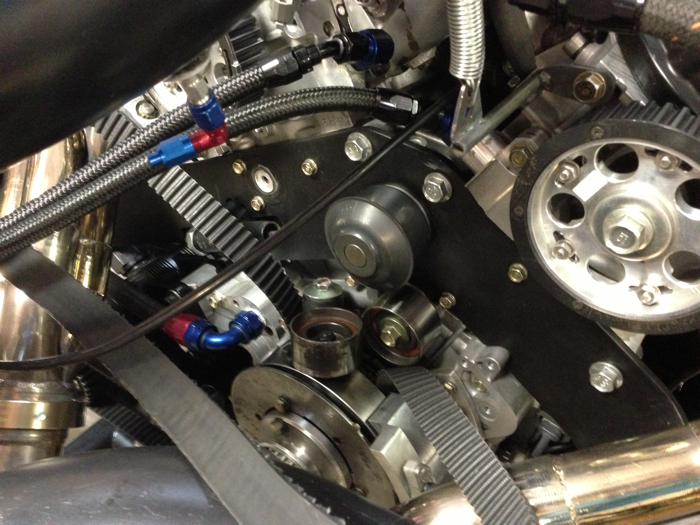
Just saying...
Nothing beats peace of mind when you're driving a car that's been completely re-engineered for a purpose that in no manner reflects its original intent. Can't tell you how many times I've been driving my car and thought to myself: I'm sure glad I didn't settle on just any parts when building this beast. And not just parts either. Also, the quality and attention to details I invested into her that give me ACTUAL comfort in using it as a daily driver. Being able to truly enjoy the experience is only brought by the phrase above: "peace of mind".
IHC's is a swell guy and if it weren't for his obnoxious, distasteful personality, why we would be BFFs!!!
Just saying...
I guess I look at that a bit different - you have a LOT of time and money in your setup. How much extra was the heavy duty belt? Even if it was $100 more, is that not worth the peace of mind in the grand scheme of it all? If you ran a stock timing belt and then it snapped on a WOT pull, wouldn't you be pretty pissed wondering if the heavy duty belt would have prevented it?
I'm inclined to think there are far more people that want that peace of mind than don't, considering the availability of the heavy duty timing belt.
I'm inclined to think there are far more people that want that peace of mind than don't, considering the availability of the heavy duty timing belt.
IHC's is a swell guy and if it weren't for his obnoxious, distasteful personality, why we would be BFFs!!!

Burning Brakes
Joined: Aug 2012
Posts: 892
Likes: 357
From: SE Wisconsin
I would bet the tensioner bolt broke first, however I want to see a picture of the belt break, that would be helpful. The edges of the portion of belt shown in the picture looked frayed. I don't care if you had a super fancy timing belt if your tensioner falls off your going to have a bad day. Either way a nice blue timing belt from Gates is good insurance due to it's strength and heat resistance.

That sucks, is this your engine?
I would bet the tensioner bolt broke first, however I want to see a picture of the belt break, that would be helpful. The edges of the portion of belt shown in the picture looked frayed. I don't care if you had a super fancy timing belt if your tensioner falls off your going to have a bad day. Either way a nice blue timing belt from Gates is good insurance due to it's strength and heat resistance.
I would bet the tensioner bolt broke first, however I want to see a picture of the belt break, that would be helpful. The edges of the portion of belt shown in the picture looked frayed. I don't care if you had a super fancy timing belt if your tensioner falls off your going to have a bad day. Either way a nice blue timing belt from Gates is good insurance due to it's strength and heat resistance.
This motor is now said to be at 40lbs+ of boost and making xxxx digit numbers on the dyno.

FYI, Gates is the oem manufacturer for Honda/Acura. Both belts are made by Gates.
Burning Brakes
Joined: Aug 2012
Posts: 892
Likes: 357
From: SE Wisconsin

Sorry for continuing off topic posts on your thread KN.

Senior Moderator


Joined: Aug 2002
Posts: 81,385
Likes: 3,068
From: Appleton WI
Though nobody can prove which one broke first, the tensioner or the belt, this boosted j-series would have most DEFINITELY benefitted from that really unnecessary, expensive blue timing belt and redesigned, stronger tensioner:

Just saying...
Nothing beats peace of mind when you're driving a car that's been completely re-engineered for a purpose that in no manner reflects its original intent. Can't tell you how many times I've been driving my car and thought to myself: I'm sure glad I didn't settle on just any parts when building this beast. And not just parts either. Also, the quality and attention to details I invested into her that give me ACTUAL comfort in using it as a daily driver. Being able to truly enjoy the experience is only brought by the phrase above: "peace of mind".
IHC's is a swell guy and if it weren't for his obnoxious, distasteful personality, why we would be BFFs!!!
Just saying...
Nothing beats peace of mind when you're driving a car that's been completely re-engineered for a purpose that in no manner reflects its original intent. Can't tell you how many times I've been driving my car and thought to myself: I'm sure glad I didn't settle on just any parts when building this beast. And not just parts either. Also, the quality and attention to details I invested into her that give me ACTUAL comfort in using it as a daily driver. Being able to truly enjoy the experience is only brought by the phrase above: "peace of mind".
IHC's is a swell guy and if it weren't for his obnoxious, distasteful personality, why we would be BFFs!!!
I thought he said it was the bolt for the tensioner?
Back at it again. Lapped valves on the heads I picked up and got them installed.
Need to drill a few holes in the floor to use one leg of my lift as a hoist and I drop it on the subframe next.
Hopefully things will move along more quickly now that most of the household things are done.


Need to drill a few holes in the floor to use one leg of my lift as a hoist and I drop it on the subframe next.
Hopefully things will move along more quickly now that most of the household things are done.



Senior Moderator

Joined: Feb 2006
Posts: 21,418
Likes: 2,188
From: Space Coast, FL
^agree, I believe so. Look at how the belt is lying, if it was split then the front (side with the tensioner still attached) would be lying outwards, not thrown over towards the other belt.
This is why new bolts should be used on high HP builds every time. Most bolts used are custom for honda, so newer hardware on a XXXX HP motor should have been used in the first place, even if it was a 400+HP car, I still wouldn't use the old bolts!
This is why new bolts should be used on high HP builds every time. Most bolts used are custom for honda, so newer hardware on a XXXX HP motor should have been used in the first place, even if it was a 400+HP car, I still wouldn't use the old bolts!