


HID and fog lights, changing at the same time?


Thread Starter
Advanced
Joined: Apr 2014
Posts: 78
Likes: 4
HID and fog lights, changing at the same time?
i have a fog light out and my lights seem dim. i just got a good deal on 10000k hid that reading from the reviews, they actually seem more like 8000k which is what i wanted and i got some 8000k fogs and im doing this all at the same time. is there a good way about doing this ( taking bumper off or not, etc.)
also do i absolutely need the security torx screw for the back of the light? will anything else work like pliers or something? i just want to make sure i have all the tools needed and i feel thats the only thing i dont have. id like to hear how you guys have done this! thanks in advance guys!
also do i absolutely need the security torx screw for the back of the light? will anything else work like pliers or something? i just want to make sure i have all the tools needed and i feel thats the only thing i dont have. id like to hear how you guys have done this! thanks in advance guys!



Thread Starter
Advanced
Joined: Apr 2014
Posts: 78
Likes: 4
i do take pride in the way my car looks so sure. i believe i can get both visibility and looks with the 8000k and after all hid is a more powerful light source to begin with. again thats not what this thread is about.
Instructor
Joined: Jul 2013
Posts: 134
Likes: 16
From: Central Ohio
Definitely change in pairs, as the color difference will bug you, at least it did me. Bumper removal is honestly easiest way, and torx bits are a necessity. I remove the headlight housings and change the bulbs on the kitchen table, closer to the beer in the fridge anyway. Disassembly & reassembly is the longest part of the job.
Trending Topics


Senior Moderator


Joined: Aug 2002
Posts: 81,385
Likes: 3,068
From: Appleton WI
As for your question, No, you dont need to take your bumper off to do it. It may help for adding the kit to the fogs. Get the security torx and be done with it. It will make the job easier.
Thread Starter
Advanced
Joined: Apr 2014
Posts: 78
Likes: 4
okay, just a quick follow up…i ordered the security torx bits off ebay for 5$ and i just went and ordered the 6000K hid bulbs as well. ill keep the 10000k around if i ever get the blues LOL but i think what it came down to for me was i just didnt want the cops up my butt. i still personally like the way it looks however!  but i litterally only paid 15$ for the 10000k so i guess its good to just have some kind of spare.
but i litterally only paid 15$ for the 10000k so i guess its good to just have some kind of spare.

Moderator
Joined: Jan 2009
Posts: 6,509
Likes: 1,021
From: Baja, México.
You don't lose nothing with 8K vs 6K the difference is just not there.. Having used 8K for Years now +5 at least I haven't had a single issue with them, Neither with cops or just seeing the road... Perhaps some need an eye-scan.
Not seeing the road? PLEASE! I haven't seen a single car Halogen High Bulb beam lighting up more than my 8K Lows/Fogs even less Vs my 5K High Beams.. And I´m Talking about 15 bucks 8K Lows not some fancy off-brand...
Ive used it All Kelvin Ratings up to 12,000K.. And 8K are still useable the difference is in the Color HUE not Brightness.
Not seeing the road? PLEASE! I haven't seen a single car Halogen High Bulb beam lighting up more than my 8K Lows/Fogs even less Vs my 5K High Beams.. And I´m Talking about 15 bucks 8K Lows not some fancy off-brand...
Ive used it All Kelvin Ratings up to 12,000K.. And 8K are still useable the difference is in the Color HUE not Brightness.
Last edited by Skirmich; May 14, 2014 at 08:13 PM.
Senior Moderator
Joined: Aug 2002
Posts: 81,385
Likes: 3,068
From: Appleton WI
You don't lose nothing with 8K vs 6K the difference is just not there.. Having used 8K for Years now +5 at least I haven't had a single issue with them, Neither with cops or just seeing the road... Perhaps some need an eye-scan.
Not seeing the road? PLEASE! I haven't seen a single car Halogen High Bulb beam lighting up more than my 8K Lows/Fogs even less Vs my 5K High Beams.. And I´m Talking about 15 bucks 8K Lows not some fancy off-brand...
Ive used it All Kelvin Ratings up to 12,000K.. And 8K are still useable the difference is in the Color HUE not Brightness.
Not seeing the road? PLEASE! I haven't seen a single car Halogen High Bulb beam lighting up more than my 8K Lows/Fogs even less Vs my 5K High Beams.. And I´m Talking about 15 bucks 8K Lows not some fancy off-brand...
Ive used it All Kelvin Ratings up to 12,000K.. And 8K are still useable the difference is in the Color HUE not Brightness.
But There IS a difference in LUMENS, Over A 1k difference between stock and 8k. That is usable light. While they may "appear every bit as bright they arent as good for visibility. Its not one mans opinion, its fact. Brightness of the bulb is often confused as good for visibility.
Last edited by fsttyms1; May 15, 2014 at 08:50 AM.
Senior Moderator
Joined: Aug 2002
Posts: 81,385
Likes: 3,068
From: Appleton WI
Taken from this site
http://www.toyota-4runner.org/engine...then-some.html
And more info can be found at
http://www.hidplanet.com/forums/forum.php
Terms:
Watt- Measure of electrical power (w)
Volt- Measure of electrical charge (v)
Kelvin- Measure of color temperature (K)
Lumen- Measure of light brightness (lu)
Capsule- technically correct term for a HID "bulb".
Candela- Measure of light intensity (cd)
Ampere- Measure of electrical current
Cut-off- A distinctive line of light produced by the shield in a headlight that blocks light above a certain height in order to prevent blinding of oncoming motorists.
Beam Pattern- The pattern of light that is projected onto the ground which includes angle of lateral dispersion, width and depth of illumination.
Capsule- Another term for an HID bulb. Some refer to HID bulbs as gas discharge capsules.
Optics- The lighting control assembly structured around the bulb, which effects the dispersion of light and it's characteristics to a great degree.
HID (High Intensity Discharge)= Gas Discharge
Halogen= Incandescence
What is HID?
HID technology is also known as gas discharge (High Intensity Discharge) and is quite different from halogens. HID uses a capsule (bulb) with two adjacent electrodes positioned in close proximity to each other. The capsule sends these two leads to an electronic HID ballast. The ballast is an electronic module that has a circuit board lined with several small high current capacitors, transistors, and resistors. This ballast acts as an ignition box to fire up the gas discharge process, and as a control unit to regulate a steady power flow. The HID capsule is filled with a rich mixture of noble gases as well as alkali earth metal salts. In this setup, the noble gases and metal salts are actually used as part of the lighting processes instead of as a buffer (as with halogens). For quick ignition, the ballast takes in a small amount of input power of 35 watts at 12 volts and inducts a solid-state charge of 25,000 volts to the positive electrode. This creates a very high-powered arc of electricity across the electrodes, which excites xenon gas into discharging photon particles (light). This process is known as the Gas Discharge Principle.
The light is relatively cool burning compared to halogen, consumes much less power, and produces much more light at a much higher color temperature. Halogen lighting in automobiles has become an archaic technology and is steadily being replaced by HID lighting systems in more and more automobiles. They are no longer limited in availability as high-end luxury amenities. Nissan, Toyota, GM and Ford are already offering factory HIDs in some of their cars.
Bulbs / KELVINS:
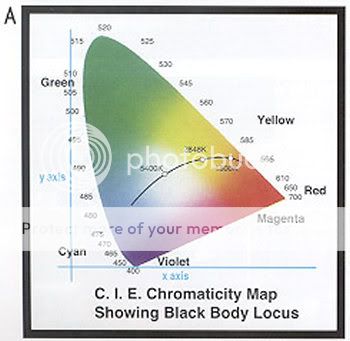
Now that we know what HID is, let’s continue to where it takes place. The capsule or bulb. The common mistake some people hear is that all these high kelvin rated bulbs are "the ones to have". If it is brightness you are after, then they are wrong. The higher you go in kelvin, the less light and lumens you'll have. So what is the best bulb out there then you ask? 4100-4300k.There is a reason why auto manufactures use this kelvin rating. It has the most lumens out of all the HID bulbs produced. Below is a graph showing you the variances of the light spectrum. As you can see, 4100k would be right where the "sweet spot" is on that chart. It produces near to the suns same kelvin thus giving you daylight-like output. Think of it like this, high kelvin bulbs would be like being out in the sun with sunglasses on vs. a 4100k being in the sun w/o glasses on.
Misconceptions:
"Why does my friend's headlights look brighter than mine and he has xxxx-K temperature bulbs???"- The reason higher Kelvin bulbs may appear brighter is that they are actually glaring more off of the road surface. Glare is NOT how light output is measured. It's annoying, very distracting and dangerous for oncoming drivers. Anything above a 6000K color rating is extremely ineffective & can be deemed practically useless. 6000K is generally the highest Kelvin rating you can go without losing too much luminosity or creating too much glare. The higher the Kelvin rating, the lower the lumen output is.
When the Kelvin rating is above 6000K, generally the lumen rating is around 2000 or below. This actually puts the HID output level back in the category of Halogen Output. What about 3000K HID bulbs? A 3000K HID bulb is designed for foul-weather or fog situations. 3000K produces a yellow light that cuts through rain, snow & fog better than a white light.

Kelvin and its relationship to Lumens:
Standard OEM halogen 55W 9006(HB4) = 1100 lm (lumens)
* these ratings are approximate (lumens are a measure of intensity and Kelvins are a measure of color so a direct relationship isn’t easy to graph directly, but here is the best chart I could find)

Here is a list of Kelvin and Lumens. Please disregard the brand (Philips). These are here as a guide only.
4300k D2S Philips = 3200 lm (lumens)
4300k D2R Philips = 2800 lm (lumens)
4300k D2S Philips = 2400 lm (lumens) actually 5800k
4300k D2R Philips = 2000 lm (lumens) actually 5800k
4800k D4S/R (brand) = 3800 (lumens) ** brightest in the market
5800k D4S/R (brand) = 3300 (lumens)
7000k D2S other = 1790 lm (lumens) *(other bulb brand)
7000k D2R other = 1390 lm (lumens) *(other bulb brand)
8000k D2S other = 1180 lm (lumens) *(other bulb brand)
8000k D2R other = 780 lm (lumens) *(other bulb brand)
As you can observe, anything higher than 8000k, the light output significantly drops off, causing the light to be almost useless, less than halogen bulbs.
Here is picture, again these values are approximate, I include this for clarity.

Why 4100-4300K? OEM thoroughly tested.
4100K has been proven through tireless independent research by the Germans, Japanese, and Americans to be the most functional, truest white and thus the brightest possible color temperature. At this Kelvin, they produce the most lumens which is what you want.
Every car manufacturer in the world (including BMW and Audi) uses none other than a standard 4100K gas-discharge bulb. The reason being is that 4100K is daylight white in color and produces the same color visible light as direct sunlight. This is least fatiguing functional color on the eyes and produces the most comfortable contrast on the road.
Ballast:
The HID ballast is a counterpart to the bulb, and must match its electrical requirements exactly to the mixture of gas/salt in the bulb. The requirement is to turn 12volts DC into both an explosive charge at 24,000 volts momentarily, and then match the steady state 85 volts AC that the 35 watt capsules require to stay lit. This requires high frequency switching transistors, and makes a lot of heat and is very taxing. Smaller manufacturers may skimp on components inside the ballast, may not have water proof enclosures, or simply have a bad design which doesn't last.
HID Ballasts & Ignitors are the power plant of your HID system. A poor quality ballast will decrease the lifespan of your HID bulb. A ballast has two important functions. The first is to take the 12-volt input and turn it into a 20,000+ volt arc which ignites the HID bulb's Xenon gas & salts (this is also sometimes referred to as the headlight's "pretty startup". To me, it looks like a fluorescent light is turning on). The second function is to stabilize that arc and maintain it throughout the duration of the bulb being on.
A good quality ballast uses LESS amperage than a standard 55/60 watt halogen bulb. Startup amperage is generally spiked at around 9-10 amps for less than a fraction of a second & once the arc is stabilized it uses around 3-4 amps @ 35watts. Your average halogen bulb uses nearly 6-7 amps @ 55/60 watts ALL the time. Less amperage means less strain on your alternator and electrical system.
There are a variety of different ballasts available, each with their own fitment & rating. OEM ballasts such as Mitsubishi, Matsu$hita and Denso have often been used in the world of HID Retrofits due to their long-term reliability, durability & fail-safe features.
Aftermarket ballasts have always been viewed as less reliable and more troublesome than anything. This is mostly true, especially with the cheap Plug-n-Play Kits seen advertised everywhere. Morimotos are known to be very reliable aftermarket ballasts. OEM ballast such as Densos are second to none. Densos are the real McCoy (as the others mentioned above).
Look for ballast that are potted and/or waterproof. Because of the nature of an off-road ready 4Runner and water, this feature is especially important.
Relays
A relayed wiring harness will allow the user to safely wire up their Xenon/Halogen lighting and horn systems by running power directly from the battery through a relayed harness that will be triggered by a factory connector. This way you can assure the stock wiring system is not overloaded; which can cause long-term issues such as wires melting or even catching on fire. Using relays eliminates the need to power up your lighting system using the already insufficiently thin stock wiring. The output from your lighting system may be compromised if you do not use a relayed wiring harness since so may experience significant voltage drop by directly taking power from the stock wiring. Using relays and our thicker gauge wiring provides the right amount of current carrying capacity to bring your system up to full performance in a safe way.
Some have suggested that no relays are needed, but I like to err on the side of caution.
Reflector vs. Projectors:
This is a very touchy subject for people in most automotive forums. Can you install an HID kit into your reflective headlight (all generation 4Runners except 2006-2009)? Of course you can, many have done so including yours truly. Is it the correct way? Optically speaking, no. The following will give you a better understanding as to why this is. No doubt you will notice a much brighter light in front of your truck, but glare and hotspots are an issue.
Halogen Reflector
A factory halogen reflector housing uses a specific focal point & reflector design to control light output. This design is based around a halogen bulbs 360 degrees of light output or illumination. A halogen bulb creates 360 degrees of light due to its use of a filament.
http://www.toyota-4runner.org/engine...then-some.html
And more info can be found at
http://www.hidplanet.com/forums/forum.php
Terms:
Watt- Measure of electrical power (w)
Volt- Measure of electrical charge (v)
Kelvin- Measure of color temperature (K)
Lumen- Measure of light brightness (lu)
Capsule- technically correct term for a HID "bulb".
Candela- Measure of light intensity (cd)
Ampere- Measure of electrical current
Cut-off- A distinctive line of light produced by the shield in a headlight that blocks light above a certain height in order to prevent blinding of oncoming motorists.
Beam Pattern- The pattern of light that is projected onto the ground which includes angle of lateral dispersion, width and depth of illumination.
Capsule- Another term for an HID bulb. Some refer to HID bulbs as gas discharge capsules.
Optics- The lighting control assembly structured around the bulb, which effects the dispersion of light and it's characteristics to a great degree.
HID (High Intensity Discharge)= Gas Discharge
Halogen= Incandescence
What is HID?
HID technology is also known as gas discharge (High Intensity Discharge) and is quite different from halogens. HID uses a capsule (bulb) with two adjacent electrodes positioned in close proximity to each other. The capsule sends these two leads to an electronic HID ballast. The ballast is an electronic module that has a circuit board lined with several small high current capacitors, transistors, and resistors. This ballast acts as an ignition box to fire up the gas discharge process, and as a control unit to regulate a steady power flow. The HID capsule is filled with a rich mixture of noble gases as well as alkali earth metal salts. In this setup, the noble gases and metal salts are actually used as part of the lighting processes instead of as a buffer (as with halogens). For quick ignition, the ballast takes in a small amount of input power of 35 watts at 12 volts and inducts a solid-state charge of 25,000 volts to the positive electrode. This creates a very high-powered arc of electricity across the electrodes, which excites xenon gas into discharging photon particles (light). This process is known as the Gas Discharge Principle.
The light is relatively cool burning compared to halogen, consumes much less power, and produces much more light at a much higher color temperature. Halogen lighting in automobiles has become an archaic technology and is steadily being replaced by HID lighting systems in more and more automobiles. They are no longer limited in availability as high-end luxury amenities. Nissan, Toyota, GM and Ford are already offering factory HIDs in some of their cars.
Bulbs / KELVINS:
Now that we know what HID is, let’s continue to where it takes place. The capsule or bulb. The common mistake some people hear is that all these high kelvin rated bulbs are "the ones to have". If it is brightness you are after, then they are wrong. The higher you go in kelvin, the less light and lumens you'll have. So what is the best bulb out there then you ask? 4100-4300k.There is a reason why auto manufactures use this kelvin rating. It has the most lumens out of all the HID bulbs produced. Below is a graph showing you the variances of the light spectrum. As you can see, 4100k would be right where the "sweet spot" is on that chart. It produces near to the suns same kelvin thus giving you daylight-like output. Think of it like this, high kelvin bulbs would be like being out in the sun with sunglasses on vs. a 4100k being in the sun w/o glasses on.
Misconceptions:
"Why does my friend's headlights look brighter than mine and he has xxxx-K temperature bulbs???"- The reason higher Kelvin bulbs may appear brighter is that they are actually glaring more off of the road surface. Glare is NOT how light output is measured. It's annoying, very distracting and dangerous for oncoming drivers. Anything above a 6000K color rating is extremely ineffective & can be deemed practically useless. 6000K is generally the highest Kelvin rating you can go without losing too much luminosity or creating too much glare. The higher the Kelvin rating, the lower the lumen output is.
When the Kelvin rating is above 6000K, generally the lumen rating is around 2000 or below. This actually puts the HID output level back in the category of Halogen Output. What about 3000K HID bulbs? A 3000K HID bulb is designed for foul-weather or fog situations. 3000K produces a yellow light that cuts through rain, snow & fog better than a white light.
Kelvin and its relationship to Lumens:
Standard OEM halogen 55W 9006(HB4) = 1100 lm (lumens)
* these ratings are approximate (lumens are a measure of intensity and Kelvins are a measure of color so a direct relationship isn’t easy to graph directly, but here is the best chart I could find)
Here is a list of Kelvin and Lumens. Please disregard the brand (Philips). These are here as a guide only.
4300k D2S Philips = 3200 lm (lumens)
4300k D2R Philips = 2800 lm (lumens)
4300k D2S Philips = 2400 lm (lumens) actually 5800k
4300k D2R Philips = 2000 lm (lumens) actually 5800k
4800k D4S/R (brand) = 3800 (lumens) ** brightest in the market
5800k D4S/R (brand) = 3300 (lumens)
7000k D2S other = 1790 lm (lumens) *(other bulb brand)
7000k D2R other = 1390 lm (lumens) *(other bulb brand)
8000k D2S other = 1180 lm (lumens) *(other bulb brand)
8000k D2R other = 780 lm (lumens) *(other bulb brand)
As you can observe, anything higher than 8000k, the light output significantly drops off, causing the light to be almost useless, less than halogen bulbs.
Here is picture, again these values are approximate, I include this for clarity.
Why 4100-4300K? OEM thoroughly tested.
4100K has been proven through tireless independent research by the Germans, Japanese, and Americans to be the most functional, truest white and thus the brightest possible color temperature. At this Kelvin, they produce the most lumens which is what you want.
Every car manufacturer in the world (including BMW and Audi) uses none other than a standard 4100K gas-discharge bulb. The reason being is that 4100K is daylight white in color and produces the same color visible light as direct sunlight. This is least fatiguing functional color on the eyes and produces the most comfortable contrast on the road.
Ballast:
The HID ballast is a counterpart to the bulb, and must match its electrical requirements exactly to the mixture of gas/salt in the bulb. The requirement is to turn 12volts DC into both an explosive charge at 24,000 volts momentarily, and then match the steady state 85 volts AC that the 35 watt capsules require to stay lit. This requires high frequency switching transistors, and makes a lot of heat and is very taxing. Smaller manufacturers may skimp on components inside the ballast, may not have water proof enclosures, or simply have a bad design which doesn't last.
HID Ballasts & Ignitors are the power plant of your HID system. A poor quality ballast will decrease the lifespan of your HID bulb. A ballast has two important functions. The first is to take the 12-volt input and turn it into a 20,000+ volt arc which ignites the HID bulb's Xenon gas & salts (this is also sometimes referred to as the headlight's "pretty startup". To me, it looks like a fluorescent light is turning on). The second function is to stabilize that arc and maintain it throughout the duration of the bulb being on.
A good quality ballast uses LESS amperage than a standard 55/60 watt halogen bulb. Startup amperage is generally spiked at around 9-10 amps for less than a fraction of a second & once the arc is stabilized it uses around 3-4 amps @ 35watts. Your average halogen bulb uses nearly 6-7 amps @ 55/60 watts ALL the time. Less amperage means less strain on your alternator and electrical system.
There are a variety of different ballasts available, each with their own fitment & rating. OEM ballasts such as Mitsubishi, Matsu$hita and Denso have often been used in the world of HID Retrofits due to their long-term reliability, durability & fail-safe features.
Aftermarket ballasts have always been viewed as less reliable and more troublesome than anything. This is mostly true, especially with the cheap Plug-n-Play Kits seen advertised everywhere. Morimotos are known to be very reliable aftermarket ballasts. OEM ballast such as Densos are second to none. Densos are the real McCoy (as the others mentioned above).
Look for ballast that are potted and/or waterproof. Because of the nature of an off-road ready 4Runner and water, this feature is especially important.
Relays
A relayed wiring harness will allow the user to safely wire up their Xenon/Halogen lighting and horn systems by running power directly from the battery through a relayed harness that will be triggered by a factory connector. This way you can assure the stock wiring system is not overloaded; which can cause long-term issues such as wires melting or even catching on fire. Using relays eliminates the need to power up your lighting system using the already insufficiently thin stock wiring. The output from your lighting system may be compromised if you do not use a relayed wiring harness since so may experience significant voltage drop by directly taking power from the stock wiring. Using relays and our thicker gauge wiring provides the right amount of current carrying capacity to bring your system up to full performance in a safe way.
Some have suggested that no relays are needed, but I like to err on the side of caution.
Reflector vs. Projectors:
This is a very touchy subject for people in most automotive forums. Can you install an HID kit into your reflective headlight (all generation 4Runners except 2006-2009)? Of course you can, many have done so including yours truly. Is it the correct way? Optically speaking, no. The following will give you a better understanding as to why this is. No doubt you will notice a much brighter light in front of your truck, but glare and hotspots are an issue.
Halogen Reflector
A factory halogen reflector housing uses a specific focal point & reflector design to control light output. This design is based around a halogen bulbs 360 degrees of light output or illumination. A halogen bulb creates 360 degrees of light due to its use of a filament.


 100%
100%

Intermediate
Joined: Apr 2014
Posts: 38
Likes: 12
I used a pair of needle nose pliers and was able to turn it until eventually I was able to get it out by hand.

Thread Starter
Advanced
Joined: Apr 2014
Posts: 78
Likes: 4
thanks fsttyms for all that info. and thanks again to enzytebob, thats what i was looking to hear. just recieved my torx bits yesterday in the mail so good to know that they should be able to come off with pliers too!
Pro
Joined: Feb 2014
Posts: 673
Likes: 63
You don't lose nothing with 8K vs 6K the difference is just not there.. Having used 8K for Years now +5 at least I haven't had a single issue with them, Neither with cops or just seeing the road... Perhaps some need an eye-scan.
Not seeing the road? PLEASE! I haven't seen a single car Halogen High Bulb beam lighting up more than my 8K Lows/Fogs even less Vs my 5K High Beams.. And I´m Talking about 15 bucks 8K Lows not some fancy off-brand...
Ive used it All Kelvin Ratings up to 12,000K.. And 8K are still useable the difference is in the Color HUE not Brightness.
Not seeing the road? PLEASE! I haven't seen a single car Halogen High Bulb beam lighting up more than my 8K Lows/Fogs even less Vs my 5K High Beams.. And I´m Talking about 15 bucks 8K Lows not some fancy off-brand...
Ive used it All Kelvin Ratings up to 12,000K.. And 8K are still useable the difference is in the Color HUE not Brightness.
I put 6000K on my car and wish I had stuck with 4300K instead. They don't look "cool" (let alone the full on blue or purple of 8000-1000K... yuck) and they don't have as much usable light.
Moderator
Joined: Jan 2009
Posts: 6,509
Likes: 1,021
From: Baja, México.
Again 5 Years, with Rain, Fog, All weather... I just might have some incredible powerful inhuman eyes because I haven't had a single issue with 8K Lows/Fogs. I hardly use High Beams at all and those are 5K HIDs which light up so much that its insane! I bother incoming traffic from at least half a mile away but remember! Lows are shielded.
The difference is in HUE not perceived brightness If only the light color weren't different you would understand what I'm talking about.. Light output is overall the same between 6K and 8K the thing that changes its the color!!! Some people can handle it and some other obviously cant.
The difference is in HUE not perceived brightness If only the light color weren't different you would understand what I'm talking about.. Light output is overall the same between 6K and 8K the thing that changes its the color!!! Some people can handle it and some other obviously cant.
Last edited by Skirmich; May 21, 2014 at 05:47 PM.
Moderator
Joined: Jan 2009
Posts: 6,509
Likes: 1,021
From: Baja, México.
Here is a list of Kelvin and Lumens. Please disregard the brand (Philips). These are here as a guide only.
4300k D2S Philips = 3200 lm (lumens)
4300k D2R Philips = 2800 lm (lumens)
4300k D2S Philips = 2400 lm (lumens) actually 5800k
4300k D2R Philips = 2000 lm (lumens) actually 5800k
*4800k D4S/R (brand) = 3800 (lumens) ** brightest in the market
5800k D4S/R (brand) = 3300 (lumens)
7000k D2S other = 1790 lm (lumens) *(other bulb brand)
7000k D2R other = 1390 lm (lumens) *(other bulb brand)
8000k D2S other = 1180 lm (lumens) *(other bulb brand)
8000k D2R other = 780 lm (lumens) *(other bulb brand)
4300k D2S Philips = 3200 lm (lumens)
4300k D2R Philips = 2800 lm (lumens)
4300k D2S Philips = 2400 lm (lumens) actually 5800k
4300k D2R Philips = 2000 lm (lumens) actually 5800k
*4800k D4S/R (brand) = 3800 (lumens) ** brightest in the market
5800k D4S/R (brand) = 3300 (lumens)
7000k D2S other = 1790 lm (lumens) *(other bulb brand)
7000k D2R other = 1390 lm (lumens) *(other bulb brand)
8000k D2S other = 1180 lm (lumens) *(other bulb brand)
8000k D2R other = 780 lm (lumens) *(other bulb brand)
Fatty sometimes dude... You make me ROFL there hard..
So basically by that chart my Lows light up less than a House 60w Halogen Bulb? Do you really believe that? DO YOU?
That light chart is wrong and you know it.. Its impossible that 8K lights up less than a House Halogen bulb and you know it man, cmon!
*4800K being 3800lm? hahahaha CMON MAN!!! You know 3800K has the biggest output of all at 3800lm..
I used most common HID Kelvins ratings dude, Literally in my TL.. 8K light as much as 6K but less than 5K its common knowledge..
Last edited by Skirmich; May 21, 2014 at 05:55 PM.

4300k it is!!!! LOL
There is nothing worse than a 92 honda civic with 3 tone paint and a missing fender with uneven aftermarket purple fog lights shinning in my eyes when I'm driving at night. Don't be THAT GUY!!!
There is nothing worse than a 92 honda civic with 3 tone paint and a missing fender with uneven aftermarket purple fog lights shinning in my eyes when I'm driving at night.
Don't be THAT GUY!!!
Pro
Joined: Feb 2014
Posts: 673
Likes: 63
Going 8000K will result in less light than a regular halogen. 10,000K even less.
Moderator
Joined: Jan 2009
Posts: 6,509
Likes: 1,021
From: Baja, México.
^ Have you tried them yourself or are you just another Internet-repeater?
For the 500th time.. Its impossible that an 8K Bulb give less than a Halogen Bulb even a 60W High Beam doesn't give as much light as an 8K Bulb... 5 Years with them.. All Kelvin Ratings used, this is experience talking here not "That Internet Page Said".
Why suddenly people starting saying 8K give less brightness than a Halogen Bulb? 2 Years ago they where just less bright than 5K now they are less bright than a Dashboard Light? What the hell is going on here?.. Are people that Naïve? How they make the jump from being less bright than 5K to being less Bright than a Candle Light? Miss-information is strong in this subject.
This video must be tampered!! 80W Halogen should be a million times better than 8K:
Tricked obviously:
This must be so wrong, Even the Lm Spectrum tracking is wrong Halogen is clearly the winner vs 8K:
Its pretty obvious people have no clue what they are talking about...
Keep popping more Internet Charts its obvious a Factual Video is tricked since a Chart Online says 8K gives less light than a Candle, Rationality just doesn't grow on some people.
For the 500th time.. Its impossible that an 8K Bulb give less than a Halogen Bulb even a 60W High Beam doesn't give as much light as an 8K Bulb... 5 Years with them.. All Kelvin Ratings used, this is experience talking here not "That Internet Page Said".
Why suddenly people starting saying 8K give less brightness than a Halogen Bulb? 2 Years ago they where just less bright than 5K now they are less bright than a Dashboard Light? What the hell is going on here?.. Are people that Naïve? How they make the jump from being less bright than 5K to being less Bright than a Candle Light? Miss-information is strong in this subject.
This video must be tampered!! 80W Halogen should be a million times better than 8K:
Tricked obviously:
This must be so wrong, Even the Lm Spectrum tracking is wrong Halogen is clearly the winner vs 8K:
Its pretty obvious people have no clue what they are talking about...
Keep popping more Internet Charts its obvious a Factual Video is tricked since a Chart Online says 8K gives less light than a Candle, Rationality just doesn't grow on some people.
Last edited by Skirmich; Jun 2, 2014 at 07:47 PM.
Pro
Joined: Feb 2014
Posts: 673
Likes: 63
^ Have you tried them yourself or are you just another Internet-repeater?
For the 500th time.. Its impossible that an 8K Bulb give less than a Halogen Bulb even a 60W High Beam doesn't give as much light as an 8K Bulb... 5 Years with them.. All Kelvin Ratings used, this is experience talking here not "That Internet Page Said".
For the 500th time.. Its impossible that an 8K Bulb give less than a Halogen Bulb even a 60W High Beam doesn't give as much light as an 8K Bulb... 5 Years with them.. All Kelvin Ratings used, this is experience talking here not "That Internet Page Said".
It is a well established fact that our eyes are less sensitive to light in the blue spectrum. 8000K bulbs may give off just as much radiated energy as 4200K, but our eyes see it as less bright.
The measurement of lumens specifically takes the absorption of the light by our eyes into account, that's why it shows less lumens for higher color temperature.
Lumen (unit)
From Wikipedia, the free encyclopedia
The lumen (symbol: lm) is the SI derived unit of luminous flux, a measure of the total "amount" of visible light emitted by a source. Luminous flux differs from power (radiant flux) in that luminous flux measurements reflect the varying sensitivity of the human eye to different wavelengths of light, while radiant flux measurements indicate the total power of all electromagnetic waves emitted, independent of the eye's ability to perceive it. A lux is one lumen per square meter.
From Wikipedia, the free encyclopedia
The lumen (symbol: lm) is the SI derived unit of luminous flux, a measure of the total "amount" of visible light emitted by a source. Luminous flux differs from power (radiant flux) in that luminous flux measurements reflect the varying sensitivity of the human eye to different wavelengths of light, while radiant flux measurements indicate the total power of all electromagnetic waves emitted, independent of the eye's ability to perceive it. A lux is one lumen per square meter.
Pro
Joined: Feb 2014
Posts: 673
Likes: 63
Also, nowhere in that last video do they state that the xenon comparison is using an 8000K bulb. If you look straight at the lights, the blue has more glare which makes you more of a distraction to other drivers while at the same time your usable light is less.
Senior Moderator
Joined: Aug 2002
Posts: 81,385
Likes: 3,068
From: Appleton WI
^ Have you tried them yourself or are you just another Internet-repeater?
Its pretty obvious people have no clue what they are talking about...
Keep popping more Internet Charts its obvious a Factual Video is tricked since a Chart Online says 8K gives less light than a Candle, Rationality just doesn't grow on some people.
Its pretty obvious people have no clue what they are talking about...
Keep popping more Internet Charts its obvious a Factual Video is tricked since a Chart Online says 8K gives less light than a Candle, Rationality just doesn't grow on some people.
Last edited by fsttyms1; Jun 4, 2014 at 07:50 AM.
Senior Moderator
Joined: Aug 2002
Posts: 81,385
Likes: 3,068
From: Appleton WI
Oh and ill do a side by side with you with my 5k bulbs, lets see who has brighter and more usable light. Better yet. Go buy yourself a set of CBIs, They are 5k and if you honestly think your 8k are brighter i will buy them from you (and pay for your vision test

Thread
Thread Starter
Forum
Replies
Last Post
prox
5G TLX Problems & Fixes
6
Sep 1, 2015 02:03 AM