When you click on links to various merchants on this site and make a purchase, this can result in this site earning a commission. Affiliate programs and affiliations include, but are not limited to, the eBay Partner Network.
I'm hunting and gathering in preparation for a coolant change on my '17 RDX. The manual shows a drain on the rear of the block but doesn't offer any other clue about the location. Is it on the left or right side of the block? Any other tips are welcome.
I'm just changing coolant based on age, the car only has 15k miles on it.
Don't bother. Honda long life coolant is amazing. The actual interval is 120k or 10 years I think. That said, it usually gets changed with the timing belt service because the water pump gets replaced. Don't think about it until then. If you might need to top off a little, make sure use the real thing. Even when changing it it should be the real thing. You will never get all the old coolant out anyway. This engine is used in Honda Odysseys with a rear heater core. Those things never get all the old coolant out and end up going to 300k with some of the factory fill in them.
I'm on my 10th Honda and have never had a coolant related issue. The only issues I remember reading about are a damaged radiator. Sometimes the electric fans have sensor issues.
it is not a Ford...
Thanks Egads, I appreciate the input.
I already have the Honda coolant and several jugs of distilled water on hand so plan to do the drain and fill out of an (over?) abundance of caution. I realize coolants have gotten much better over the years but my car is pretty much a grocery getter so is in the 'severe service' category, especially with summer temps of 115 or higher.
The distilled water is for the flush. I get all the old coolant out that I can (the block drain helps), refill the system with distilled and run until the fans cycle a couple of times then drain and fill again with new coolant.
Having change the coolant in my 2013 Sienna and 2015 Camry, I would recommend doing just a drain and fill. Long life coolant is impressive nowadays. Also If you don't get all the distilled water out, you have no way of telling what percentage of water to coolant you will have, throwing off the 50/50 mix.
Make sure you measure the strength of the coolant once you're done.
Also If you don't get all the distilled water out, you have no way of telling what percentage of water to coolant you will have, throwing off the 50/50 mix.
Make sure you measure the strength of the coolant once you're done.
Which is why I buy concentrated and not diluted coolant. I'll mix it at 60/40 or 65/35 for that reason alone.
And after some driving, I'll measure the concentration.
By the way, if you want to increase the concentration of the Honda coolant that is pre-diluted at 50/50, put some in pot and boil it. Of course you may be sleeping on the sofa if you are married.
Thanks DTown,
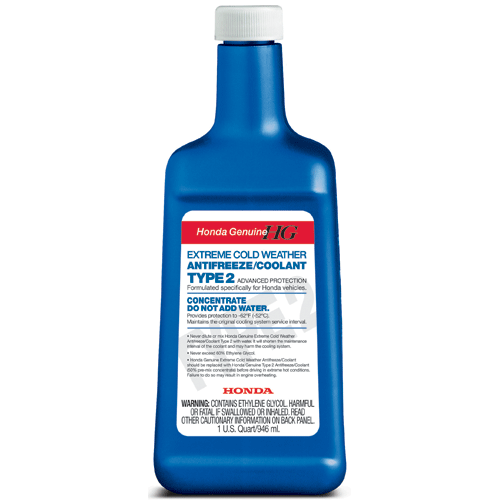
I live in the desert southwest so the water/chemical balance isn't all that critical (we don't get deep freezes). I did search for Honda Type 2 'concentrate' which I'd have preferred but couldn't find anything but this stuff. The label says 'concentrate' but then says 'do not add water.'
Last edited by Gadgetjq; Nov 28, 2021 at 01:18 PM.
That is what I thought when I did a search on Google Images for the Honda Long Life Antifreeze/Coolant Type 2. It looked blue; thanks for confirming that.
Honda doesn't make any fluids so they obviously get it from somewhere like all manufacturers do. So it looks like Valvoline ZEREX Asian (Blue) for Hondas will do the trick. Same for the Pentofrost A3 (blue). Both are a 50/50 mixture as well (probably where Honda gets it).
Well, that was easy, and I finally found the block coolant drain (photo below). If you're planning to do this at some point in the future or just want to know how it's done here's the how-to by the numbers. Note, the Gen2 RDX cooling system is supposed to take 1.7 gallons of coolant. My total drain from the engine and radiator was just a hair over 6.5 quarts so 1.625 gallons....pretty darn close and very little of the original coolant still in the system. Some owners don't believe in draining the block but I got 3.5 quarts from the block (and presumably the heater) so........
You will need
Two gallons of Honda pre-diluted coolant (or your choice of aftermarket)
At least two gallons of distilled water to be sure old coolant is rinsed (double that if you want to rinse twice)
1- 12mm wrench or socket
Towels (paper or old shop to clean spillage)
Aluminum turkey pan to catch old coolant
Funnel that fits in the (very small) radiator opening
Flashlight or work light
1. Park where you have good access to your RDX from the right side. Turn your front wheels all the way to the left so you can access the block drain.
2. Remove the radiator cap and the overflow tank cap. Pull straight up on the overflow tank to remove. Empty the contents into another container and rinse well. Replace but leave empty.
3. With the engine cold(ish), open the petcock (no tools needed) at the bottom right (passenger side) of the radiator. You can access it through a triangular opening in the plastic body pan. Warning, you're going to get coolant on your hand and probably down your forearm at least to your elbow so don't wear a long sleeve shirt. When all the coolant has drained from the radiator close the petcock and move your drain pan to the rear of the car about a foot.
4. It's time to find the engine block drain. Use the photo below and the flashlight to orient yourself. Look 'up' at the back of the block from the gap between your tire and the frame. Follow the axle toward the center of the car. When you get to the rubber boot look up and to the left. Once you have that 'ah-ha' moment you won't be able to un-see it. It's fairly easy to reach if you turned the wheels all the way to the left as mentioned above. Get a 12mm socket or wrench on the brass portion and give it the old lefty loosey action. Mine was really tight and required a bit of manly grunting and some breath holding before it finally broke loose. My knuckles are fine thanks. Turn the brass piece by hand until you're getting a nice stream into your catch pan. This time you'll probably only get coolant on your hand. When it's finished draining, tighten by hand then give it just a touch more with your wrench (you'll be opening it again).
4. With both drains closed start pouring your distilled water into the radiator. It's going to take a little over a gallon and a half (see pic below). Place the radiator cap loosely on the radiator and start the engine. While it's running keep checking the top radiator hose. When it starts getting warm, squeeze it a few times to help burp any air caught in the system. Leave the engine running until you feel really warm air coming from the heater. With both the heater and top radiator hose warm you know the distilled water is circulating through the system. Run the RPMs up a bit (2-3k) to help speed circulation and hold it there for a couple of minutes. Shut the engine down and......wait. It's going to take awhile for everything to cool down so go have lunch, grab an adult beverage, read a book. It helps if you have a box fan you can lay on top of the engine and let run on high speed.
5. When you can stick your finger into the top of the radiator and the liquid feels cool you can drain everything again. Radiator, block, just like before but this time tighten the block drain snugly (spec is 7ft lb). If you don't think the liquid that came out is clear enough feel free to do the rinse process again. Move your drain pan out of the way so you can't possibly, not no way not no how, trip over it.
6. Refill your radiator as you did with the water but this time with coolant. If you happen to spill a little don't worry it won't eat/melt anything and you should have some distilled water left over to do a rinse. You still have some coolant left in the jug and you also happen to need about a quart of it to bring your overflow tank up to the bottom (cold) mark or a hair higher. As before, warm everything up (heater still on high). Shut the engine down, check the coolant level in the radiator. If it has some air space, top it off. Go for a short drive, let the engine cool again and check coolant level.
7. All good? The next time you'll do this will be when you replace the timing belt and water pump which is just a bit more involved or five years whichever comes first.
Cheers!
Locate The Block Drain. It's a brass nipple a few inches above and a little to the left of the axle boot. Note: Fluid coming from drain is the flush mixture and is almost clear.
Real Honda Pre Mix Long Life (blue) Coolant
Roughly The Amount Of Distilled Water (I spilled a little) You'll Need For Each Rinse (if you've drained the block)
Last edited by Gadgetjq; Nov 29, 2021 at 02:19 PM.







 Turn the brass piece by hand until you're getting a nice stream into your catch pan. This time you'll probably only get coolant on your hand. When it's finished draining, tighten by hand then give it just a touch more with your wrench (you'll be opening it again).


