When you click on links to various merchants on this site and make a purchase, this can result in this site earning a commission. Affiliate programs and affiliations include, but are not limited to, the eBay Partner Network.
Does anyone know where the TMPS Antenna Location is? Part Number 39360-STK-A01
I'm having a "Check TPMS System" light on the dash and it's driving me nuts. I've replaced all TPMS sensors in the wheels with OEM sensors and the issue still persists. I had 3 local shops scan the issue with their scan tool and all say something similar to "TPMS not detected" which makes me think the computer is faulty, which I'm planning to change, but I bought this wrong part and just incase this part is bad I would like to know the location.
Also, if I change the TPMS computer is faulty and it's changed, does it need to be reprogrammed? Can anyone tell me what else could cause the TPMS System Issue? Thanks in advance!
Does anyone know where the TMPS Antenna Location is? Part Number 39360-STK-A01
I'm having a "Check TPMS System" light on the dash and it's driving me nuts. I've replaced all TPMS sensors in the wheels with OEM sensors and the issue still persists. I had 3 local shops scan the issue with their scan tool and all say something similar to "TPMS not detected" which makes me think the computer is faulty, which I'm planning to change, but I bought this wrong part and just incase this part is bad I would like to know the location.
Also, if I change the TPMS computer is faulty and it's changed, does it need to be reprogrammed? Can anyone tell me what else could cause the TPMS System Issue? Thanks in advance!
The part above is called an initiator sensor; #3 below, they appear to be located in the for corners?
I'm looking for the main module reciever. Are there modules for each wheels? I'm confused. Scanner tools are telling me nothing tpms related exists, as if no module is there to read. So my assumption is the reciever itself is bad. I've already changed all 4 wheel sensors already. Any insight would be appreciated
I'm looking for the main module reciever. Are there modules for each wheels? I'm confused. Scanner tools are telling me nothing tpms related exists...
I'm confused too.
Let's take a step back. Basics: most Hondas use a simple TPMS system that relies on the wheel speed sensors to figure out if the tire pressure is low. Our wonderful RDX has a more advanced system that actually reads each tire's pressure via a TPMS sensor in each wheelwell. This is the 'receiver' I assumed you were referring to.
You should be able to see each tire's pressure on that little display on the dash - do you? If so, all the TPMS sensor are reading properly; if not, you'll see which one is the issue.
At the end of the day, this is just a fancy system to help you avoid getting out of the car to check tire pressure..... but as long as you have another way to check your tire pressure, there's really no issue beyond the annoying TPMS system warnings.
Let's take a step back. Basics: most Hondas use a simple TPMS system that relies on the wheel speed sensors to figure out if the tire pressure is low. Our wonderful RDX has a more advanced system that actually reads each tire's pressure via a TPMS sensor in each wheelwell. This is the 'receiver' I assumed you were referring to.
You should be able to see each tire's pressure on that little display on the dash - do you? If so, all the TPMS sensor are reading properly; if not, you'll see which one is the issue.
At the end of the day, this is just a fancy system to help you avoid getting out of the car to check tire pressure..... but as long as you have another way to check your tire pressure, there's really no issue beyond the annoying TPMS system warnings.
Precisely this is what I'm talking about. I have a TPMS system error so I'm not sure what's not exactly working. I replaced all wheel sensors but it seems there are 4 recievers in each wheel well, but what communicates with those recievers? Are there a main computer? I doubt all (4) in wheel recievers would go bad at once, would they?
To answer your question, I'm not seeing any tire pressure at all just the warning light that shows TPMS System error. I can check my pressure manually but the light everytime I start the car is annoying and I'm an OCD clean dash type of person haha
Do you mean the wheel speed sensors? It would be helpful to know specifically which parts you replaced. Although other Hondas use the speed sensors to monitor tire pressure, the RDX does not.
I'm not seeing any tire pressure at all just the warning light that shows TPMS System error.
Ok so: when you're in the TPMS section of that menu, hit the SEL/RESET button - do you see something like the attached pic?
I have a feeling one of the TPMS sensors in the wheel needs to be replaced, which is fairly common because they run off a battery that eventually dies. When this happens, you get an annoying TPMS system error, but you should be able to see which wheel is the culprit by going into the TPMS menu as described above.
I've currently replaced 4 of these, I thought this would be the issue like you indicated, I thought the batteries ran down. Keep in mind I bought the vehicle used like this and didn't think it was an issue, but I'm getting fed up of the light haha.
Please let me know what I'm missing or doing wrong, thanks in advance!
Interesting - so you've replaced the actual TPMS sensors, which rules that out.
Just curious - what happens when you hit SEL/RESET while that screen is displayed? I'm guessing your RDX is a tech model b/c that display is different than mine.
I think there's a good chance you have an electrical/wiring issue with the TPMS itself - rare and unfortunately a difficult problem to chase down as a DIYer,
It might be worth sourcing/borrowing a Honda-specific OBDII reader. There are a number of DTCs that the TPMS can throw that universal code scanners won't read.
So I'm getting this warning message- I've currently replaced 4 of these,
Was step #9 below completed?
Tire Pressure Sensor Replacement
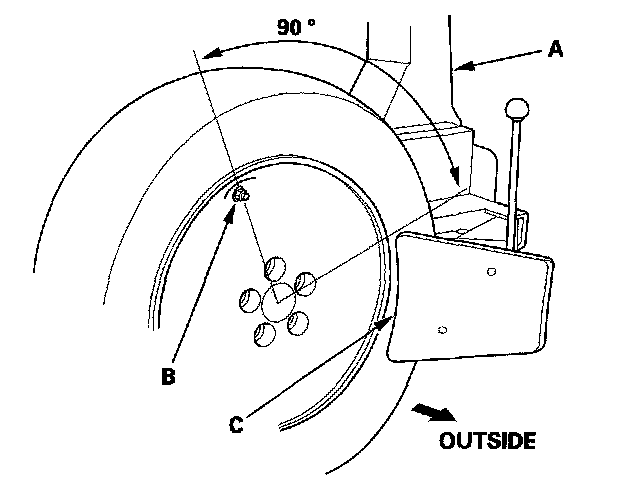
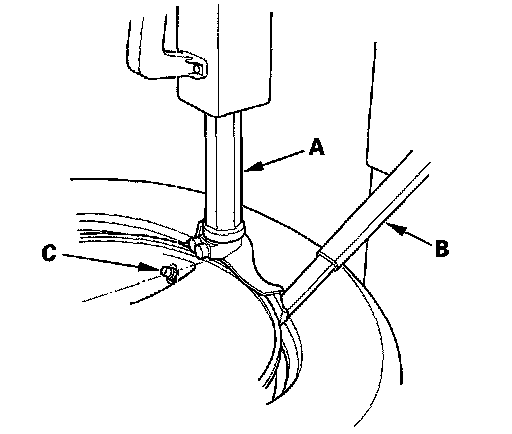
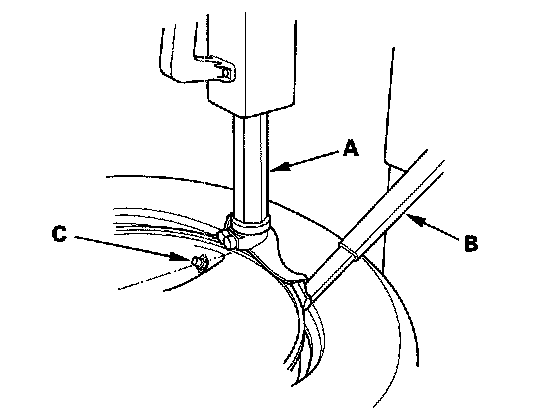
Tire Pressure Sensor Replacement Removal 1.Raise the vehicle, and support it with safety stands in the proper locations. 2.Remove the wheel with the faulty sensor. 3.Remove the tire valve cap and the valve core, and let the tire deflate. 4.Remove any balance weights, and then break the bead loose from the wheel with a commercially available tire changer (A). NOTICE Note these items to avoid damaging the tire pressure sensor: -Do the outside of the wheel first. -Position the wheel as shown so the valve stem (B) is 90 degrees from the bead breaker (C) as shown. -Do not position the bead breaker of the tire changer too close to the rim. 5.Position the wheel so the tire machine (A) and tire iron (B) are next to the valve stem (C) and will move away from it when the machine starts. Then remove the tire from the wheel.
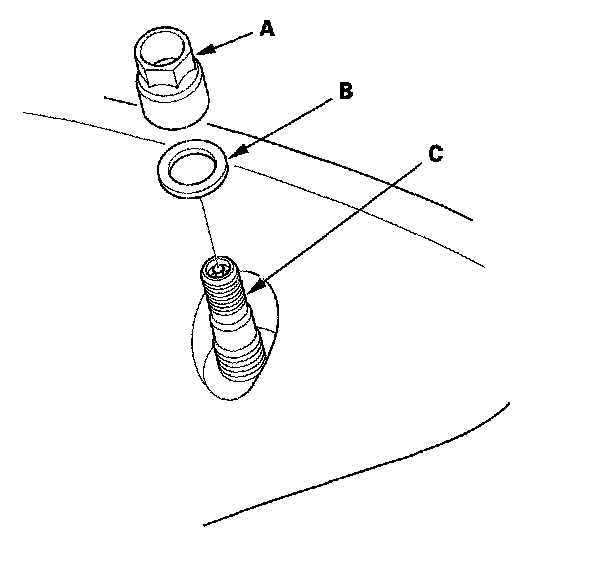
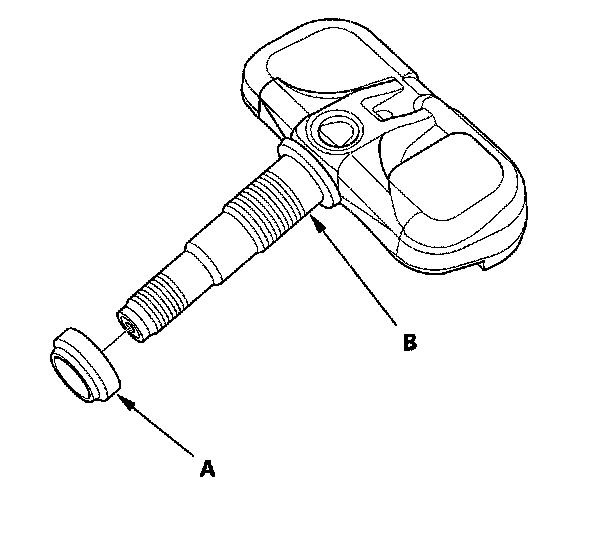
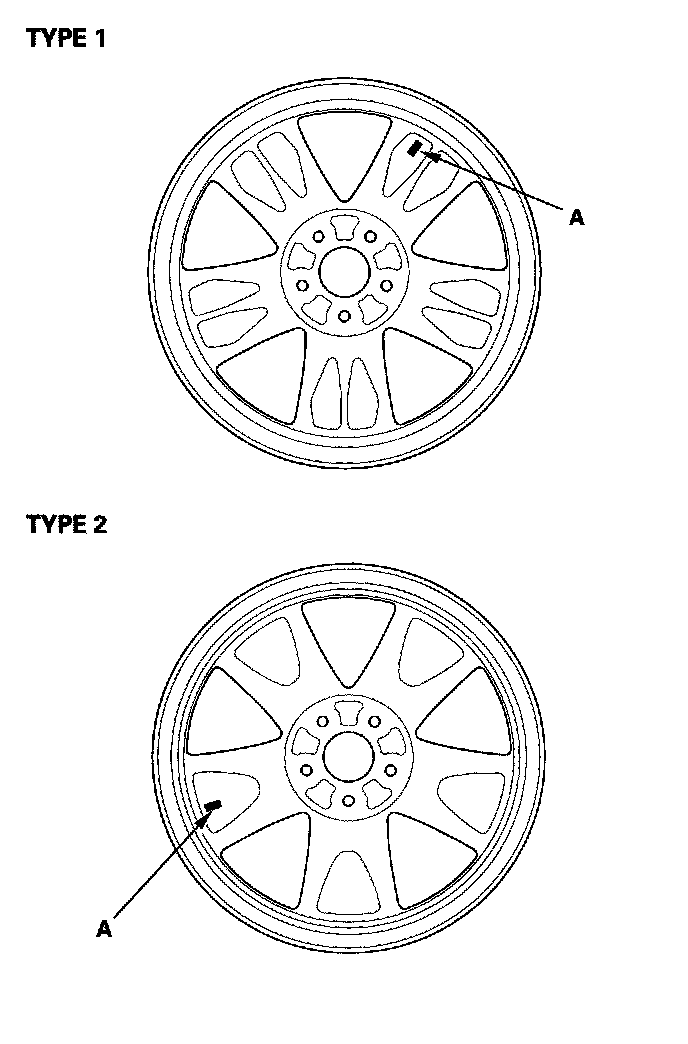
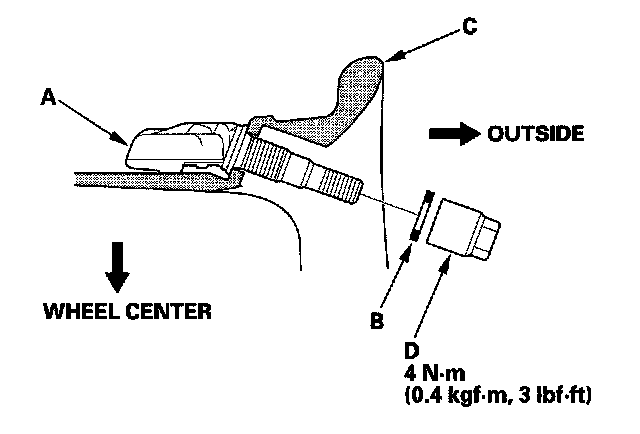
6.Remove the valve stem nut (A) and washer (B), then remove the tire pressure sensor with valve stem (C) from the wheel. 7.Remove and discard the valve stem grommet (A), from the tire pressure sensor (B). NOTE: -The valve stem grommet might stay in the wheel; make sure you remove it. -Always use a new valve stem grommet whenever the tire pressure sensor has been removed from the wheel. When only removing a tire from the wheel, replace the valve stem grommet if it is possible. Installation NOTE: -Use only wheels that have a "STK" stamp (A) on them. -This vehicle may be equipped with either type 1 or type 2 wheels. 1.Before installing the tire pressure sensor, clean the mating surfaces on the sensor and the wheel. 2.Install the tire pressure sensor (A) and the washer (B) to the wheel (C), and tighten the valve stem nut (D) finger tight. Make sure the pressure sensor is resting on the wheel. 3.Tighten the valve stem nut to the specified torque while holding the tire pressure sensor. NOTE: Do not use air or electric impact tools to tighten a valve stem nut. 4.Lube the tire bead, and position the wheel so the tire machine (A) and tire iron (B) are next to the valve stem (C) and will move away from it when the machine starts. Then install the tire onto the wheel.
5.Inflate the tire to 300 kPa (3.1 kgf/cm2, 44 psi) to seat the tire bead to the rim, then adjust the tire pressure to 220 kPa (2.2 kgf/cm2, 32 psi). NOTE: Make sure the tire bead is seated on both sides of the rim uniformly. 6.Check the valve stem nut tightening torque, then install the valve stem cap. 7.Check and adjust the wheel balance, then install the wheels on the vehicle. Torque the wheels to specifications. 8.Remove the jack stands, and lower the vehicle. 9.Connect the HDS and memorize the pressure sensor ID(s).
I always assumed TPMS sensors were beyond a DIY repair for this reason, which is why I didn't think OP had actually changed them.
But it sounds like this could still be the culprit - the rest of the TPMS is just wiring and circuit boards, i.e. no wear parts.
Fwiw, fuse # 20 in the under-dash fusebox is for the TPMS. I wonder if pulling this fuse would just disable it?
Also... 3 ft-lbs of torque, but they remind us not to use an impact... lol
I have not done step number 9 so perhaps this may be the issue. I thought they were self-learning tpms sensors as long as they were OEM. I will update once I've tried, thank you!
Guys, it turned out to be the TPMS fuse literally missing. Thanks to the guy who pointed it out, I said let me take a look and it was missing, replaced it and pressure came up in minutes. LOL