


How long do I polish before moving on?


Thread Starter
Instructor
Joined: Aug 2004
Posts: 125
Likes: 1
From: SD, CA
How long do I polish before moving on?
So I'm still new to the PC. I understand (or at least I think I do) that when working with a polish or compound, you want to run your buffer until the product has broken down. So how do I know when that is?
Here's a scenario: Let's say I have some swirls that I'm trying to remove. I'm using OP II with a white pad. I apply it to a quarter of the hood using speed 4 (I have a PC7424) until it's evenly applied, then I increase to 5. How long (or how many passes do I make) before I say "Ok, this isn't working, I need to change to an orange pad, or stronger polish).
The obvious answer is that it just takes practice / experience, but I'm looking for some tips from the pros out there.
Here's a scenario: Let's say I have some swirls that I'm trying to remove. I'm using OP II with a white pad. I apply it to a quarter of the hood using speed 4 (I have a PC7424) until it's evenly applied, then I increase to 5. How long (or how many passes do I make) before I say "Ok, this isn't working, I need to change to an orange pad, or stronger polish).
The obvious answer is that it just takes practice / experience, but I'm looking for some tips from the pros out there.

Former Sponsor
Joined: May 2004
Posts: 6,624
Likes: 9
From: Thousand Oaks, CA
These are minimums, that I suggest to all users.
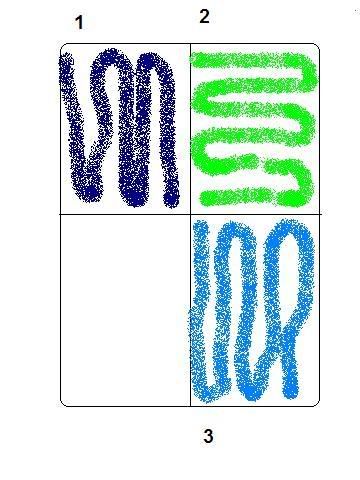
Make sure your passes overlap 50%.
This is a guideline to get you started. With patience and practice, it will break down your very light abrasive polish. OC II will cut to the chase much quicker, and is still a safe polish with a white and/or orange pad.
Below, is what your trying to accomplish with light swirl minimization. Your looking to reduce that vertical edge which grabs and reflects the light back to you.
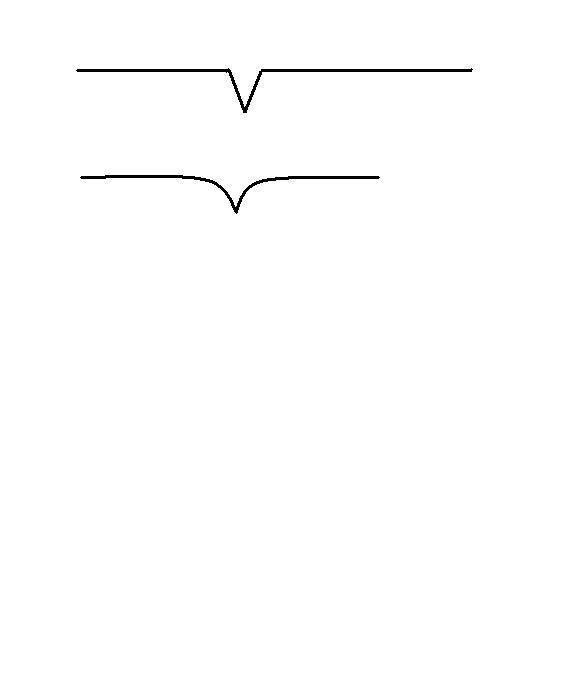
Make sure your passes overlap 50%.
This is a guideline to get you started. With patience and practice, it will break down your very light abrasive polish. OC II will cut to the chase much quicker, and is still a safe polish with a white and/or orange pad.
Below, is what your trying to accomplish with light swirl minimization. Your looking to reduce that vertical edge which grabs and reflects the light back to you.


Thread Starter
Instructor
Joined: Aug 2004
Posts: 125
Likes: 1
From: SD, CA
Thanks - so if I understand your illustration correctly, once I've made those three passes, the product should be broken down more or less (ie, I should move on to something else if it hasn't worked?)
Former Sponsor
Joined: May 2004
Posts: 6,624
Likes: 9
From: Thousand Oaks, CA
Thanks Denzil!!
Try those three passes and then gauge your results. Breakdown also depends on speeds used, surface condition (Fallout and other debris may prematurely break down abrasives) and pressure applied.
Use just enough pressure to manipulate the machine and maybe just a tad more.
First pass is just for applying the product in in even fashion to the surface (spread product). Second pass begins breakdown, try speed 4-5, overlap. 3rd pass bump to 5-6 (if comfortable), overlap, and use slower arm movement to bring machine across the surface area.
Try those three passes and then gauge your results. Breakdown also depends on speeds used, surface condition (Fallout and other debris may prematurely break down abrasives) and pressure applied.
Use just enough pressure to manipulate the machine and maybe just a tad more.
First pass is just for applying the product in in even fashion to the surface (spread product). Second pass begins breakdown, try speed 4-5, overlap. 3rd pass bump to 5-6 (if comfortable), overlap, and use slower arm movement to bring machine across the surface area.

The Old Grey Whistle Test
Joined: Oct 2004
Posts: 1,001
Likes: 18
From: Florida / England
Diminishing Abrasives (require friction)
While the majority of polishes on the market use a form of diminishing (non- linear) abrasive, which you polish to a ‘haze’ (when a polish "flashes" from a liquid paste to a light semi-dry haze, much like a coating of Vaseline) the diminishing polish has then broken down and is ready for removal.
It is important to know when a polish has broken down because if you take it too far you will re-introduce surface marring.
During the polishing process, trace amounts of paint and / or oxidation is removed; this can cause the debris and the polish to “clump” together. This can cause a haze to the paint surface, a wipe-down or a paint cleaning product will eliminate this
While the majority of polishes on the market use a form of diminishing (non- linear) abrasive, which you polish to a ‘haze’ (when a polish "flashes" from a liquid paste to a light semi-dry haze, much like a coating of Vaseline) the diminishing polish has then broken down and is ready for removal.
It is important to know when a polish has broken down because if you take it too far you will re-introduce surface marring.
During the polishing process, trace amounts of paint and / or oxidation is removed; this can cause the debris and the polish to “clump” together. This can cause a haze to the paint surface, a wipe-down or a paint cleaning product will eliminate this
Trending Topics

when i make a pass, i work it much like patrick has shown, but i probably go up and down and back and fourth 4 times, and you can tell the polish is broken down when it starts to dissapear/hazes over....

Burning Brakes
Joined: Feb 2008
Posts: 1,107
Likes: 4
From: Ottawa, Canaduh!
What a timely thread...I just rec'd my shipment of OC & OCII and am going to start polishing my NBP TL-S....great info everyone!
As a noob to the "next level" of detailing , when I was researching polishes & waxes, I also bought a bottle of the Optimum Poli-seal which is also touted as a final stage wax. Would it also remove the haze from polishing or is a seperate product required?
Thanks in advance...
As a noob to the "next level" of detailing
, when I was researching polishes & waxes, I also bought a bottle of the Optimum Poli-seal which is also touted as a final stage wax. Would it also remove the haze from polishing or is a seperate product required?Thanks in advance...
Race Director


Joined: Jan 2007
Posts: 11,213
Likes: 174
From: Portland, Oregon
What a timely thread...I just rec'd my shipment of OC & OCII and am going to start polishing my NBP TL-S....great info everyone!
As a noob to the "next level" of detailing, when I was researching polishes & waxes, I also bought a bottle of the Optimum Poli-seal which is also touted as a final stage wax. Would it also remove the haze from polishing or is a seperate product required?
Thanks in advance...
As a noob to the "next level" of detailing
, when I was researching polishes & waxes, I also bought a bottle of the Optimum Poli-seal which is also touted as a final stage wax. Would it also remove the haze from polishing or is a seperate product required?Thanks in advance...

2016 E350 Sport
Joined: Mar 2005
Posts: 1,953
Likes: 20
From: East Bay Area, CA
One item we have not considered is pad speed. How fast you move the pad over the surface is also important. You can perform 3-4 passes and not break down the polish because you are moving too fast. If you are correcting I recommend slowing down your pad speed. I typically get 3-4 passes like Patrick illustrated. The initial passes are at about 1-2 inches/second. Once the polish flashes I will speed up the final pass at around 4-5 inches/second. How fast the polish flashes depends on outside temperature, humidity, machine type, machine speed, pad selection, pad speed, and product formulation. This is why I always recommend performing a test spot first and checking your work in the sunlight. Master and adapt your procedure based on the present conditions. What works one day may not work as well on a different day. The sun is perfect at revealing paint defects. Once the test spot is perfect then you have a template for polishing the rest of the car.
Last edited by SweetJazz; May 14, 2009 at 12:25 PM.

Thread
Thread Starter
Forum
Replies
Last Post
SidhuSaaB
3G TL Problems & Fixes
18
May 30, 2020 12:40 AM
detailersdomain
Wash & Wax
3
Oct 9, 2015 10:13 PM
darksky
3G TL Problems & Fixes
2
Sep 5, 2015 03:11 AM
