


Mercedes F700 Concept


Thread Starter
me,gill,and tl-s
Joined: Mar 2007
Posts: 405
Likes: 0
From: bay area
Mercedes F700 Concept
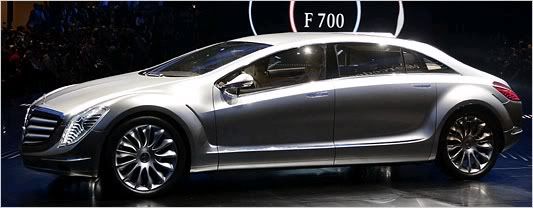
“It was a ghastly thing, truly horrible to look at. I could barely even take pictures of it.”
This quote could easily have been overheard at, say, the scene of a terrible crime or a tragic accident. Unfortunately for Mercedes-Benz, I overheard this little gem in the press lounge when the subject turned to the technology-laden F700 design study. During its theatrical press conference — complete with gyrating dancers and extravagant lighting display — Mercedes rolled 19 concept cars and production vehicles onto its stand. However, the F700 was undeniably the star of the occasion.
This is with good reason, as the F700 packs some very advanced technology under its controversial skin.
Despite being nearly the same length as the top-of-the-line Mercedes S-Class sedan, the F700 is powered by a 238 horsepower 1.8-liter 4-cylinder engine. This is almost half the size of the smallest engine presently available in the current S-Class. Called the Diesotto, this engine employs turbocharging, direct fuel injection, and extremely precise control of the combustion process to produce V-6 levels of power with 4-cylinder economy.
Mercedes says that the F700 is capable of 44.3 miles per gallon — a very impressive figure for a car of this size.
There’s even more wizardry in the Pre-Scan suspension system, which packs two laser sensors mounted alongside the headlights. While driving, these lasers send pulses onto the surface of the road ahead. Measurements are taken, and the information is passed along to the hydraulic suspension. In short, the F700 can react to a pothole before it even reaches it.
The cabin also has some novel features, like individual seating positions in which passengers (though hopefully not the driver) can turn their seats to face each other or rearward. A driver can also “discuss” items like satellite navigation input with a customizable avatar, an electronic personal assistant.
So the F700 isn’t short on hardware. Yet Mercedes might have been better served putting this gadgetry into a cardboard box. With few exceptions, the design of the F700 is what got tongues wagging in Frankfurt. From the front, the bulging fenders and bold grille look like what we might see on the next-generation S-Class. From there on back, things get a little odd.
It seems that the Mercedes designers borrowed styling elements from all over the automotive landscape. The side window treatment is very much in line with the current Mercedes CLS sedan, but the split window rear sunroof apes a 1963 Corvette and the lumpy tail seems bizarre.
Personally, I sort of like it. Or at least I’ll forgive it some stylistic faults for the cool technology lurking
This quote could easily have been overheard at, say, the scene of a terrible crime or a tragic accident. Unfortunately for Mercedes-Benz, I overheard this little gem in the press lounge when the subject turned to the technology-laden F700 design study. During its theatrical press conference — complete with gyrating dancers and extravagant lighting display — Mercedes rolled 19 concept cars and production vehicles onto its stand. However, the F700 was undeniably the star of the occasion.
This is with good reason, as the F700 packs some very advanced technology under its controversial skin.
Despite being nearly the same length as the top-of-the-line Mercedes S-Class sedan, the F700 is powered by a 238 horsepower 1.8-liter 4-cylinder engine. This is almost half the size of the smallest engine presently available in the current S-Class. Called the Diesotto, this engine employs turbocharging, direct fuel injection, and extremely precise control of the combustion process to produce V-6 levels of power with 4-cylinder economy.
Mercedes says that the F700 is capable of 44.3 miles per gallon — a very impressive figure for a car of this size.
There’s even more wizardry in the Pre-Scan suspension system, which packs two laser sensors mounted alongside the headlights. While driving, these lasers send pulses onto the surface of the road ahead. Measurements are taken, and the information is passed along to the hydraulic suspension. In short, the F700 can react to a pothole before it even reaches it.
The cabin also has some novel features, like individual seating positions in which passengers (though hopefully not the driver) can turn their seats to face each other or rearward. A driver can also “discuss” items like satellite navigation input with a customizable avatar, an electronic personal assistant.
So the F700 isn’t short on hardware. Yet Mercedes might have been better served putting this gadgetry into a cardboard box. With few exceptions, the design of the F700 is what got tongues wagging in Frankfurt. From the front, the bulging fenders and bold grille look like what we might see on the next-generation S-Class. From there on back, things get a little odd.
It seems that the Mercedes designers borrowed styling elements from all over the automotive landscape. The side window treatment is very much in line with the current Mercedes CLS sedan, but the split window rear sunroof apes a 1963 Corvette and the lumpy tail seems bizarre.
Personally, I sort of like it. Or at least I’ll forgive it some stylistic faults for the cool technology lurking

Senior Moderator


Joined: Dec 2001
Posts: 169,125
Likes: 23,886
What do I think...? I think that this is a  , that's what.
https://acurazine.com/forums/automotive-news-6/mercedes-benz-f-700-research-sedan-news-373994/

, that's what. https://acurazine.com/forums/automotive-news-6/mercedes-benz-f-700-research-sedan-news-373994/

Thread
Thread Starter
Forum
Replies
Last Post
Yumcha
Automotive News
1
Sep 25, 2015 06:14 PM
