When you click on links to various merchants on this site and make a purchase, this can result in this site earning a commission. Affiliate programs and affiliations include, but are not limited to, the eBay Partner Network.
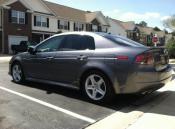
All of a sudden my TL has developed an engine knock. It sounds like metal on metal, doesn't go away after warmup, happens with gas from two different gas stations. Anyway, a video is better than a thousand words:
So, I drove it for a couple of weeks, first draining old tank, then on a new tank, then made an appt with my dealer, and left the car their for a day.
At the end of that day their service adviser calls me with the sad news that they have isolated the noise to the lower part of the engine, and that they're not going to diagnose it any further w/o me paying in excess of their default diagnostic fee of $119. Besides, according to them, such diagnostic would be pointless anyway because they never ever rebuild engines, so no matter what they find my only recourse would be to replace the entire engine, the quote for which ranges from $6K for a used one with 43K miles to $10K for a new one. The car is 2008 with 90K miles, btw.
To summarize, all they did on the car was to lift it up, use stethoscope to listen to the source of the noise, and lower it back down. No pulling plugs, no dropping oil pan, nothing extra. They ruled out the valves, pulleys and stopped. Why bother when the showroom is full of TLX?
I feel a little stupid for asking, but after listening to the noise in the above video, could someone PLEASE throw an advice on how grave this matter could be and what else I can try to confirm that swapping engines is the only practical thing?
I tried pulling plugs one by one, there is no change in the noise. There are no shavings on the oil stick, I'll try to drop the oil pan over the weekend or just change the oil and look at the magnetic plug (or is it not magnetic, am I confusing it with transmission drain plug?). The adviser quoted a $800 fee for doing the oil pan, removing the caps and checking on the bearings. According to him, just dropping the pan and looking for shavings or bearing parts to confirm the issue wouldn't be very helpful, because if they were damaged that bad or turned, the car wouldn't even run properly. And I was driving it fine up until now. According to the adviser this does sound like a bearing, not a broken bearing, but a worn one, perhaps with an extra thousandth of an inch of wear (sounds wrong or grossly exaggerated), and a new bearing would have to be fit to the crankshaft with resurfacing of the latter. Arghh. The entire conversation steered into the bearing area simply because I brought them up questioning their swap advise and diag fee. They just don't care to figure it out. Perhaps these aren't bearings at all.
I can't say just by the video what the problem is, but I would find a Honda/Acura specialty shop that does a lot of work on these engines. You're right in that all the dealership will do is replace the engine w/o finding out what's wrong. It may still need a new engine but it may not be as pricey as what the dealer is telling you.
Agree with erdoc48. Going to be very difficult to fully diagnose with a video (still much better than you describing it)so finding a local indie Honda shop will likely be your best bet. Also not sure what you financial position is but I wouldn't bank on driving all that long with the engine making that noise. In other words, I wouldn't drag my feet about getting this looked at / diagnosed or you may wind up without transportation.
Hard to tell from a video, but doesn't sound like a rod knocking, at least not to me armchairing it.
I'll say this though - their price on a used engine is terrible. Definitely find an independent shop. I wouldnt rebuild a motor when you can get a used one for about a grand. I'd ballpark 1000 - 1500 for the engine, and then 1000 - 1500 for install.
I saw a thread elsewhere here that said it was 15hrs book time to remove the engine. That sounds exceptionally high (not that its not true), but even 30 hours (remove/replace) is about $3000 labor.
Realistically I'd say a full r/r is 15 hours, but the dealer will go by the book. Half the time they will screw you with double labor to up it as well. Oh we replaced the torque converter - that's 6 hours. We removed and replaced the engine - thats 30 hours. If they remove the engine, the torque converter is readily accessible. MAYBE an extra 30 minutes.
Well, how exactly do I approach this engine swap outside of the dealer network?
I do have a favorite tire place, a mechanic that I would trust to do simple things on my cars like brake or oil changes (and frankly, I tend to do them myself lately), but an engine swap requires someone that would know Acura engines and whom I'd ultimately trust. How do you find such a place in the neighborhood? Searching for a car service brings places like Meineke on one end and engine rebuilders on the other. And the latter, I'm afraid, are more into tuning and customizing than into helping an Acura owner to swap one stock for another.
And where do I even source the engine from, if I decide to go for a swap? What are the risks associated with it, do engines come with some sort of warranty, or is it a pure gamble? I swap one knock for another.
The "old" ears aren't what they used to be, but a rod knock will be twice the speed of the valve train, but the noise sounds in sync with the valve train, but never heard a sound like this associated with the valve assembly.
Hook up a timing light and if the sound is in sync with the light, valve train, if twice as fast, bottom end.
If an engine is needed, check Car-Part.com--Used Auto Parts Market in the area you live. When you find an engine, ask the yard who might do the installation.
Big yard near Philly has 4 engines ($1600=1 with 27k miles) and probably charges @ $1000 for install.
Hmmm, I don't have a timing light, but I did measure the time between the knocks in the video. It's 0.08s, which is 720 beats per minute. Same as engine's RPM at idle.
Add to it noise's immunity to plug pulls, thicker oil, and I don't know what to think any more.
Hmmm, I don't have a timing light, but I did measure the time between the knocks in the video. It's 0.08s, which is 720 beats per minute. Same as engine's RPM at idle.
Add to it noise's immunity to plug pulls, thicker oil, and I don't know what to think any more.
Well, if the noise is consistent with the RPM 720/720, then it's the bottom end as the tach indicates crank rotation.
Now... This is interesting... I removed serpentine belt, and the noise vanished. Put it back, and the noise is back... All accessories seem to rotate just fine, and the noise seems to be coming from the crankshaft pulley, a few inches into the engine...
Is the pulley supposed to separate in two pieces like in these pictures?
Like Justnspace said, definitely not supposed to come apart like that.
Sounds like you found your issue. That's pretty excellent. Also goes to show how extensive the dealer looked when they put your car on the lift. They should have been able to isolate that noise to the crank pulley.
You should bring those pictures and your narrative back to the dealership where they first said you need a new engine so that they can see how poor their diagnostic skills are- great job on finding the problem!
Thanks everybody, I still can't believe my luck! People at the dealership are surely going to hear a lot from me this week.
As for this pulley... It sounds like removing it will require a special removal tool plus perhaps an impact wrench... Is this a garage type of work at all?
Even if you do have to take it to a garage, it'll be way cheaper than a new engine.
Again, great job at diagnostics...you just saved yourself a boatload of cash.
Thanks everybody, I still can't believe my luck! People at the dealership are surely going to hear a lot from me this week.
As for this pulley... It sounds like removing it will require a special removal tool plus perhaps an impact wrench... Is this a garage type of work at all?
it took me about a week to take it off with 2 breaker bars and the special "crank pulley bolt holder" tool.
You can remove it quite easily if you wedge a breaker bar on the crank pulley bolt and then wedge it between two suspension pieces up front and then turn the motor over with your key (just once). It should break the bolt loose no problem.
Otherwise, you'll need a really long breaker bar (to provide maximum torque) to get it off.
Great catch.
Haven't used it in years, but the starter method will break the bolt loose, but as said previously a breaker bar with a long pipe attached will make the job easy.
Just had a tough time breaking an oil cooler line banjo bolt loose, naturally not on the TL. Hit it with an electric impact, no go, then the air impact, nothing, then a breaker bar with a 3' pipe and the bolt broke loose easily.
That's awesome and I would definitely bring the failed part back to the dealership.
For what it's worth, a rod knock is usually in time with the valvetrain at half engine speed. The actual knock usually only occurs on the power stroke which is every other revolution and this is why pulling the offending cylinder's plug wire will eliminate the noise.
The shop should have known that by listening to it.
That's great that you were able to figure it out on your own. I rewatched and listened to your video and it is hard to imagine the pulley is making that noise but I guess anything is possible. Congrats!!
I didn't know we had 1 turn ignition, either, lol. I'll have to try that.
as explained by Honda
Originally Posted by Hondanews.com
A new feature for automatic-equipped TL and Type-S models is One Touch Start. The driver simply twists the key in the ignition to the "start" position and releases it, and then the TL engine will continue cranking until it has started. In the event of a problem, the One Touch Start system will stop after 8 to 10 seconds of starting and will display a warning on the MID system.
I ordered the pulley, replaced it, brought the split one back to the dealer. The service manager was more than apologetic, he had the car checked by a mechanic again, confirmed that the issue was indeed in the pulley, said that it was quite an unusual defect, reimbursed diagnostic fee, and gave service credit for the price of the pulley.
The initial mechanic's screwup is undeniable, but overall I was satisfied with how things got resolved, so the dealer isn't that crappy after all.
You can remove it quite easily if you wedge a breaker bar on the crank pulley bolt and then wedge it between two suspension pieces up front and then turn the motor over with your key (just once). It should break the bolt loose no problem.
Otherwise, you'll need a really long breaker bar (to provide maximum torque) to get it off.
I just stepped on my wrench and it broke loose for me :p