When you click on links to various merchants on this site and make a purchase, this can result in this site earning a commission. Affiliate programs and affiliations include, but are not limited to, the eBay Partner Network.
The RDX will self destruct if you put in regular. It will realize its the same engine and transmission in a Honda that uses regular and die in shame when it realizes its been pretending to be a luxury vehicle this whole time.
Lol, I wonder if the seats in the RDX will also self destruct with this realization.
@Sounds I think I found the app. Search for AUTOsist-Car/Fleet Maintenance on the App Store. The screenshots look the same as the one that OliveBread shared.
@Sounds I think I found the app. Search for AUTOsist-Car/Fleet Maintenance on the App Store. The screenshots look the same as the one that OliveBread shared.
The RDX belongs to my mom, but I drive it fairly often. That said, she only put regular gas in it and I don't think she or I could tell the difference anyway. If the car loses a little HP with the lower octane stuff, nobody is going to notice. I don't think the accelerator pedal has ever been pushed to the floor.
I've tried all grades from 87 to 94. My observations concur with those of the dog. It does seem like the accelerator has to be pressed further to get the same performance with lower octane fuel. Further, there seems to be odd surging with lower octanes, as though someone was lightly and variably applying the brake while accelerating. Stronger and smoother with 94. That said, my experience has shown -o-meter measurements are not always accurate. At some point I would like to dragstrip test the various grades to know for sure.
My impression in other Acuras is that drivetrain responsiveness and smoothness are somewhat better with "premium" grade fuel. Almost like the drivetrain was tuned for it.
But as you say, my seatometer isn't calibrated to the hundredth of a second, so I don't know if the WOT performance is much different. But having said that, I will reiterate that 91 octane ethanol-free gasoline is not the same as 91 octane gasoline/ethanol blend. But no, you won't dust off Bugattis running ethanol-free gas, aviation fuel, or nitromethane, sorry to say. ( Although I'd pay good money to watch someone try to dragstrip an RDX running nitromethane... from a respectful distance ).
My impression in other Acuras is that drivetrain responsiveness and smoothness are somewhat better with "premium" grade fuel. Almost like the drivetrain was tuned for it.
If you can notice the difference with premium and feel like it's worth the added expense go for it. I think most people buying a CUV wouldn't be able to notice the change and it would be a waste of money to them.
My impression in other Acuras is that drivetrain responsiveness and smoothness are somewhat better with "premium" grade fuel.
Likely placebo effect. Like how they experimented with people who drink $2 wines with a $100 label/bottle and think it's very tasty wine.
Only way to tell for sure is to do a double-blind test of driving cars with/without 91 octane and actually see if people can TRULY tell a difference.
Originally Posted by skarface
If you can notice the difference with premium and feel like it's worth the added expense go for it. I think most people buying a CUV wouldn't be able to notice the change and it would be a waste of money to them.
It's probably just that...a feeling that it's worth it. People expect better results so they probably convince themselves the car MUST be faster.
Only way to tell is with a blind test. Should be interesting if one has the time/access to RDX and several drivers to do one.....
3G RDX owners can do a little meetup and octane test...upload to youtube/AZine....profit
I run premium because that is what is recommended and I am fortunate to afford it. period, end of story.
And there is nothing wrong with that.
91 or 89 or 87. People feel very strongly on this subject. I'm glad AAA actually did some science and showed some real world/tested data. People can make their own decisions.
To be fair, Acura also 'recommends' servicing your vehicle with Acura trained technicians who will also 'recommend' that you allow them to change your cabin and air filter for $200 when it takes 10 minutes and $20 in parts. I'm sure everyone could afford to let Acura do it, but I'm not so sure it's 'worth it' to a lot of people when they do the cost/benefit analysis. So, I wouldn't take Acura's recommendations as the end all be all until you figure in the value you actually receive by following their recommendations. I think a lot of Acura buyers are frugal but like nice things, which is why we buy Acuras and not Audi/BMW/Mercedes. The added cost is something we could afford but we don't see the value in doing it.
The RDX is likely lose more power by using 87 instead of 91 than the Accord will gain by using 91 instead of 87 simply because the Accord is tuned for 87 and the RDX is tuned for 91 from the factory. Even with the same tune, the RDX will still develop more power on 91 than the Accord will on 91 because of differences in the intake and exhaust systems.
Some in this thread have mentioned TLs. I'm the original owner of a 2002 TL Type S that is still my daily driver. The car has only grown on me! Very early in its life I switched to regular gas after hearing an episode of Car Talk in which the Magliozzi brothers argued, and convinced me, that premium fuel was unnecessary for most cars under most conditions. I've never noticed a difference in performance, and the engine has never made a knocking sound. As the car nears its 18th birthday, however, it does have a small water leak that my mechanic hasn't been able to locate...
I get my premium 92 octane from Costco, it’s usually only about 30 cents more a gallon, and Costco gives us 25 cents in store credit for every gallon I buy so it evens out other gas stations will be about 50-90 cents more a gallon tho, not sure how Costco beats them by that much, and there’s is top tier 92 octane as the other more expensive places are 91
I’m no mechanic so I asked one if there were any risks/downsides to running regular in an engine that is recommended for premium. I was told the computer would adjust the timing to deal with the lower octane but this would cause the motor to run warmer and cut down on the life expectancy of the turbo....FWIW
Regardless of tuning, we know this engine *can* run on regular, and if Acura has it as "recommend", it *should* be fine.
Now my K23A1 2007 RDX will never see a drop of regular in the tank, thought of that makes me cringe...
But I'd think a new RDX would be different since the Accord uses regular. It may be a little slower a d not as smooth upon idle, but it ought to run fine...
I am so into the concept that "anyone who cant afford premium fuel shouldn't have bought an Acura". One time the tanks where I stopped were totally out of premium and I needed fuel bad. I bought a few gallons of regular but insisted that I pay the premium price just to show that I could afford it.
I am so into the concept that "anyone who cant afford premium fuel shouldn't have bought an Acura". One time the station I stopped at was at was totally out of premium and I needed fuel bad. I bought a few gallons of regular but insisted that I pay the premium price just to show that I could afford it.
I ran regular for the first 3K miles, and premium for the last 1.5K. My mileage showed no difference. My butt dyno tells me the premium makes it feel smoother, and I don’t have to go as deep in the throttle as I did on regular.
Friday, I will embark on a 1300 mile drive to FL. I will start off on premium, and, basically, alternate tanks as we go. I will see if I observe any difference.
I ran both fuel types. The mileage was the same. I also experienced no change in power. The computer on this car can manage any type of fuel. My dealer has a master mechanic. He said the new RDX does not need premium unless your racing st VIR.
"13 Use of lower-octane gasoline can cause an occasional metallic knocking noise in the engine and will result in decreased engine performance. Use of gasoline with a pump octane less than 91 can lead to engine damage."
http://techinfo.honda.com/rjanisis/p...BTJB1919OM.PDF Page 27 says: Unleaded gasoline with a Pump Octane Number (PON) of 91 or higher is recommended. Use of lower octane gasoline can cause occasional metallic knocking noise in the engine and will result in decreased engine performance. Use of gasoline with a pump octane less than 87 can lead to engine damage.
Nope, there's no mid grade storage tank at any service station I know of. The gas pumps draw from both regular and premium storage tanks when mid grade is selected. But, I didn't actually do what I said since I have better uses for the extra bucks involved. But, I have no doubt some people on here would pay double for regular so they could maintain their Acura-owner self-image.
Nope, there's no mid grade storage tank at any service station I know of. The gas pumps draw from both regular and premium storage tanks when mid grade is selected. But, I didn't actually do what I said since I have better uses for the extra bucks involved. But, I have no doubt some people on here would pay double for regular so they could maintain their Acura-owner self-image.
OK.... Glad 93 octane is only about $2.35 where I am right now. If I could put 87 in a TL, I'd get that for sure, but since it requires 91+, I'm not sure if I totally want my TL back, I'm thinking Accord for this one reason. It's about $10 more per tank, multiplied by about seven tanks a month is $70, which is a lot for gas on otherwise similar performance. So I do get it. RDX is premium forever only and always!
Last edited by Midnight Mystery; Jan 20, 2019 at 11:58 PM.
Reason: 91+
If I buy the RDX, I'll run 93 exclusively for the break-in period; first 1k - 2k miles or so. Then, I'll experiment. See if I notice any change in performance, mileage or engine knocking.
Based on the compression of the engine, even with the turbo, I'm not sure why anything higher than 87 would be needed. Don't know of other factors that require higher octane.
If I buy the RDX, I'll run 93 exclusively for the break-in period; first 1k - 2k miles or so. Then, I'll experiment. See if I notice any change in performance, mileage or engine knocking.
Based on the compression of the engine, even with the turbo, I'm not sure why anything higher than 87 would be needed. Don't know of other factors that require higher octane.
Higher octane allows, here, higher performance, which boosts the numbers. Ignoring the HP numbers, which is a mathematical product of torque and RPMs, the Accord makes 273 lb-ft at 1500-4000 on regular, and the RDX makes 280 lb-fr at 1600-4500. Which means, to me that the RDX on premium gives more power throughout the rev band.
In my area, Raleigh, more HP can result in more tickets.
i use sport plus to give me that 20 seconds of burst getting on highway. Then I drop down to sport and drive normal.
I find it kind of funny that people spending over $40K on a vehicle are skimping on the recommend fuel. It's not that much more expensive to use premium unless you drive way more miles than average. Why risk potential engine issues? If you don't plan on keeping the vehicle that long maybe cheap out on gas but otherwise just use the recommended grade.
I find it kind of funny that people spending over $40K on a vehicle are skimping on the recommend fuel. It's not that much more expensive to use premium unless you drive way more miles than average. Why risk potential engine issues? If you don't plan on keeping the vehicle that long maybe cheap out on gas but otherwise just use the recommended grade.
Ah yes, THERE IT IS! I knew someone had to say this, like they do with every other reg vs premium thread.
Rich folks don't get rich by wasting money. Saving hundreds a year on fuel is not a bad thing.
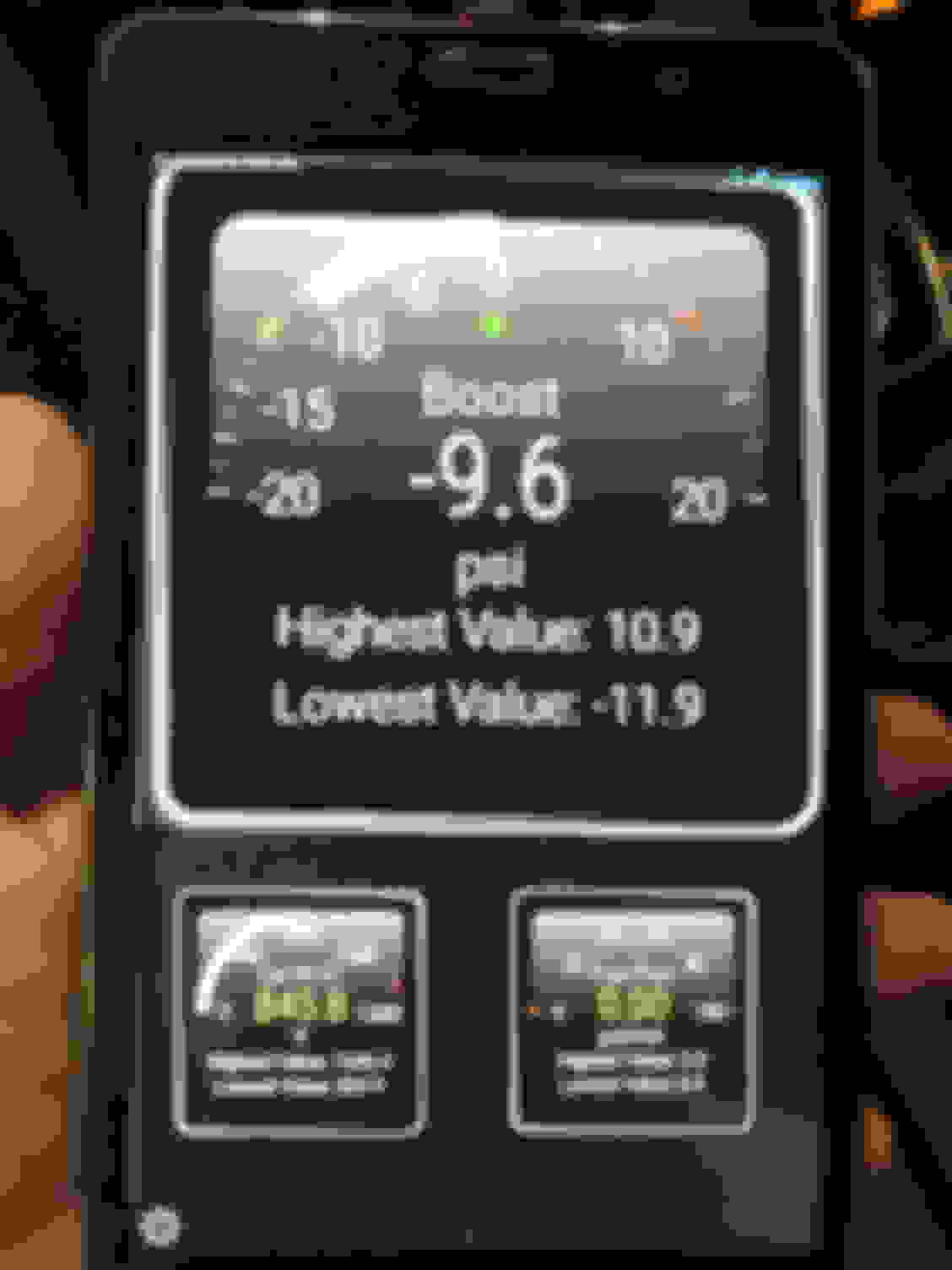
I took a boost reading and the highest I could get flooring it in sport+ was 10.9 psi so they are not running super high boost on this engine, unless my reading was wrong but it’s pulling from the OBD2
That resulted in 0.3 gallons per minute of fuel flow while peaking 😎
Ah yes, THERE IT IS! I knew someone had to say this, like they do with every other reg vs premium thread.
Rich folks don't get rich by wasting money. Saving hundreds a year on fuel is not a bad thing.
Not a bad thing unless it leads to engine issues. Why is the manufacturer recommending it? They don’t benefit from us paying more for gas.
For me it’s not hundreds a year. I could also make the argument that you’re wasting your money on an Acura when a cheaper Honda would work just fine....
Ah yes, THERE IT IS! I knew someone had to say this, like they do with every other reg vs premium thread.
Yep, it was bound to happen. That's why I said in the original post "please don't say "If you can afford a premium car you should be able to afford premium gas.""
If Acura thought that less than premium would lead to engine damage then they would require premium. I have 280,000 miles on a car running less than recommended but not forbidden by Acura. By my calculations that is several thousand dollars that I got to keep....and hey my engine is doing just fine. If you want the extra couple of HP then go for it.
Not a bad thing unless it leads to engine issues. Why is the manufacturer recommending it? They don’t benefit from us paying more for gas.
For me it’s not hundreds a year. I could also make the argument that you’re wasting your money on an Acura when a cheaper Honda would work just fine....
If it was possible that using regular would damage the engine, Acura would have required premium, like they did with previous models.
In may places premium is 70-90 cents more per gallon. Your possible MPG increase using premium vs. regular will not beat out the cost difference. *shrug*
Do you realize that mid-grade fuel is basically a mixture of the high octane and low octane fuels? So if they are out of premium, they are also out of mid grade too.








 -o-meter measurements are not always accurate. At some point I would like to dragstrip test the various grades to know for sure.