


Tein Basic Coilovers


Thread Starter
Instructor
Joined: Jul 2006
Posts: 171
Likes: 0
From: Houston
 Tein Basic Coilovers
Does anyone know a good price for the Tein basic coilovers? and what about the Tein type flex, do they make them for a 2003 TL? And if i buy these coilovers, do i need to get a camber kit as well?
BTW: In search for a TL OEM full body kit. I live in Houston, and im looking to buy immediately!
BTW: In search for a TL OEM full body kit. I live in Houston, and im looking to buy immediately!

Former Sponsor
iTrader: (1)
Joined: Mar 2004
Posts: 9,877
Likes: 624
From: www.ExceleratePerformance.com
Shoot me a PM with your year, make, model, and zip code and I will get you prices on the coilovers you want. They don't make the FLEX for the 99-03 TL. The best setup you can get is the Super Streets with the Pillowball Upper Mounts.

Depending on the wheels you will be riding on, and I'm no expert, but I don't think you'll need a camber kit if you stay stock. As soon as you go aftermarket though, you might be looking at a camber kit depending on the size of the wheel.

Instructor
Joined: Apr 2005
Posts: 172
Likes: 0
From: Vancouver, British Columbia
Originally Posted by xdxlx
And if i buy these coilovers, do i need to get a camber kit as well?
If you lower the car about 2.09 inches in the front and 1.69inches( Tein pre-set lowered conditions for the coilovers), you will most likely need a camber kit in the REAR of the car. The front is okay even with the 2.09 inches of lowered height, especially since the Acura TL is a double-wish bone type of suspension system and not the Macpherson type of suspension where the lowering effects of coilovers will have more of an impact on the suspension geometry of the car. At 2.09 inches you will be just "within" Acura specifications of being "okay".
Borderline height lowering in the REAR of the car will be about 1.5inches of lowering. At Tein's factory-set height for their REAR coilovers of 1.69 inches, it is going to throw your Acura specifications out and NOT within fixable, adjustable range without having a rear camber kit. You can possibly get away without any adverse effects of the suspension lowering if you raise it up to 1.5 inches (you can adjust the front accordingly to make a level car suspension drop. This adjustment should make you "within" tolerable specification for the rear of the car. The good part about coilover is that you can adjust the height to whatever suits your needs.
NOTE: Any lowering below the Tein specified height of the coilovers, i.e. lower than 2.1 inches and 1.69 inches, you WILL need a camber kit if you don't want uneven wear. "Slamming" the car will also be below the reference points of the Tein coilovers which will shorten the stroke of the shocks too which will give different than normal, optimal working conditions. Doing this will increase your chances of bottoming out (as Tein springs for the coilovers are already too soft for our TL's) and likely affecting ride quality, now that the shock has less room to move in it's normal range. Personally, "slamming" the car, in my opinion is stupid and posses more problems and is more for theoretical asthetics rather than actual street use and driving conditions (i.e. Problems: guaranteed rubbing and hitting the underneath of your bumper and possibly the lower control arms, definitely needing a camber kit, rubbing your aftermarket wheels/tires especially if it's wrong offset, affecting the handling of the car, and putting more wear and tear on shocks).

Make sure you get an alignment done! After about 3weeks of driving or so or about 500 miles for the springs to break in. Other than that, I think you'll like the handling and performance of the Tein SS/Basics. Some people have said the springs are too soft for our heavier TL's compared to the Honda Accord which it was based on; I would have to concur. Either way, it will definitely improve your handling.
Hope this answers your questions. If not, do a search. I wrote plenty on this topic before
Thread Starter
Instructor
Joined: Jul 2006
Posts: 171
Likes: 0
From: Houston
Thanks a lot, you guys are very knowledgeable. I just plan on getting the coilovers first, its all i can afford. Rims will come in time. I don't plan on dropping my car more than the preset amount that you said is stock with the tein coilovers. So rear camber kits is all i need right?

Originally Posted by xdxlx
2003 TL-s. zip 77082. just let me know some prices on basic coilovers, and the SS ones. and if i need a camber kit or any other components.
MrHeeltoe's Facts of Honda Camber
Fact One:
When changing your double-wishbone/multilink Honda's ride height, regardless of product type, product brand, or degree of height change, the camber will be effected. Raising the car will result in politive camber, lowering will result in negative camber.
Fact Two:
Camber is a non-adjustable alignment angle on all double-wishbone/multilink Honda suspension arrangements. In order to adjust camber back to factory spec a camber kit is needed. Caster angle is also non-adjustable. Toe angle has a wide range of adjustment from the factory.
Fact Three:
Regardless of vehicle height (within reasonable limits, not more than 2.5-3" lowered) camber need not be to factory spec to avoid rapid inner tire wear. A proper 4-wheel alignment which adjusts the toe angle to the factory spec will be essential to preventing premature inner tire wear.
Trending Topics
Instructor
Joined: Apr 2005
Posts: 172
Likes: 0
From: Vancouver, British Columbia
So rear camber kits is all i need right?
Generally, for the Acura TL, it will be the REAR of the car that is most likely in need of a camber kit. The front technically should use a camber kit but there are problems with SPC balljoint camber kits for some members who have lowered their cars too much. If you don't need to spend the money on the front camber kit since it's very likely it will be "within" specfications, why spend more money

Secondly, based on Mr. Heeltoe's quote:
Regardless of vehicle height (within reasonable limits, not more than 2.5-3" lowered) camber need not be to factory spec to avoid rapid inner tire wear
I am 100% sure if you don't get rapid, inner tire wear, you are bound to get uneven tire wear issues sooner or later, especially at "2.5-3" lol. For example, such as having the inner tire treads wear more than the outer tire tread. With consistent tire rotation, you *may* be able to counter the fated, uneven wear of the tires but it's definitely going to result in uneven tire wear without a doubt. A friend's car is a good example, he dropped the car at least 2.1 inches in the front (occasionally scrubs his bumper underneath) of the car with no camber kit and didn't rotate tires consistently and eventually had uneven tire wear. This of course means buying new tires, sooner than if the issue had been corrected or not having the car lowered so much to begin with, and wasting money due to uneven tire wear.
Let's say you didn't care about tires, premature tire wear or money to buy new tires. You have to also think about performance and handling characteristics of your car after you have changed the suspension geometry of your car now, since you have lowered it. Let's say you "slammed" your car or dropped it extremely low and you now have a very negative camber on all of your four wheels, your tire contact patch will definitely be in less contact with the road now and if your wheels/tires aren't riding with an optimal contact patch, think of how that's going to affect your cornering of your car for example; you may have say a 215/225 tire width but because of such negative camber, your tire patch width may only have a solid 195/205 of tire tread on the ground when you take a corner.
Some camber is usually always done for performance reasons but too much negative camber is no good.Here's a grapical illustration of what I mean at Eibach's website:
Eibach website under "pro-alignment kits" under "Check out our complete line of Performance Suspension"
Originally Posted by Michael03TLS
Secondly, based on Mr. Heeltoe's quote:
True and possible but there's more to the story (note: I wouldn't consider up to 3" as "reasonable" for every day driving conditions and for practical use - unless you like hitting the bottom of your car, bumpers, and getting in more fatal accidents were one to happen since your car is so low now.) Besides this, for your reference, especially the Tein SS/Basics, there are reference points for those coilovers to not go below. One reason is that these coilovers do not have isolated spring perches to maintain spring stroke/rates without affecting the shock stroke.
Originally Posted by Michael03TLS
I am 100% sure if you don't get rapid, inner tire wear, you are bound to get uneven tire wear issues sooner or later, especially at "2.5-3" lol. For example, such as having the inner tire treads wear more than the outer tire tread. With consistent tire rotation, you *may* be able to counter the fated, uneven wear of the tires but it's definitely going to result in uneven tire wear without a doubt. A friend's car is a good example, he dropped the car at least 2.1 inches in the front (occasionally scrubs his bumper underneath) of the car with no camber kit and didn't rotate tires consistently and eventually had uneven tire wear. This of course means buying new tires, sooner than if the issue had been corrected or not having the car lowered so much to begin with, and wasting money due to uneven tire wear.
Originally Posted by Michael03TLS
Let's say you didn't care about tires, premature tire wear or money to buy new tires. You have to also think about performance and handling characteristics of your car after you have changed the suspension geometry of your car now, since you have lowered it. Let's say you "slammed" your car or dropped it extremely low and you now have a very negative camber on all of your four wheels, your tire contact patch will definitely be in less contact with the road now and if your wheels/tires aren't riding with an optimal contact patch, think of how that's going to affect your cornering of your car for example; you may have say a 215/225 tire width but because of such negative camber, your tire patch width may only have a solid 195/205 of tire tread on the ground when you take a corner.
Some camber is usually always done for performance reasons but too much negative camber is no good.Here's a grapical illustration of what I mean at Eibach's website:
Eibach website under "pro-alignment kits" under "Check out our complete line of Performance Suspension"
The fact of the matter is, you get better cornering performance with more camber, if the car is being cornered harder. Your point is technically correct but you are not taking cornering loads and tire rolling into consideration. When cornering harder, the tires will actually wear more even if there is negative camber present.
Scroll down to "Camber"
They cite that as negative camber increases, inner wear goes up and performance goes up. My point is that the wear does increase, but rather than wear being focused toward the inside, it is merely biased there. Wear still exists along the entire tire, but there is a bias toward inner wear. The nightmare inner tire wear stories we have all heard are not this kind of wear. Too many people have lowered their cars and not aligned them, and started a "camber myth".
Now, they also cite funny handling characteristics associated with negative camber. I agree with this as well (I must, since it is true). BUT, they are talking about high traction situations, probably slick or DOT approved slicks. I believe they are also talking about extreme camber angles (somewhat of a "more is not better" case).
In the end, I think they are correct in saying that it really is up to the driver. Keep in mind, we are not talking about a situation where we are adding negative camber. The camber you get from lowering is already present in the chassis under cornering loads. Effectively, all you are doing is presetting the suspension to a cornering stance, which is exactly why installing sport suspension that lower the car increases the performance. To put a camber kit back on the car, you are actually negating half the reason to installing sport suspension in the 1st place. The A-Spec sus does not come with a camber kit, does it? For mildly better performance they have retuned the suspension and lowered the cernter of gravity and thus have also dialed in more camber. A Tein suspension kit will do the same, but is intended for even more performance....lower COG, and more camber. You yourself mention that some camber is good. So why not dial some into the car? Why get a camber kit and wipe it out? 2-3 degrees is not a lot of camber...it just looks like it from the outside.
So yes, get a camber kit if all you want to do is lower the car and a stock, non-camber look. But for tire wear and handling considerations, drive with some negative camber. But always get an alignment and fix that toe angle!!!
Marcus
Originally Posted by MrHeeltoe
The fact of the matter is, you get better cornering performance with more camber, if the car is being cornered harder. Your point is technically correct but you are not taking cornering loads and tire rolling into consideration. When cornering harder, the tires will actually wear more even if there is negative camber present.
Check this out......
Look at how much camber they run on the front of the RTR TSX:
Now look at the car when it is cornering:
The outside sidewall of the outside tire pulls under and the contact patch is actually flat on the ground. The wheel itself is almost perpendicular.
This is an extreme case, but graphically is shows well. We don't run nearly that much camber when we lower the cars 1.5-2", and we don't corner that hard either. My point is there is nothing wrong with running the camber, it is totally normal and acceptable.
Even in a straight line, inner wear is almost negligable, beacuse there are no lateral forces scrubbing the tire away. The car is rolling straight. Just rolling on the tires does not make them wear out quickly at all. This is especially true for the rear. There is no logical, realistic, or practial reason to think that FWD cars with negative camber in the rear with a good toe alignment will wear those tires out at an accellerated rate.
Instructor
Joined: Apr 2005
Posts: 172
Likes: 0
From: Vancouver, British Columbia
MrHeeltoe/Marcus,
First off, I do admire your vociferous, outspoken ,and apologetic viewpoints, as you usually like to defend all your products that you sell like Tein and Comptech (i.e. Comptech Springs past rusting issues) mentioned in previous threads of this Acurazine board, however, I need to make a few more comments; After all, you are a reseller and you do have a vested interests in expressing your viewpoints.
I think you forgot to mention or didn't read what I wrote earlier. Yes, the Tein SS/Basic may in fact be lowered below their reference points, but "without any issues at all" is where I do got issue to clarify. Better coilovers such as Zeal , or perhaps Tein Flex coilover as an example, have an independent spring perch which isolates the spring characteristics as an independent function of varying the height of a vehicle (they use a threaded lower shock body for changing the vehicle height instead of lowering the spring perches on the Tein SS/Basics) for a particular reason:
Quoted from another coilover brand: "without changing the spring compression and sacrificing the shock stroke. Traditional (coil-overs) require the movement of the spring perch to determine the ride height, causing a reduction in suspension travel and induce coil spring binding. The bottom shock fork/connecter is treaded to allow height adjustments to each driver's need without having to shorten the suspension travel by maintaining the original spring perch location. With this function, each driver can lower the center of gravity to achieve better handling and still maintain a consistent ride quality"
So you see, your idea of "without any issues at all" is in fact a fallacious statement and an inaccurate fact.
LOL,I'd be damn surprised if you lowered the TL up to 2.5" or 3" and you wouldn't be hitting anything or scrapping your bumper making it look like shit, especially speed bumps or those small parking lot rectangular cement stoppers. The TL is not a car you can lower that much, in this particular case.
I think you misconstrued my statement and have perverted it's original value that I was trying to get at. I never said that lowering WILL get you into a fatal accident. What I did say is that lowering the car and as a result of "getting in more fatal accidents were one to happen since your car is so low now". Cars on the public roads were built on certain safety regulations such as the height of the car above the ground and the car frame and height of the car when the bumper come in contact with other cars when , for example, being in a colllision. Having your car lowered puts your car bumper isolators and car frame lower than what it is at normal height and *were* an accident to happen, your car would not absorb as much of the collision force as it would given its normal ride height. I never said a fatal accident is a result of lowering.
On the contrary, I did take in consideration of the cornering loads and tire rolling into consideration. When you say "cornering harder, the tires will actually wear more even", this point needs to be qualified. We need to clarify the tradeoffs and what kind of driver we are dealing with: a reserved driver, a fairly aggressive driver, lunatic aggressive, or a total different situation like track/race scenario driver ( as you put in the photos). Per the site "Appropriate camber settings that take into account the vehicle and driver's aggressiveness will help balance treadwear with cornering performance". As far as "even" tire wear goes, the only time you are going to get even wear is to be "within" Acura factory specifications. Anytime you are off that Manufacturer's researched and conservative "range", you are going to have uneven tire wear issues period!
Again, "When you say "cornering harder, the tires will actually wear more even", you're saying that tires will wear more even during cornering or during straight line driving? In the case of cornering, I can see that the tire's goal during cornering is to "remain perpendicular to the road during hard cornering (for more generous grip) and this would "wear it evenly", but what about ordinary straight line driving with the excessive negative camber? It supposed to wear evenly too, to " allow the tires to remain vertical when traveling straight down the road (for more even wear?
Now here's some down sides to negative camber, in addition to uneven tire wear and less tire contact patch, which is what some of us don't heed:
"If the vehicle encounters a bump that only causes one tire to lose some of its grip, the other tire's negative camber will push the vehicle in the direction of the tire that lost grip. The vehicle may feel more "nervous" and become more susceptible to tramlining. Excessive camber will also reduce the available straight-line grip required for rapid acceleration and hard stops."
In addition to your statement.....:
You will also notice that when you have too much camber, you're steering wheel will feel heavier and less responsive and crisp compared to when the car was unlowered.
We are not adding negative camber? How is lowering the car not going to add more negative camber to the TL's default 0.5 negative camber.
You better stop selling those camber kits for the cars then if you are saying it is negating the reason to installing a sport suspension. And since you say the lowering of the car is neglible in causing tire wear issues, there's really no need for any camber kits or camber kit packages you have with your Tein coilovers.
True, however, they have already done their researching knowing that the A-Spec suspension falls "WITHIN" the Acura manufacturing specifications ( camber is within factory specs) and that is why they do not require or have a camber kit for you to install. Another way of looking at it, it's considered "safe lowering", and if it did indeed cause problems like premature tire wear, Acura owners would look for blame and start their bitching.....
Ultimately, it's the consumer that takes the risk in lowering their cars and any adverse effects as a result of it. They want to take their chances thinking that there will be no tire wear issues and less than optimal handling, then that's their prerogative.
First off, I do admire your vociferous, outspoken ,and apologetic viewpoints, as you usually like to defend all your products that you sell like Tein and Comptech (i.e. Comptech Springs past rusting issues) mentioned in previous threads of this Acurazine board, however, I need to make a few more comments; After all, you are a reseller and you do have a vested interests in expressing your viewpoints
.
Originally Posted by MrHeeltoe
That is entirely subjective, I am sure you agree. Some people (like myself) feel that anything less than 1" lowering is somewhat pointless. But that is neither here nor there. Tein SS and Basic may be lowered all the way down without any issues at all, but the bump stop must be trimmed.
Quoted from another coilover brand: "without changing the spring compression and sacrificing the shock stroke. Traditional (coil-overs) require the movement of the spring perch to determine the ride height, causing a reduction in suspension travel and induce coil spring binding. The bottom shock fork/connecter is treaded to allow height adjustments to each driver's need without having to shorten the suspension travel by maintaining the original spring perch location. With this function, each driver can lower the center of gravity to achieve better handling and still maintain a consistent ride quality"
So you see, your idea of "without any issues at all" is in fact a fallacious statement and an inaccurate fact.
Originally Posted by MrHeeltoe
Hitting the ground depends on a lot of factors. ONE is how high the car is, but also driver ability and precaution an road conditions also contribute. Although, I do respect your opinion that 3" is pretty low! Really, it depends on the car. Some cars are higher than others and lowering 3" is sometimes totally reasonable.
Originally Posted by MrHeeltoe
Getting in fatality accidents is not a normal result of lowering too much. You are making a pretty bold and somewhat grossly overdramatic case here
Originally Posted by MrHeeltoe
The fact of the matter is, you get better cornering performance with more camber, if the car is being cornered harder. Your point is technically correct but you are not taking cornering loads and tire rolling into consideration. When cornering harder, the tires will actually wear more even if there is negative camber present.
Scroll down to "Camber"
My point is that the wear does increase, but rather than wear being focused toward the inside, it is merely biased there. Wear still exists along the entire tire, but there is a bias toward inner wear.
Scroll down to "Camber"
My point is that the wear does increase, but rather than wear being focused toward the inside, it is merely biased there. Wear still exists along the entire tire, but there is a bias toward inner wear.
Again, "When you say "cornering harder, the tires will actually wear more even", you're saying that tires will wear more even during cornering or during straight line driving? In the case of cornering, I can see that the tire's goal during cornering is to "remain perpendicular to the road during hard cornering (for more generous grip) and this would "wear it evenly", but what about ordinary straight line driving with the excessive negative camber? It supposed to wear evenly too, to " allow the tires to remain vertical when traveling straight down the road (for more even wear?
Now here's some down sides to negative camber, in addition to uneven tire wear and less tire contact patch, which is what some of us don't heed:
"If the vehicle encounters a bump that only causes one tire to lose some of its grip, the other tire's negative camber will push the vehicle in the direction of the tire that lost grip. The vehicle may feel more "nervous" and become more susceptible to tramlining. Excessive camber will also reduce the available straight-line grip required for rapid acceleration and hard stops."
In addition to your statement.....:
Originally Posted by MrHeeltoe
Now, they also cite funny handling characteristics associated with negative camber. I agree with this as well (I must, since it is true). BUT, they are talking about high traction situations, probably slick or DOT approved slicks. I believe they are also talking about extreme camber angles (somewhat of a "more is not better" case).
Originally Posted by MrHeeltoe
In the end, I think they are correct in saying that it really is up to the driver. Keep in mind, we are not talking about a situation where we are adding negative camber. The camber you get from lowering is already present in the chassis under cornering loads. Effectively, all you are doing is presetting the suspension to a cornering stance, which is exactly why installing sport suspension that lower the car increases the performance.
Originally Posted by MrHeeltoe
To put a camber kit back on the car, you are actually negating half the reason to installing sport suspension in the 1st place. The A-Spec sus does not come with a camber kit, does it? For mildly better performance they have retuned the suspension and lowered the cernter of gravity and thus have also dialed in more camber.
Originally Posted by MrHeeltoe
The A-Spec sus does not come with a camber kit, does it?
Ultimately, it's the consumer that takes the risk in lowering their cars and any adverse effects as a result of it. They want to take their chances thinking that there will be no tire wear issues and less than optimal handling, then that's their prerogative.
Originally Posted by Michael03TLS
MrHeeltoe/Marcus,
First off, I do admire your vociferous, outspoken ,and apologetic viewpoints, as you usually like to defend all your products that you sell like Tein and Comptech (i.e. Comptech Springs past rusting issues) mentioned in previous threads of this Acurazine board, however, I need to make a few more comments; After all, you are a reseller and you do have a vested interests in expressing your viewpoints.
First off, I do admire your vociferous, outspoken ,and apologetic viewpoints, as you usually like to defend all your products that you sell like Tein and Comptech (i.e. Comptech Springs past rusting issues) mentioned in previous threads of this Acurazine board, however, I need to make a few more comments; After all, you are a reseller and you do have a vested interests in expressing your viewpoints
. I understand I am a reseller. But I must contest with the notion that my posts are merely constructed as methods to selling my product. I sell the product I sell because I believe it is the best. Not because it might be the most profitable or convenient for me to sell. Overall, my comments here are more based on lowering Hondas in general, rather than lowering any specific car with any specifi kit. So try not to consider my posts biased based on anything beyond my personal, prefessional experience and education. I can supply my credentials if needed.
Originally Posted by Michael03TLS
I think you forgot to mention or didn't read what I wrote earlier. Yes, the Tein SS/Basic may in fact be lowered below their reference points, but "without any issues at all" is where I do got issue to clarify. Better coilovers such as Zeal , or perhaps Tein Flex coilover as an example, have an independent spring perch which isolates the spring characteristics as an independent function of varying the height of a vehicle (they use a threaded lower shock body for changing the vehicle height instead of lowering the spring perches on the Tein SS/Basics) for a particular reason:
Quoted from another coilover brand: "without changing the spring compression and sacrificing the shock stroke. Traditional (coil-overs) require the movement of the spring perch to determine the ride height, causing a reduction in suspension travel and induce coil spring binding. The bottom shock fork/connecter is treaded to allow height adjustments to each driver's need without having to shorten the suspension travel by maintaining the original spring perch location. With this function, each driver can lower the center of gravity to achieve better handling and still maintain a consistent ride quality"
So you see, your idea of "without any issues at all" is in fact a fallacious statement and an inaccurate fact.
Quoted from another coilover brand: "without changing the spring compression and sacrificing the shock stroke. Traditional (coil-overs) require the movement of the spring perch to determine the ride height, causing a reduction in suspension travel and induce coil spring binding. The bottom shock fork/connecter is treaded to allow height adjustments to each driver's need without having to shorten the suspension travel by maintaining the original spring perch location. With this function, each driver can lower the center of gravity to achieve better handling and still maintain a consistent ride quality"
So you see, your idea of "without any issues at all" is in fact a fallacious statement and an inaccurate fact.
However, these systems are intended for more track/racing applications where lowering is not the primary goal. These kits are adjustable in this fashion so that more adjustment flexibility is availble considering corner weighting. Corner weights are better set when dialing in preload and vehicle height independantly.
I think the lower mount adjustment is a great tool for lowering in itself, but these systems usually come with pillow upper mounts and firmer springs/dampers, which limit their functionality on the street. Therefore, I recommend Basics or Super Streets to nearly everyone here.
And this issue of extreme lowering on a system that does not have an adjustable lower mount is valid; however, Tein dampers are all a short-stroke design, which means that even in the middle of their travel they lower the car in a range of 1.75-2.25" and still maintain full travel needed for a good ride, and the avoidance of spring displacement under full-droop. Indeed, an ultimate drop of 3" is available with the Tein dampers, and suspension travel is maintained.
THIS IS NOT the same thing that happens when you run a very low spring on a stock-length shock. In this case, you will run out of travel and ride and handling is seriously compromised. This is the primary reason I like to talk TSX folk out of the Tanabe SOC-2, as they are stock-length dampers and use a really short spring. This is the reason behind the help-spring in the SOC-1...without it, the spring clanks around with 2" if free-play when the suspension is unloaded!
So yes, you can lower a car 2.5-3" without any mechanical issues on Tein dampers.
Originally Posted by Michael03TLS
LOL,I'd be damn surprised if you lowered the TL up to 2.5" or 3" and you wouldn't be hitting anything or scrapping your bumper making it look like shit, especially speed bumps or those small parking lot rectangular cement stoppers. The TL is not a car you can lower that much, in this particular case.
The TL at 2" front and 1.5" lowered still has a full-finger gap and plenty of ground clearance to keep out of trouble. I would say that lowering a max of 1" more would really hinder the ability to keep from scraping here an there. But forethought and planning have to go into your driving. I don't expect you to agree, since it is subjective. Just understand that your viewpoint is not shared by everyone, and it need not be. PLenty of people like to lower this much and live with the clearance issues. Ride is still nice at this height.
Originally Posted by Michael03TLS
I think you misconstrued my statement and have perverted it's original value that I was trying to get at. I never said that lowering WILL get you into a fatal accident. What I did say is that lowering the car and as a result of "getting in more fatal accidents were one to happen since your car is so low now". Cars on the public roads were built on certain safety regulations such as the height of the car above the ground and the car frame and height of the car when the bumper come in contact with other cars when , for example, being in a colllision. Having your car lowered puts your car bumper isolators and car frame lower than what it is at normal height and *were* an accident to happen, your car would not absorb as much of the collision force as it would given its normal ride height. I never said a fatal accident is a result of lowering.
In an accident, a great amount of chaos goes on that is out of anyone's control. I for one will not let the slight possibility of an accident keep me from enjoying my car at the height I like.
Originally Posted by Michael03TLS
On the contrary, I did take in consideration of the cornering loads and tire rolling into consideration. When you say "cornering harder, the tires will actually wear more even", this point needs to be qualified. We need to clarify the tradeoffs and what kind of driver we are dealing with: a reserved driver, a fairly aggressive driver, lunatic aggressive, or a total different situation like track/race scenario driver ( as you put in the photos). Per the site "Appropriate camber settings that take into account the vehicle and driver's aggressiveness will help balance treadwear with cornering performance". As far as "even" tire wear goes, the only time you are going to get even wear is to be "within" Acura factory specifications. Anytime you are off that Manufacturer's researched and conservative "range", you are going to have uneven tire wear issues period!
The photos I used are extreme examples that happened to illustrate my point well. That TSX is probably running a minimum of 4-4.5 degrees negative in the front. Clearly too much for reasonable dialy driving, but perfect for a lunatic driver or a racer.
We must have very drifferent driving style. My cars, at factory specs, usually wear more at the outer edge. Some negative camber helps my car's tires wear even. And no, I don't drive like a lunatic.
Originally Posted by Michael03TLS
Again, "When you say "cornering harder, the tires will actually wear more even", you're saying that tires will wear more even during cornering or during straight line driving? In the case of cornering, I can see that the tire's goal during cornering is to "remain perpendicular to the road during hard cornering (for more generous grip) and this would "wear it evenly", but what about ordinary straight line driving with the excessive negative camber? It supposed to wear evenly too, to " allow the tires to remain vertical when traveling straight down the road (for more even wear?
This is the exact reason why the TOE is the tire killer. Toe dictates the direction of the tire relative to the direction of the car's travel. When you lower the car, the front toe goes positive, and this means that the front tires are pointing in different directions- away from eachother. Yet, the car on the freeway is going straight. You end up with a lateral "scrubbing" of the tires that wears them away very quickly. this is why an alignment is so imparative to adjust the toe, yet camber makes very little imact on the tire wear.
The convetional thought is "my tires wore on the inside, and I can visually see the tires leaning on that edge, so if I fix that the problem will be solved." So the person gets a camber kit, and an alignment, and voila, the problem goes away. The underlying truth here is that the camber kit did nothing to fix the wear. Indeed it was the alignment itself, and the accompanying toe adjustment, that saved the tires.
Originally Posted by Michael03TLS
Now here's some down sides to negative camber, in addition to uneven tire wear and less tire contact patch, which is what some of us don't heed:
"If the vehicle encounters a bump that only causes one tire to lose some of its grip, the other tire's negative camber will push the vehicle in the direction of the tire that lost grip. The vehicle may feel more "nervous" and become more susceptible to tramlining. Excessive camber will also reduce the available straight-line grip required for rapid acceleration and hard stops."
In addition to your statement.....:
You will also notice that when you have too much camber, you're steering wheel will feel heavier and less responsive and crisp compared to when the car was unlowered.
"If the vehicle encounters a bump that only causes one tire to lose some of its grip, the other tire's negative camber will push the vehicle in the direction of the tire that lost grip. The vehicle may feel more "nervous" and become more susceptible to tramlining. Excessive camber will also reduce the available straight-line grip required for rapid acceleration and hard stops."
In addition to your statement.....:
You will also notice that when you have too much camber, you're steering wheel will feel heavier and less responsive and crisp compared to when the car was unlowered.
Originally Posted by Michael03TLS
We are not adding negative camber? How is lowering the car not going to add more negative camber to the TL's default 0.5 negative camber.
In a double-wishbone suspension (I am only talking about DW sus here! Mulitilink sus applies here, but for simplicity's sake just consider them the same. This does not necessarily apply to Trailing arm or MacPherson sus!!!), as the suspension travels up (compresses) the tire tilts in at that top. IE, more camber exists under full compression. This is a natual part of pretty much all DW suspensions. The degree of camber that exists under different compression levels is determinded by the suspension engineers who, admittedly, know a hell of a lot more about this discussion that all of us put together,
When we lower the car by installing shocks and springs that place the suspension's neutral position to a higher level in the car's normal travel range. Hence, we have not added any more camber to the system than already exists. We are just setting the suspension to a PRE-LOADED state. In the loaded state, the car is designed to handle and make direction changes with better feel and agility. By presetting the suspension there we can get better handling out of the car all the time, without needing to wait for the suspension to load upoin entering a corner.
We are not adding any more camber or taking any way until we add a longer or shorter link somewhere. When we make the lower arms shorter, we are actually not getting rid of negative camber, but rather ADDING positive camber to the system.
I took a class in kinematics of mechanisms and I am pretty sure changing the length of one of the links in a system like this will change the geometry of the system. You car not going to get the same performance out of the car you did before. In my estimation, putting in a camber kit should only be done for those mild drivers who drive slowly and don't take corners with any kind of enthusiasm. These are probably the same folks who are more worried about the 'look' of the negative camber as well. So.......
Originally Posted by Michael03TLS
You better stop selling those camber kits for the cars then if you are saying it is negating the reason to installing a sport suspension. And since you say the lowering of the car is neglible in causing tire wear issues, there's really no need for any camber kits or camber kit packages you have with your Tein coilovers.
Originally Posted by Michael03TLS
True, however, they have already done their researching knowing that the A-Spec suspension falls "WITHIN" the Acura manufacturing specifications ( camber is within factory specs) and that is why they do not require or have a camber kit for you to install. Another way of looking at it, it's considered "safe lowering", and if it did indeed cause problems like premature tire wear, Acura owners would look for blame and start their bitching.....
Originally Posted by Michael03TLS
Ultimately, it's the consumer that takes the risk in lowering their cars and any adverse effects as a result of it. They want to take their chances thinking that there will be no tire wear issues and less than optimal handling, then that's their prerogative.
I agree 100%. To think that you are going to mod any parts on your car at all, and there will be no reprocutions (good or bad) in either handling, quality, ride, driving attitude/style required, tire wear, exhaust noise, rattles, gas mileage change, or anything else, is totally unreasonable. Dick with your car at your own risk, despite what you read online

I always say, internet advice should be taken with a seriously big chunk of salt. Net-mechanics are worse than magazine mechanics. Professionals with proper training should be consulted.
Marcus
PS, I am not the only one that thinks this way:
https://acurazine.com/forums/showthread.php?p=1514536
Originally Posted by MrHeeltoe
I agree 100%. To think that you are going to mod any parts on your car at all, and there will be no reprocutions (good or bad) in either handling, quality, ride, driving attitude/style required, tire wear, exhaust noise, rattles, gas mileage change, or anything else, is totally unreasonable.
Indeed, modding the car at all is inpursuit of change, and disturbing the compromises placed in the car by the original manufacturer. By saying you want a car that handles better and rides like stock is rediculous. For a given ride quality, the Acura engineers made the car handle the best they could. We can get it to handle better, only by disruptin the ride.
Thread Starter
Instructor
Joined: Jul 2006
Posts: 171
Likes: 0
From: Houston
You guys were really getting at it. lol. But from what i read, getting a camber kit is just a matter of opinion? I personally wouldnt lower it more than 2 inches, even less in fact. 1.5" drop would be good for me, because i dont want to ride around and have pebbles scrapping my undercarriage. I'm just looking for better handling, and a "more agressive" look to the car. If im not going to lower it too much, my wheels shouldnt suffer too much premature wear and tear, should it? (btw, you guys are great help)

SOS Brigade
Joined: Dec 2005
Posts: 53
Likes: 0
From: Houston
i had my car dropped about 2 finger gap before (around 1.5'' too i think) with no camber kit and my camber wear was very minimal. if you don't happen to get one, just make sure to check your tires every few thousand miles..like every oil change maybe? i rode on mine for about 1500 miles then cchecked it and the camber wear was hardly noticable (on stock rims). but if you have the extra cash...it doesn't hurt to get a camber kit to be safe.
Originally Posted by xdxlx
You guys were really getting at it. lol. But from what i read, getting a camber kit is just a matter of opinion? I personally wouldnt lower it more than 2 inches, even less in fact. 1.5" drop would be good for me, because i dont want to ride around and have pebbles scrapping my undercarriage. I'm just looking for better handling, and a "more agressive" look to the car. If im not going to lower it too much, my wheels shouldnt suffer too much premature wear and tear, should it? (btw, you guys are great help)
No, it is not a matter of opinion. It is a matter of preference. I encourage certain people to get them, and tell others not to. It depends on what you want out of the car. By what you describe, you would not need a camber kit. Just lower the car and get an alignment.
Really, it is not a life or death decision. If you pass up getting one initially, you can always go back and get one later. Not that big of a deal.
Ricky, I am pretty sure when you say the tire wear is hardly noticable at 1500 miles, I think you either A) have super sensitive vision and/or measured the tire, because in that amount of miles the car should have a very minute, if at all noticable, amount of wear anywhere along the tread...or B) either did not get an alignment, or got a poor one, and your toe is out a little.
This is just my opinion. I do not see lowering your car 1.5" and getting any sort of noticable wear, inner or other, in that amount of milles.
Also, the inner wear from camber is not the same as inner wear from toe. If the tire is worn from camber, you will notice the whole tire being worn all across, with slightly more wear occurring on the inner half of the tire. If the tire is worn from toe, all or the majority of the tire wear will occur within approximately 2" of section width at the inside, while the outer half of the tire will appear to be hardly worn at all.
Basically, if the insides of your tires are wearing, and the outsides are barely wearing at all, you have a toe problem. If the tire is wearing all across, but there appears to be slightly more wear on the inside of the tire, you have a camber issue. The camber issue will not get worse over time, the tire will just wear down, across the whole tread this way. The toe problem continues in a concentrated area on the inner edge, and within a very short time the inside of the tire is bald, and the outside appears new still.
Marcus
SOS Brigade
Joined: Dec 2005
Posts: 53
Likes: 0
From: Houston
well i guess it might have had a slight wear because the fronts were dropped all the way lowest possible (tire was tucking) for about 500 of those miles =x (due to wrong springs that came with my suspension).
Three Wheelin'
Joined: Oct 2002
Posts: 1,718
Likes: 0
From: The Great Big Apple...
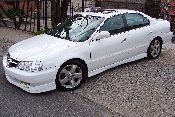
So after all that being said, Is a 2 finger gap safe to go with? How do we measure the drop to know that we have it even all around and it's acutually not more than a 2 finger drop after installing the teins?
new wheels = old school
Joined: Aug 2002
Posts: 381
Likes: 0
From: Arizona
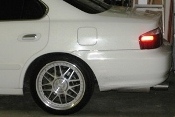
with some it is, with some it is not. like said above it is mostly preference. if you want close to perfect tire wear, you can be safe and get a camber kit.
park somewhere level and stick two fingers on the very top of your tire between the fender and if your two fingers can't fit, it's less than a 'two finger gap'...if it is, raise it up and retry.
to make sure it is an even drop, measure from the jackpoints to the ground. another way of doing it is measuring from the centermost part of the wheel to the lip of the fender. good luck.
park somewhere level and stick two fingers on the very top of your tire between the fender and if your two fingers can't fit, it's less than a 'two finger gap'...if it is, raise it up and retry.
to make sure it is an even drop, measure from the jackpoints to the ground. another way of doing it is measuring from the centermost part of the wheel to the lip of the fender. good luck.
Originally Posted by Napsoner
So after all that being said, Is a 2 finger gap safe to go with? How do we measure the drop to know that we have it even all around and it's acutually not more than a 2 finger drop after installing the teins?
Safe? Safe how and for who? That is a little ambiguous. Putting Teins on your car at any height is not going to hurt anyone. If you are asking about safe for the tires, you should maybe reread some of my posts. At that height, tire wear is not going to be an issue without a camber kit. There is no "safe" to it. But you will need an alignment.
The instructions that come with the Teins tell you how to set the suspension for a specific drop. 2 fingers is actually raising it from their recommended settings. Some very simple math and a dash of logic will provide the answer. Or, maybe consider professional installation.
Marcus

Thread
Thread Starter
Forum
Replies
Last Post
MrHeeltoe
1G TSX Tires, Wheels, & Suspension
20
Feb 23, 2023 01:54 PM
ITSJESTER
4G TL Audio, Bluetooth, Electronics & Navigation
17
Dec 6, 2018 02:29 AM
MrHeeltoe
2G TSX Tires, Wheels & Suspension
3
Sep 29, 2015 10:43 PM
MrHeeltoe
3G TL Tires, Wheels & Suspension
0
Sep 28, 2015 05:43 PM
