


Performance gain from lighter wheels??


Thread Starter
Racer
Joined: Dec 2002
Posts: 265
Likes: 0
From: Wilmington, DE
Performance gain from lighter wheels??
Hey guys, I'm getting ready to get rid of my current setup in favor of something that is MUCH lighter. I currently have chrome '03 CL-S wheels on my TL-S with 235/45/17 Sumitomo HTR+ tires. This setup weighs approximately 52 lbs per wheel/tire.
Now, what I'm looking at getting are the new Konig Trouble wheels in the same size as the CL-S wheels (17 X 7). Each rim weighs 19 lbs, as compared to 26 lbs for the CL-S wheels. Also, I believe I'm going back to stock size tires as they are lighter and I don't believe I'll lose much cornering ability. I'm going to get the Falken Ziex ZE-512 tires, which get really good reviews and are one of the lightest tires available.
So I'll be going from 52 lbs per corner to 40.4 lbs per corner, resulting in a 11.6 lbs savings per wheel/tire. What kind of performance gains can I expect from this much weight savings? Handling, acceleration, ride...etc Thanks in advance...
Now, what I'm looking at getting are the new Konig Trouble wheels in the same size as the CL-S wheels (17 X 7). Each rim weighs 19 lbs, as compared to 26 lbs for the CL-S wheels. Also, I believe I'm going back to stock size tires as they are lighter and I don't believe I'll lose much cornering ability. I'm going to get the Falken Ziex ZE-512 tires, which get really good reviews and are one of the lightest tires available.
So I'll be going from 52 lbs per corner to 40.4 lbs per corner, resulting in a 11.6 lbs savings per wheel/tire. What kind of performance gains can I expect from this much weight savings? Handling, acceleration, ride...etc Thanks in advance...

Adventurist.
Joined: Jan 2004
Posts: 6,661
Likes: 58
From: Orange County, CA
Acceleration will improve somewhat d/t less rotational mass, you should also see an increase in MPG. Ride will be the same, running the same tire size. Handling is somewhat improved, not much, it all really depends where the weight of the wheel lies... inner, outer, center.

Suzuka Master
Joined: Nov 2000
Posts: 7,388
Likes: 1
From: Ninth Gate & So Cal
Please use the search engine...
THE SEARCH ENGINE IS YOUR FRIEND! Try searching on: "lighter wheels" and/or "rotational inertia"
It depends on the construction of the wheels!
You could end up with an equivalent reduction of static weight close to reduction in wheel mass (if weight loss was concentrated near the center of the wheel/rim).
So, example: If the tires are the same, rim diameters the same, but the verymost inside of the wheels weight 2 lbs less per wheel, you would have 8lbs less weight and you could just subtract this from the car's weight and reconvert your power-to-weight. (3500 - 8 = new weight). You then figure your new power-to-weight.
Do the same thing -- as shown above -- but with 3X times your weight loss per rim to find the upper bound of possible equivalent static weight loss.
There is no such thing as HP gain from loss in rotational inertia or loss in static weight.
The outside of a wheel is moving with a rotational component and translational component. The inside of the wheel is moving at the same speed as the rest of the car (it's call translational motion).
IF the "bulk" of the tire/wheel weight were concentrated at the outside of the wheel, the "effect" of this weight loss would be close to 3x.
The max equivalent gain is close to 3X (So, if you lost 60lbs from tires and wheels you could consider that to be 180lbs of lost weight from the car at the most). If that same 60lbs was only "lost" at the inside of the wheel, the gain would only get equal to 60 lbs. Take the weight and subtract it from the car’s weight and plug in the NHRA acceleration calculator and that’s about as close as your going to get without getting into some real work.
Every wheel is made differently, so there is no such thing as getting xx HP from xx lbs of lost wheel weight.
See the following picture:

LINK: http://dept.physics.upenn.edu/course...on4_1_4_3.html
The wheels and tires on a vehicle are translating at 1x car's velocity and the outside is rotating at 2x car's velocity); this makes for a possible upper bound in equivalent static weight going of 3X (1x + 2x).
Without knowing the construction of the tires, exactly how much they weight, you are going to be guessing and so is everyone else.
The Toyos + SSR competitions vs. stock were about 38lbs/wheel vs. 52lbs wheel tire stock. That's close to 60lbs. The rims were forged and the outside are VERY light. The tires in the 235/45-17 were 2-3lbs lighter than the stock tires. The net effect was like having one less heavy passenger or throwing out two light people.
You might very well lose enough traction from going back to the thinner rim and tire to negate any weight advantage. Finally, the different tires have different drag losses. IOW, you could actually lose performance. When you change more than one thing at a time, you are really making it very difficult to chart what gave gains or losses.
It depends on the construction of the wheels!
You could end up with an equivalent reduction of static weight close to reduction in wheel mass (if weight loss was concentrated near the center of the wheel/rim).
So, example: If the tires are the same, rim diameters the same, but the verymost inside of the wheels weight 2 lbs less per wheel, you would have 8lbs less weight and you could just subtract this from the car's weight and reconvert your power-to-weight. (3500 - 8 = new weight). You then figure your new power-to-weight.
Do the same thing -- as shown above -- but with 3X times your weight loss per rim to find the upper bound of possible equivalent static weight loss.
There is no such thing as HP gain from loss in rotational inertia or loss in static weight.
The outside of a wheel is moving with a rotational component and translational component. The inside of the wheel is moving at the same speed as the rest of the car (it's call translational motion).
IF the "bulk" of the tire/wheel weight were concentrated at the outside of the wheel, the "effect" of this weight loss would be close to 3x.
The max equivalent gain is close to 3X (So, if you lost 60lbs from tires and wheels you could consider that to be 180lbs of lost weight from the car at the most). If that same 60lbs was only "lost" at the inside of the wheel, the gain would only get equal to 60 lbs. Take the weight and subtract it from the car’s weight and plug in the NHRA acceleration calculator and that’s about as close as your going to get without getting into some real work.
Every wheel is made differently, so there is no such thing as getting xx HP from xx lbs of lost wheel weight.
See the following picture:
LINK: http://dept.physics.upenn.edu/course...on4_1_4_3.html
The wheels and tires on a vehicle are translating at 1x car's velocity and the outside is rotating at 2x car's velocity); this makes for a possible upper bound in equivalent static weight going of 3X (1x + 2x).
Without knowing the construction of the tires, exactly how much they weight, you are going to be guessing and so is everyone else.
The Toyos + SSR competitions vs. stock were about 38lbs/wheel vs. 52lbs wheel tire stock. That's close to 60lbs. The rims were forged and the outside are VERY light. The tires in the 235/45-17 were 2-3lbs lighter than the stock tires. The net effect was like having one less heavy passenger or throwing out two light people.
You might very well lose enough traction from going back to the thinner rim and tire to negate any weight advantage. Finally, the different tires have different drag losses. IOW, you could actually lose performance. When you change more than one thing at a time, you are really making it very difficult to chart what gave gains or losses.

Happy CL-S Pilot
Joined: Jan 2001
Posts: 9,215
Likes: 1
From: Nashua, NH, USA
I would like to see some dyno charts of light weight wheels compared to stock!
In principle, there should be gains or loss... but let us say if it is less than 1-2%... does it matter?
In principle, there should be gains or loss... but let us say if it is less than 1-2%... does it matter?
boosted is best
Joined: Feb 2003
Posts: 3,289
Likes: 4
From: .
I would expect a slight increase in WHP with lighter wheels and/or brakes. Doesn't rotational mass (unsprung weight) from the wheels, brakes, etc... slightly reduce the amount of power delivered to the ground?
Trending Topics
Suzuka Master
Joined: Nov 2000
Posts: 7,388
Likes: 1
From: Ninth Gate & So Cal
1-2% (who says?) And for a busted down Buick or a race car?
Originally Posted by Nashua_Night_Hawk
I would like to see some dyno charts of light weight wheels compared to stock!
In principle, there should be gains or loss... but let us say if it is less than 1-2%... does it matter?
In principle, there should be gains or loss... but let us say if it is less than 1-2%... does it matter?
If you ask that question around a F1 paddock … well, good luck.
See above and if you add up a bunch of 1- to 2-percents it matters quite a bit. BTW, if you calc in about 60x3 = 180 for equivalent static weight, then take the car weight around 3600 lbs, you're talking about 3600 / (3600 - 180.0) ~= 1.05 (around 5 percent gain).
And, when you use an inertial dyno, you are going to test only two of the wheels against the weight of the drum -- and not the weight of the car. So, if you're driving a heavy-ass car, your gains will probably be minimal. If the car is lighter than the drum, the gains will be greater. And, a drum is not going to replicate tire deformation on the street.
Why do you think Porsche uses hollow spokes? And, why does the NSX use titanium connecting rods?
Next time you toss a passenger in the car, who weighs about 200 lbs, see how your 1/4 mile times are.
One of the reasons people SHOULD put light weight wheels on their car is to reduce unsprung weight. The car rides much better and handles better with the tires staying in contact with the road. When you have heavy wheels, you end up using the tire's material and air inside it as a secondary spring and it doesn't do too well with a heavy-ass wheel. Take some heavy wheels and go over some "sloppy" section of pavement and then put some light ones on.
Another reason is: lighter load on the engine and TRANNY. If you lower the weight of the car or the rotating parts on the BACK end of the transmission, you’re lowering the load on it. It may be a few percent, but that is quite different from adding more HP/TQ and increasing the stress for performance gains.
Another reason is: better gas mileage.
BTW, have you forgotten all of the "Why is my 1/4 mile time so bad" from the folks that put on larger chrome wheels!
Suzuka Master
Joined: Nov 2000
Posts: 7,388
Likes: 1
From: Ninth Gate & So Cal
Unsprung weight != rotational inertia
Originally Posted by cls6sp03
I would expect a slight increase in WHP with lighter wheels and/or brakes. Doesn't rotational mass (unsprung weight) from the wheels, brakes, etc... slightly reduce the amount of power delivered to the ground?
Unsprung weight != rotational inertia. Related – yes. Same thing – no.
If the part is rotating: rotors, wheels, tires, etc -- it will impact the rotating inertia. The more the weight is moved outward, the more it impact performance. The radius is very important as the effect is related to radius^2.
Unsprung weight is all of the weight (including some or the actual spring), that is on the wheel end of a spring. IOW, the brake calipers, brake rotors, pads, suspension parts (generally some percent of their weight depending on what they are), wheels, brakes, etc.
For example, the static weight of a tire and wheel can be put on a scale and that will give you the unsprung weight. Same with the brake calipers.
You get better handling and tire contact with lower unsprung weight. It's easier to "damp" a light tire and wheel that a really heavy one. If you have a lot of unsprung weight, the tire's sidewalls (along with the air inside it) is working as a spring/shock between the road surface and the wheel.

ex 6 Speed owner :(
Joined: Jun 2002
Posts: 960
Likes: 0
From: Huntington Beach, CA
I used to switch wheels all the time on my Accord. My aftermarket setup was about 10 lbs. heavier per corner and it made a HUGE difference, most notably in braking! Acceleration also dramatically improved as well as ride and handling. AND I'd get 2-4mpg better with the stock wheels on. I will never buy heavier that stock wheels ever again!
Suzuka Master
Joined: Nov 2000
Posts: 7,388
Likes: 1
From: Ninth Gate & So Cal
Originally Posted by BlueCLS6
I used to switch wheels all the time on my Accord. My aftermarket setup was about 10 lbs. heavier per corner and it made a HUGE difference, most notably in braking! Acceleration also dramatically improved as well as ride and handling. AND I'd get 2-4mpg better with the stock wheels on. I will never buy heavier that stock wheels ever again!
Braking improved -- yes!

Good point!
My SSR/235-45-17 tire setup weigh in at 38lbs each. I saw a difference in ride, handling, braking, & speed. Does it improve 1/4 mile? Comon sense says it should as well as dyno #'s. I really don't know though.

boosted is best
Joined: Feb 2003
Posts: 3,289
Likes: 4
From: .
Originally Posted by EricL
Unsprung weight != rotational inertia. Related – yes. Same thing – no.
If the part is rotating: rotors, wheels, tires, etc -- it will impact the rotating inertia. The more the weight is moved outward, the more it impact performance. The radius is very important as the effect is related to radius^2.
Unsprung weight is all of the weight (including some or the actual spring), that is on the wheel end of a spring. IOW, the brake calipers, brake rotors, pads, suspension parts (generally some percent of their weight depending on what they are), wheels, brakes, etc.
For example, the static weight of a tire and wheel can be put on a scale and that will give you the unsprung weight. Same with the brake calipers.
You get better handling and tire contact with lower unsprung weight. It's easier to "damp" a light tire and wheel that a really heavy one. If you have a lot of unsprung weight, the tire's sidewalls (along with the air inside it) is working as a spring/shock between the road surface and the wheel.
If the part is rotating: rotors, wheels, tires, etc -- it will impact the rotating inertia. The more the weight is moved outward, the more it impact performance. The radius is very important as the effect is related to radius^2.
Unsprung weight is all of the weight (including some or the actual spring), that is on the wheel end of a spring. IOW, the brake calipers, brake rotors, pads, suspension parts (generally some percent of their weight depending on what they are), wheels, brakes, etc.
For example, the static weight of a tire and wheel can be put on a scale and that will give you the unsprung weight. Same with the brake calipers.
You get better handling and tire contact with lower unsprung weight. It's easier to "damp" a light tire and wheel that a really heavy one. If you have a lot of unsprung weight, the tire's sidewalls (along with the air inside it) is working as a spring/shock between the road surface and the wheel.
Also, I'll be getting a dyno shortly afterward to compare to my previous dyno.

Moderator Alumnus
Joined: Mar 2001
Posts: 17,856
Likes: 0
From: Carrollton, Texas
speaking of lighter wheels, I bought 2 SSR comps from a local guy who had them on his TL. 100x5 is printed on the actual rim. Our bolt pattern is 114x5 or something like that. Will the 100x5 bolt pattern work on the CL? He had taken these off of his TL, so I figured they would fit. 
Racer
Joined: Aug 2003
Posts: 478
Likes: 0
From: il
Turbo mag. Did this test on a civic hatchback. The car had 15's on it and they plus sized it to a 17" set up. The overall diameter was raised by an inch or so, but the weight was raised 10-11lbs. They dyno'ed the car with the stock set up and then with the plus sizing. Adding 10lbs to the wheels made the car lose 6hp and 4lbs of torque. so I don't know if it works in reverse, that you will gain the same amount by subtracting 10lbs.

Lead Footed
Joined: May 2001
Posts: 3,415
Likes: 15
From: Plano - Texas
Originally Posted by Nashua_Night_Hawk
I would like to see some dyno charts of light weight wheels compared to stock!
In principle, there should be gains or loss... but let us say if it is less than 1-2%... does it matter?
In principle, there should be gains or loss... but let us say if it is less than 1-2%... does it matter?
So what's it all worth. Based on my personal experiences, wheels and tires can be equal to the gains of a CAI or headers. My claim for this is that at the track my TLS with 18.2lb wheels and 20.8lb Toyos was running with and even beating guys with headers or CAIs. I'm not talking about beating them in a heads up race, but was beating their times.
Don't over look it is all I got to say.
Ruf

Banned
Joined: Aug 2002
Posts: 5,045
Likes: 0
From: Miami, FL
Originally Posted by mantis23
speaking of lighter wheels, I bought 2 SSR comps from a local guy who had them on his TL. 100x5 is printed on the actual rim. Our bolt pattern is 114x5 or something like that. Will the 100x5 bolt pattern work on the CL? He had taken these off of his TL, so I figured they would fit.
Lead Footed
Joined: May 2001
Posts: 3,415
Likes: 15
From: Plano - Texas
Originally Posted by mantis23
speaking of lighter wheels, I bought 2 SSR comps from a local guy who had them on his TL. 100x5 is printed on the actual rim. Our bolt pattern is 114x5 or something like that. Will the 100x5 bolt pattern work on the CL? He had taken these off of his TL, so I figured they would fit.

Maybe we can try at the cooling mod meet to see if they work.
Ruf
Lead Footed
Joined: May 2001
Posts: 3,415
Likes: 15
From: Plano - Texas
BTW - I did a dyno with the wheels and tires and the numbers did not change from what I could tell. But my 0-60 times dropped 2 10ths and my 1/4 mile times were in the 14.65-14.75 range . . . a 2 10th improvement and with no other mods.
This would indicate that the biggest impact is on the lowend . . . which means once the tires are turning then it's not that big of a deal anymore.
EricL, that would make sense . . right?
Ruf
This would indicate that the biggest impact is on the lowend . . . which means once the tires are turning then it's not that big of a deal anymore.
EricL, that would make sense . . right?
Ruf
Thread Starter
Racer
Joined: Dec 2002
Posts: 265
Likes: 0
From: Wilmington, DE
Thanks to everyone for some great advice. It sounds like I'm going to be pretty happy with the added performance all around this lighter setup is going to give me.
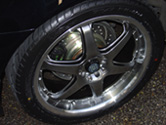
These are the wheels that I'm getting...what do you guys think?

These are the wheels that I'm getting...what do you guys think?


Sweet as Gold
Joined: Oct 2002
Posts: 2,869
Likes: 1
From: NY
those wheels are hot!!The also offer those rims in black w/ the center of the spokes polished...and they also have those same rims w/ seven spokes instead of five. Get someone to photoshop all of them on ur car before u make ur decision.


Suzuka Master
Joined: Nov 2000
Posts: 7,388
Likes: 1
From: Ninth Gate & So Cal
Originally Posted by RUF87
BTW - I did a dyno with the wheels and tires and the numbers did not change from what I could tell. But my 0-60 times dropped 2 10ths and my 1/4 mile times were in the 14.65-14.75 range . . . a 2 10th improvement and with no other mods.
This would indicate that the biggest impact is on the lowend . . . which means once the tires are turning then it's not that big of a deal anymore.
EricL, that would make sense . . right?
Ruf
This would indicate that the biggest impact is on the lowend . . . which means once the tires are turning then it's not that big of a deal anymore.
EricL, that would make sense . . right?
Ruf
Inertia is inertia. Depending on the engine, you might see more "effective" gain at different speeds. Some ECUs will respond well to lighter load, and lighter wheels are equivalent to going downhill. If the engine is in an area where it is not getting a lot a intake velocity charging, the effect of going downhill, losing weight by chassis lightening or reducing rotational inertia can have a more pronounced effect. (There can be some "synergy.") So, you could very well be noticing a more-subtle aspect...
You will get the gains evenly in different gears -- unlike the pulleys that give you more punch in lower gears. The wheels and any spinning parts on the backside of the transmission will not be affected by "reflected load" issues that show up with engine-side lightening. For example, if you lighten the flywheel, crank pulley, or con rods, you're going to get a greater effect in lower gears. A good book control systems will explain this.
When the car reaches the end of the 1/4 mile, the bulk of the drag force is from aero effects. A lighter wheel would have little or no impact on top speed (the aero drag being related to velocity squared.)
I haven't run any 1/4 miles at any strip. However, the Gtech times are MUCH lower with the wheels. With Comptech headers, AEM intake, 60-70 F, 1/4 tank, the car does around 5.7 seconds to 60. When colder out, it goes even faster.
The day I drove out of the shop with the SSR Comps, I noticed an acceleration difference instantly. I noticed it at all speeds (then I got used to it). Since I was taking it easy on the tires, I didn't mash the pedal, but the car needed much less throttle input and gas mileage was better from that day forward.
When I first got car back with the intake and headers, I noticed a BIG difference from 5K and up.
When I first got the car (stock), and it was properly broken in, the 0..60 second times using the same gas, load, etc was 6.4 seconds.
I've been next to 540Is, 350Zs, and a few other cars and the owners were surprised. And, before this gets into a pissing content, I talked with some guys after we "played" and had a nice chat and enjoyed each others cars. The two had manual trannies and we weren't trying to run people off the road -- END.
Lead Footed
Joined: May 2001
Posts: 3,415
Likes: 15
From: Plano - Texas
Originally Posted by EricL
I think so…
Inertia is inertia. Depending on the engine, you might see more "effective" gain at different speeds. Some ECUs will respond well to lighter load, and lighter wheels are equivalent to going downhill. If the engine is in an area where it is not getting a lot a intake velocity charging, the effect of going downhill, losing weight by chassis lightening or reducing rotational inertia can have a more pronounced effect. (There can be some "synergy.") So, you could very well be noticing a more-subtle aspect...
You will get the gains evenly in different gears -- unlike the pulleys that give you more punch in lower gears. The wheels and any spinning parts on the backside of the transmission will not be affected by "reflected load" issues that show up with engine-side lightening. For example, if you lighten the flywheel, crank pulley, or con rods, you're going to get a greater effect in lower gears. A good book control systems will explain this.
When the car reaches the end of the 1/4 mile, the bulk of the drag force is from aero effects. A lighter wheel would have little or no impact on top speed (the aero drag being related to velocity squared.)
I haven't run any 1/4 miles at any strip. However, the Gtech times are MUCH lower with the wheels. With Comptech headers, AEM intake, 60-70 F, 1/4 tank, the car does around 5.7 seconds to 60. When colder out, it goes even faster.
The day I drove out of the shop with the SSR Comps, I noticed an acceleration difference instantly. I noticed it at all speeds (then I got used to it). Since I was taking it easy on the tires, I didn't mash the pedal, but the car needed much less throttle input and gas mileage was better from that day forward.
When I first got car back with the intake and headers, I noticed a BIG difference from 5K and up.
When I first got the car (stock), and it was properly broken in, the 0..60 second times using the same gas, load, etc was 6.4 seconds.
I've been next to 540Is, 350Zs, and a few other cars and the owners were surprised. And, before this gets into a pissing content, I talked with some guys after we "played" and had a nice chat and enjoyed each others cars. The two had manual trannies and we weren't trying to run people off the road -- END.
Inertia is inertia. Depending on the engine, you might see more "effective" gain at different speeds. Some ECUs will respond well to lighter load, and lighter wheels are equivalent to going downhill. If the engine is in an area where it is not getting a lot a intake velocity charging, the effect of going downhill, losing weight by chassis lightening or reducing rotational inertia can have a more pronounced effect. (There can be some "synergy.") So, you could very well be noticing a more-subtle aspect...
You will get the gains evenly in different gears -- unlike the pulleys that give you more punch in lower gears. The wheels and any spinning parts on the backside of the transmission will not be affected by "reflected load" issues that show up with engine-side lightening. For example, if you lighten the flywheel, crank pulley, or con rods, you're going to get a greater effect in lower gears. A good book control systems will explain this.
When the car reaches the end of the 1/4 mile, the bulk of the drag force is from aero effects. A lighter wheel would have little or no impact on top speed (the aero drag being related to velocity squared.)
I haven't run any 1/4 miles at any strip. However, the Gtech times are MUCH lower with the wheels. With Comptech headers, AEM intake, 60-70 F, 1/4 tank, the car does around 5.7 seconds to 60. When colder out, it goes even faster.
The day I drove out of the shop with the SSR Comps, I noticed an acceleration difference instantly. I noticed it at all speeds (then I got used to it). Since I was taking it easy on the tires, I didn't mash the pedal, but the car needed much less throttle input and gas mileage was better from that day forward.
When I first got car back with the intake and headers, I noticed a BIG difference from 5K and up.
When I first got the car (stock), and it was properly broken in, the 0..60 second times using the same gas, load, etc was 6.4 seconds.
I've been next to 540Is, 350Zs, and a few other cars and the owners were surprised. And, before this gets into a pissing content, I talked with some guys after we "played" and had a nice chat and enjoyed each others cars. The two had manual trannies and we weren't trying to run people off the road -- END.
Thank EricL,
I'm pretty sure I followed most of that . . . it makes sense.
. . . and yes, I experience the same thing when accelerating from a stop . . . much easy to spin the tires . . . which made launches a bit trickers. :P
Also, I agree with the experience you had with the 540's and 350's . . . I've surprised a few people myself . . .
Ruf
Moderator Alumnus
Joined: Mar 2001
Posts: 17,856
Likes: 0
From: Carrollton, Texas
Originally Posted by darrinb
who has done before/after dynos on lighter wheels??
he claimed a 10 HP increase when using lighter wheels on the same dyno day.
don't remember the diffrences in weight however.
boosted is best
Joined: Feb 2003
Posts: 3,289
Likes: 4
From: .
Originally Posted by mantis23
blxmjx did.
he claimed a 10 HP increase when using lighter wheels on the same dyno day.
don't remember the diffrences in weight however.
he claimed a 10 HP increase when using lighter wheels on the same dyno day.
don't remember the diffrences in weight however.
Moderator Alumnus
Joined: Mar 2001
Posts: 17,856
Likes: 0
From: Carrollton, Texas
Suzuka Master
Joined: Nov 2000
Posts: 7,388
Likes: 1
From: Ninth Gate & So Cal
Originally Posted by mantis23
Pretty reliable fellow. Those were light wheels, but they were also 19". The size negates some of the weight loss.
If he hadn't doubled that actual dyno gain by 2, then the "equivalent gain" is actually 24HP. (The back wheels are not spinning on the dyno, and their inertia is just as important as the fronts.)
So, if someone was trying to relate the HP to dyno roller weight, you'd need to multiply the 12HP by 2 for the equivalent gain from an engine mod.
So, presuming that is correct, that would be 24HP, and that is almost a 10% gain.
As I mentioned, some care should be taken when using this value. The inertia is being compared against the weight of the roller(s)/drum(s) -- and not the car.

Senior Moderator
Joined: Oct 2000
Posts: 7,588
Likes: 48
From: Port Richey, FL
Originally Posted by EricL
Pretty reliable fellow. Those were light wheels, but they were also 19". The size negates some of the weight loss.
If he hadn't doubled that actual dyno gain by 2, then the "equivalent gain" is actually 24HP. (The back wheels are not spinning on the dyno, and their inertia is just as important as the fronts.)
So, if someone was trying to relate the HP to dyno roller weight, you'd need to multiply the 12HP by 2 for the equivalent gain from an engine mod.
So, presuming that is correct, that would be 24HP, and that is almost a 10% gain.
As I mentioned, some care should be taken when using this value. The inertia is being compared against the weight of the roller(s)/drum(s) -- and not the car.
If he hadn't doubled that actual dyno gain by 2, then the "equivalent gain" is actually 24HP. (The back wheels are not spinning on the dyno, and their inertia is just as important as the fronts.)
So, if someone was trying to relate the HP to dyno roller weight, you'd need to multiply the 12HP by 2 for the equivalent gain from an engine mod.
So, presuming that is correct, that would be 24HP, and that is almost a 10% gain.
As I mentioned, some care should be taken when using this value. The inertia is being compared against the weight of the roller(s)/drum(s) -- and not the car.
Suzuka Master
Joined: Nov 2000
Posts: 7,388
Likes: 1
From: Ninth Gate & So Cal
Delta == change needs to be considered. Presuming change is uniform at front & rear.
Originally Posted by typeR
eric i question that logic though because HP on a dyno is relative ...his other dyno never showed the HP loss from the original rear wheels because they were never measured...thats why i never really cared about dynos ...take it to the track...thats the gain im looking for
CHANGE (delta) in inertia is always the same. Just because the rotors or other parts in the rear are different doesn't impact a change. As long as the tire/wheel combo at the front/rear is identical, the results would need to be multiplied by 2. If you can make a case for the wheels not being in contact with the road, that would be different.
If someone wants to play "armchair HP vs. inertia tech-wiz," they need to consider that unless you're on a 4-wheel dyno, you're only going to get the "presumed" gain or loss from only two of the wheels. IOW, you need to multiply by two (that assumes that all the tire and/or wheel modifications are identical).
If you do a FWD car on a two-wheel dyno, you will never see the results from the changed rear wheels.
If you do a RWD car on a two-wheel dyno, you will never see the results from the changed front wheels.
If you have identical tires and wheels in the front and back -- as is the case with most FWD cars -- you will lose or gain the same amount of inertia (FRONT and BACK) from a given change (this presuming that you change ALL four wheels/tires and the change is uniform for all four wheels and tires!
If you do a RWD dyno on a newer RWD car, the 2x factor would be USELESS, since most of the newer RWD cars have bigger tires and wheels in the rear. (Not all of them, but most of the high-performance sport models do). In this case, it would be pure guesswork to figure out what you were getting. At best, it's a number to toss around.
RE: track – yes.
It would be best, of course, to just find out at the track. This presumes that you have similar track conditions (same track, same temp, humidity, gas load, etc.)

Thread
Thread Starter
Forum
Replies
Last Post
ExcelerateRep
Sponsored Sales & Group Buys
8
Jan 6, 2016 09:59 AM
ExcelerateRep
4G TL Performance Parts & Modifications
8
Dec 11, 2015 12:58 PM
JarrettLauderdale
2G CL Dynograph Gallery
5
Sep 21, 2015 07:51 PM
