


Oil analysis completed


Thread Starter
Instructor
Joined: Jan 2008
Posts: 244
Likes: 12
From: Oregon
Oil analysis completed
Since oil type and change interval are often topics of discussion with no quantitative analysis or scientific evidence presented, I share my first oil change results.
Background:
87 octane fuel from whatever station is cheapest (Freddy's, Arco, Shell)
46,000 miles on the OD
10,200 miles on the oil
1 year change interval
Mobil 1 5W-30 oil used
No makeup oil added
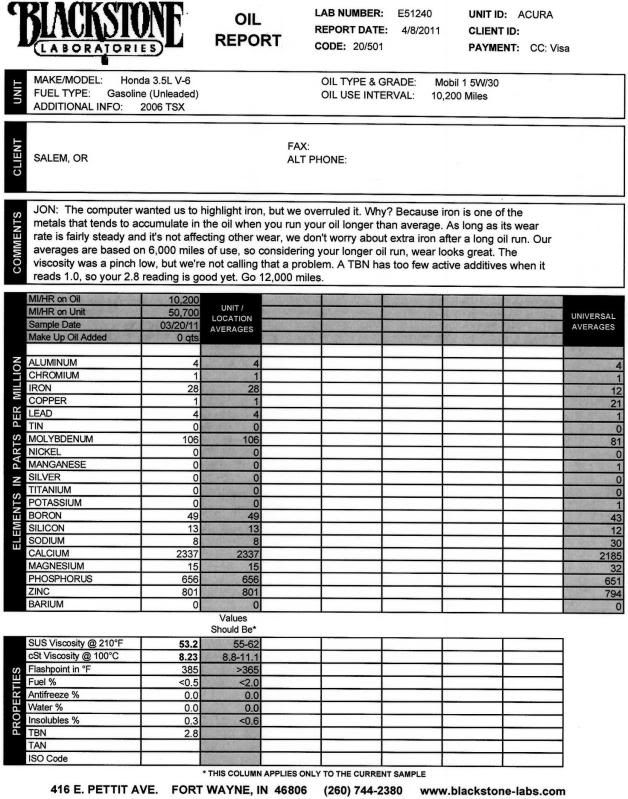
Background:
87 octane fuel from whatever station is cheapest (Freddy's, Arco, Shell)
46,000 miles on the OD
10,200 miles on the oil
1 year change interval
Mobil 1 5W-30 oil used
No makeup oil added
JON: The computer wanted us to highlight iron, but we overruled it. Why? Because iron is one of the
metals that tends to accumulate in the oil when you run your oil longer than average. As long as its wear
rate is fairly steady and it's not affecting other wear, we don't worry about extra iron after a long oil run. Our
averages are based on 6,000 miles of use, so considering your longer oil run, wear looks great. The
viscosity was a pinch low, but we're not calling that a problem. A TBN has too few active additives when it
reads 1.0, so your 2.8 reading is good yet. Go 12,000 miles.
metals that tends to accumulate in the oil when you run your oil longer than average. As long as its wear
rate is fairly steady and it's not affecting other wear, we don't worry about extra iron after a long oil run. Our
averages are based on 6,000 miles of use, so considering your longer oil run, wear looks great. The
viscosity was a pinch low, but we're not calling that a problem. A TBN has too few active additives when it
reads 1.0, so your 2.8 reading is good yet. Go 12,000 miles.



Thread Starter
Instructor
Joined: Jan 2008
Posts: 244
Likes: 12
From: Oregon
At this rate, you will be waiting about 4 years. I'll update this in a year if I can remember.
I'll throw in my MPG graph too. I expect 31 mpg to be average from here on out in my 6mt. 60/40 hyw/city
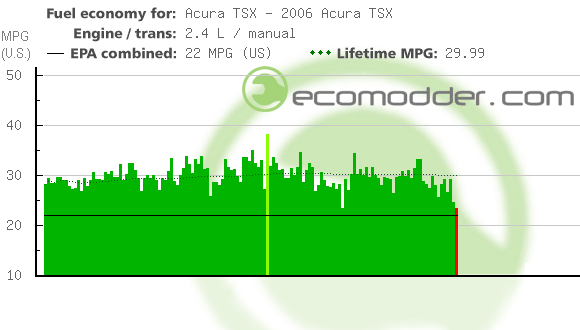
I'll throw in my MPG graph too. I expect 31 mpg to be average from here on out in my 6mt. 60/40 hyw/city
Last edited by redpoint; Jun 9, 2011 at 10:29 PM.

in the 24th and a half...
Joined: Mar 2006
Posts: 852
Likes: 38
Just a note, I'm running the same oil on a 5,000 mile change set-up and have several reports to check. My 55k report was closest to yours and shows lower levels of most materials (as do all my other reports) except boron, calcium, phosporous, and zinc.
The thing that jumped out to me in your report was your insolubles matched mine at twice the oil life, so that plus TBN suggests the oil isn't breaking down, but I think the levels suggest some potential adverse effect. Your gas mileage doesn't suggest a drive it like you stole it approach, so I'm wondering.
I check every 15k to keep a running watch on my engine, and just got a spike in molybdenum to close to your levels. I think I'd be a little nervous about some of your levels vs. the earlier oil change levels I've been seening...perhaps trying a 7.5k change to see how the levels responded.
The thing that jumped out to me in your report was your insolubles matched mine at twice the oil life, so that plus TBN suggests the oil isn't breaking down, but I think the levels suggest some potential adverse effect. Your gas mileage doesn't suggest a drive it like you stole it approach, so I'm wondering.
I check every 15k to keep a running watch on my engine, and just got a spike in molybdenum to close to your levels. I think I'd be a little nervous about some of your levels vs. the earlier oil change levels I've been seening...perhaps trying a 7.5k change to see how the levels responded.


Thread Starter
Instructor
Joined: Jan 2008
Posts: 244
Likes: 12
From: Oregon
Trending Topics

Thread Starter
Instructor
Joined: Jan 2008
Posts: 244
Likes: 12
From: Oregon
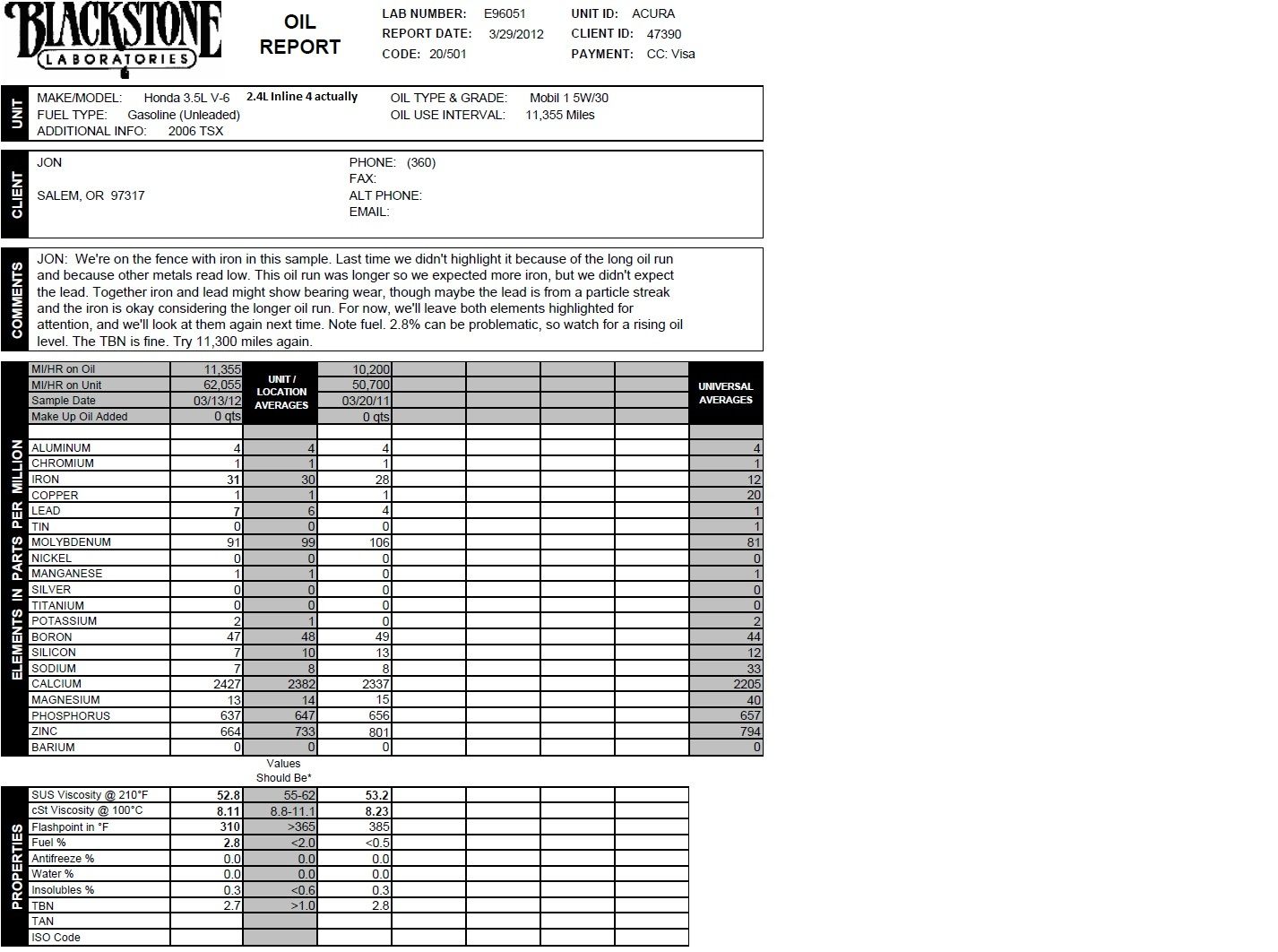
Did my yearly oil change again in March. Just now getting around to posting the results.
I use 87 octane because it is the cheapest fuel that Acura approves, and I don't find any loss in MPG by running it. I'm almost never going above 4000rpm, and it still runs well when I do. If premium produced better fuel economy in proportion to the increased price, then I would run that.
I use 87 octane because it is the cheapest fuel that Acura approves, and I don't find any loss in MPG by running it. I'm almost never going above 4000rpm, and it still runs well when I do. If premium produced better fuel economy in proportion to the increased price, then I would run that.

it's a car-drive it
Joined: Apr 2007
Posts: 5,375
Likes: 262
From: North Carolina
Did my yearly oil change again in March. Just now getting around to posting the results.
I use 87 octane because it is the cheapest fuel that Acura approves, and I don't find any loss in MPG by running it. I'm almost never going above 4000rpm, and it still runs well when I do. If premium produced better fuel economy in proportion to the increased price, then I would run that.
I use 87 octane because it is the cheapest fuel that Acura approves, and I don't find any loss in MPG by running it. I'm almost never going above 4000rpm, and it still runs well when I do. If premium produced better fuel economy in proportion to the increased price, then I would run that.

Instructor
Joined: Nov 2007
Posts: 154
Likes: 3
From: USA
I believe the higher octane produces lower emissions, which help Acura qualify for the LEV classification. Someone correct me if I'm wrong. I've used nothing but 93 octane (we don't have 91 readily available down here) for 8 years in this car, and there's never been a problem with knocking or hesitation.
in the 24th and a half...
Joined: Mar 2006
Posts: 852
Likes: 38

Cruisin'
Joined: Jun 2012
Posts: 15
Likes: 1
huh thats intriguing... ive always changed my oil at 3k. with eneos 5w-30...
maybe i should test my oil to see what kind of results i would get. So the listed elements are normal readings im assuming?


Old Guy
Joined: Apr 2007
Posts: 2,873
Likes: 161
How shall I put this.... You've been wasting your money, time, and oil, I'm afraid. Oil change intervals have been a fairly common topic of conversation here (and I see you haven't been here for any of it), and some discussions have become somewhat contentious. Acura recommended a 10K mile oil change interval for the 04 and 05 models (and 20K mile interval for the filter), with the maintenance nanny taking over for the newer models (those have tended to come it at shorter intervals). All that said, I've had my oil tested a number times, and it seems 10K miles is not stretch (that's all highway driving, your results may vary). I've been somewhat vocal about the unwillingness of those that insist on clinging to the very old 3K miles change routine; it's really only has "feel good" value now. Engine and oil technology have allowed the longer intervals, and I (and many others) have embraced that. I would suggest having your oil analyzed, but I would also recommend that you run the oil at least, say.... 5K miles (change is hard, baby steps might help), and see what Blackstone has to say. My guess is they'll recommend that you could run the oil much longer next time. My wife and I both drive a TSX. My 05 has 173K miles on it, her 07 is at around 160K. Neither use a drop of oil, and both run like new. We've managed to accomplish this without changing the oil every 3K miles.
Thread Starter
Instructor
Joined: Jan 2008
Posts: 244
Likes: 12
From: Oregon
Use of a gasoline with a pump octane number less than 87 can lead to engine damage.
in the 24th and a half...
Joined: Mar 2006
Posts: 852
Likes: 38
Direct quote from my '06 manual (other years may be different):
While this may not technically be an endorsement, it implies that 87 octane does not lead to engine damage. In other words, 87 is ok. Other people may interpret this to mean it is approved. Of course, if you want the highest performance, 91 octane is the way to go.
While this may not technically be an endorsement, it implies that 87 octane does not lead to engine damage. In other words, 87 is ok. Other people may interpret this to mean it is approved. Of course, if you want the highest performance, 91 octane is the way to go.
"Fuel Recommendation
Your vehicle is designed to operate on premium unleaded gasoline with a pump octane number of 91 or higher. Use of a lower octane gasoline can cause occasional metallic knocking noises in the engine and will result in decreased engine performance. Use of a gasoline with a pump octane number less than 87 can lead to engine damage"
Now, that says Acura/Honda endorses 91 octane plus and says "OCCASIONAL USE" of 87 to 90 octane fuel is allowable with a note on engine sounds and performance. Remember, as cars age, octane demand can climb. If that happens, then 87 octane might start causing damage because the computer can no longer adjust spark timing to avoid pre-ignition.
The debate on octane has been had many times, and a number of people have successfully used 87 octane only. My question is, do you understand the risk? If you do, and you wish to, go right ahead. But please, DO NOT spread false claims on what is endorsed.
Thread Starter
Instructor
Joined: Jan 2008
Posts: 244
Likes: 12
From: Oregon
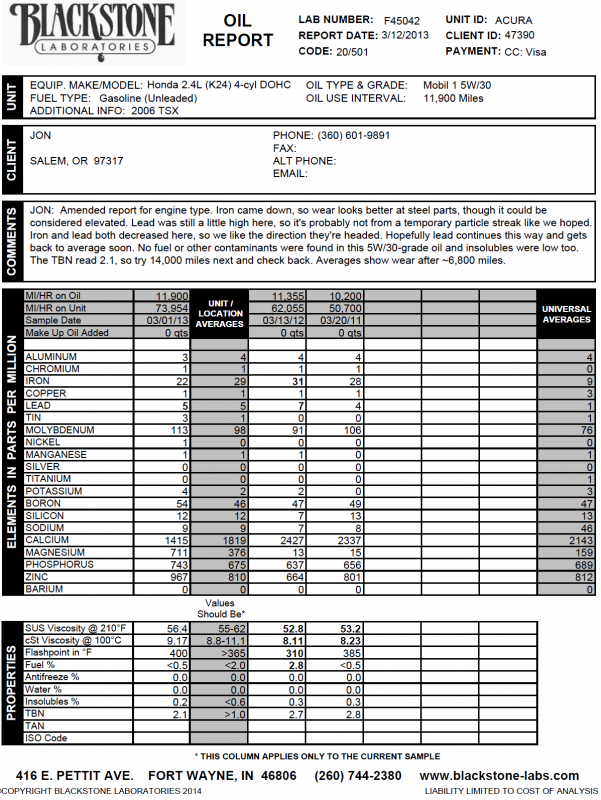
Another year gone by, another oil report.
As a side-note to the octane debate in this thread, I'm considering a switch to 91 PON because I do believe my driving style pushes the pre-ignition properties of the fuel. While I do not rev high, I do consistently run a 90% load while accelerating. What this means is that my throttle is nearly completely open, which draws in a large volume of nearly sea level (dense) air. The threat of pre-ignition would likely be lower if I ran higher RPM and lower load, but of course, this is an inefficient way to drive.
Premium gasoline costs about 5% more than regular at current prices, so I would hope to see a 5% increase in fuel economy, or 1.5mpg in my case. I'm spending close to $1,500 per year to travel roughly 12,000 miles. Buying premium fuel would cost an extra $75 yearly.
On to the analysis:
87 octane fuel from whatever station is cheapest (Freddy's, Arco, Shell)
74,000 miles on the OD
11,900 miles on the oil
1 year change interval
Mobil 1 5W-30 oil used
No makeup oil added

As a side-note to the octane debate in this thread, I'm considering a switch to 91 PON because I do believe my driving style pushes the pre-ignition properties of the fuel. While I do not rev high, I do consistently run a 90% load while accelerating. What this means is that my throttle is nearly completely open, which draws in a large volume of nearly sea level (dense) air. The threat of pre-ignition would likely be lower if I ran higher RPM and lower load, but of course, this is an inefficient way to drive.
Premium gasoline costs about 5% more than regular at current prices, so I would hope to see a 5% increase in fuel economy, or 1.5mpg in my case. I'm spending close to $1,500 per year to travel roughly 12,000 miles. Buying premium fuel would cost an extra $75 yearly.
On to the analysis:
87 octane fuel from whatever station is cheapest (Freddy's, Arco, Shell)
74,000 miles on the OD
11,900 miles on the oil
1 year change interval
Mobil 1 5W-30 oil used
No makeup oil added
JON: Iron came down, so wear looks better at steel parts. Lead was still a little high here, so it's probably
not from a temporary particle streak like we hoped. Sometimes, bearing wear increases when the engine
sees prolonged idling, increased city driving, or other hard use. In any case, it decreased here, so we like
the direction it's headed. Hopefully it continues that way and gets back to average. No fuel or other
contaminants were found in this 5W/30-grade oil and insolubles were low too. The TBN read 2.1, so try
going up to ~14,000 miles next and check back.
not from a temporary particle streak like we hoped. Sometimes, bearing wear increases when the engine
sees prolonged idling, increased city driving, or other hard use. In any case, it decreased here, so we like
the direction it's headed. Hopefully it continues that way and gets back to average. No fuel or other
contaminants were found in this 5W/30-grade oil and insolubles were low too. The TBN read 2.1, so try
going up to ~14,000 miles next and check back.
Thread Starter
Instructor
Joined: Jan 2008
Posts: 244
Likes: 12
From: Oregon
Someone pointed that out 2 years ago, and Blackstone has yet to correct the info. Not sure why they ask what engine my car has if they just choose whatever they want to list. I just sent in another request for them to correct the engine info, so next year we will see if they listened.
Old Guy
Joined: Apr 2007
Posts: 2,873
Likes: 161
Someone pointed that out 2 years ago, and Blackstone has yet to correct the info. Not sure why they ask what engine my car has if they just choose whatever they want to list. I just sent in another request for them to correct the engine info, so next year we will see if they listened.
Thread Starter
Instructor
Joined: Jan 2008
Posts: 244
Likes: 12
From: Oregon

Thread Starter
Instructor
Joined: Jan 2008
Posts: 244
Likes: 12
From: Oregon
I was able to get in touch with Blackstone and get an updated report with the correct engine. Fantastic service this time around. The universal averages are different than the 6-cylinder.
Note: You may need to delete your browser cache before the updated report shows correctly.
Note: You may need to delete your browser cache before the updated report shows correctly.
Last edited by redpoint; Mar 13, 2013 at 02:09 PM.
Thread Starter
Instructor
Joined: Jan 2008
Posts: 244
Likes: 12
From: Oregon
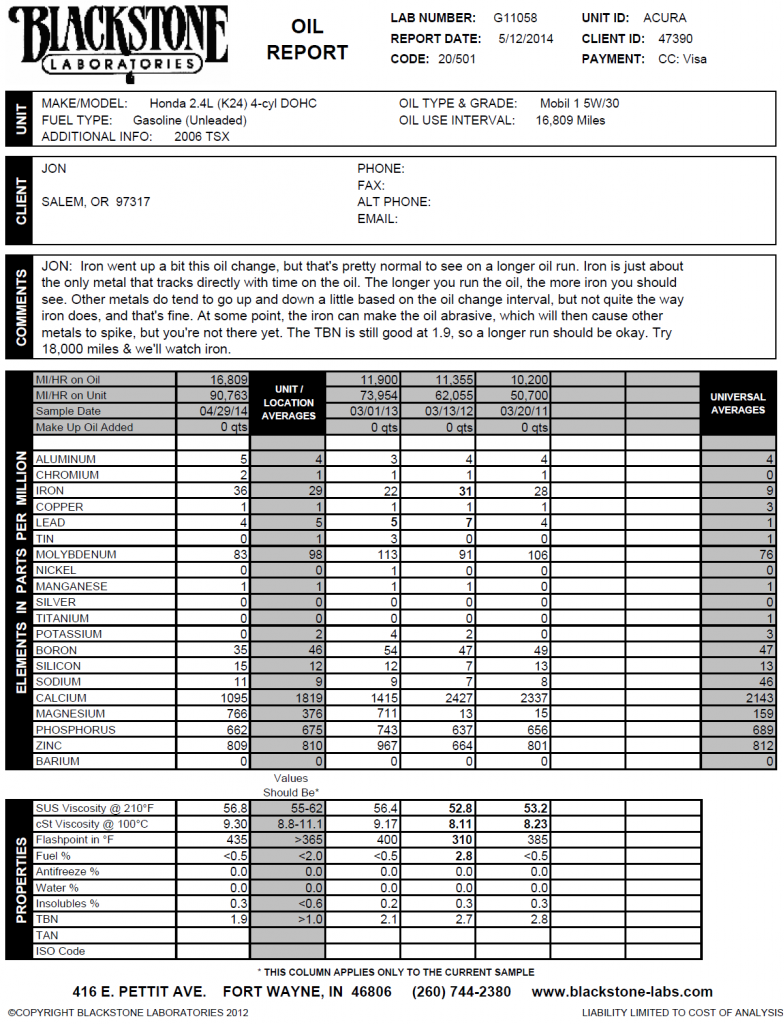
I accidentally went 14 months and 16,800 miles on this oil!
This year I sometimes filled with 87 octane, and sometimes went with 89. I have an UltraGauge installed and noticed that with 87 octane, the ignition timing was not very advanced. The ECU on the TSX monitors the combustion of the fuel, and retards the timing when using lower octane fuels. When I use 89 octane (mid-grade in Oregon/Washington), the ignition timing goes to full 40 degrees advance when cruising on the highway. Since my driving style is low RPM and high load, I'll stick with the mid-grade fuel.
I also started filling at Costco since it's the cheapest fuel, and they are now Top Tier certified, meaning extra detergents to clean the fuel system. The problem is, their pumps don't offer mid-grade fuel, and premium is 92 octane (1 more than specified by the owners manual). I have found no performance increase with 92 octane vs 89, so I don't want to pay extra for the higher octane of premium when it has zero benefit.
Pumps in Oregon/Washington mix 40% premium fuel with 60% regular to achieve mid-grade 89 octane. You can often save a tiny bit of money by pumping 40% premium and then 60% regular instead of paying for mid-grade and letting the pump mix it for you. Since Costco doesn't have mid-grade, I sometimes do this.
90,763 miles on the OD
16,800 miles on the oil
14 month change interval
Mobil 1 5W-30 oil used
No makeup oil added
This year I sometimes filled with 87 octane, and sometimes went with 89. I have an UltraGauge installed and noticed that with 87 octane, the ignition timing was not very advanced. The ECU on the TSX monitors the combustion of the fuel, and retards the timing when using lower octane fuels. When I use 89 octane (mid-grade in Oregon/Washington), the ignition timing goes to full 40 degrees advance when cruising on the highway. Since my driving style is low RPM and high load, I'll stick with the mid-grade fuel.
I also started filling at Costco since it's the cheapest fuel, and they are now Top Tier certified, meaning extra detergents to clean the fuel system. The problem is, their pumps don't offer mid-grade fuel, and premium is 92 octane (1 more than specified by the owners manual). I have found no performance increase with 92 octane vs 89, so I don't want to pay extra for the higher octane of premium when it has zero benefit.
Pumps in Oregon/Washington mix 40% premium fuel with 60% regular to achieve mid-grade 89 octane. You can often save a tiny bit of money by pumping 40% premium and then 60% regular instead of paying for mid-grade and letting the pump mix it for you. Since Costco doesn't have mid-grade, I sometimes do this.
90,763 miles on the OD
16,800 miles on the oil
14 month change interval
Mobil 1 5W-30 oil used
No makeup oil added

Thread
Thread Starter
Forum
Replies
Last Post
asahrts
Member Cars for Sale
0
Sep 4, 2015 05:55 PM
