


Activating Vtec or Ivtec in our case~

Thread Starter
Instructor
Joined: Jan 2009
Posts: 102
Likes: 1
 Activating Vtec or Ivtec in our case~
so took it up to 6,000 rpms today freaking sweet~ i had a WRX before and didn't think this car would pull like that IT SURPRISED THE HELL OUT OF ME. its like a total different car cause when i drive i usually don't even get up past 3,500 rpms, once u pass max torque at 4500 and then hit 6000, awesomeness.
ok enough of my rant of how much i am a I-vtec believer now~ definitely gonna start to mod....people who bash this car and engine are absurd~ i came from an 07 WRX with plenty of torque and let me just say*** to have pretty much TWO cars in one, low rpms for gas/economy and high rpm for performance, its crazy
my question is i took it all the way to like 65-75 mph i think in 2nd GEAR is this normal? just to get it to vtec/redline? that can't be good for tranny~ that means even in spirited driving i won't need to use anything past 3rd GEAR......maybe im just used to the subarus really short/low rpm band.
How are other people shifting and at what RPM when racing?
thoughts opinions comments advice ALL appreciated.
ok enough of my rant of how much i am a I-vtec believer now~ definitely gonna start to mod....people who bash this car and engine are absurd~ i came from an 07 WRX with plenty of torque and let me just say*** to have pretty much TWO cars in one, low rpms for gas/economy and high rpm for performance, its crazy
my question is i took it all the way to like 65-75 mph i think in 2nd GEAR is this normal? just to get it to vtec/redline? that can't be good for tranny~ that means even in spirited driving i won't need to use anything past 3rd GEAR......maybe im just used to the subarus really short/low rpm band.
How are other people shifting and at what RPM when racing?
thoughts opinions comments advice ALL appreciated.
Last edited by cwhsu; Mar 10, 2009 at 09:03 PM.


Yeah, top of 2nd barely get you pass 60. Here's one I did awhile back.
http://www.youtube.com/watch?v=50ErcB46cJY
http://www.youtube.com/watch?v=50ErcB46cJY


Trending Topics

It has the Hondata reflash so vtec switches over at 5000 rpm and rev limit is at 7600 rpm. Stock rev limit is at 7300.

Racer
Joined: Mar 2008
Posts: 453
Likes: 2
From: Honolulu, HI
2nd gear in auto is a pretty tall gear.
race cars have much higher rpm limits and 4 cylinder engines need to stay in the upper rpm level to stay in their powerband. in racing application, they are like motorcycles with 10,000+ rpm's - you have to carry high corner speed to stay in the powerband and try to gas it out of the apex. you can't just point-brake-squirt like a v-twin, or in car speak, v6 or greater.
with our 4 cylinder engines, you just can't drive it like you would a car with more torque...
race cars have much higher rpm limits and 4 cylinder engines need to stay in the upper rpm level to stay in their powerband. in racing application, they are like motorcycles with 10,000+ rpm's - you have to carry high corner speed to stay in the powerband and try to gas it out of the apex. you can't just point-brake-squirt like a v-twin, or in car speak, v6 or greater.
with our 4 cylinder engines, you just can't drive it like you would a car with more torque...


n00b
Joined: Jul 2003
Posts: 2,738
Likes: 45
From: SoCal
Which auto racing series do you follow that uses 4-cylinder engines and spinning them at 10k+ rpm?

Let me help you!
Joined: Apr 2006
Posts: 1,987
Likes: 12
From: So. Cali
He probably means that our 4-cylinder engines need to stay in the higher rpm range to stay in their powerband, somewhat like how race cars and motorcycles have high rpm limits and try to stay in the upper rpm range.
Thread Starter
Instructor
Joined: Jan 2009
Posts: 102
Likes: 1
2nd gear FTW
Lol i guess 2nd gear is our cars best friend huh?
seems to be where most of the *pull* is from my tsx gave a great omph* all throughout second gear man shifting to 3rd though it went down to 4500 rpm~
2nd gear FTW
seems to be where most of the *pull* is from my tsx gave a great omph* all throughout second gear man shifting to 3rd though it went down to 4500 rpm~
2nd gear FTW
Instructor
Joined: Oct 2006
Posts: 173
Likes: 0
From: Alhambra, CA
Racer
Joined: Mar 2008
Posts: 453
Likes: 2
From: Honolulu, HI
I think he has terrible writing skills and was combining two thoughts into one sentence.
He probably means that our 4-cylinder engines need to stay in the higher rpm range to stay in their powerband, somewhat like how race cars and motorcycles have high rpm limits and try to stay in the upper rpm range.
He probably means that our 4-cylinder engines need to stay in the higher rpm range to stay in their powerband, somewhat like how race cars and motorcycles have high rpm limits and try to stay in the upper rpm range.
Originally Posted by jl1080
I don't remember the engine's name, but doesn't the AE86 5-valve 4-piston engine revs up as high as 13k rpm (the 4age?) This is the engine used for rallies, I think...

Instructor
Joined: Jun 2008
Posts: 247
Likes: 0
F1 is now limited to 18,000 RPM:
"As of the start of the 2009 season all engines are now limited to 18,000 rpm in an effort to improve engine reliability and to cut costs down in general."
From: http://en.wikipedia.org/wiki/Formula_One_car
Some of the engines were approaching 20,000 RPM's (but, I can no longer find that article). F1 engines now have the same displacement as the TSX engine; 2.4 L.
"As of the start of the 2009 season all engines are now limited to 18,000 rpm in an effort to improve engine reliability and to cut costs down in general."
From: http://en.wikipedia.org/wiki/Formula_One_car
Some of the engines were approaching 20,000 RPM's (but, I can no longer find that article). F1 engines now have the same displacement as the TSX engine; 2.4 L.
Thread Starter
Instructor
Joined: Jan 2009
Posts: 102
Likes: 1
ok rpm questiom
Ok ultra noob question wat are the benefits or why are higher revving high rpm cars better? I have a friend who drives a rx7 and constantly bashes vtec engines for it high end rpm power cause u gotta rev so high where as his power comes much faster at lower rpms and his rz7 is twin turbo which I'm sure helps I mean if our cars were twin turboed.. Duh anyways so yea why is having a higher rpm like 18000 or even 13000 better?
CL9 ABP
iTrader: (1)
Joined: Feb 2005
Posts: 4,528
Likes: 245
From: Commack, Long Island -> Queens NY
http://www.youtube.com/watch?v=DJcoIy_m7j0
sorry for the bad quality i had my friend film this a awhile ago.
05 at hondata.
sorry for the bad quality i had my friend film this a awhile ago.
05 at hondata.
Make a hole, coming thru!
Joined: Aug 2007
Posts: 2,945
Likes: 15
From: Somewhere between 70 and 125 mph
Great stuff. I don't do that often, but I'm still tempted to get the Hondata mod....
I'm reading this the same day that a coworker posted about the local Sports Car Club rally racing event in 2 weeks. I'm tempted to take my 06 un-modded TSX just to experience it WOT in a controlled environment.
When I've done a fast climb to takeoff velocity, 2nd gear just lasts lots, then third doesn't disappoint. I'm glad I have the 5AT for the mileage and rush hour ease, but I don't think I'll ever drive another auto that doesn't have tiptronic/SSM. Yeah, I KNOW it's not the same as a 6MT, but it manages.
I'm reading this the same day that a coworker posted about the local Sports Car Club rally racing event in 2 weeks. I'm tempted to take my 06 un-modded TSX just to experience it WOT in a controlled environment.
When I've done a fast climb to takeoff velocity, 2nd gear just lasts lots, then third doesn't disappoint. I'm glad I have the 5AT for the mileage and rush hour ease, but I don't think I'll ever drive another auto that doesn't have tiptronic/SSM. Yeah, I KNOW it's not the same as a 6MT, but it manages.
Last edited by davidspalding; Mar 12, 2009 at 12:29 PM.
Great stuff. I don't do that often, but I'm still tempted to get the Hondata mod....
I'm reading this the same day that a coworker posted about the local Sports Car Club rally racing event in 2 weeks. I'm tempted to take my 06 un-modded TSX just to experience it WOT in a controlled environment.
When I've done a fast climb to takeoff velocity, 2nd gear just lasts lots, then third doesn't disappoint. I'm glad I have the 5AT for the mileage and rush hour ease, but I don't think I'll ever drive another auto that doesn't have tiptronic/SSM. Yeah, I KNOW it's not the same as a 6MT, but it manages.
I'm reading this the same day that a coworker posted about the local Sports Car Club rally racing event in 2 weeks. I'm tempted to take my 06 un-modded TSX just to experience it WOT in a controlled environment.
When I've done a fast climb to takeoff velocity, 2nd gear just lasts lots, then third doesn't disappoint. I'm glad I have the 5AT for the mileage and rush hour ease, but I don't think I'll ever drive another auto that doesn't have tiptronic/SSM. Yeah, I KNOW it's not the same as a 6MT, but it manages.

https://acurazine.com/forums/showpos...7&postcount=21

Instructor
Joined: Jun 2008
Posts: 247
Likes: 0
For any given engine size, the power output can be increased by increasing the RPM's -- providing that other components do not intrude to limit the output -- such as value float or vibration. The higher the RPM's, the more power strokes within a given time period.
Vtec could be used to boost power at any RPM's. But, vtec increases roughness at lower RPM's -- and reduces gas mileage at all RPM's and speeds. Having vtec is sort of like having a mild mannered car most of the time -- and a race car when you push it hard. When vtec cuts in, your power increases, your acceleration increases, and your mileage (MPG's) decreases. So, vtec gives you a smooth running engine with good mileage -- that can achieve a boost in power, when needed, by changing the value timing and lift at the higher RPM range. Vtec gives you some of the benefit that a turbo that comes online at high RPM would give you -- without the weight, heat, pressure, and maintenance issues of a turbo. It was a brilliant idea. To me, the vtec in the '06-'08 models is a little more noticeable than the '04-05' models because of the slightly larger values. I think it was '06 when Acura increased the value diameter.
Vtec could be used to boost power at any RPM's. But, vtec increases roughness at lower RPM's -- and reduces gas mileage at all RPM's and speeds. Having vtec is sort of like having a mild mannered car most of the time -- and a race car when you push it hard. When vtec cuts in, your power increases, your acceleration increases, and your mileage (MPG's) decreases. So, vtec gives you a smooth running engine with good mileage -- that can achieve a boost in power, when needed, by changing the value timing and lift at the higher RPM range. Vtec gives you some of the benefit that a turbo that comes online at high RPM would give you -- without the weight, heat, pressure, and maintenance issues of a turbo. It was a brilliant idea. To me, the vtec in the '06-'08 models is a little more noticeable than the '04-05' models because of the slightly larger values. I think it was '06 when Acura increased the value diameter.
 I did it with a relatively mild launch.

Racer
Joined: Apr 2008
Posts: 398
Likes: 0
From: NY
This is what I am talking about. I have been wondering about some 0-60 times for modded cars and no one really has much in the way of concrete times. JTso, are you S/C'd? I would also ask where you got the timer but it seems someone said it can be found in your youtube post. Nice.
Thread Starter
Instructor
Joined: Jan 2009
Posts: 102
Likes: 1
 Thank you jim~
For any given engine size, the power output can be increased by increasing the RPM's -- providing that other components do not intrude to limit the output -- such as value float or vibration. The higher the RPM's, the more power strokes within a given time period.
Vtec could be used to boost power at any RPM's. But, vtec increases roughness at lower RPM's -- and reduces gas mileage at all RPM's and speeds. Having vtec is sort of like having a mild mannered car most of the time -- and a race car when you push it hard. When vtec cuts in, your power increases, your acceleration increases, and your mileage (MPG's) decreases. So, vtec gives you a smooth running engine with good mileage -- that can achieve a boost in power, when needed, by changing the value timing and lift at the higher RPM range. Vtec gives you some of the benefit that a turbo that comes online at high RPM would give you -- without the weight, heat, pressure, and maintenance issues of a turbo. It was a brilliant idea. To me, the vtec in the '06-'08 models is a little more noticeable than the '04-05' models because of the slightly larger values. I think it was '06 when Acura increased the value diameter.
Vtec could be used to boost power at any RPM's. But, vtec increases roughness at lower RPM's -- and reduces gas mileage at all RPM's and speeds. Having vtec is sort of like having a mild mannered car most of the time -- and a race car when you push it hard. When vtec cuts in, your power increases, your acceleration increases, and your mileage (MPG's) decreases. So, vtec gives you a smooth running engine with good mileage -- that can achieve a boost in power, when needed, by changing the value timing and lift at the higher RPM range. Vtec gives you some of the benefit that a turbo that comes online at high RPM would give you -- without the weight, heat, pressure, and maintenance issues of a turbo. It was a brilliant idea. To me, the vtec in the '06-'08 models is a little more noticeable than the '04-05' models because of the slightly larger values. I think it was '06 when Acura increased the value diameter.
Thread Starter
Instructor
Joined: Jan 2009
Posts: 102
Likes: 1
how to hear it more ivtec~
so is having more power at a higher RPM better than being able to get it at a lower rpm for racing and stuff example subarus/evos/turboedcars.....vs our vtec engines or anyother high rpm revving engine?
i know with any intake mod, especially exhaust ill be able to hear the vtec more/better~ how bout just a k&n drop in filter WHO has one and can tell me for sure there is a noticable difff? Is it a significant increase in noise~
i know with any intake mod, especially exhaust ill be able to hear the vtec more/better~ how bout just a k&n drop in filter WHO has one and can tell me for sure there is a noticable difff? Is it a significant increase in noise~
This is what I am talking about. I have been wondering about some 0-60 times for modded cars and no one really has much in the way of concrete times. JTso, are you S/C'd? I would also ask where you got the timer but it seems someone said it can be found in your youtube post. Nice.

Intermediate
Joined: Mar 2009
Posts: 26
Likes: 0
so is having more power at a higher RPM better than being able to get it at a lower rpm for racing and stuff example subarus/evos/turboedcars.....vs our vtec engines or anyother high rpm revving engine?
i know with any intake mod, especially exhaust ill be able to hear the vtec more/better~ how bout just a k&n drop in filter WHO has one and can tell me for sure there is a noticable difff? Is it a significant increase in noise~
i know with any intake mod, especially exhaust ill be able to hear the vtec more/better~ how bout just a k&n drop in filter WHO has one and can tell me for sure there is a noticable difff? Is it a significant increase in noise~

Racer
Joined: Feb 2006
Posts: 313
Likes: 17
From: OKC
Yeah, top of 2nd barely get you pass 60. Here's one I did awhile back.
http://www.youtube.com/watch?v=50ErcB46cJY
http://www.youtube.com/watch?v=50ErcB46cJY
Instructor
Joined: Jun 2008
Posts: 247
Likes: 0
Look at the power band of the TSX. Second gear is good from 5 MPH to ___ MPH. Third gear is good from 20 MPH to over 100 MPH? I can drop from 4th gear to 2nd gear as I approach a curve and not over rev the engine. Occasionally, I will drop from 5th gear to 2nd gear without touching the brakes. For my driving style, the wide power band is much more useful than a lot of torque at low RPM's. Now, if I had a boat, I would want a different engine -- give me the diesel. If I wanted maximum mileage and efficiency, I would take the diesel.
Diesel engines still reflect older designs with high torque, low RPM's, and, as far as I know, most of the time pushrods. Diesel engines have not proven suitable for racing. They tend not to have fast response to changes in throttle inputs. They tend to weigh more than gasoline engines and require more frequent oil changes (or a par with turbo charged engines). The advantage of diesel is the much greater efficiency over gasoline engines, along with high torque.
Last edited by JimHolloman; Mar 13, 2009 at 05:24 PM.
Racer
Joined: Mar 2008
Posts: 453
Likes: 2
From: Honolulu, HI
Diesel engines have not proven suitable for racing. They tend not to have fast response to changes in throttle inputs. They tend to weigh more than gasoline engines and require more frequent oil changes (or a par with turbo charged engines). The advantage of diesel is the much greater efficiency over gasoline engines, along with high torque.
volkswagen also started their tdi cup for rookie drivers using their jetta tdi cars...
Thread Starter
Instructor
Joined: Jan 2009
Posts: 102
Likes: 1
JimHolloman
Look at the power band of the TSX. Second gear is good from 5 MPH to ___ MPH. Third gear is good from 20 MPH to over 100 MPH? I can drop from 4th gear to 2nd gear as I approach a curve and not over rev the engine. Occasionally, I will drop from 5th gear to 2nd gear without touching the brakes. For my driving style, the wide power band is much more useful than a lot of torque at low RPM's. Now, if I had a boat, I would want a different engine -- give me the diesel. If I wanted maximum mileage and efficiency, I would take the diesel.
Awesome information~ thank you~ out of curiosity what is your driving style? street racing? So are you saying that with our engine setup with all things equal its actually better than perhaps a turboed engine car that has power at lower rpm but not so much at higher rpms~
Look at the power band of the TSX. Second gear is good from 5 MPH to ___ MPH. Third gear is good from 20 MPH to over 100 MPH? I can drop from 4th gear to 2nd gear as I approach a curve and not over rev the engine. Occasionally, I will drop from 5th gear to 2nd gear without touching the brakes. For my driving style, the wide power band is much more useful than a lot of torque at low RPM's. Now, if I had a boat, I would want a different engine -- give me the diesel. If I wanted maximum mileage and efficiency, I would take the diesel.
Awesome information~ thank you~ out of curiosity what is your driving style? street racing? So are you saying that with our engine setup with all things equal its actually better than perhaps a turboed engine car that has power at lower rpm but not so much at higher rpms~
Racer
Joined: Feb 2006
Posts: 313
Likes: 17
From: OKC
Speaking in general terms, power at lower RPM's is aligned with pushrods and turbos. Both have distinct disadvantages -- as well as advantages. Engines with overhead cams have less torque and higher RPM's than pushrod engines. One of many things that has been to GM's detrimental has been their persistence in using cast iron pushrod engines -- engines that are now consider out-of-date by most of the experts. Now, if you want to tow a boat, or a trailer, pushrod engines are great. But, if you want a wider power band and an engine that is less prone to suffer value float at higher RPM's, then you want overhead cams. Since overhead cam engines can reach higher RPM's, they can produce more power for any given engine size and weight. Thus, they are the current state-of-the-art in engine design. Everyone wants to save weight.
Look at the power band of the TSX. Second gear is good from 5 MPH to ___ MPH. Third gear is good from 20 MPH to over 100 MPH? I can drop from 4th gear to 2nd gear as I approach a curve and not over rev the engine. Occasionally, I will drop from 5th gear to 2nd gear without touching the brakes. For my driving style, the wide power band is much more useful than a lot of torque at low RPM's. Now, if I had a boat, I would want a different engine -- give me the diesel. If I wanted maximum mileage and efficiency, I would take the diesel.
Diesel engines still reflect older designs with high torque, low RPM's, and, as far as I know, most of the time pushrods. Diesel engines have not proven suitable for racing. They tend not to have fast response to changes in throttle inputs. They tend to weigh more than gasoline engines and require more frequent oil changes (or a par with turbo charged engines). The advantage of diesel is the much greater efficiency over gasoline engines, along with high torque.
Look at the power band of the TSX. Second gear is good from 5 MPH to ___ MPH. Third gear is good from 20 MPH to over 100 MPH? I can drop from 4th gear to 2nd gear as I approach a curve and not over rev the engine. Occasionally, I will drop from 5th gear to 2nd gear without touching the brakes. For my driving style, the wide power band is much more useful than a lot of torque at low RPM's. Now, if I had a boat, I would want a different engine -- give me the diesel. If I wanted maximum mileage and efficiency, I would take the diesel.
Diesel engines still reflect older designs with high torque, low RPM's, and, as far as I know, most of the time pushrods. Diesel engines have not proven suitable for racing. They tend not to have fast response to changes in throttle inputs. They tend to weigh more than gasoline engines and require more frequent oil changes (or a par with turbo charged engines). The advantage of diesel is the much greater efficiency over gasoline engines, along with high torque.
First of all you are correct both have advantages and disadvantages...
But to say overhead cam engines rev higher or that pushrod engines don't or that they are somehow inferior is 100% false. Sprint Cup cars use your so called inferior technology...even worse they dont even have fuel injection but they have no trouble turning 10,000 rpm with the terrible engineering that is the pushrod motor.

Oh yeah and they also develop 900 + horsepower at the flywheel....
An engines potential RPM has more to do with rotating mass and parts engineering than it does overhead cam vs pushrod. And by the way the corvette motors which use pushrods aren't made of iron.
Smaller motors in many cases turn more RPM because you can get more power if you rev it higher. Smaller motors have less rotating mass so less cost goes into building the rotating assembly to turn a required RPM. Overhead cams have nothing to do with RPM, it has everything to do with the original design intent of the motor. The 1989 corvette ZR1 had a 350cu in DOHC V8...it didn't turn 9,000 rpm...why? It didn't need to and it would have been cost prohibitive at the time. I believe that motor turned 6500 rpm and in its final iteration was developing 405 horsepower...GM came out with the LT1 in 1992, car made good power and got pretty good gas mileage. I owned one in a 1995 trans am with a 6 speed manual transmission. Worst mileage I ever got on a tank with normal driving was 17mpg, the best? 30mpg all highway. Not bad mileage for 300 horsepower...and by the way 2nd gear was good 75mph, speed in any gear has more to do with gearing and virtually nothing to do with the motor unless you want to consider available or necessary torque required to move a tall gear from a standstill. I digress...
The pushrod V8 in the Z06 is known to turn 7000+ rpm and that motor has a LOT more engineering in it than anything Honda's got on the street at this point. Oh yeah and the Z06 gets 27mpg highway and if you drive relatively nice in town you'll get 20...sounds outdated to me

You also think most experts consider pushrod technology out of date? Might wanna see who's won numerous engine awards since the mid 1990s...GM, with a host of pushrod and DOHC V8s. There is FAR more to engine technology than simply saying DOHC is better or worse. If you can build a more reliable cost effictive, powerful and efficient motor with out the rotating parts? Why the hell would you not do that?
There can be some very distinct advantages to using DOHC technology on smaller discplacement motors, there is no doubt about it. But piling on GM because they use "pushrod" technology just pissed me off...
Then you want to talk about a wider powerband? Ever seen the powerband on a honda motor? Compare their NSC motor to the LT1 we discussed earlier, when it comes to wider powerband the "pushrod" LT1 wins hands down, hell we could go back to the L98 which GM came out with in 1985 and its got a wider power band than the NSX. Why? Power delivery, sure the redline was 5500rpm and the motor really ran out of steam at 5000+ but from 1200 rpm to 4400rpm you had 300 ft/lbs of torque or MORE. NSX? And i've driven several has a higher RPM but a smaller power band like most honda motors you've gotta keep the revs on to get the most out of the motor, thats not a problem for me, but it a rev range/rev band and a power band are completely different. Oh yeah and that Z06 motor, might wanna check the power band on that too. Here's a Z06 dynograph....I assume most people hare are familiar with TSX and other dynographs from Honda...
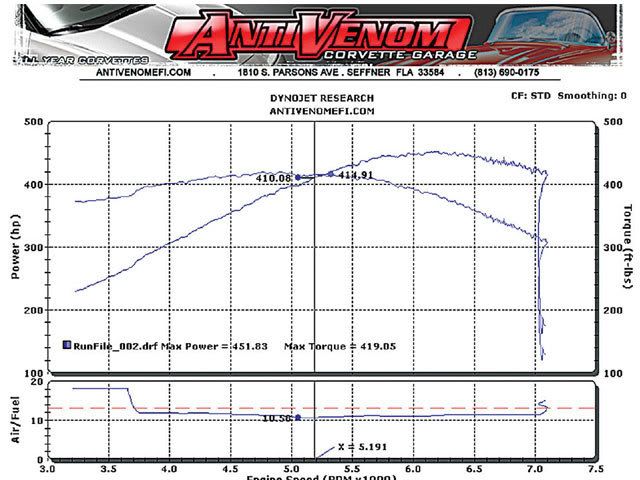
its hard to get accurate data on dyno's below 2500 rpm, you generally have to do a two stage dyno in order to get 1000rpm to 3000rpm readings, but I've seen them done on numerous "pushrod" vehicles and the results are pretty consistent good torque right out of the gate...but to say you can't get high rpm power out of them is idiotic as this clearly shows the car revved to 7100rpm before they shut it down...If I'm not mistake the TSX redlines at 7100 rpm? The motor is less than half the size so from an engineering perspective its much easier to rev the TSX higher (see rotating mass)...
Overhead cam motors valve float to, again it has to do with rotating mass and valve construction. The Z06's that came out in 2001 (or was it 1999?) suffered from valve float if you revved them into the 7000rpm area. That was EASILY addressed with new valves and springs, NOT DOHC. Again don't believe? Look at all the spring cup shit turning 10000rpm...
Now lets talk again about using a gear at a given speed...in my trans am I could run 4th gear from a stop to 115mph. Top Gear tested a Z06 and ran 5th gear from 0 to 165mph...
Now you wanna talk about powerbands and how pushrod motors don't have them?
DOHC motors make it easier to get power from smaller discplacement motors in street applications because you can have two intake and exhaust valves, keep the parts fairly small (as opposed to two larger valves to allow for the same volume of air). Small parts make it easier to rev a motor higher (see mass again) so there are definate advantages to DOHC especially on vehicles like Civic's, Accords and TSX's. The power band on DOHC motors is typically narrower than pushrod motors but the rev range is typically higher...again that has a lot to do with engineering and you can engineer a motor to do just about anything, but saying a car can go from x mph to xxmph in a given gear, saying that has to do with the motor while completely ignoring the gearing which is the MOST important factor in achieving a speed in any given gear is just weird and/or misinformed.
And why on earth do you think overhead cam motors save weight? You do know that most engines today are made of this thing called aluminum? even GM has some of those!