


Ford: Mach-E News


Fahrvergnügen'd
Joined: Mar 2001
Posts: 13,494
Likes: 1,569
From: Maryland
Considering that a maxed out Mach-E will be $61K before tax incentives and the new Mercedes EQC will be in the low $80Ks, I think as long as this launch isn’t a shitshow they will do well.
My ‘13 Focus was a lemon but my ‘15 Mustang was really good save a rattle in the trim around the gauges.
I have my fingers crossed.
My ‘13 Focus was a lemon but my ‘15 Mustang was really good save a rattle in the trim around the gauges.
I have my fingers crossed.
Last edited by charliemike; Dec 9, 2019 at 11:11 AM.

2014 RDX AWD Tech


Joined: Apr 2014
Posts: 4,197
Likes: 355
If other automakers do jump into the battery electric vehicle that is not because of their superior technology or engineering, it’s simply because Tesla allowed them to (gave away the patents for free in good faith). Just don’t forget what GM did to EV tech some decades ago. I’d rather trust Tesla than any other automaker at this point (or until a point of no return happens ...? “happened already”).
I simply don’t believe that other automakers (who seem to have a lot of vested interests- oil cartel, dealerships, service sector, engine mechanics, just to name a few) will act in our good faith to bring the EV tech to affordable level for general public. Yes they may create a high end market niche for these vehicles but otherwise I’m skeptical.
Tesla has singlehandedly managed to uproot all preconceived notions of vehicle ownership, sales methodology, reliance on oil, etc and other automakers are taking notice “ONLY BECAUSE THEY ARE FORCED TO DO THAT” by Tesla.
The effort by Ford is a good one. As I understand the Mach E is the closest competitor to Model Y in all aspects including price (will be slightly cheaper due to federal rebate).
Lets see how the Ford dealerships manage that (test of their sincerity ). Will they do significant “dealership add-ons” to make it uncompetitive, or park them in the darkest corner of parking lot with an unleashed pit bull nearby... remains to be seen.
And will they offer lifetime over the wire updates like Teslas...?
I recently heard that Porsche actually caved in to dealerships with regards to OTA updates for Taycan and wants the cars to be brought in to dealerships to do all updates and calibration (with associated costs to customer). See where it’s going. ....
I simply don’t believe that other automakers (who seem to have a lot of vested interests- oil cartel, dealerships, service sector, engine mechanics, just to name a few) will act in our good faith to bring the EV tech to affordable level for general public. Yes they may create a high end market niche for these vehicles but otherwise I’m skeptical.
Tesla has singlehandedly managed to uproot all preconceived notions of vehicle ownership, sales methodology, reliance on oil, etc and other automakers are taking notice “ONLY BECAUSE THEY ARE FORCED TO DO THAT” by Tesla.
The effort by Ford is a good one. As I understand the Mach E is the closest competitor to Model Y in all aspects including price (will be slightly cheaper due to federal rebate).
Lets see how the Ford dealerships manage that (test of their sincerity
). Will they do significant “dealership add-ons” to make it uncompetitive, or park them in the darkest corner of parking lot with an unleashed pit bull nearby... remains to be seen. And will they offer lifetime over the wire updates like Teslas...?
I recently heard that Porsche actually caved in to dealerships with regards to OTA updates for Taycan and wants the cars to be brought in to dealerships to do all updates and calibration (with associated costs to customer). See where it’s going. ...
.
2014 RDX AWD Tech
Joined: Apr 2014
Posts: 4,197
Likes: 355
.
What features and technology? Other than the EV drive, it's basically a normal car with a few other gimmicks. If you're thinking that other automakers can't do the autopilot thing, that's absolutely wrong. They CHOOSE not to because it's not safe and they'd get sued into oblivion if something went wrong.
What features and technology? Other than the EV drive, it's basically a normal car with a few other gimmicks. If you're thinking that other automakers can't do the autopilot thing, that's absolutely wrong. They CHOOSE not to because it's not safe and they'd get sued into oblivion if something went wrong.
Ever had a free navigation update on a premium car,,,? I have to pay $300 or so for one.
What about functions such as remote start / climate control/ navigation etc from phone ... oops sorry you got to enroll in the monthly subscription.
I’m sorry my friend, Tesla offers all of these and a lot more free if I’m not mistaken.
As I said before, it is not just the EV drive, it’s the entire package starting from EV drive to latest technology, free OTA updates, low cost charging infrastructure, avoidance of dealerships...etc. which other automaker provides ALL OF THOSE?
.
Each time you go to the dealership for anything (usually more than once a year) you are made aware that your car is a few years older and you “need” to trade in to a newer car “to feel special”. .... Ha.
Not only that these cars are fickle and need babying all the time. They don’t like severe weather, bad roads, rough driving, etc..... each time you do that you are reminded not to do that by way of a hefty pocket expense. Their rims are made of soft metal (apparently to improve ride) but bend on a moderate pothole which is not helped by the razor thin rubber on wheels (of course for the sporty performance looks).
Now if you were to park in any place during congested hours, you can be assured of a door ding “thanks to other road users”.
All it provides is some street cred / (parking lot creds) when going for outings with friends.
Did I talk about depreciation... better not. Tesla at least controls that. They keep adding new features OTA free every few months and this keep the car refreshed.
Last edited by Comfy; Dec 9, 2019 at 01:51 PM.
2014 RDX AWD Tech
Joined: Apr 2014
Posts: 4,197
Likes: 355
https://electrek.co/2019/12/08/here-...-run-at-tesla/
As mentioned in the article, Tesla model 3 is eating away the lunch of BMW, Mercedes, and most of all premium automakers. Model Y is expected to do the same. Hope the Mach E shows some resilience.
https://www.teslarati.com/tesla-auto...ure-video/amp/
Lets hope that this trend of continuously improving the features in existing cars percolate to mainstream automakers and not simply remain a Tesla trait.
Don’t want want to hear that “you want to purchase that option” line from the dealership anymore. Or....” sorry, that deal has gone last weekend, however if you buy this new model, you can have that feature for free”.
As mentioned in the article, Tesla model 3 is eating away the lunch of BMW, Mercedes, and most of all premium automakers. Model Y is expected to do the same. Hope the Mach E shows some resilience.
https://www.teslarati.com/tesla-auto...ure-video/amp/
Lets hope that this trend of continuously improving the features in existing cars percolate to mainstream automakers and not simply remain a Tesla trait.
Don’t want want to hear that “you want to purchase that option” line from the dealership anymore. Or....” sorry, that deal has gone last weekend, however if you buy this new model, you can have that feature for free”.
2014 RDX AWD Tech
Joined: Apr 2014
Posts: 4,197
Likes: 355
Yikes, Ford isn't going to be selling any electric cars through dealers like this
https://youtu.be/Aq2k9d_ZPzE
https://youtu.be/Aq2k9d_ZPzE
Thread Starter
Moderator


Joined: Aug 2010
Posts: 29,353
Likes: 6,436
From: Spring, TX
The couple Hyundai dealers near my house/office were the same with the G70. A few had no idea what I was talking about when I called, or said they hadn't received much information on them yet (at the time, it was still pre-production).
2014 RDX AWD Tech
Joined: Apr 2014
Posts: 4,197
Likes: 355
Activating rear seat heaters through an over the air update. Show me another automaker who can do that (has done that).
https://www.teslarati.com/tesla-mode...ted-seats-ota/
https://www.teslarati.com/tesla-mode...ted-seats-ota/

Ex-OEM King

Joined: Dec 2013
Posts: 17,753
Likes: 6,973
From: Minnesnowta
Activating rear seat heaters through an over the air update. Show me another automaker who can do that (has done that).
https://www.teslarati.com/tesla-mode...ted-seats-ota/
https://www.teslarati.com/tesla-mode...ted-seats-ota/
2014 RDX AWD Tech
Joined: Apr 2014
Posts: 4,197
Likes: 355
In Europe: Tesla Superchargers are now over 3x cheaper than their biggest competitor
Tesla’s Supercharger Network just undercut one of its biggest competitors by over three times, and the company did not even have to lower its prices. In a recent announcement, IONITY, the rapid charging network that is considered as VW, BMW, Daimler, and Ford’s answer to the Tesla Superchargers, revealed that it would be updating its pricing structure by the end of the month — and what an update it is.
In a press release, IONITY stated that it would be launching a kilowatt-hour-based pricing scheme for customers across its established pan-European network starting January 31, 2020. The new rate is simple, with the company charging customers per kWh. The only issue is that IONITY will be charging electric car drivers 0.79 EUR ($0.88) per kWh.
That’s a substantial premium compared to the Tesla Supercharging Network, which has a rate of about 0.25 EUR ($0.28) per kWh. Thus, with this new pricing structure in place, an Audi e-tron or Porsche Taycan owner would end up paying about $80 to charge the all-electric SUV from zero to 100%. Considering that these vehicles are capable of traveling just over 200 miles on a charge, IONITY’s updated prices will make long trips on electric cars far more expensive than before.
IONITY boss Michael Hajesch, for one, noted that he does not think the new pricing strategy will turn customers away from using the network. In an interview with Handelsblatt‘s EV publication Edison Media, the IONITY executive explained that the rapid charging network’s advantages would likely be worth it for electric car drivers.
“I don’t have that fear. It is important to mention that the connected mobility service providers – and in this case, also include the Porsche charging service and BMW ChargeNow – offer attractive end customer offers. Direct customers without a contract benefit from the IONITY service promise, such as high availability, a Europe-wide HPC charging network, top locations directly on the motorway, and responsible operation of the charging stations with green electricity.”
He also argued that such price adjustments would likely not deter the advent of electric mobility. While he admitted that IONITY’s new pricing is high compared to its rivals in the market, Hajesch stated that the decision to raise the network’s prices was not difficult at all, even among its owners, VW, BMW, and Daimler.
“The discussion was not fierce or difficult at all. The price will not deter customers from buying, on the contrary. The overall service promise of the European IONITY HPC network already gives an answer to the key criticisms of the past regarding availability, charging power, green electricity supply, and range anxiety. We are therefore convinced that we are making a significant contribution to the market acceptance of electromobility.
“The purchase decision will not only depend on the IONITY price point on the long-haul route, which only accounts for five to ten percent of the annual charging needs. You also have to take into account the other use cases at home/work and public charging, which can already result in advantages over diesel and gasoline,” he said.
Despite the IONITY boss’ arguments, the fact remains that EV owners now need to pay far more to charge their vehicles using the rapid charging network. This will likely deter electric car ownerswho are budget conscious, and it might very well incentivize the ownership of internal combustion cars once more. After all, why buy an Audi e-tron that takes about $80 to fill up when a comparable gas or diesel-powered SUV can fill up for far less?
That being said, this update in IONITY’s pricing also highlights the practicality of Tesla’s Supercharger Network, which charges about $0.28 per kWh. Tesla’s Superchargers currently top out at 250 kW, which is less than IONITY’s peak of 350 kW, but considering the price difference, electric car owners will likely take the slightly slower charging speed and be charged a rate that is several times more affordable. It’s unfortunate, but for now, at least, it appears that the only rapid charging network that is seriously going for petrol’s jugular is Tesla and it's Superchargers.
I hope this is NOT what is in store for the charging set up for Ford Mach-E, VW, and other brands such as Rivian which are relying on "Electrify America" to compete with Tesla. If charging them is going to cost the same (or more) as an ICE vehicle, then half the battle is already lost.
In a press release, IONITY stated that it would be launching a kilowatt-hour-based pricing scheme for customers across its established pan-European network starting January 31, 2020. The new rate is simple, with the company charging customers per kWh. The only issue is that IONITY will be charging electric car drivers 0.79 EUR ($0.88) per kWh.
That’s a substantial premium compared to the Tesla Supercharging Network, which has a rate of about 0.25 EUR ($0.28) per kWh. Thus, with this new pricing structure in place, an Audi e-tron or Porsche Taycan owner would end up paying about $80 to charge the all-electric SUV from zero to 100%. Considering that these vehicles are capable of traveling just over 200 miles on a charge, IONITY’s updated prices will make long trips on electric cars far more expensive than before.
IONITY boss Michael Hajesch, for one, noted that he does not think the new pricing strategy will turn customers away from using the network. In an interview with Handelsblatt‘s EV publication Edison Media, the IONITY executive explained that the rapid charging network’s advantages would likely be worth it for electric car drivers.
“I don’t have that fear. It is important to mention that the connected mobility service providers – and in this case, also include the Porsche charging service and BMW ChargeNow – offer attractive end customer offers. Direct customers without a contract benefit from the IONITY service promise, such as high availability, a Europe-wide HPC charging network, top locations directly on the motorway, and responsible operation of the charging stations with green electricity.”
He also argued that such price adjustments would likely not deter the advent of electric mobility. While he admitted that IONITY’s new pricing is high compared to its rivals in the market, Hajesch stated that the decision to raise the network’s prices was not difficult at all, even among its owners, VW, BMW, and Daimler.
“The discussion was not fierce or difficult at all. The price will not deter customers from buying, on the contrary. The overall service promise of the European IONITY HPC network already gives an answer to the key criticisms of the past regarding availability, charging power, green electricity supply, and range anxiety. We are therefore convinced that we are making a significant contribution to the market acceptance of electromobility.
“The purchase decision will not only depend on the IONITY price point on the long-haul route, which only accounts for five to ten percent of the annual charging needs. You also have to take into account the other use cases at home/work and public charging, which can already result in advantages over diesel and gasoline,” he said.
Despite the IONITY boss’ arguments, the fact remains that EV owners now need to pay far more to charge their vehicles using the rapid charging network. This will likely deter electric car ownerswho are budget conscious, and it might very well incentivize the ownership of internal combustion cars once more. After all, why buy an Audi e-tron that takes about $80 to fill up when a comparable gas or diesel-powered SUV can fill up for far less?
That being said, this update in IONITY’s pricing also highlights the practicality of Tesla’s Supercharger Network, which charges about $0.28 per kWh. Tesla’s Superchargers currently top out at 250 kW, which is less than IONITY’s peak of 350 kW, but considering the price difference, electric car owners will likely take the slightly slower charging speed and be charged a rate that is several times more affordable. It’s unfortunate, but for now, at least, it appears that the only rapid charging network that is seriously going for petrol’s jugular is Tesla and it's Superchargers.
I hope this is NOT what is in store for the charging set up for Ford Mach-E, VW, and other brands such as Rivian which are relying on "Electrify America" to compete with Tesla. If charging them is going to cost the same (or more) as an ICE vehicle, then half the battle is already lost.

Sanest Florida Man


Joined: Aug 2007
Posts: 45,850
Likes: 11,669
From: Florida
Maybe they feel they can hike the prices because gas prices are so high in Europe. Or maybe they're moving to the razor/printer sales model. Sell your vehicle at a loss or little profit and then make all the money on electricity costs.
Also why is this in the Mach-e thread
Also why is this in the Mach-e thread
2014 RDX AWD Tech
Joined: Apr 2014
Posts: 4,197
Likes: 355
Isn’t Electrify America powering all Ford and VW group vehicles, that’s why I posted it here.
2014 RDX AWD Tech
Joined: Apr 2014
Posts: 4,197
Likes: 355
Ford Mach E is going to be “sold out” soon. Reservations over 41000.
https://electrek.co/2020/03/02/ford-...all-50-states/
Ford’s Mustang Mach-E reservations are moving along nicely, with the car’s release coming at the end of this year. We learned today that, if reservation numbers are sequential (and they seem to be), the car now has approximately 41,400 reservations (globally) according to forum posts.
Also, according to Ford, there have been Mach-E reservations in all 50 US states so far.
Ford’s reservation numbers seem to be sequential, though they didn’t start at zero. The earliest reservers from the day of the reveal have numbers as low as ~4,000. It seems that the first 4,000 cars will be reserved internally for Ford’s purposes (Ford corporate fleet, employee sales, etc.). They’re also coming in from around the globe.
Those reservation numbers jumped up to the 20,000 range in the first week after the presentation, and have slowed down since then but are still plugging along. Two days ago the number was in the 41,000 range, and five days prior to that it was in the 40,000 range.
Extrapolating, it looks like we’re still seeing about a thousand orders a week. If this continues to be the case, then Ford’s first-year of production should be “sold out” within the next couple of months. The “first edition” model “sold out” within the first week.
In the first year, Ford plans to build 50,000 Mach-Es across all trim levels. But the American company plans to allocate around 60% of those first- cars to Europe. This is to help Ford meet EU emissions regulations, which are getting much stronger and most automakers are facing big fines if they don’t push more EVs in Europe soon.
Ford also shared an animation showing reservation numbers across the US, along with the most popular color reserved in each state.
Video Player
00:00
00:12
The Mach-E looks to be the most popular in the expected places – out West, particularly in California, and in the Detroit area. It’s also really popular around Washington, DC and in the main cities of Texas.
In particular, there have been questions about whether traditionalists would accept the use of the “Mustang” name on an electric crossover SUV. The car’s popularity in Detroit, the home of American muscle cars, suggests that a relatively traditional market can still be brought on board despite some big changes.
Ford noted that there are reservations in all 50 states of the US. though it looks like North Dakota only barely eked in there.
Ford credits the broad popularity of the Mach-E to the availability of all-wheel drive and large available range options.
While almost 3/4 of cars across the US were ordered with AWD, that number climbs to 9/10 in cold Northeast states. And the “extended-range” battery, which is targeting 300 miles of range, has been most popular in spread-out West and Southwest states.
Ford also shared that about 30% of reservations are for the top-performance GT model, which is targeting 0-60 performance of mid-3-seconds.
But for a company without a proven EV track record, releasing their first purpose-built EV, and without first-to-market advantage, I’d say these numbers are still quite good.
We’re pretty excited about the Mach-E at Electrek, and think it offers a good balance between innovation and inspiration. So it’s good to see it doing well with still almost a year to go until launch.
But one development that might take the wind out of Ford’s sails is that the Tesla Model Y is coming to market much earlier than expected. We’ve already seen Model Ys shipping from the factory this weekend.
So customers will have the option of a good-looking, well-thought-out, good-performing electric crossover SUV several months before Mach-E hits the market.
The Mach-E will have one big advantage though: tax credits. Since Tesla ran out of credits and Ford still has plenty, Ford should be able to undercut Tesla on price once incentives are taken into account. This will help buoy their sales for the first year and beyond – though the popularity of the top-end GT model suggests that early customers aren’t all that price sensitive.
Ford’s Mustang Mach-E reservations are moving along nicely, with the car’s release coming at the end of this year. We learned today that, if reservation numbers are sequential (and they seem to be), the car now has approximately 41,400 reservations (globally) according to forum posts.
Also, according to Ford, there have been Mach-E reservations in all 50 US states so far.
Ford’s reservation numbers seem to be sequential, though they didn’t start at zero. The earliest reservers from the day of the reveal have numbers as low as ~4,000. It seems that the first 4,000 cars will be reserved internally for Ford’s purposes (Ford corporate fleet, employee sales, etc.). They’re also coming in from around the globe.
Those reservation numbers jumped up to the 20,000 range in the first week after the presentation, and have slowed down since then but are still plugging along. Two days ago the number was in the 41,000 range, and five days prior to that it was in the 40,000 range.
Extrapolating, it looks like we’re still seeing about a thousand orders a week. If this continues to be the case, then Ford’s first-year of production should be “sold out” within the next couple of months. The “first edition” model “sold out” within the first week.
In the first year, Ford plans to build 50,000 Mach-Es across all trim levels. But the American company plans to allocate around 60% of those first- cars to Europe. This is to help Ford meet EU emissions regulations, which are getting much stronger and most automakers are facing big fines if they don’t push more EVs in Europe soon.
Ford also shared an animation showing reservation numbers across the US, along with the most popular color reserved in each state.
Video Player
00:00
00:12
The Mach-E looks to be the most popular in the expected places – out West, particularly in California, and in the Detroit area. It’s also really popular around Washington, DC and in the main cities of Texas.
In particular, there have been questions about whether traditionalists would accept the use of the “Mustang” name on an electric crossover SUV. The car’s popularity in Detroit, the home of American muscle cars, suggests that a relatively traditional market can still be brought on board despite some big changes.
Ford noted that there are reservations in all 50 states of the US. though it looks like North Dakota only barely eked in there.
Ford credits the broad popularity of the Mach-E to the availability of all-wheel drive and large available range options.
While almost 3/4 of cars across the US were ordered with AWD, that number climbs to 9/10 in cold Northeast states. And the “extended-range” battery, which is targeting 300 miles of range, has been most popular in spread-out West and Southwest states.
Ford also shared that about 30% of reservations are for the top-performance GT model, which is targeting 0-60 performance of mid-3-seconds.
Electrek’s Take
These numbers are pretty impressive, though pale in comparison to other EVs, even ones announced around the same time.But for a company without a proven EV track record, releasing their first purpose-built EV, and without first-to-market advantage, I’d say these numbers are still quite good.
We’re pretty excited about the Mach-E at Electrek, and think it offers a good balance between innovation and inspiration. So it’s good to see it doing well with still almost a year to go until launch.
But one development that might take the wind out of Ford’s sails is that the Tesla Model Y is coming to market much earlier than expected. We’ve already seen Model Ys shipping from the factory this weekend.
So customers will have the option of a good-looking, well-thought-out, good-performing electric crossover SUV several months before Mach-E hits the market.
The Mach-E will have one big advantage though: tax credits. Since Tesla ran out of credits and Ford still has plenty, Ford should be able to undercut Tesla on price once incentives are taken into account. This will help buoy their sales for the first year and beyond – though the popularity of the top-end GT model suggests that early customers aren’t all that price sensitive.
2014 RDX AWD Tech
Joined: Apr 2014
Posts: 4,197
Likes: 355
Ford’s European future: Far fewer dealerships and more online sales.
Ford’s plan to rein in costs and grow profit (well, create it, to be more accurate) in the European market will see the automaker shed dealers en masse.
Figuring those who really want to test drive a vehicle will be willing to go the distance to do it, Ford’s dealer cull coincides with the release of an online sales platform. That platform rolls out alongside the first model offered through it: the electric Mustang Mach-E.
The automaker’s planned dealer ditching is said to be most severe in the UK, a particularly troubled market for the Blue Oval. One industry newsletter estimated some 180 of the country’s 400 dealers could fall by the wayside. Ford of Europe President Stuart Rowley didn’t cite specifics when speaking with Automotive News Europe.
“It will be appropriate for the market,” he said of the cuts, adding that shedding costs in the area of distribution is key to returning to profitability.
“There is obviously a lot of cost wrapped up in the distribution network and that ends up in the price of the vehicle or coming out of profit,” Rowley said. “We want to make the network more efficient.”
Last year, Ford reported a pre-tax loss of $44 million in the region — a significant improvement over the previous year, despite sales and revenues coming in lower. The automaker said the decline “in Europe’s top line metrics is an outcome of our redesign and portfolio shift as we exit low-margin businesses and refocus our portfolio on
higher-growth and higher-return opportunities.”
In Ford’s mind, fewer dealers does not equal fewer models sold. The online sales system arriving later this year will fill the gap in service left by departing dealers, though the company estimates 90 percent of Britain’s population will still reside within 30 minutes of a Ford dealer.
“Customers want to be able to order their vehicle online. They want to pay for it online. They want a single interface,” Rowley said. They also want convenient servicing, which is why Ford plans to convert some dealers into service-only centers. Others will focus entirely on selling the Transit family of commercial and passenger vans — a fresh product lineup with much growth potential in the region.
Isn’t it strange that in Europe they can do online business without any worries from dealerships lobby.
https://www.thetruthaboutcars.com/20...-online-sales/
Figuring those who really want to test drive a vehicle will be willing to go the distance to do it, Ford’s dealer cull coincides with the release of an online sales platform. That platform rolls out alongside the first model offered through it: the electric Mustang Mach-E.
The automaker’s planned dealer ditching is said to be most severe in the UK, a particularly troubled market for the Blue Oval. One industry newsletter estimated some 180 of the country’s 400 dealers could fall by the wayside. Ford of Europe President Stuart Rowley didn’t cite specifics when speaking with Automotive News Europe.
“It will be appropriate for the market,” he said of the cuts, adding that shedding costs in the area of distribution is key to returning to profitability.
“There is obviously a lot of cost wrapped up in the distribution network and that ends up in the price of the vehicle or coming out of profit,” Rowley said. “We want to make the network more efficient.”
Last year, Ford reported a pre-tax loss of $44 million in the region — a significant improvement over the previous year, despite sales and revenues coming in lower. The automaker said the decline “in Europe’s top line metrics is an outcome of our redesign and portfolio shift as we exit low-margin businesses and refocus our portfolio on
higher-growth and higher-return opportunities.”
In Ford’s mind, fewer dealers does not equal fewer models sold. The online sales system arriving later this year will fill the gap in service left by departing dealers, though the company estimates 90 percent of Britain’s population will still reside within 30 minutes of a Ford dealer.
“Customers want to be able to order their vehicle online. They want to pay for it online. They want a single interface,” Rowley said. They also want convenient servicing, which is why Ford plans to convert some dealers into service-only centers. Others will focus entirely on selling the Transit family of commercial and passenger vans — a fresh product lineup with much growth potential in the region.
Isn’t it strange that in Europe they can do online business without any worries from dealerships lobby.
https://www.thetruthaboutcars.com/20...-online-sales/

Moderator
Joined: Jun 2006
Posts: 29,869
Likes: 3,489
Most high volume auto dealerships are scummy by nature anyway. Difficult to make money on affordable cars with thin margins when you have a lot of overhead.
Don't have experience with or working in a European dealership, but I can't imagine it's drastically different.
Don't have experience with or working in a European dealership, but I can't imagine it's drastically different.

Race Director

Joined: Oct 2003
Posts: 14,432
Likes: 637
From: Orlando, Fl
Fahrvergnügen'd
Joined: Mar 2001
Posts: 13,494
Likes: 1,569
From: Maryland
Race Director
Joined: Oct 2003
Posts: 14,432
Likes: 637
From: Orlando, Fl
Ford is ramping up training as the Mustang Mach-E is nearly ready for sale. According to dealer communiques from Ford, snagged by EVBite, the Mach-E dealer order books will open June 22, which means that “reservations will start to be converted to orders for the electric car.” It takes eight-12 weeks from order to delivery.
Ford will also hold online training exercises for dealers including a virtual walkaround of the vehicle. Something like this would normally be held in person, but since the pandemic ... you know the rest. Dealers won’t be able to physically interact with the car, but this teleconference will allow the Mach-E to stay on schedule. As we know, U.S. deliveries, at least, will still be on time. The only one you can’t get, as far as we’ve heard, is the First Edition, which is sold-out.
The First Edition of the Ford Mustang Mach-E is sold-out. FORDThe Mach-E will get a 210-kW motor in back and a smaller motor in front for AWD purposes. Power ranges from 255 hp and 306 lb-ft of torque in the entry level Select model to 333 hp and 429 lb-ft in the First Edition model. The most powerful GT model is rated at 459 hp and 612 lb-ft of torque. Prices should range from about $44K for the entry level Select model to $61K for the top-spec version. Sprint times will be quick; the cheapest models get there in the mid-five-second range, the GT will do it in less than four seconds.
The Mustang Mach-E should have a decent charging network, as well. The brand will introduce the FordPass Charging Network that put several networks under its banner, including Electrify America. It will total more than 12,000 stations with more than 35,000 plugs and will be free for two years with the purchase of a Mach-E. The company also trademarked “Fastor Charge,” which EVBites thinks is a small charging network starting from its dealerships.

We also know that the Mustang Mach-E EV will be a beast in the snow with all four wheels getting power. Earlier this year we saw the car testing in Michigan’s Upper Peninsula, demonstrating its ability to smoothly cut sweeping drifts in powdered and packed snow.
The Mustang Mach-E will be produced in Mexico, which could make it profitable in its first year, a rarity for new electric vehicles.
You should start seeing the Mustang Mach-E in driveways later this year. We’ve reached out to Ford about the dealer training stuff and will update when we learn more.
Ford will also hold online training exercises for dealers including a virtual walkaround of the vehicle. Something like this would normally be held in person, but since the pandemic ... you know the rest. Dealers won’t be able to physically interact with the car, but this teleconference will allow the Mach-E to stay on schedule. As we know, U.S. deliveries, at least, will still be on time. The only one you can’t get, as far as we’ve heard, is the First Edition, which is sold-out.
The First Edition of the Ford Mustang Mach-E is sold-out. FORDThe Mach-E will get a 210-kW motor in back and a smaller motor in front for AWD purposes. Power ranges from 255 hp and 306 lb-ft of torque in the entry level Select model to 333 hp and 429 lb-ft in the First Edition model. The most powerful GT model is rated at 459 hp and 612 lb-ft of torque. Prices should range from about $44K for the entry level Select model to $61K for the top-spec version. Sprint times will be quick; the cheapest models get there in the mid-five-second range, the GT will do it in less than four seconds.
The Mustang Mach-E should have a decent charging network, as well. The brand will introduce the FordPass Charging Network that put several networks under its banner, including Electrify America. It will total more than 12,000 stations with more than 35,000 plugs and will be free for two years with the purchase of a Mach-E. The company also trademarked “Fastor Charge,” which EVBites thinks is a small charging network starting from its dealerships.
We also know that the Mustang Mach-E EV will be a beast in the snow with all four wheels getting power. Earlier this year we saw the car testing in Michigan’s Upper Peninsula, demonstrating its ability to smoothly cut sweeping drifts in powdered and packed snow.
The Mustang Mach-E will be produced in Mexico, which could make it profitable in its first year, a rarity for new electric vehicles.
You should start seeing the Mustang Mach-E in driveways later this year. We’ve reached out to Ford about the dealer training stuff and will update when we learn more.
Race Director
Joined: Oct 2003
Posts: 14,432
Likes: 637
From: Orlando, Fl
The all-electric Ford Mustang Mach-E performance crossover won’t just be breaking new ground for the Blue Oval in terms of powertrain technology. Ford has previously announced that it’ll be capable of over-the-air (OTA) updates. Now Ford tells us the Mach-E will have more rarified driver assist technology on offer, like a new-to-Ford Hands-Free Mode.
The hands-off driving is a feature of Active Drive Assist, which is essentially adaptive cruise control with lane-keeping assist. It’s part of Ford’s larger Co-Pilot360 suite of driver assistance aids. Like GM's Super Cruise, Active Drive Assist allows the driver to take their hands off the wheel in certain situations, and Ford says it works on over 100,000 miles of divided highways in the U.S. and Canada.
Hands-Free Mode is available on pre-mapped roads, and is aided by multiple driver-facing cameras to monitor head and eye position to ensure the driver still pays attention to the road. Ford says these infrared cameras work even when the user wears glasses or a face mask. With cruise control on, the system will alert the driver when they’re in a hands-free zone, and they can allow the Mach-E to take over steering in addition to acceleration and braking.
To get hands-free driving, customers must purchase the Ford Co-Pilot360 Active 2.0 Prep Package, which includes the necessary hardware for the feature. The system will be enabled via an OTA update when the software becomes available in the third quarter of 2021. In the meantime, customers will be able to enjoy the included Active Park Assist 2.0, allowing the driver to enter or exit parking space with a push of a button.
Ford Co-Pilot360 also gets some other upgrades for the introduction of the Mustang Mach-E. As standard, its lane detection system gets road edge detection capability to better keep you in your lane. Its blind spot system can also help with a nudge to keep you from changing lanes toward another vehicle if you missed the warning. There’s also a new Intersection Assist feature that will initiate automatic emergency braking if there’s an oncoming car when making a left turn.
Another improvement: The stop-and-go adaptive cruise control will remain active for 30 seconds after coming to a stop, instead of requiring driver reactivation after three seconds of stoppage.
Ford hasn’t announced pricing for the Active Drive Assist system or the Prep Package containing the necessary hardware for Hands-Free Mode. It did say, however, that it won’t stop with the Mustang Mach E, and that we can expect to see this technology become available on other Ford vehicles in the 2021 model year.
The hands-off driving is a feature of Active Drive Assist, which is essentially adaptive cruise control with lane-keeping assist. It’s part of Ford’s larger Co-Pilot360 suite of driver assistance aids. Like GM's Super Cruise, Active Drive Assist allows the driver to take their hands off the wheel in certain situations, and Ford says it works on over 100,000 miles of divided highways in the U.S. and Canada.
Hands-Free Mode is available on pre-mapped roads, and is aided by multiple driver-facing cameras to monitor head and eye position to ensure the driver still pays attention to the road. Ford says these infrared cameras work even when the user wears glasses or a face mask. With cruise control on, the system will alert the driver when they’re in a hands-free zone, and they can allow the Mach-E to take over steering in addition to acceleration and braking.
To get hands-free driving, customers must purchase the Ford Co-Pilot360 Active 2.0 Prep Package, which includes the necessary hardware for the feature. The system will be enabled via an OTA update when the software becomes available in the third quarter of 2021. In the meantime, customers will be able to enjoy the included Active Park Assist 2.0, allowing the driver to enter or exit parking space with a push of a button.
Ford Co-Pilot360 also gets some other upgrades for the introduction of the Mustang Mach-E. As standard, its lane detection system gets road edge detection capability to better keep you in your lane. Its blind spot system can also help with a nudge to keep you from changing lanes toward another vehicle if you missed the warning. There’s also a new Intersection Assist feature that will initiate automatic emergency braking if there’s an oncoming car when making a left turn.
Another improvement: The stop-and-go adaptive cruise control will remain active for 30 seconds after coming to a stop, instead of requiring driver reactivation after three seconds of stoppage.
Ford hasn’t announced pricing for the Active Drive Assist system or the Prep Package containing the necessary hardware for Hands-Free Mode. It did say, however, that it won’t stop with the Mustang Mach E, and that we can expect to see this technology become available on other Ford vehicles in the 2021 model year.
2014 RDX AWD Tech
Joined: Apr 2014
Posts: 4,197
Likes: 355
Race Director
Joined: Oct 2003
Posts: 14,432
Likes: 637
From: Orlando, Fl
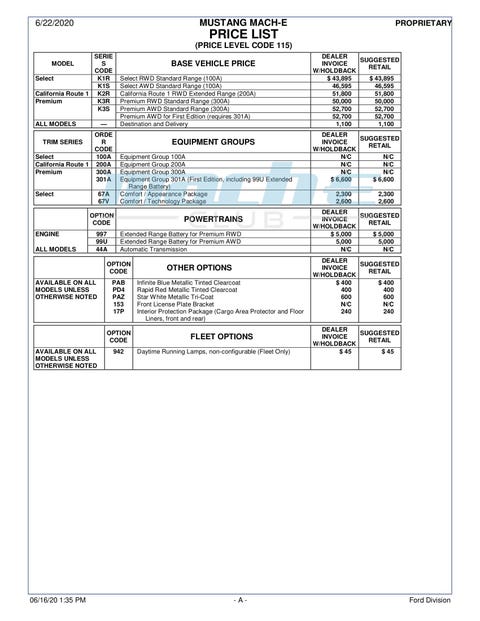
The Mustang Mach-E forums continue to spill the beans on features and specs and orders for the new battery-electric vehicle. Today we get an alleged price list from a dealer, and it looks to match up to what we’ve seen before—with a good look at options, packages and colors, too.
Let’s review. The base (Select trim) Mach-E, rear-wheel drive with the standard range battery, will start at $44,995. Adding all-wheel drive bumps that up to $47,695, a charge of $2,700 for AWD. The California Route 1 RWD version will cost $52,900 and for the Premium RWD Standard Range trim you’ll pay $51,100. All these prices include the $1,100 for destination and delivery. Moving on to the Premium AWD Standard Range trim, that will set you back $53,800; the Premium AWD First Edition is also $53,800, but it requires equipment group 301A, which is another $6,600, for a total of $60,400. That will be your most expensive model except for the GT, which isn't listed on this sheet.
From our Mach-E reveal story: “Power output varies depending on model and drivetrain configuration, from 255 hp and 306 lb-ft of torque in the entry level Select model to 333 hp and 429 lb-ft in the First Edition model. A press release we got at the intro briefing goes further, listing output of the GT model at 459 hp and 612 lb-ft of torque, after you convert all those kWs. Of course, it’s the GT model Mach-E that gets to 60 in the threes.”
On the options side, the Comfort and Appearance Package is $2,300, and the Comfort/Technology Package is $2,600. To get the extended-range battery on the Premium trims you’ll have to shell out $5,000. The liquid-cooled pouch batteries come in two sizes: 75.7 kWh for the standard range (230 miles to 270 miles) and 98.8 kWh for the Premium and California Route 1 models with up to 300 miles of range.
Let’s review. The base (Select trim) Mach-E, rear-wheel drive with the standard range battery, will start at $44,995. Adding all-wheel drive bumps that up to $47,695, a charge of $2,700 for AWD. The California Route 1 RWD version will cost $52,900 and for the Premium RWD Standard Range trim you’ll pay $51,100. All these prices include the $1,100 for destination and delivery. Moving on to the Premium AWD Standard Range trim, that will set you back $53,800; the Premium AWD First Edition is also $53,800, but it requires equipment group 301A, which is another $6,600, for a total of $60,400. That will be your most expensive model except for the GT, which isn't listed on this sheet.
From our Mach-E reveal story: “Power output varies depending on model and drivetrain configuration, from 255 hp and 306 lb-ft of torque in the entry level Select model to 333 hp and 429 lb-ft in the First Edition model. A press release we got at the intro briefing goes further, listing output of the GT model at 459 hp and 612 lb-ft of torque, after you convert all those kWs. Of course, it’s the GT model Mach-E that gets to 60 in the threes.”
On the options side, the Comfort and Appearance Package is $2,300, and the Comfort/Technology Package is $2,600. To get the extended-range battery on the Premium trims you’ll have to shell out $5,000. The liquid-cooled pouch batteries come in two sizes: 75.7 kWh for the standard range (230 miles to 270 miles) and 98.8 kWh for the Premium and California Route 1 models with up to 300 miles of range.
2014 RDX AWD Tech
Joined: Apr 2014
Posts: 4,197
Likes: 355
https://www.macheforum.com/site/thre...nd-for-it.844/

Old Man Yelling at Clouds
Joined: Apr 2007
Posts: 16,973
Likes: 7,362
From: Seattle, WA
Super interested to see what this looks like in person.
It's hard to tell from pictures, but my knock on most EVs to date has been they are priced much higher than their gas counterparts when you compare ones with similar options. The one trump card the EVs have is performance of course. But if the performance difference isn't a discriminator for a buyer, it's hard to get over paying north of $50k for a car that's equipped like a $40k car (options, luxury, etc.). So I'm curious to see where the Mach-E will land. $50k-$60k is a price range with a lot of very strong choices. At that price point a very premium interior is expected, along with ride quality and handling.
I'm not a Tesla 3 hater or anything and find them impressive in their own way, but dollar for dollar they do not hold up to their gas counterparts with respect to luxury, interior quality, ride quality, etc. at their price point. I think the people drawn to them are willing to may more for less in those areas because of the technology. Which is fine, I don't question those motives at all. But I think it's excluding some buyers like myself.
So curious how this Ford will come out.
It's hard to tell from pictures, but my knock on most EVs to date has been they are priced much higher than their gas counterparts when you compare ones with similar options. The one trump card the EVs have is performance of course. But if the performance difference isn't a discriminator for a buyer, it's hard to get over paying north of $50k for a car that's equipped like a $40k car (options, luxury, etc.). So I'm curious to see where the Mach-E will land. $50k-$60k is a price range with a lot of very strong choices. At that price point a very premium interior is expected, along with ride quality and handling.
I'm not a Tesla 3 hater or anything and find them impressive in their own way, but dollar for dollar they do not hold up to their gas counterparts with respect to luxury, interior quality, ride quality, etc. at their price point. I think the people drawn to them are willing to may more for less in those areas because of the technology. Which is fine, I don't question those motives at all. But I think it's excluding some buyers like myself.
So curious how this Ford will come out.
2014 RDX AWD Tech
Joined: Apr 2014
Posts: 4,197
Likes: 355
Super interested to see what this looks like in person.
It's hard to tell from pictures, but my knock on most EVs to date has been they are priced much higher than their gas counterparts when you compare ones with similar options. The one trump card the EVs have is performance of course. But if the performance difference isn't a discriminator for a buyer, it's hard to get over paying north of $50k for a car that's equipped like a $40k car (options, luxury, etc.). So I'm curious to see where the Mach-E will land. $50k-$60k is a price range with a lot of very strong choices. At that price point a very premium interior is expected, along with ride quality and handling.
I'm not a Tesla 3 hater or anything and find them impressive in their own way, but dollar for dollar they do not hold up to their gas counterparts with respect to luxury, interior quality, ride quality, etc. at their price point. I think the people drawn to them are willing to may more for less in those areas because of the technology. Which is fine, I don't question those motives at all. But I think it's excluding some buyers like myself.
So curious how this Ford will come out.
It's hard to tell from pictures, but my knock on most EVs to date has been they are priced much higher than their gas counterparts when you compare ones with similar options. The one trump card the EVs have is performance of course. But if the performance difference isn't a discriminator for a buyer, it's hard to get over paying north of $50k for a car that's equipped like a $40k car (options, luxury, etc.). So I'm curious to see where the Mach-E will land. $50k-$60k is a price range with a lot of very strong choices. At that price point a very premium interior is expected, along with ride quality and handling.
I'm not a Tesla 3 hater or anything and find them impressive in their own way, but dollar for dollar they do not hold up to their gas counterparts with respect to luxury, interior quality, ride quality, etc. at their price point. I think the people drawn to them are willing to may more for less in those areas because of the technology. Which is fine, I don't question those motives at all. But I think it's excluding some buyers like myself.
So curious how this Ford will come out.
Old Man Yelling at Clouds
Joined: Apr 2007
Posts: 16,973
Likes: 7,362
From: Seattle, WA
You are absolutely right about that. The Mach E will have a higher quality interior than Model Y for sure, but that is to make up for their lack of technology / efficiency. The auto industry is going to be reshaped in the very near future and EV are going to be the norm. Price conscious buyers exist in all segments of society and car buyers are no exception. EV will have a killer advantage here. The convenience of home charging (including possibility of free solar charging) will seal the deal for many. Tesla's innovations and technology lead in many areas spurred me to question the need for interior niceties in a car. Sure they are important for many, as you have demonstrated, but I'm not sure as of now.
I don't consider myself price conscious as I am value conscious. I'll pay $50k for a car, but cars at that price point come with certain expectations. I spend 2 hrs a day in my car and most of that is in dense traffic, so I do value ride quality and interior comfort maybe more than most. EVs will always check the performance box. I just don't want to spend $50k on a car that has the look and feel of a $35k car.
I suspect a plug-in hybrid might be my next stop before full EV. But I won't be in the market for a while so I'll keep my eye on this Ford and see what it becomes. I think they have a winning look and winning concept. Hope the execution of it matches.
Old Man Yelling at Clouds
Joined: Apr 2007
Posts: 16,973
Likes: 7,362
From: Seattle, WA
2014 RDX AWD Tech
Joined: Apr 2014
Posts: 4,197
Likes: 355

2014 RDX AWD Tech
Joined: Apr 2014
Posts: 4,197
Likes: 355
This is what’s in store for VW EV owners, Ford Mach E or anyone who is planning to use Electrify America high speed chargers.
https://www.reddit.com/r/electricveh...v_afteralmost/
I almost feel sorry for those guys. Even if they increase the charging stations and quality, they are not going to lower the rates.
https://www.reddit.com/r/electricveh...v_afteralmost/
I almost feel sorry for those guys. Even if they increase the charging stations and quality, they are not going to lower the rates.
2014 RDX AWD Tech
Joined: Apr 2014
Posts: 4,197
Likes: 355
Ford is not planning to build battery plant.
Ford after all is not serious about EVs. They have decided that they are not planning to build their own batteries. Instead they’ll rely on third party suppliers. They even try to justify it by stating that third party supplies are cheaper. Great. We know how it’s gonna turn out. Their goal is less than 100,000 EVs in the next few years (even if they have to plan for bigger share, they need to start planning for a factory now). Bunch of idiots who seem oblivious to their own graveyard which is within sight.
https://www.thetruthaboutcars.com/20...ess-right-now/
If electric vehicles are ever to supplant the tried-and-true gasoline-driven automobile, we’ll need to make a lot of changes. Infrastructure will need to tailor itself to electric driving by implementing more charging stations while bolstering the electrical grid with more power plants and a higher capacity for energy storage. But auto manufacturers will also need to manufacture them at a scale that will adequately feed society, requiring more capable machines — and the batteries they’ll be dependent upon.
While most large automakers have dumped billions into R&D for “mobility projects,” including items pertaining directly toward advancing EVs, their approaches have varied. Some manufacturers (e.g. Tesla) built battery plants to support themselves, others are contented with having made deals with suppliers. Ford has officially taken the latter approach, according to its own leadership.
Citing outgoing Ford CEO Jim Hackett during the company’s second-quarter earnings call, Automotive News helped make the brand’s strategy a bit clearer.
“The supply chain has ramped up since Elon [Musk] built his Gigafactory, and so there’s plenty there that does not warrant us to migrate our capital into owning our own factory,” he said. “There’s no advantage in the ownership in terms of cost or sourcing.”
From AN:
The divergent strategies have huge financial implications. Tesla’s stock jumped last week after CEO Musk hinted that the automaker would reveal improved battery capacity in September. Wall Street analysts have spoken glowingly about GM’s Ultium technology and its potential to support a spinoff EV business.
Sam Abuelsamid, a principal e-mobility analyst at Guidehouse Insights, says both strategies have advantages.
“I don’t know that there is a definitively better path,” he said. “If you source your own, you’ll have a guaranteed supply, but you’re potentially stuck with that supply if you can’t sell them. If you source from suppliers, if there’s a technology breakthrough, you’ve left yourself flexibility and haven’t made a big investment in something that may be prematurely obsolete. It’s a bit of a crapshoot either way you go.”
By not bothering to build an extravagantly priced battery production facility, Ford may actually find itself in a better situation than its peers when the next major technological breakthrough occurs. Yet it could lag behind them if EV demand balloons over the next couple of years. Ford is prioritizing electrics and making plenty of noise about its Mach-E crossover, but it’s also pursuing a mixed approach to vehicle production by attempting to scale down internal combustion powertrains and modifying its fleet to include more hybrids.
In contrast, Volkswagen is more focused on converting its lineup to become entirely dependent on electricity, and will soon offer up that technology to the Blue Oval thanks to a previously established EV partnership. That means VW can take additional risks by betting the farm on electric cars while Ford takes a more mixed approach. Of course, Ford doesn’t get to enjoy the same preferred treatment on Wall Street now that the stock exchange has decided anything that can be construed (or, sometimes misconstrued) as environmentally friendly deserves to have truckloads of money blindly thrown at it.
Still, what works with investors may not play well with customers. General Motors has committed to transforming Cadillac into a luxury EV brand, which seems like a colossal risk for it to take. Granted, the transition only happens if GM feels there is sufficient demand, but that may still leave the brand with a confusingly lineup of vehicles. Hasn’t Cadillac’s identity been muddled enough already?
Ford doesn’t think EV demand will be strong enough to warrant total commitment.
“We don’t have that volume initially to justify that capital expenditure,” Hau Thai-Tang, Ford’s head of product development and purchasing, told analysts earlier this month. “There’s insufficient scale for any one OEM, other than somebody who’s a full-line battery-electric manufacturer like Tesla, to justify that spending.”
He also noted that content requirements in North America and China further complicate the issue, and that Ford would need to sell somewhere between 100,000 to 150,000 EVs annually to rationalize building its own battery factory. However, we’re under the assumption that its more of a cost issue than a supply factor. Volkswagen Group has encountered problems in getting enough power cells for its first round of EVs, despite having just cut its teeth on the segment. And Ford has already stated it will probably have to limit sales of the Mustang Mach-E in its first year specifically because it might not be able to source enough batteries.
https://www.thetruthaboutcars.com/20...ess-right-now/
If electric vehicles are ever to supplant the tried-and-true gasoline-driven automobile, we’ll need to make a lot of changes. Infrastructure will need to tailor itself to electric driving by implementing more charging stations while bolstering the electrical grid with more power plants and a higher capacity for energy storage. But auto manufacturers will also need to manufacture them at a scale that will adequately feed society, requiring more capable machines — and the batteries they’ll be dependent upon.
While most large automakers have dumped billions into R&D for “mobility projects,” including items pertaining directly toward advancing EVs, their approaches have varied. Some manufacturers (e.g. Tesla) built battery plants to support themselves, others are contented with having made deals with suppliers. Ford has officially taken the latter approach, according to its own leadership.
Citing outgoing Ford CEO Jim Hackett during the company’s second-quarter earnings call, Automotive News helped make the brand’s strategy a bit clearer.
“The supply chain has ramped up since Elon [Musk] built his Gigafactory, and so there’s plenty there that does not warrant us to migrate our capital into owning our own factory,” he said. “There’s no advantage in the ownership in terms of cost or sourcing.”
From AN:
The divergent strategies have huge financial implications. Tesla’s stock jumped last week after CEO Musk hinted that the automaker would reveal improved battery capacity in September. Wall Street analysts have spoken glowingly about GM’s Ultium technology and its potential to support a spinoff EV business.
Sam Abuelsamid, a principal e-mobility analyst at Guidehouse Insights, says both strategies have advantages.
“I don’t know that there is a definitively better path,” he said. “If you source your own, you’ll have a guaranteed supply, but you’re potentially stuck with that supply if you can’t sell them. If you source from suppliers, if there’s a technology breakthrough, you’ve left yourself flexibility and haven’t made a big investment in something that may be prematurely obsolete. It’s a bit of a crapshoot either way you go.”
By not bothering to build an extravagantly priced battery production facility, Ford may actually find itself in a better situation than its peers when the next major technological breakthrough occurs. Yet it could lag behind them if EV demand balloons over the next couple of years. Ford is prioritizing electrics and making plenty of noise about its Mach-E crossover, but it’s also pursuing a mixed approach to vehicle production by attempting to scale down internal combustion powertrains and modifying its fleet to include more hybrids.
In contrast, Volkswagen is more focused on converting its lineup to become entirely dependent on electricity, and will soon offer up that technology to the Blue Oval thanks to a previously established EV partnership. That means VW can take additional risks by betting the farm on electric cars while Ford takes a more mixed approach. Of course, Ford doesn’t get to enjoy the same preferred treatment on Wall Street now that the stock exchange has decided anything that can be construed (or, sometimes misconstrued) as environmentally friendly deserves to have truckloads of money blindly thrown at it.
Still, what works with investors may not play well with customers. General Motors has committed to transforming Cadillac into a luxury EV brand, which seems like a colossal risk for it to take. Granted, the transition only happens if GM feels there is sufficient demand, but that may still leave the brand with a confusingly lineup of vehicles. Hasn’t Cadillac’s identity been muddled enough already?
Ford doesn’t think EV demand will be strong enough to warrant total commitment.
“We don’t have that volume initially to justify that capital expenditure,” Hau Thai-Tang, Ford’s head of product development and purchasing, told analysts earlier this month. “There’s insufficient scale for any one OEM, other than somebody who’s a full-line battery-electric manufacturer like Tesla, to justify that spending.”
He also noted that content requirements in North America and China further complicate the issue, and that Ford would need to sell somewhere between 100,000 to 150,000 EVs annually to rationalize building its own battery factory. However, we’re under the assumption that its more of a cost issue than a supply factor. Volkswagen Group has encountered problems in getting enough power cells for its first round of EVs, despite having just cut its teeth on the segment. And Ford has already stated it will probably have to limit sales of the Mustang Mach-E in its first year specifically because it might not be able to source enough batteries.
Old Man Yelling at Clouds
Joined: Apr 2007
Posts: 16,973
Likes: 7,362
From: Seattle, WA
I'm not sure I'm connecting the assertion that not building your own batteries means they are not serious. It would be impossible for each auto manufacturer to establish their own R&D and manufacturing capability.
However, the ultimate success of EVs will depend on the batteries to be sure, and relying on 3rd party vendors means your batteries will never give you a competitive edge. Tesla got that right, because rest assured the best and most capable batteries will go in their cars, the lesser versions they'll sell to others. But I'm not sure that outsourcing dooms them to failure. They will just only perform as well as everyone else. They'll have to discriminate themselves with styling and features, which I think they can do.
However, the ultimate success of EVs will depend on the batteries to be sure, and relying on 3rd party vendors means your batteries will never give you a competitive edge. Tesla got that right, because rest assured the best and most capable batteries will go in their cars, the lesser versions they'll sell to others. But I'm not sure that outsourcing dooms them to failure. They will just only perform as well as everyone else. They'll have to discriminate themselves with styling and features, which I think they can do.

2014 RDX AWD Tech
Joined: Apr 2014
Posts: 4,197
Likes: 355
However, the ultimate success of EVs will depend on the batteries to be sure, and relying on 3rd party vendors means your batteries will never give you a competitive edge. Tesla got that right, because rest assured the best and most capable batteries will go in their cars, the lesser versions they'll sell to others. But I'm not sure that outsourcing dooms them to failure. They will just only perform as well as everyone else. They'll have to discriminate themselves with styling and features, which I think they can do.
The statement from Ford that Battery plant makes financial sense only if they are planning for more than 100-150k / year, .... and they are not doing it. So they are not planning any EVs in high volume, probably not to cannibalize their highly profitable ICE lineup. They are sucking up to oil mafia. What more connection do you need?
If they want to even compete effectively in the EV pick up market , they’ll need their own battery factory.
If they are planning for higher volume Mustang EV in future they should be planning to build factories now (so that it can be operational in a few years- they don’t work at Tesla’s pace).
These laggards will start thinking about a factory in five years when they will at the bottom of the pile, when everyone else will have a running factory of batteries and they will find themselves at disadvantage again since they don’t have neither the technology, nor the factory. And LG and others will be happy to sell them their own versions (sealed with profit margins). Is Ford planning to quit automotive field?
Last edited by Comfy; Sep 2, 2020 at 02:16 PM.
Ex-OEM King
Joined: Dec 2013
Posts: 17,753
Likes: 6,973
From: Minnesnowta
So apparently comfy has some inside line into Ford's general business decision making data for why they chose to not pour billions into a plant but instead would rather source from third party suppliers.
Comfy would it surprise you to know that Ford doesn't actually make much of anything? They mostly assemble stuff. This is the sort of thing you can do when you have a supply chain 10 miles deep and capable of providing all this stuff.
Comfy would it surprise you to know that Ford doesn't actually make much of anything? They mostly assemble stuff. This is the sort of thing you can do when you have a supply chain 10 miles deep and capable of providing all this stuff.
Old Man Yelling at Clouds
Joined: Apr 2007
Posts: 16,973
Likes: 7,362
From: Seattle, WA
That’s the definition of mediocre.
The statement from Ford that Battery plant makes financial sense only if they are planning for more than 100-150k / year, .... and they are not doing it. So they are not planning any EVs in high volume, probably not to cannibalize their highly profitable ICE lineup. They are sucking up to oil mafia. What more connection do you need?
If they want to even compete effectively in the EV pick up market , they’ll need their own battery factory.
If they are planning for higher volume Mustang EV in future they should be planning to build factories now (so that it can be operational in a few years- they don’t work at Tesla’s pace).
These laggards will start thinking about a factory in five years when they will at the bottom of the pile, when everyone else will have a running factory of batteries and they will find themselves at disadvantage again since they don’t have neither the technology, nor the factory. And LG and others will be happy to sell them their own versions (sealed with profit margins). Is Ford planning to quit automotive field?
The statement from Ford that Battery plant makes financial sense only if they are planning for more than 100-150k / year, .... and they are not doing it. So they are not planning any EVs in high volume, probably not to cannibalize their highly profitable ICE lineup. They are sucking up to oil mafia. What more connection do you need?
If they want to even compete effectively in the EV pick up market , they’ll need their own battery factory.
If they are planning for higher volume Mustang EV in future they should be planning to build factories now (so that it can be operational in a few years- they don’t work at Tesla’s pace).
These laggards will start thinking about a factory in five years when they will at the bottom of the pile, when everyone else will have a running factory of batteries and they will find themselves at disadvantage again since they don’t have neither the technology, nor the factory. And LG and others will be happy to sell them their own versions (sealed with profit margins). Is Ford planning to quit automotive field?
Back to Ford - Tesla sold about 360k cars last year. There are a lot of auto makers now introducing competition in 2021 and 2022. So if I'm a bean counter at Ford right now and the data says they have to own about half that market in order to be profitable - also in the face of a ton of other competition coming on line - I can see why they might put a pin in that decision and wait. Plus, these people have to decide if they are in the car business or the battery business. Its not both unless you are Tesla. So Ford (or anyone) can't just look at starting a battery industry if their cars are the only customer. There has to be a broader market, and there are already established players way out ahead of them. If I were Ford, I might look to just buy someone who already does it. Maybe that's where they are headed?
But your point about trucks is well taken - this IS an area Ford is one of the dominant players and they sell a ton of them. A truck-based battery would be a competitive advantage for sure. But that said, who knows what they are doing privately vs what they are stating publicly.
2014 RDX AWD Tech
Joined: Apr 2014
Posts: 4,197
Likes: 355
I agree with most of your statements except the speed of EV adoption. Your comparison about hybrid vehicles not being in the mainstream is relevant however the difference was that there was some sort of a compromise in the cargo space area with the available hybrids from 10 years ago. Battery technology has completely changed now. Applying your logic, hybrid should not be popular even now, but they are getting increasingly popular.
Which world are you living in? Tesla will sell 1 million vehicles by end of 2021. Within 2-3 years it’ll cross the 5 million mark.
But your point about trucks is well taken - this IS an area Ford is one of the dominant players and they sell a ton of them. A truck-based battery would be a competitive advantage for sure. But that said, who knows what they are doing privately vs what they are stating publicly.
I would hate to see Ford lose their leadership in the truck category. Maybe they are banking on Volkswagen to supply batteries for them just in case things went South.
Which world are you living in? Tesla will sell 1 million vehicles by end of 2021. Within 2-3 years it’ll cross the 5 million mark.
But your point about trucks is well taken - this IS an area Ford is one of the dominant players and they sell a ton of them. A truck-based battery would be a competitive advantage for sure. But that said, who knows what they are doing privately vs what they are stating publicly.
Old Man Yelling at Clouds
Joined: Apr 2007
Posts: 16,973
Likes: 7,362
From: Seattle, WA
The people buying EVs now are the crowd of people that are chomping at the bit to get into one, can afford it, and use it in a way that the charging infrastructure and range of EVs supports. Plus they still get government incentives. That's a finite number of people.
To do what you suggest, EVs have to win over the next group of people - which will be folks like me who will cross-shop EVs against gas burners. I have more challenges with charging and range. I'm not so enamored with EVs that I'll spend $10k more to get something comparable to its gas burner counterpart. And the incentives may expire. EVs don't appeal to everyone. Range is a problem. Charging is a problem. Price is a problem. I think Tesla's build quality is far below it's peers at their price points. I'm more interested in value than gee-whiz, and I don't think I'm alone by any stretch. I'm interested to see what these other manufacturers do but I'm not going to shell over $80k to get the same car I can get for $60k with an ICE.
We'll see what happens when the group who was willing to pay more to be early runs out. Maybe EV friendly places like CA may win the day for a while. Maybe growth like you state is possible, but I think it's far from a foregone conclusion. Auto manufacturers are going to be dipping their toe in the water before they jump in to ensure the sales are there.