


The Ultimate Cooling Mod

Three Wheelin'
Joined: Jun 2009
Posts: 1,360
Likes: 47
From: NYC
never heard of jet turbine engines making their own "pressure". The reduction in performance at altitude due to air density is negligible when compared to the aerodynamic benefit. Jet's go high when they want to cruise and save gas.
Helo's (not sure about props) suffer from lack of performance and lack of air to push at altitude.
Helo's (not sure about props) suffer from lack of performance and lack of air to push at altitude.
u never heard of a jet turbine compressing air? whats the point of the compressor powered by the turbine then? id like to understand this


practicing nihilist
Joined: Dec 2005
Posts: 990
Likes: 5
From: Jax, FL
well, they compress air but if there's less air to compress per given unit, compressor shaft speed will eventually have to slow down because it won't be making enough combustion to keep up with the power turbine demand. as all this slows, you'll burn up the engine if you ask for too much power since there will be less intake air being drawn for cooling. generally, only about 30% of intake air is used for combustion...other 70 is for cooling and shaping of the flame.

Team Owner
Joined: Mar 2006
Posts: 20,172
Likes: 1,818
From: Bakersfield
well, they compress air but if there's less air to compress per given unit, compressor shaft speed will eventually have to slow down because it won't be making enough combustion to keep up with the power turbine demand. as all this slows, you'll burn up the engine if you ask for too much power since there will be less intake air being drawn for cooling. generally, only about 30% of intake air is used for combustion...other 70 is for cooling and shaping of the flame.
One thing I've always wondered, is it possible to stall a jet engine at extremely high altitudes if the airspeed goes too low?
Three Wheelin'
Joined: Jun 2009
Posts: 1,360
Likes: 47
From: NYC
well, they compress air but if there's less air to compress per given unit, compressor shaft speed will eventually have to slow down because it won't be making enough combustion to keep up with the power turbine demand. as all this slows, you'll burn up the engine if you ask for too much power since there will be less intake air being drawn for cooling. generally, only about 30% of intake air is used for combustion...other 70 is for cooling and shaping of the flame.
practicing nihilist
Joined: Dec 2005
Posts: 990
Likes: 5
From: Jax, FL
Honestly, I'm a chopper dude and this is all 8 year old basic jet engine knowledge I'm pulling out of my arse.
Are we off topic yet?



I Have A Meth Lab In
Joined: Jul 2008
Posts: 164
Likes: 1
From: Washington, DC
Well said. Am rethinking a few things, mostly the CAI. Can't figure out how the new CAI is better than the stock, which gets it's air from the front and increases as velocity does. The CAI is stuck in place, in heat. Hmm.
No matter what fancy steps you take reduce heat soak and loss of power in hot summer temps, the TRUE underlying reason why power diminishes in the warmer temps is a thing called density altitude or DA. In a nutshell, hot air is less dense than cold air. The more humid the air, the less available O2. The lower the barometric pressure, the less o2 that naturally gets pushed into the motor. On a humid (50%) 90 degree day in Kansas City (1100' above sea level) with 29.9 baro pressure (typical), the density altitude conditions are in the 4000' range or essentially sucking out about 10% of the available power compared to "standard conditions" at sea level. On a dry (30% humidity) and cold (40 degree) day, the DA is right around sea conditions (ie negating the true elevation of Kansas City).
DA is out of your control. You can wrap your intake pipes, add silly plastic spacers to your intake manifolds, ice the intake manifold, but the reality is the motor is going to heat soak in stop and go traffic. You can't stop heat soak in warm weather. You can slow down the heat soak process by a few minutes, but that's the best you're going to get. If you're on the highway, heat soak won't be as much as issue because a lot of air is moving through the engine bay. Hook up an OBDII datalogger and read the air intake sensor values. You'll see what I'm talking about. Also, hot compression chambers (ie block/heads) with a cold air charge create the most power and are the most efficent. Not a cool engine with hot summer air.
Yanking and cutting all these parts off the car really hasn't improved the motors ability to shed heat and has most likely increased drag. Those lower bumper ducts are designed to funnel air to the raditator, tranny cooler, and AC cooler. Apparently you didn't know that. Now you've made a setup that makes the incoming air turbulent and not directed towards probably the most critcal components of a car. I'd strongly reconsider this modification.
These fenderwell CAIs are silly as well. Do you guys not realize that ambient temps at near street surfaces approach 130+ degrees on 90+ degree days? Expose the filter like Inaccurate did and now you open up the potential for all sort of debris to pummel and lodge itself in the filter media. The OEM intakes on your cars, while quiet, are very efficent and become pressurized at speed due to the location and the way the ducting is shaped. More importantly, the air brought in is ambient and not as influenced by street temps. I have yet to see anyone post a 3rd party dyno of a CAI either. From what I can tell, everyone is apparently buying these things based on what the aftermarket companies say and the incorrect notion that the OEM intake is restrictive because it's "ugly". It's so far from the truth.
I'm all for Shade Tree mods, but sometimes you need to step back and research and understand why highly paid engineers do the things they do.
DA is out of your control. You can wrap your intake pipes, add silly plastic spacers to your intake manifolds, ice the intake manifold, but the reality is the motor is going to heat soak in stop and go traffic. You can't stop heat soak in warm weather. You can slow down the heat soak process by a few minutes, but that's the best you're going to get. If you're on the highway, heat soak won't be as much as issue because a lot of air is moving through the engine bay. Hook up an OBDII datalogger and read the air intake sensor values. You'll see what I'm talking about. Also, hot compression chambers (ie block/heads) with a cold air charge create the most power and are the most efficent. Not a cool engine with hot summer air.
Yanking and cutting all these parts off the car really hasn't improved the motors ability to shed heat and has most likely increased drag. Those lower bumper ducts are designed to funnel air to the raditator, tranny cooler, and AC cooler. Apparently you didn't know that. Now you've made a setup that makes the incoming air turbulent and not directed towards probably the most critcal components of a car. I'd strongly reconsider this modification.
These fenderwell CAIs are silly as well. Do you guys not realize that ambient temps at near street surfaces approach 130+ degrees on 90+ degree days? Expose the filter like Inaccurate did and now you open up the potential for all sort of debris to pummel and lodge itself in the filter media. The OEM intakes on your cars, while quiet, are very efficent and become pressurized at speed due to the location and the way the ducting is shaped. More importantly, the air brought in is ambient and not as influenced by street temps. I have yet to see anyone post a 3rd party dyno of a CAI either. From what I can tell, everyone is apparently buying these things based on what the aftermarket companies say and the incorrect notion that the OEM intake is restrictive because it's "ugly". It's so far from the truth.
I'm all for Shade Tree mods, but sometimes you need to step back and research and understand why highly paid engineers do the things they do.

Does anyone have numbers for air intake temps for the CAI vs stock at a few speeds, say Idle, 35, 60?
Even though I have not much technical knowledge on these sort of things, I think we are over thinking the heat soak issue of the intake tube. I'm not sure how many cfm are flowing at those various speeds, but if I had to guess, I'd say the air, regardless of the density altitude, is reaching the engine so fast that it its temperature isn't really affected by the surrounding tube's temperature. It's not like it's passing through a flame... The real issue is from where the air is being collected and both are out of the engine bay, which would be much hotter than any ambient temp collection point, be it in the fender well closer to the road (CAI) or where the OEM intake collects, which if I recall is right near there by the front grill. Also, the last time I was under the nose, I thought I remembered small fins cut into the splashguard directing air upwards into the fender well. Could be mistaken...
It is an interesting point someone made about the engine flowing about 220 cfm and the intakes able to supply way more than required. I think Opel was calling for a bench flow test on the OEM intake and I guess that's what we'll need to see if there is a difference and in fact a restriction based on the engine's demand.
These last points being suggested, I always "feel" like the CAI makes an improvement in performance, but i suppose I could be a victim of brilliant marketing, aggressive engine note, or hopeless desire for improvements. That being said, I enjoy my AEM Cold Air Intake and I'll not be putting the stock one back on. (It's in a dozen pieces at the local landfill anyway.)
Even though I have not much technical knowledge on these sort of things, I think we are over thinking the heat soak issue of the intake tube. I'm not sure how many cfm are flowing at those various speeds, but if I had to guess, I'd say the air, regardless of the density altitude, is reaching the engine so fast that it its temperature isn't really affected by the surrounding tube's temperature. It's not like it's passing through a flame... The real issue is from where the air is being collected and both are out of the engine bay, which would be much hotter than any ambient temp collection point, be it in the fender well closer to the road (CAI) or where the OEM intake collects, which if I recall is right near there by the front grill. Also, the last time I was under the nose, I thought I remembered small fins cut into the splashguard directing air upwards into the fender well. Could be mistaken...
It is an interesting point someone made about the engine flowing about 220 cfm and the intakes able to supply way more than required. I think Opel was calling for a bench flow test on the OEM intake and I guess that's what we'll need to see if there is a difference and in fact a restriction based on the engine's demand.
These last points being suggested, I always "feel" like the CAI makes an improvement in performance, but i suppose I could be a victim of brilliant marketing, aggressive engine note, or hopeless desire for improvements. That being said, I enjoy my AEM Cold Air Intake and I'll not be putting the stock one back on. (It's in a dozen pieces at the local landfill anyway.)
Team Owner
Joined: Mar 2006
Posts: 20,172
Likes: 1,818
From: Bakersfield
I've done the measurements with the filter placed behind the grill, near the road, in the engine bay, and in the wheelwell. Nothing beat the behind the grill temps especially at idle.
You have tons of fresh air, no worries about heat from the asphalt, etc.
When buying a CAI I would put restriction last on the list of things to look at and filter placement and type up front.
I much prefer an inlet behind the grill with the filter enclosed in the engine bay. Quite honestly, I think a modified factory system would be the absolute best. Take the piping from the bottom of the factory airbox and route it straight to the upper grill area, sort of how it already is but without all the extra tubing. That way you have the coolest possible air, the filter is protected from the elements and hydrolocking, the box is designed so that even if water enters it, it can drain out before any damage is done. The TL doesn't even require 300CFM at WOT, I guarantee that the factory plumbing and paper filter outflow the engine requirements. But if it makes you feel any better, throw a K&N drop in which will flow enough for 500hp.
Really, there is no better system out there than air ducted from behind the grill into a filter box under the hood.
You have tons of fresh air, no worries about heat from the asphalt, etc.
When buying a CAI I would put restriction last on the list of things to look at and filter placement and type up front.
I much prefer an inlet behind the grill with the filter enclosed in the engine bay. Quite honestly, I think a modified factory system would be the absolute best. Take the piping from the bottom of the factory airbox and route it straight to the upper grill area, sort of how it already is but without all the extra tubing. That way you have the coolest possible air, the filter is protected from the elements and hydrolocking, the box is designed so that even if water enters it, it can drain out before any damage is done. The TL doesn't even require 300CFM at WOT, I guarantee that the factory plumbing and paper filter outflow the engine requirements. But if it makes you feel any better, throw a K&N drop in which will flow enough for 500hp.
Really, there is no better system out there than air ducted from behind the grill into a filter box under the hood.
Burning Brakes
Joined: Jul 2008
Posts: 1,140
Likes: 2
I've done the measurements with the filter placed behind the grill, near the road, in the engine bay, and in the wheelwell. Nothing beat the behind the grill temps especially at idle.
You have tons of fresh air, no worries about heat from the asphalt, etc.
When buying a CAI I would put restriction last on the list of things to look at and filter placement and type up front.
I much prefer an inlet behind the grill with the filter enclosed in the engine bay. Quite honestly, I think a modified factory system would be the absolute best. Take the piping from the bottom of the factory airbox and route it straight to the upper grill area, sort of how it already is but without all the extra tubing. That way you have the coolest possible air, the filter is protected from the elements and hydrolocking, the box is designed so that even if water enters it, it can drain out before any damage is done. The TL doesn't even require 300CFM at WOT, I guarantee that the factory plumbing and paper filter outflow the engine requirements. But if it makes you feel any better, throw a K&N drop in which will flow enough for 500hp.
Really, there is no better system out there than air ducted from behind the grill into a filter box under the hood.
You have tons of fresh air, no worries about heat from the asphalt, etc.
When buying a CAI I would put restriction last on the list of things to look at and filter placement and type up front.
I much prefer an inlet behind the grill with the filter enclosed in the engine bay. Quite honestly, I think a modified factory system would be the absolute best. Take the piping from the bottom of the factory airbox and route it straight to the upper grill area, sort of how it already is but without all the extra tubing. That way you have the coolest possible air, the filter is protected from the elements and hydrolocking, the box is designed so that even if water enters it, it can drain out before any damage is done. The TL doesn't even require 300CFM at WOT, I guarantee that the factory plumbing and paper filter outflow the engine requirements. But if it makes you feel any better, throw a K&N drop in which will flow enough for 500hp.
Really, there is no better system out there than air ducted from behind the grill into a filter box under the hood.
My old integra I had the filter on top on a openening under the hood, even smashing around my temp was below the temp guage..almost like right when u turn on the car in the morning..no kiddin
Team Owner
Joined: Mar 2006
Posts: 20,172
Likes: 1,818
From: Bakersfield
The more I think about the "ultimate cooling mod", I wonder about the fans. Not aftermarket fans.
How about making it so both the fans run all the time as opposed to only when they're needed or when the AC is running.
I've taken temps from the GN before and while the air coming off the radiator might be 190 degrees when the fan kicks on, it will steadily drop to the 110 degree range as the thermostat closes. This would have the potential to make a signifigant difference in underhood temps. While it will be more up and down, the average should stay significantly lower. Only thing this might affect would be fan life.
I'm sure the fans are controlled by a relay triggered by the computer and maybe a temp sensor as a backup so it would be easy enough to run the trigger wire to a 12v ignition hot source.
How about making it so both the fans run all the time as opposed to only when they're needed or when the AC is running.
I've taken temps from the GN before and while the air coming off the radiator might be 190 degrees when the fan kicks on, it will steadily drop to the 110 degree range as the thermostat closes. This would have the potential to make a signifigant difference in underhood temps. While it will be more up and down, the average should stay significantly lower. Only thing this might affect would be fan life.
I'm sure the fans are controlled by a relay triggered by the computer and maybe a temp sensor as a backup so it would be easy enough to run the trigger wire to a 12v ignition hot source.

Burning Brakes
Joined: Apr 2006
Posts: 950
Likes: 45
From: Shawnee, KS
E-fans put hella draw on the alternator which then affects available HP. If the TL's engine bay is anything like my prior 94 Z28, prior 96 Maxima, wife's 98 Legacy GT wagon, or my G35, the engine bay temps drop to within 5 or so degrees of ambient once you reach approximately 30-35mph so running the fans all the time would seem a bit pointless, IMO. The air gets within 5 degrees of ambient, but engine components will still remain fairly warm at speed and will get very hot once the air movement slows down like at a slow roll or stop light.

Thread Starter
Safety Car
Joined: Jan 2006
Posts: 4,442
Likes: 482
From: Houston, Texas
I Hate Cars,
Here is my previous homework. Please feel free to give it a try. Like I said, I was about to do it before realizing the cowl removal was a more viable route.
The instructions are fairly simple.
1) Gain access to the ECU.
2) Splice a ground wire into E6 and B10.
THESE NEED TO HAVE GROUND
-------------------------------------
Condensor E6 FANL Green/Yellow
Radiator B10 FANH Green


Originally Posted by Inaccurate from my Post #82 on page 3 of this thread
My second idea was to make both oem fans stay on continuously (well, with key in the "on" position). I had even studied the wiring diagram to figure out how to do it. I was close to implementing it when I thought of removing the cowling. I was reluctant to make the fans run at 100% duty cycle - Could the wiring handle 100% duty cycle? Could the fans handle it? Worried about the strain on the electrical system with 100% duty cycle of both fans. (For other readers, please don't reply to these questions.. these are rhetorical questions).
The instructions are fairly simple.
1) Gain access to the ECU.
2) Splice a ground wire into E6 and B10.
THESE NEED TO HAVE GROUND
-------------------------------------
Condensor E6 FANL Green/Yellow
Radiator B10 FANH Green
Team Owner
Joined: Mar 2006
Posts: 20,172
Likes: 1,818
From: Bakersfield
E-fans put hella draw on the alternator which then affects available HP. If the TL's engine bay is anything like my prior 94 Z28, prior 96 Maxima, wife's 98 Legacy GT wagon, or my G35, the engine bay temps drop to within 5 or so degrees of ambient once you reach approximately 30-35mph so running the fans all the time would seem a bit pointless, IMO. The air gets within 5 degrees of ambient, but engine components will still remain fairly warm at speed and will get very hot once the air movement slows down like at a slow roll or stop light.
Even so, suppose you are right and engine bay temps are nearly ambient once the car is cruising above 35mph. Where we have the most problem is stop and go traffic at or below a 35mph average. Feeding the engine bay 110 degree air instead of 190+ degree air is sure to have some benefits. Electric fans do have a bit of draw but it's not too bad once they're running. The big draw is the spike when they first kick on. Even if they require 2hp worth of electrical draw, the car is going to gain more than that if it can stop it from pulling timing.
Team Owner
Joined: Mar 2006
Posts: 20,172
Likes: 1,818
From: Bakersfield
I Hate Cars,
Here is my previous homework. Please feel free to give it a try. Like I said, I was about to do it before realizing the cowl removal was a more viable route.
The instructions are fairly simple.
1) Gain access to the ECU.
2) Splice a ground wire into E6 and B10.
THESE NEED TO HAVE GROUND
-------------------------------------
Condensor E6 FANL Green/Yellow
Radiator B10 FANH Green
Here is my previous homework. Please feel free to give it a try. Like I said, I was about to do it before realizing the cowl removal was a more viable route.
The instructions are fairly simple.
1) Gain access to the ECU.
2) Splice a ground wire into E6 and B10.
THESE NEED TO HAVE GROUND
-------------------------------------
Condensor E6 FANL Green/Yellow
Radiator B10 FANH Green
Burning Brakes
Joined: Apr 2006
Posts: 950
Likes: 45
From: Shawnee, KS
My G has a huge undertry which seals off the engine the from the bottom. Only the cats coming off the back of the engine are exposed. It's even got air diffusers around the lower portion of the rear suspension and a flat bottom exhaust resonator and muffler so that Nissan could claim zero lift and take the Cd down into the 0.26 range.
Thread Starter
Safety Car
Joined: Jan 2006
Posts: 4,442
Likes: 482
From: Houston, Texas
I Hate Cars,
Later (tonight, tomorrow, or Wednesday), I will locate where those two wires are located under the hood. It will be easier to ground these two wires from under the hood versus under the dash (ecu). The two wires from the ecu go to relays under the hood.
Later (tonight, tomorrow, or Wednesday), I will locate where those two wires are located under the hood. It will be easier to ground these two wires from under the hood versus under the dash (ecu). The two wires from the ecu go to relays under the hood.
Three Wheelin'
Joined: Jun 2009
Posts: 1,360
Likes: 47
From: NYC
obvioulsy the relay is controlled by the ECU...so all you need is tap onto the power input and the output of the relay going to the fan and put a switch (not the relay coil input)...so when ya want, u flick the switch. This way you close the circuit without the need of the relay coil to do that, and you avoid the closed loop (coil feeder) being read by the ecu

Intermediate
Joined: Jul 2007
Posts: 28
Likes: 0
From: B'ham, AL
If it is set up like my old turbo Eclipse, the radiator will only use one fan and the ac uses both. We would jump the relay so that when the rad fan kicked on (using the factory thermostat control) it would activate both fans instead of just the one. And there is no more drag on the alternator since both fans would run with the ac anyway. I think this is what IHC was talking about more than having both fans running continuously. To have both fans cycle on instead of just the one.

Team Owner
Joined: Mar 2006
Posts: 20,172
Likes: 1,818
From: Bakersfield
If the second fan comes on when you turn the air on, the compressor is running. The demand may be low with the inside fan on low and the heating of the condensor may not be much but it's still running. I've noticed the TL likes to run the compressor in almost any mode unless you specifically turn it off.
Thread Starter
Safety Car
Joined: Jan 2006
Posts: 4,442
Likes: 482
From: Houston, Texas
I Hate Cars,
Here is the DIY (untested) for making both fans run continuously without gaining access to the ecu. It seems that my first instructions were a bit inaccurate (pun, haha). Only one wire (B10 FANH Green) needs to be grounded (not two wires that I had thought).
In the pic below, please see the red-colored ground symbol that I added to illustrate the goal. The goal is to use a typical gauge wire (16-18 ga.?) as a jumper, splice the jumper into the relay socket wire (green wire, socket 4), and send the other end of the jumper to chassis ground.

In the pic below, please see the red arrow that points to the relay that has the "B10 FANH Green" wire on it's #4 terminal.

By the way, here is the Ultimate Cooling Mod for Dogs

Here is the DIY (untested) for making both fans run continuously without gaining access to the ecu. It seems that my first instructions were a bit inaccurate (pun, haha). Only one wire (B10 FANH Green) needs to be grounded (not two wires that I had thought).
In the pic below, please see the red-colored ground symbol that I added to illustrate the goal. The goal is to use a typical gauge wire (16-18 ga.?) as a jumper, splice the jumper into the relay socket wire (green wire, socket 4), and send the other end of the jumper to chassis ground.
In the pic below, please see the red arrow that points to the relay that has the "B10 FANH Green" wire on it's #4 terminal.
By the way, here is the Ultimate Cooling Mod for Dogs
Thread Starter
Safety Car
Joined: Jan 2006
Posts: 4,442
Likes: 482
From: Houston, Texas
4SFED is correct!
Whoop! Thanks 4SFED. It's nice having someone to watch my back. You are right on both counts. However, we are looking to run both fans on High continuously. So, I didn't incorporate your advice to make both turn-on according to the ecu.
REVISED INSTRUCTIONS
In the pic below, please see the TWO red-colored ground symbols that I added to illustrate the goal. The goal is to use TWO typical gauge wire (16-18 ga.?) as jumpers (Jumper A & Jumper B).
Jumper A = splice the jumper into the Radiator Fan Relay socket wire (green wire, socket 4), and send the other end of the jumper to chassis ground.
Jumper B = splice the other jumper into the Condenser Fan Relay socket wire (green/yellow wire, socket 4), and send the other end of the jumper to chassis ground.

Here is a close-up


Whoop! Thanks 4SFED. It's nice having someone to watch my back. You are right on both counts. However, we are looking to run both fans on High continuously. So, I didn't incorporate your advice to make both turn-on according to the ecu.
REVISED INSTRUCTIONS
In the pic below, please see the TWO red-colored ground symbols that I added to illustrate the goal. The goal is to use TWO typical gauge wire (16-18 ga.?) as jumpers (Jumper A & Jumper B).
Jumper A = splice the jumper into the Radiator Fan Relay socket wire (green wire, socket 4), and send the other end of the jumper to chassis ground.
Jumper B = splice the other jumper into the Condenser Fan Relay socket wire (green/yellow wire, socket 4), and send the other end of the jumper to chassis ground.
Here is a close-up
Last edited by Inaccurate; Sep 8, 2009 at 02:47 PM.

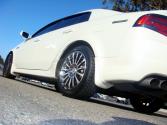
 i feel so terribly left out and forgotten. i already did a vented hood that doesn't look anywhere near as ricey as that white one


Thread Starter
Safety Car
Joined: Jan 2006
Posts: 4,442
Likes: 482
From: Houston, Texas
Sharp looking hood. But, I don't see any vent. And those cutout letters don't count as a vent.... nowhere near enough surface area to be called a functional vent. Nice looking hood although. 
If the second fan comes on when you turn the air on, the compressor is running. The demand may be low with the inside fan on low and the heating of the condensor may not be much but it's still running. I've noticed the TL likes to run the compressor in almost any mode unless you specifically turn it off.
Three Wheelin'
Joined: Jun 2009
Posts: 1,360
Likes: 47
From: NYC
3G TL will also run both fans, even when the AC compressor is off....it just depends on whether its needed or not...if one fan can't handle the cooling (especially when its really hot out and driving in stop and go traffic) both fans will go on, doesnt matter if AC is running or not!
Team Owner
Joined: Mar 2006
Posts: 20,172
Likes: 1,818
From: Bakersfield
3G TL will also run both fans, even when the AC compressor is off....it just depends on whether its needed or not...if one fan can't handle the cooling (especially when its really hot out and driving in stop and go traffic) both fans will go on, doesnt matter if AC is running or not!
Three Wheelin'
Joined: Jun 2009
Posts: 1,360
Likes: 47
From: NYC
now what i wanna know is, why would he have interior fans blowing (unless its heat) without the ac compressor on? lol

Chapter Leader (Southern Region)
Joined: Sep 2008
Posts: 88,888
Likes: 11,846
From: Waffles, BU
dont have total timing. there's a crank sensor triggered by a gear behind the crank timing pulley, not the harmonic....its tucked inside...and its a bitch and a half to get to it... since im talking about it...i had to strip it down once...trying to take out the harmonic, couldn't losen the bolt....went by a shop to get it lose with a strong air gun...didnt happen,,,,they ended up trying to torch the bolt to break it lose...burnt the timing cover a bit...still nothing...so i left... i tried the retarded way, i was just determined to get this...socket, extension, breaker bar leaning on the control arm....yes you guessed it.... i crank the motor to break it loose...didnt happen... then i try to start the car... it wouldn't start...right away i thought the freaking crank sensor got messed up from the torch.. so i waited till i got the harmonic tool !!! this was over thanksgiving weekend, stores closed, i was screwed... i get it opened, check the sensor it was fine lol.... turned out , i had jumped 4 teeth on the front cam lol
 Fk'n Murphy!.. had a minor yet similar experience this weekend. I would have wanted to break a brick on someone's head if I were you.. lol.

Senior Moderator


Joined: Aug 2002
Posts: 81,385
Likes: 3,068
From: Appleton WI
It shouldnt. You HAVE to have the AC button pressed to get the 2nd fan to run. If that button is pressed the compressor still cycles. If its not both fans arent running. If both are running, its not from turning the vent on but because 1 fan isnt enough.