


Few questions.


Thread Starter
Intermediate
Joined: Jan 2011
Posts: 44
Likes: 2
From: Texas, USA
Few questions.
First, whats a good way to learn stick shift without actually owning a car thats stick? When I plan to upgrade my 05 TL I want to get a manual version but I dont really know stick all too well and don't want to have to learn on the new TL, so how do people normally learn if they don't own a stick shift?
I messaged Ack(I think that's his name) about all the A-spec stuff since he seems to be the most trusted dealer but since he hasn't replied can someone explain to me what all parts there are that are A-spec (excluding the lip kit) and if possible list some general prices?
I was also thinking of putting the XLR8 jpipe on my tl (be it current or future) and I was wondering how hard is it to pass inspection without that 3rd cat. I read that some people swap back to the stock pipe but I wanted to see if there was another method.
Finally, my girlfriend just bought a 2006 Audi A3 2.0T S-line (Its better equipped than my TL =/) and we can't seem to find an Audi community quite as good as what we have here at AZ (Love you guys by the way, I've learned so much since I started trolling these forums a week ago). So is there something like AZ out there for her?
If I have any more questions I'll edit my post.
I messaged Ack(I think that's his name) about all the A-spec stuff since he seems to be the most trusted dealer but since he hasn't replied can someone explain to me what all parts there are that are A-spec (excluding the lip kit) and if possible list some general prices?
I was also thinking of putting the XLR8 jpipe on my tl (be it current or future) and I was wondering how hard is it to pass inspection without that 3rd cat. I read that some people swap back to the stock pipe but I wanted to see if there was another method.
Finally, my girlfriend just bought a 2006 Audi A3 2.0T S-line (Its better equipped than my TL =/) and we can't seem to find an Audi community quite as good as what we have here at AZ (Love you guys by the way, I've learned so much since I started trolling these forums a week ago). So is there something like AZ out there for her?
If I have any more questions I'll edit my post.


Thread Starter
Intermediate
Joined: Jan 2011
Posts: 44
Likes: 2
From: Texas, USA
 I'm starting to think that learning on a friends car is the only way. Would you say that using the sport mode in the auto TL helps at all? It seems like the RPM's and speeds at which you change gears would be the same so all I would need to do is re familiarize myself with the clutch and starting the car from a dead stop.

the overexplainer
Joined: Feb 2011
Posts: 3,287
Likes: 385
From: OC, CA
sport mode wont do anything to help you drive a manual. Anyone can upshift once they get going (though probably not smoothly). It's learning how to start from a stop that's a challenge. You'll need to learn on a friend's car, or pay to take lessons from someone. Dont screw up unsuspecting people's cars or a dealership's for your benefit.
That said, I gave up teaching people when I got rid of my old integra. I'm sure the massive jolts fudged the clutch disk springs on it. Still driveable, but the clutch is super heavy due to the spring getting in the way of the pressure plate. Not teaching anyone in my TL.
That said, I gave up teaching people when I got rid of my old integra. I'm sure the massive jolts fudged the clutch disk springs on it. Still driveable, but the clutch is super heavy due to the spring getting in the way of the pressure plate. Not teaching anyone in my TL.
Last edited by ez12a; Jul 19, 2011 at 11:16 PM.
Thread Starter
Intermediate
Joined: Jan 2011
Posts: 44
Likes: 2
From: Texas, USA
sport mode wont do anything to help you drive a manual. Anyone can upshift once they get going (though probably not smoothly). It's learning how to start from a stop that's a challenge. You'll need to learn on a friend's car, or pay to take lessons from someone. Dont screw up unsuspecting people's cars or a dealership's for your benefit.
That said, I gave up teaching people when I got rid of my old integra. I'm sure the massive jolts fudged the clutch disk springs on it. Still driveable, but the clutch is super heavy due to the spring getting in the way of the pressure plate. Not teaching anyone in my TL.
That said, I gave up teaching people when I got rid of my old integra. I'm sure the massive jolts fudged the clutch disk springs on it. Still driveable, but the clutch is super heavy due to the spring getting in the way of the pressure plate. Not teaching anyone in my TL.
I used to own a 2001 Jetta that was stick, just as I started figuring it out and was able to drive on open road my transmission cracked because the previous owner had it rebuilt and the mechanic left a wrench in it. So I do know that starting from that stop is the hardest part. About a year ago I tried to relearn on a friends mustang and just could not get it down (the starting). Maybe I'll find somewhere that I can get lessons, that honestly sounds like the best option for me.
But I would never use other peoples cars, I cherish my car and would never want anyone doing that to me so I understand how wrong that really is.
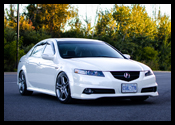


1. Included in the "A-Spec package" offered back in 2004 was a A-Spec Steering Wheel , A-Spec Suspension, A-Spec Lip-Kit, A-Spec Badge, and A-Spec Rims (Original were 8.5" wide Gun-Metals). It also included a rear lip spoiler (which isn't really "special" as to A-Spec), and Auto TLs get A-Spec brake pads.
The steering wheel you can pick up in the black market for around $250-$400.
The suspension you can pick up from the black market for around $500-$600.
The Badge is discontinued, I believe.
The A-Spec rims you can find for about $700-$1100.
The brake pads you can get on ebay for $128
2. Sorry, can't help you much on this question as I don't have a exhaust system lol
3. Audizine.com? heheh
The steering wheel you can pick up in the black market for around $250-$400.
The suspension you can pick up from the black market for around $500-$600.
The Badge is discontinued, I believe.
The A-Spec rims you can find for about $700-$1100.
The brake pads you can get on ebay for $128
2. Sorry, can't help you much on this question as I don't have a exhaust system lol
3. Audizine.com? heheh
Last edited by guitarplayer16; Jul 19, 2011 at 11:29 PM.
Thread Starter
Intermediate
Joined: Jan 2011
Posts: 44
Likes: 2
From: Texas, USA
1. Included in the "A-Spec package" offered back in 2004 was a A-Spec Steering Wheel, A-Spec Suspension, A-Spec Lip-Kit, A-Spec Badge, and A-Spec Rims (Original were 8.5" wide Gun-Metals). It also included a rear lip spoiler (which isn't really "special" as to A-Spec), and Auto TLs get A-Spec brake pads.
2. Sorry, can't help you much on this question as I don't have a exhaust system lol
3. Audizine.com? heheh
2. Sorry, can't help you much on this question as I don't have a exhaust system lol
3. Audizine.com? heheh
3. I didn't even think to check. I'll point her there.
Trending Topics
Racer
Joined: Mar 2011
Posts: 341
Likes: 23
From: Reading, PA
As for learning stick, it's tought in this car, I came from a cable clutch and the hydrolic these cars have is way different. The easiest thing I can say is to get a feel for the stall point by slowly letting off the clutch until you see the RPM's start to drop and it sounds like it's gonna stall, that's the grabbing point of the clutch. As for the exhaust I would go with the RV6 V3 J-Pipe, just from personal experience, that's what I have. It won't make you fail emissions since the third cat is only there to obtain the ULEV rating. Hope this helps!

Registered Member
Joined: Jul 2004
Posts: 8,342
Likes: 163
From: Suburb of Manassas, VA
Trust me on this. One of the worse ways you can learn how to operate a manual transmission is from a friend or family member. Now mind you, this is a very general statement and to qualify what I mean to convey is this.
You will pick up whatever bad habits, erroneous techniques, and outright blatant misinformation from your "instructors". This makes it extremely difficult for someone who hasn't a clue how a clutch and manual transmission work together, to know how to separate the valid data from the crap.
My advice would be first to research as much as possible the proper techniques for operating a manual transmission and try to make some sense of it all. At some point, the dots will connect and you'll begin to fathom what is correct and what is dangerous to the longevity of your drive train. THEN when you get an opportunity to actually drive a manual, you'll at least have some ground work in your favor.
There is a ton of information on this website written by a number of us over the years about the proper way to operate a manual transmission. I have written thousands of lines of instruction and tips myself on this and other sites covering this topic. So start your search here and don't be afraid to ask questions.
For what it's worth, I learned how to operate a manual transmission when I was a a kid (around 11 or 12) in a panel truck in the rear of a warehouse that had no engine or transmission in it. But it did have the throttle, brake, and clutch pedals and the shifter. I spent many hours in that truck pretending I was driving. When the time finally came for me to drive a manual (it was a Jeep), I was good to go and did fine, only stalling once at a light on a hill. I had the basics down from that panel truck and had applied knowledge and logic and all worked in my favor.
Good luck to you.
You will pick up whatever bad habits, erroneous techniques, and outright blatant misinformation from your "instructors". This makes it extremely difficult for someone who hasn't a clue how a clutch and manual transmission work together, to know how to separate the valid data from the crap.
My advice would be first to research as much as possible the proper techniques for operating a manual transmission and try to make some sense of it all. At some point, the dots will connect and you'll begin to fathom what is correct and what is dangerous to the longevity of your drive train. THEN when you get an opportunity to actually drive a manual, you'll at least have some ground work in your favor.
There is a ton of information on this website written by a number of us over the years about the proper way to operate a manual transmission. I have written thousands of lines of instruction and tips myself on this and other sites covering this topic. So start your search here and don't be afraid to ask questions.
For what it's worth, I learned how to operate a manual transmission when I was a a kid (around 11 or 12) in a panel truck in the rear of a warehouse that had no engine or transmission in it. But it did have the throttle, brake, and clutch pedals and the shifter. I spent many hours in that truck pretending I was driving. When the time finally came for me to drive a manual (it was a Jeep), I was good to go and did fine, only stalling once at a light on a hill. I had the basics down from that panel truck and had applied knowledge and logic and all worked in my favor.
Good luck to you.


Thread Starter
Intermediate
Joined: Jan 2011
Posts: 44
Likes: 2
From: Texas, USA

Thread Starter
Intermediate
Joined: Jan 2011
Posts: 44
Likes: 2
From: Texas, USA
When you go to a university 8 hours away while your friends go to the community college you tend to lose touch. But I think the only friend I had who actually owned a stick sold it as it was just the spare car his dad had.
I'll look for one. Thanks for the tip.
I'll look for one. Thanks for the tip.

Three Wheelin'
Joined: Sep 2006
Posts: 1,562
Likes: 120
From: Chicagoland
Trust me on this. One of the worse ways you can learn how to operate a manual transmission is from a friend or family member. Now mind you, this is a very general statement and to qualify what I mean to convey is this.
You will pick up whatever bad habits, erroneous techniques, and outright blatant misinformation from your "instructors". This makes it extremely difficult for someone who hasn't a clue how a clutch and manual transmission work together, to know how to separate the valid data from the crap.
You will pick up whatever bad habits, erroneous techniques, and outright blatant misinformation from your "instructors". This makes it extremely difficult for someone who hasn't a clue how a clutch and manual transmission work together, to know how to separate the valid data from the crap.
If you're really interested in learning, I'd suggest finding the SCCA auto-x forums or mailing list for your area. Post up that you want to learn stick and are looking for an instructor. There are alot of very qualified people on those lists and most of them will probably do it for beer money. The SCCA usually runs auto-x schools as well that are very inexpensive if you're interesting in learning to handle your car better in general as well.
Registered Member
Joined: Jul 2004
Posts: 8,342
Likes: 163
From: Suburb of Manassas, VA
I think most people learn this skill better from a live person, not from reading. True enough that bad teachers pass on bad habits. I grew up thinking I'd damage the engine over 3krpm for example.
If you're really interested in learning, I'd suggest finding the SCCA auto-x forums or mailing list for your area. Post up that you want to learn stick and are looking for an instructor. There are alot of very qualified people on those lists and most of them will probably do it for beer money. The SCCA usually runs auto-x schools as well that are very inexpensive if you're interesting in learning to handle your car better in general as well.
If you're really interested in learning, I'd suggest finding the SCCA auto-x forums or mailing list for your area. Post up that you want to learn stick and are looking for an instructor. There are alot of very qualified people on those lists and most of them will probably do it for beer money. The SCCA usually runs auto-x schools as well that are very inexpensive if you're interesting in learning to handle your car better in general as well.
For example, if your "teacher" was taking you to an empty parking lot or perhaps a cemetery to start you out, if you didn't know what to look for as he operates his car, how would you know whether or not he is doing things correctly? Say he stops at a light on a hill and holds the car with the clutch until the light changes... maybe "playing" it a little by rolling back and moving up slightly. If you didn't know that this was VERY bad technique, he is going to teach you to do this because he thinks it's a neat little "trick". In reality, he hasn't a clue what he's doing and how bad it is for his clutch components.
Or maybe he downshifts to slow down like this;
- Removes his foot from the throttle.
- Disengages the clutch.
- Shifts to the next lower gear.
- Begins slowly releasing the clutch.
Also very bad technique. If the learner doesn't know this, then this is how he is going to downshift.
And so on.
Thread Starter
Intermediate
Joined: Jan 2011
Posts: 44
Likes: 2
From: Texas, USA
My primary point about research was to learn how everything works in concert and the reasons you do and don't do certain things. Think groundwork or education if that works better.
For example, if your "teacher" was taking you to an empty parking lot or perhaps a cemetery to start you out, if you didn't know what to look for as he operates his car, how would you know whether or not he is doing things correctly? Say he stops at a light on a hill and holds the car with the clutch until the light changes... maybe "playing" it a little by rolling back and moving up slightly. If you didn't know that this was VERY bad technique, he is going to teach you to do this because he thinks it's a neat little "trick". In reality, he hasn't a clue what he's doing and how bad it is for his clutch components.
Or maybe he downshifts to slow down like this;
Also very bad technique. If the learner doesn't know this, then this is how he is going to downshift.
And so on.
For example, if your "teacher" was taking you to an empty parking lot or perhaps a cemetery to start you out, if you didn't know what to look for as he operates his car, how would you know whether or not he is doing things correctly? Say he stops at a light on a hill and holds the car with the clutch until the light changes... maybe "playing" it a little by rolling back and moving up slightly. If you didn't know that this was VERY bad technique, he is going to teach you to do this because he thinks it's a neat little "trick". In reality, he hasn't a clue what he's doing and how bad it is for his clutch components.
Or maybe he downshifts to slow down like this;
- Removes his foot from the throttle.
- Disengages the clutch.
- Shifts to the next lower gear.
- Begins slowly releasing the clutch.
Also very bad technique. If the learner doesn't know this, then this is how he is going to downshift.
And so on.
Of the two situations, the first one should be done by using the handbrake and slowly releasing that while starting from the hill.
How should the downshift be done?
Registered Member
Joined: Jul 2004
Posts: 8,342
Likes: 163
From: Suburb of Manassas, VA
There are two schools of thought for downshifting which are preferred methods to use. One is referred to as rev matching and the other is double clutching.
Rev matching is a technique whereby the driver raises engine speed during the downshift while the clutch is disengaged to a point above which it will be when he releases the clutch in the selected lower gear. When the downshift is completed and the clutch is released, engine speed and wheel speed will be virtually matched. What this does is to significantly reduce clutch component wear, thereby prolonging clutch life several times over. It is done like this;
- Remove your foot from the throttle.
- Disengage the clutch.
- Begin the downshift but pause in the neutral gate.
- Blip the throttle to raise engine speed.
- Complete the downshift.
- Release the clutch.
Double clutching is nearly identical to rev matching but with two additional important steps added;
- Remove your foot from the throttle.
- Disengage the clutch.
- Begin downshift but pause in the neutral gate.
- Blip the throttle to raise engine speed and at the same time engage the clutch momentarily.
- Disengage the clutch again.
- Complete the downshift.
- Release the clutch.
By momentarily engaging the clutch as you blip the throttle when pausing in the neutral gate, you force the transmission input shaft to spin up instead of its speed falling off. This results in the synchronizers having significantly less work to do in matching gear set and shaft speeds within the transmission, resulting in much longer life for your synchronizers. Double clutching not only will greatly reduce clutch wear but synchronizer wear as well.
With our manual TL's and the problems they have had with their synchronizers, in particular those for third gear, any technique you can learn to perform to reduce or eliminate this problem is going to be to your advantage. My '04 manual TL has over 86,000 miles on it and displays not a hint of clutch or transmission problems of any kind whatsoever. Nothing. And double clutching is the technique I use for both downshifting and disrupted upshifts.
Last edited by SouthernBoy; Jul 20, 2011 at 10:16 PM.
Team Anthracite member
Joined: Apr 2004
Posts: 88
Likes: 0
From: Ft Lauderdale, FL
By the TL stick and start practicing. The TL has a very sweet clutch release. There is no other way to learn unless you practice. First gear is the hardest, once you get rolling all the other gears are easy. Just dont ride the clutch. Thats it. Practice makes perfect.

David_Dude
Joined: May 2011
Posts: 13,283
Likes: 581
From: Florida

I actually taught myself by watching many different people. And you wanna know something ironic. Out of all the people I kow who can drive a stick, a 20 yr old girl out drives them all. That includes the ones who've been driving a stick for most if not all their lives. She's REALLY good. I can't even tell when she shifts. It's like an automatic. So smooth an linear. Like Southerboy said, if you learn from someone with a bad habit you'll pick it up too.
I actually learned doing the rev-matching on my own. I wanted smooth upshifts/downshift and I noticed one day rev-matching worked great and it stuck with me. Now when I come up to a stop I automatically shift into neutral; in the event that it's not a complete stop I just throw it in 2nd or 3rd depending on the speed (for instance coming up to a red light, and im the first their but the light changes) an keep going. IDK if thats a bad habit or not though.

I've also seen people downshift thru each gear when coming up to a stop sign (weird to me). I've also seen people sit at a stoplight with the clutch in and in first gear waiting (i always thought that was weird an never done it). I just knew that had to be bad for the clutch. Oh oh oh and my favorite of all time....
...my bro had an ex gf who would run first gear all the way to 5K rpms and then shift and each gear after that she'd shift @ the normal 2.5-3K range.

I havent driven a stick in yrs (alway owned automatics), but I can hope into one right now and drive it like it was mine.
Hopefully I'll have one in my hands in a few mos.EDIT: BTW DON'T RIDE THE CLUTCH! I've seen that before too! 1st gear is always the hardest, but once you get the friction point down (engagement point) then you'll be good to go. I've personally never burned a clutch before. And i still consider myself a noob. Just take some practice and focus.
Last edited by Acura_Dude; Jul 20, 2011 at 10:28 PM.

BRB..Shifting!
Joined: Jun 2011
Posts: 94
Likes: 5
From: Worcester, MA
If I was in your position I would just buy the TL and learn stick on it. You're not gonna be hurting the clutch much unless you REALLY SUCK lol. It saves you the trouble of buying a crappy car thats stick and then u have to sell it afterwards and deal with all that just to learn stick. Just start it off with the TL! It's all in the timing, if you stalled or jerk really hard starting off in first gear, just ask yourself what did you think u did wrong each time and learn from your mistake each time. Was it too much gas and that's why u chirped or jolted? or was it shaky because u let the clutch out without enough gas to get it moving? Hope this helps!
Burning Brakes
Joined: Sep 2010
Posts: 830
Likes: 38
From: Chicago/London
Dont think about it so much. The stupidest thing to do is to worry about RPMs. You just have to feel the car, and the clutch. If you at least understand the concept, you will get the hang of it on the TL rather quickly. It takes alot to wipe out a clutch, so buy your car and enjoy it!
Thread Starter
Intermediate
Joined: Jan 2011
Posts: 44
Likes: 2
From: Texas, USA
Thanks for all the tips guys! I'm going to bookmark this and read them a few times every once in a while to get it into my head.
If I did just go and buy the manual TL, how should I get it off the lot? Just bug a friend? I thinking in a test drive I could either get a friend or have the salesmen drive it as I already know what the ride feels like, but I would just need to listen for problems.
If I did just go and buy the manual TL, how should I get it off the lot? Just bug a friend? I thinking in a test drive I could either get a friend or have the salesmen drive it as I already know what the ride feels like, but I would just need to listen for problems.
Registered Member
Joined: Jul 2004
Posts: 8,342
Likes: 163
From: Suburb of Manassas, VA
Dont think about it so much. The stupidest thing to do is to worry about RPMs. You just have to feel the car, and the clutch. If you at least understand the concept, you will get the hang of it on the TL rather quickly. It takes alot to wipe out a clutch, so buy your car and enjoy it!
Our engines are pretty quiet which causes some people to have problems with the manual if they are accustomed to using engine sound at a guide for throttle opening and clutching (actually, most manual drivers do this). Until you get a "feel" for this particular car, your tach is your friend. And I still to this day use my tach when something out of the ordinary takes place. I also use it when starting off from a stop on a hill to avoid both stalling and over-revving the engine.
Registered Member
Joined: Jul 2004
Posts: 8,342
Likes: 163
From: Suburb of Manassas, VA
Thanks for all the tips guys! I'm going to bookmark this and read them a few times every once in a while to get it into my head.
If I did just go and buy the manual TL, how should I get it off the lot? Just bug a friend? I thinking in a test drive I could either get a friend or have the salesmen drive it as I already know what the ride feels like, but I would just need to listen for problems.
If I did just go and buy the manual TL, how should I get it off the lot? Just bug a friend? I thinking in a test drive I could either get a friend or have the salesmen drive it as I already know what the ride feels like, but I would just need to listen for problems.
https://acurazine.com/forums/showthr...operly+operate
https://acurazine.com/forums/showthr...operly+operate
https://acurazine.com/forums/car-talk-5/how-hard-learn-how-drive-stick-762841/
Dont think about it so much. The stupidest thing to do is to worry about RPMs. You just have to feel the car, and the clutch. If you at least understand the concept, you will get the hang of it on the TL rather quickly. It takes alot to wipe out a clutch, so buy your car and enjoy it!
No one will ever "learn" on my car.

Registered Member
Joined: Jul 2004
Posts: 8,342
Likes: 163
From: Suburb of Manassas, VA
Has nothing to do with opinions, my friend. "making sure my rpm is in the perfect area' is going to be a hard task and I agree with you in that your goal is to do the best you can under road, traffic, and situational conditions to try for a consistent release at the best engine speed you can muster. Nothing is going to be perfect and certainly not all of the time. But a nice goal would be to try for starts from a stop at around 1200 to 1500 RPM, depending upon the conditions I mentioned, and go from there. You're going to be fine if you manage to do this a majority of the time. Far better than starting out with the engine turning 2500+ RPM and having to ride the clutch for 100' until the drive wheels catch up to the engine.

Team Owner
Joined: Mar 2006
Posts: 20,172
Likes: 1,818
From: Bakersfield
If you just need enough knowledge to get the TL off the dealer's lot and to your house, learn where the take-up point is on the clutch, the point where it begins to engage and load the engine down. Keep it there and feed it just a little throttle while releasing the clutch just a little more. You don't have to release it progressively, that was one of the mistakes I made early on. Find the point where it moves the car, hold it there until you pick up speed and then release it all the way. It might not be real pretty but it will get you home.
If your rpms go too high on take-off, either let the clutch out more or back off the throttle.
I usually take off at low rpms, 1,200-1,500 but it's easier to kill the engine that way if you're new at driving a manual.
When you go to shift, let off the gas right when you start pushing the clutch in, shift, once you start engaging the clutch, start giving it gas again. It's all about timing and after a while you won't have to think about it. Again, it won't be pretty at first but it will get you home.
I test drove two manual TLs and the first thing I did while putting my seatbelt on and adjusting the mirrors was find the point where the clutch engages. After that it was easy. I took my driver's test in a manual at 16 but I already knew how a clutch and transmission worked so all I had to do was go over in my head what was happening mechanically. I went out to my dad's beater Datsun 310 and applied my theories and it worked out pretty well.
If your rpms go too high on take-off, either let the clutch out more or back off the throttle.
I usually take off at low rpms, 1,200-1,500 but it's easier to kill the engine that way if you're new at driving a manual.
When you go to shift, let off the gas right when you start pushing the clutch in, shift, once you start engaging the clutch, start giving it gas again. It's all about timing and after a while you won't have to think about it. Again, it won't be pretty at first but it will get you home.
I test drove two manual TLs and the first thing I did while putting my seatbelt on and adjusting the mirrors was find the point where the clutch engages. After that it was easy. I took my driver's test in a manual at 16 but I already knew how a clutch and transmission worked so all I had to do was go over in my head what was happening mechanically. I went out to my dad's beater Datsun 310 and applied my theories and it worked out pretty well.
the overexplainer
Joined: Feb 2011
Posts: 3,287
Likes: 385
From: OC, CA
Yea, the first thing I do when getting into an unfamiliar standard transmission car is learning the throttle response first, then the clutch engagement point. After that it's all muscle memory.
That's my personal style for teaching people how to drive in a manual.
That's my personal style for teaching people how to drive in a manual.
Instructor
Joined: May 2010
Posts: 100
Likes: 16
Has nothing to do with opinions, my friend. "making sure my rpm is in the perfect area' is going to be a hard task and I agree with you in that your goal is to do the best you can under road, traffic, and situational conditions to try for a consistent release at the best engine speed you can muster. Nothing is going to be perfect and certainly not all of the time. But a nice goal would be to try for starts from a stop at around 1200 to 1500 RPM, depending upon the conditions I mentioned, and go from there. You're going to be fine if you manage to do this a majority of the time. Far better than starting out with the engine turning 2500+ RPM and having to ride the clutch for 100' until the drive wheels catch up to the engine.
What I'm wondering is this: does a 1500 RPM start generate a significant amount of heat? Assuming the driver engages the clutch as quickly as possible at 1500 RPM on every start (not riding it all the way through the intersection), could he/she expect the clutch to last >100k miles? (given they utilize proper up/downshifting technique as well)
Team Owner
Joined: Mar 2006
Posts: 20,172
Likes: 1,818
From: Bakersfield
1500 RPM feels like excessive clutch slip to me; I rarely exceed 1000-1200 RPM getting off the line. The only exceptions are very aggressive starts or steep San Francisco hills.
What I'm wondering is this: does a 1500 RPM start generate a significant amount of heat? Assuming the driver engages the clutch as quickly as possible at 1500 RPM on every start (not riding it all the way through the intersection), could he/she expect the clutch to last >100k miles? (given they utilize proper up/downshifting technique as well)
What I'm wondering is this: does a 1500 RPM start generate a significant amount of heat? Assuming the driver engages the clutch as quickly as possible at 1500 RPM on every start (not riding it all the way through the intersection), could he/she expect the clutch to last >100k miles? (given they utilize proper up/downshifting technique as well)
I can remember a long time ago I was driving a 5.0 Mustang and some girls pulled up next to me at a light. I accidentally left it in 3rd and when the light went green and I noticed my mistake, instead of downshifting back to first, I floored the gas but kept the rpms around 1,500 so it wasn't completely obvious I had screwed up. In that case, the car smelled like clutch for a couple days.
Instructor
Joined: May 2010
Posts: 100
Likes: 16
It would depend on the amount of throttle too. I tend to go from 1,200rpm barely touching the throttle until the clutch is full engaged. Sometimes it's 1,500rpm but again, very little throttle. That's with pretty much any car as long as it's geared correctly. When I say 1,500rpm, I'm talking about the engagement point, sometimes I'll bring the rpms down with the clutch as I release it.
I can remember a long time ago I was driving a 5.0 Mustang and some girls pulled up next to me at a light. I accidentally left it in 3rd and when the light went green and I noticed my mistake, instead of downshifting back to first, I floored the gas but kept the rpms around 1,500 so it wasn't completely obvious I had screwed up. In that case, the car smelled like clutch for a couple days.
I can remember a long time ago I was driving a 5.0 Mustang and some girls pulled up next to me at a light. I accidentally left it in 3rd and when the light went green and I noticed my mistake, instead of downshifting back to first, I floored the gas but kept the rpms around 1,500 so it wasn't completely obvious I had screwed up. In that case, the car smelled like clutch for a couple days.
I would think heavier throttle + very quick engagement at 1500 RPM would be better for the clutch than light throttle and letting it slip longer. I'm just speculating though, no evidence to back that up really.
I made that same third gear mistake in my '94 Ranger when I was 17, only it was painfully obvious to the people watching me take off - I reached full engagement around 10-15mph (no tachometer) then lugged the hell out of the gutless 2.3 liter engine until it was up to a reasonable speed.
Instructor
Joined: May 2010
Posts: 100
Likes: 16
Sorry to semi-derail the thread...
In response to the OP's first question, If you can possibly learn on a friend's car (think econo-car or truck, not porsche), I would do that first.
If not, I wouldn't worry too much about learning on the TL. Just read everything SouthernBoy has written, gain a basic understanding of the drivetrain, and be careful and patient.
In response to the OP's first question, If you can possibly learn on a friend's car (think econo-car or truck, not porsche), I would do that first.
If not, I wouldn't worry too much about learning on the TL. Just read everything SouthernBoy has written, gain a basic understanding of the drivetrain, and be careful and patient.
Registered Member
Joined: Jul 2004
Posts: 8,342
Likes: 163
From: Suburb of Manassas, VA
1500 RPM feels like excessive clutch slip to me; I rarely exceed 1000-1200 RPM getting off the line. The only exceptions are very aggressive starts or steep San Francisco hills.
What I'm wondering is this: does a 1500 RPM start generate a significant amount of heat? Assuming the driver engages the clutch as quickly as possible at 1500 RPM on every start (not riding it all the way through the intersection), could he/she expect the clutch to last >100k miles? (given they utilize proper up/downshifting technique as well)
What I'm wondering is this: does a 1500 RPM start generate a significant amount of heat? Assuming the driver engages the clutch as quickly as possible at 1500 RPM on every start (not riding it all the way through the intersection), could he/she expect the clutch to last >100k miles? (given they utilize proper up/downshifting technique as well)
"But a nice goal would be to try for starts from a stop at around 1200 to 1500 RPM, depending upon the conditions I mentioned, and go from there."
this in the manner I did. The "go from there" means to improve upon one's launch technique. I guess I should have made that more clear. I do the same as you mentioned and shoot for the 1000-1200 range as often as I can unless conditions are such that I have to divert from this.
You asked,
"Assuming the driver engages the clutch as quickly as possible at 1500 RPM on every start (not riding it all the way through the intersection), could he/she expect the clutch to last >100k miles? (given they utilize proper up/downshifting technique as well)"
I know what you mean by "as quickly as possible" so just for the folks who may not, he means to obtain full engagement as quickly as one can and doing so in a smooth an seemless manner.
Yes, I would expect the clutch to go over 100,000 miles doing this because it is not overly injurious to the friction surfaces. You also asked if 1500 RPM starts generated excessive heat and I would say "no" unless they were coupled with a slow engagement or aggressive throttle.
I think you're pretty much on the right path judging from what you wrote and I fully agree with your comments about a lower RPM launch when possible. Good point about cities like San Francisco. I have used their example before. That is one city that if I lived there, I would have a secondary (commuter) vehicle with an automatic in order to save my primary manual car. Where I live, we have nothing of the sort and some fine roads for nice leisurely drives.
Last edited by SouthernBoy; Jul 21, 2011 at 03:53 PM.
Registered Member
Joined: Jul 2004
Posts: 8,342
Likes: 163
From: Suburb of Manassas, VA
Yes, I was referring to the point at which it's fully engaged. I occasionally will rev a little high and bring the engine speed back down with the clutch, but this is accidental and usually results in a slight lurch.
I would think heavier throttle + very quick engagement at 1500 RPM would be better for the clutch than light throttle and letting it slip longer. I'm just speculating though, no evidence to back that up really.
I made that same third gear mistake in my '94 Ranger when I was 17, only it was painfully obvious to the people watching me take off - I reached full engagement around 10-15mph (no tachometer) then lugged the hell out of the gutless 2.3 liter engine until it was up to a reasonable speed.
I would think heavier throttle + very quick engagement at 1500 RPM would be better for the clutch than light throttle and letting it slip longer. I'm just speculating though, no evidence to back that up really.
I made that same third gear mistake in my '94 Ranger when I was 17, only it was painfully obvious to the people watching me take off - I reached full engagement around 10-15mph (no tachometer) then lugged the hell out of the gutless 2.3 liter engine until it was up to a reasonable speed.
Last edited by SouthernBoy; Jul 21, 2011 at 03:54 PM.
Registered Member
Joined: Jul 2004
Posts: 8,342
Likes: 163
From: Suburb of Manassas, VA
One of the things to watch out for when trying to start off with a very low engine speed, say in the 800+ range, is stalling the engine. This is more common with four and six cylinder engines than with eights because of the degree spread of the power strokes. Our V6 engines fire every 120 crankshaft degrees (720 / 6). A V8 fires every 90 crankshaft degrees. This puts the V8 in a better position of developing not only more torque at a lower RPM range but also more power pulses per crankshaft revolution.
A smooth engagement at around 1000 to 1200 RPM is a top goal. Granted, conditions do not always lend themselves to this, but most of the time, it is obtainable.
A smooth engagement at around 1000 to 1200 RPM is a top goal. Granted, conditions do not always lend themselves to this, but most of the time, it is obtainable.