
View Poll Results: best brand of oil for tl
penzoil
13
6.60%
vaseline
19
9.64%
mobil
114
57.87%
other
51
25.89%
Voters: 197. You may not vote on this poll

what is the best brand of oil to use for ur tl??? i also heard u go from 5w 20 to 10-30 after 75000 miles
Racer
I use Mobil-1 5w-20. I don't see any reason to switch to 10w-30. Acura recommends 5w-20 for a reason  Maybe switch to a high mileage 5w-20 after 75000 miles if you're concerned.
Maybe switch to a high mileage 5w-20 after 75000 miles if you're concerned.

Drifting
I didn't realize Unilever was in the oil business with Vaseline? But you might be onto something: High Mileage vehicles could have 'Vaseline Intensive Care' and sporting drivers could use 'Vaseline Extra Strength'.
I think you mean Valvoline? You'll get more hits if you add Royal Purple, Castrol, and Redline
I think you mean Valvoline? You'll get more hits if you add Royal Purple, Castrol, and Redline
Drifting
or how about 'Vaseline Extra Moisture' when your car sits in storage for a long time?

AZ Community Team
Bearcat94
AZ Community Team
close
Aug 19, 2023
- Join DateMay 2007
- LocationN35°03'16.75", W 080°51'0.9"
- Posts:32,488
-
iTrader Positive Feedback0
-
iTrader Feedback Score(0)
-
Likes:5,383
-
Liked:7,771 Times in 4,342 Posts
Quote:
I think you mean Valvoline? You'll get more hits if you add Royal Purple, Castrol, and Redline
Originally Posted by LaCostaRacer
I didn't realize Unilever was in the oil business with Vaseline? But you might be onto something: High Mileage vehicles could have 'Vaseline Intensive Care' and sporting drivers could use 'Vaseline Extra Strength'.I think you mean Valvoline? You'll get more hits if you add Royal Purple, Castrol, and Redline

Wait. What!?!?!? I meant Vaseline; that's why I voted for it.
God Dammit!! How do I 'un-vote'?

Racer
WOW!!! I didn't even notice earlier that Vaseline was an option or I would have voted for that instead of Mobil 


AZ Community Team
Bearcat94
AZ Community Team
close
Aug 19, 2023
- Join DateMay 2007
- LocationN35°03'16.75", W 080°51'0.9"
- Posts:32,488
-
iTrader Positive Feedback0
-
iTrader Feedback Score(0)
-
Likes:5,383
-
Liked:7,771 Times in 4,342 Posts
Quote:
Originally Posted by J35A8
All the same sh¡t.
Au contraire, mon Frere, Vaseline is markedly different.



Safety Car
Inaccurate
Safety Car
close
Feb 1, 2019
- Join DateJan 2006
- LocationHouston, Texas
- Age66
- Posts:4,442
-
iTrader Positive Feedback0
-
iTrader Feedback Score(0)
-
Likes:280
-
Liked:482 Times in 291 Posts


twigglius
we live in a simulation
close

Yesterday
- Join DateOct 2005
- LocationThe Algorithm
- Posts:3,684
-
iTrader Positive Feedback100
-
iTrader Feedback Score(6)
-
Likes:191
-
Liked:285 Times in 219 Posts
Quote:
lolOriginally Posted by leedogg
if you start a "what's the best tranny fluid to use" thread, I'll beat you.
Quote:
Wait. What!?!?!? I meant Vaseline; that's why I voted for it.
God Dammit!! How do I 'un-vote'?
Me too. Originally Posted by Bearcat94
Wait. What!?!?!? I meant Vaseline; that's why I voted for it.
God Dammit!! How do I 'un-vote'?
Quote:
The OP is staring to get pwned.Originally Posted by Bearcat94
Au contraire, mon Frere, Vaseline is markedly different.

Senior Moderator
ggesq
Senior Moderator
close
Jan 9, 2025
- Join DateSep 2006
- LocationTampa, Florida
- Posts:12,453
-
iTrader Positive Feedback100
-
iTrader Feedback Score(1)
-
Likes:2,088
-
Liked:2,186 Times in 1,212 Posts
Quote:
Fixed. OP- we let the gas thread go. Now with the what's the best oil. I urge you to search the forums, look in the Service Department or hell google what your looking for and put AcuraZine in the search terms. Originally Posted by leedogg
if you start a "what's the best tranny fluid to use" thread, I'll temp ban you.


Race Director
maharajamd
Race Director
close
Feb 27, 2017
- Join DateJan 2008
- LocationColumbus, OH
- Posts:13,382
-
iTrader Positive Feedback100
-
iTrader Feedback Score(1)
-
Likes:611
-
Liked:1,544 Times in 1,197 Posts
You guys keep paying those prices for RL. I'll pay half that and not notice a difference with M1. Lol

Race Director
nfnsquared
Race Director
close
Mar 10, 2025
- Join DateDec 2003
- LocationMAGA country
- Posts:12,521
-
iTrader Positive Feedback0
-
iTrader Feedback Score(0)
-
Likes:1,777
-
Liked:1,824 Times in 1,370 Posts
with today's oil and following MID intervals, the best oil is whatever is on sale...

UA7 NBP TL-S
Quote:
you get what you pay forOriginally Posted by Maharajamd
You guys keep paying those prices for RL. I'll pay half that and not notice a difference with M1. Lol

Drifting
JJH
Drifting
close
May 22, 2019
- Join DateJan 2012
- Age35
- Posts:2,094
-
iTrader Positive Feedback100
-
iTrader Feedback Score(1)
-
Likes:585
-
Liked:352 Times in 254 Posts
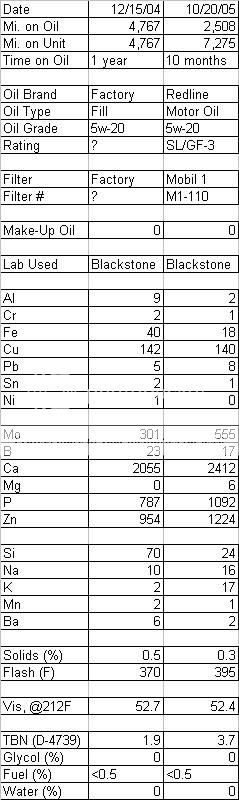
Here's a little factory tested comparison of Redline vs Factory oil
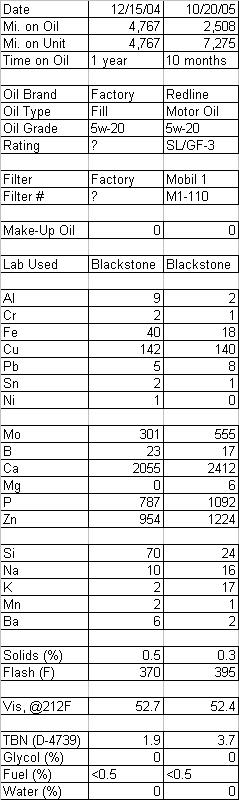
Al- Pistons, 2ppm is normal if not on the higher side. Again, from the clean-up of soft wear metals or additive clash.
Cr- Rings. 1ppm is normal ring wear.
Fe- Valvetrain wear. It is still high since the engine is new, plus a lot of this may be leftover from the factory oil. In addition, there may be some additive clash taking place with the new installation of Redline. Lastly, Redline tends to clean up soft, residue wear metals from the engine which will go into the oil, and make elemental wear values appear high (making you think its wear), when it is simply residue wear metals being cleaned up.
Cu- Bearing overlay (special) in Honda V6. It tends to remain high due to the construction of the bearing overlay, but will drop to more normal levels by 50K.
Pb- Bearings. In this case, it went up because Redline reacts with the bearings. It is normal and will drop eventually.
Sn- Tin, from the bearings. In this case, it may be some slight bearing wear from hard driving or may simply be a lab error.
Ni- From wear at the intake valves, usually present when there is dirt ingestion.
Mo- Molybdenum Disulphide (I think). Known as MoDTC, its used as an anti-oxidant and a friction modifier. Rings also contain some Molybdenum, so 1ppm of this to show up in a MoDTC-free oil is ring wear, which is normal.
B, Ca, Mg, P, Zn- All oil additives. Remember that cheap spectro analysis like this will show that the additive packs are still present even after they are depleted and unable to do their job.
Si- Dirt, silicates (from antifreeze), or an anti-foam agent. In this case, its leftover dirt from the manufacturing process.
Na- Road Salt, Antifreeze, or additive. Mobil is starting to use this now as an additive in their oils, known as sodium sulphonate, and Redline contains small amounts of this.
K- Can be either antifreeze (most common), road salt, or an additive. Redline contains some of this in its additive pack, so this reading is normal.
Mn- Fuel additive, usually the presence of this shows that the rings have not fully seated, and fuel additives are burning past the rings. It should drop to zero unless you're using a fuel that contains a lot of it.
Ba-usually from some type of manufacturing contamination, it should drop to zero
Solids- Shows the amount of blow-by, reflects combustion efficiency, effectiveness of oil filter, and sludge precursors. 0.3% is high for this amount of miles, 0.2% is probably ideal. Its high mainly because new engines do have higher levels of blowby for the first 10K or so before the rings fully seat.
Flash- Shows the volatility of the oil, and it'll drop with contamination. Generally, the target is >400F to keep the oil in a "like new" condition.
TBN- Total Base Number. Reflects the amount of detergency left in the oil. Good indicator of an oil's reserve acid capability, but this is where it gets tricky. Redline's TBN will drop very rapidly, but a 0.0 cutoff with Blackstone Lab's scale is safe. Redline's Ester baseoils will still protect and have the ability to neutralize acids for many miles after the TBN may appear to be depleted. This is different for other oils, however. Remember that many people put too much emphasis on TBN as you must consider other factors as well, such as wear, flashpoint, solids, and viscosity.
Viscosity- Should stay at a solid 20wt, which it is right now. If the viscosity changes by more than one grade, it may be a change indicator.
Al- Pistons, 2ppm is normal if not on the higher side. Again, from the clean-up of soft wear metals or additive clash.
Cr- Rings. 1ppm is normal ring wear.
Fe- Valvetrain wear. It is still high since the engine is new, plus a lot of this may be leftover from the factory oil. In addition, there may be some additive clash taking place with the new installation of Redline. Lastly, Redline tends to clean up soft, residue wear metals from the engine which will go into the oil, and make elemental wear values appear high (making you think its wear), when it is simply residue wear metals being cleaned up.
Cu- Bearing overlay (special) in Honda V6. It tends to remain high due to the construction of the bearing overlay, but will drop to more normal levels by 50K.
Pb- Bearings. In this case, it went up because Redline reacts with the bearings. It is normal and will drop eventually.
Sn- Tin, from the bearings. In this case, it may be some slight bearing wear from hard driving or may simply be a lab error.
Ni- From wear at the intake valves, usually present when there is dirt ingestion.
Mo- Molybdenum Disulphide (I think). Known as MoDTC, its used as an anti-oxidant and a friction modifier. Rings also contain some Molybdenum, so 1ppm of this to show up in a MoDTC-free oil is ring wear, which is normal.
B, Ca, Mg, P, Zn- All oil additives. Remember that cheap spectro analysis like this will show that the additive packs are still present even after they are depleted and unable to do their job.
Si- Dirt, silicates (from antifreeze), or an anti-foam agent. In this case, its leftover dirt from the manufacturing process.
Na- Road Salt, Antifreeze, or additive. Mobil is starting to use this now as an additive in their oils, known as sodium sulphonate, and Redline contains small amounts of this.
K- Can be either antifreeze (most common), road salt, or an additive. Redline contains some of this in its additive pack, so this reading is normal.
Mn- Fuel additive, usually the presence of this shows that the rings have not fully seated, and fuel additives are burning past the rings. It should drop to zero unless you're using a fuel that contains a lot of it.
Ba-usually from some type of manufacturing contamination, it should drop to zero
Solids- Shows the amount of blow-by, reflects combustion efficiency, effectiveness of oil filter, and sludge precursors. 0.3% is high for this amount of miles, 0.2% is probably ideal. Its high mainly because new engines do have higher levels of blowby for the first 10K or so before the rings fully seat.
Flash- Shows the volatility of the oil, and it'll drop with contamination. Generally, the target is >400F to keep the oil in a "like new" condition.
TBN- Total Base Number. Reflects the amount of detergency left in the oil. Good indicator of an oil's reserve acid capability, but this is where it gets tricky. Redline's TBN will drop very rapidly, but a 0.0 cutoff with Blackstone Lab's scale is safe. Redline's Ester baseoils will still protect and have the ability to neutralize acids for many miles after the TBN may appear to be depleted. This is different for other oils, however. Remember that many people put too much emphasis on TBN as you must consider other factors as well, such as wear, flashpoint, solids, and viscosity.
Viscosity- Should stay at a solid 20wt, which it is right now. If the viscosity changes by more than one grade, it may be a change indicator.
Race Director
maharajamd
Race Director
close
Feb 27, 2017
- Join DateJan 2008
- LocationColumbus, OH
- Posts:13,382
-
iTrader Positive Feedback100
-
iTrader Feedback Score(1)
-
Likes:611
-
Liked:1,544 Times in 1,197 Posts
^Climate? Purpose? Milage?
Race Director
nfnsquared
Race Director
close
Mar 10, 2025
- Join DateDec 2003
- LocationMAGA country
- Posts:12,521
-
iTrader Positive Feedback0
-
iTrader Feedback Score(0)
-
Likes:1,777
-
Liked:1,824 Times in 1,370 Posts
Quote:
Dude, you can't begin to make a comparison when one of the intervals includes the break-in period... Phail...Originally Posted by JJH
Here's a little factory tested comparison of Redline vs Factory oil ....

2023 TLX
Quote:
Agreed w/ you. I used to fill my 92 Accord with Mobil 1 when I first got it but in the latter part, I just used whatever cheapest motor oil I can find at Wal-Mart & just changed it every 8K miles. The Accord lasted me 15 years with 280K miles & was still running when I sold it.Originally Posted by nfnsquared
with today's oil and following MID intervals, the best oil is whatever is on sale...
Now, I'm doing the same for my CL.
No need to waste money on synthetic oil. It's just a marketing ploy to get you to spend more $$$$$$$$$.


Instructor
I have always used valvoline and switched to the high milage blend at 87,000 miles. Still using a mineral based oil and change it every 4000 miles. I do not put hard miles on my car. No need for me to use synthetic.

Intermediate
Quote:
agreed amsoil all the wayOriginally Posted by Sinistr
Amsoil Signature 5W-20 since day one.

LIST/RAMEN/WING MAHSTA 짱
princelybug
LIST/RAMEN/WING MAHSTA 짱
close
Mar 17, 2025
- Join DateAug 2007
- LocationOrange, CA
- Posts:22,453
-
iTrader Positive Feedback100
-
iTrader Feedback Score(16)
-
Likes:170
-
Liked:210 Times in 161 Posts
Quote:
+1.Originally Posted by Inaccurate
Red Line oils are truly ester-based oils, with very high concentrations of esters. I challenge anybody to post any other oil that can boast the same...not saying they're not out there, but I challenge anyone to find 'em.
Having said that...if you're changing your oil per the MID, synthetic oil is unnecessary. Any dino oil you can find will do.

Instructor
I do not think these results are accurate.
- both tests should be using the same oil filters,
- then try altenste oils and take samples after the same amount (mileage) of driving and driving conditions.
I do think redline is better than conventional oils,
I'm a big fan if mobile 1, and castrol both full synthetics.
- both tests should be using the same oil filters,
- then try altenste oils and take samples after the same amount (mileage) of driving and driving conditions.
I do think redline is better than conventional oils,
I'm a big fan if mobile 1, and castrol both full synthetics.
Quote:
Al- Pistons, 2ppm is normal if not on the higher side. Again, from the clean-up of soft wear metals or additive clash.
Cr- Rings. 1ppm is normal ring wear.
Fe- Valvetrain wear. It is still high since the engine is new, plus a lot of this may be leftover from the factory oil. In addition, there may be some additive clash taking place with the new installation of Redline. Lastly, Redline tends to clean up soft, residue wear metals from the engine which will go into the oil, and make elemental wear values appear high (making you think its wear), when it is simply residue wear metals being cleaned up.
Cu- Bearing overlay (special) in Honda V6. It tends to remain high due to the construction of the bearing overlay, but will drop to more normal levels by 50K.
Pb- Bearings. In this case, it went up because Redline reacts with the bearings. It is normal and will drop eventually.
Sn- Tin, from the bearings. In this case, it may be some slight bearing wear from hard driving or may simply be a lab error.
Ni- From wear at the intake valves, usually present when there is dirt ingestion.
Mo- Molybdenum Disulphide (I think). Known as MoDTC, its used as an anti-oxidant and a friction modifier. Rings also contain some Molybdenum, so 1ppm of this to show up in a MoDTC-free oil is ring wear, which is normal.
B, Ca, Mg, P, Zn- All oil additives. Remember that cheap spectro analysis like this will show that the additive packs are still present even after they are depleted and unable to do their job.
Si- Dirt, silicates (from antifreeze), or an anti-foam agent. In this case, its leftover dirt from the manufacturing process.
Na- Road Salt, Antifreeze, or additive. Mobil is starting to use this now as an additive in their oils, known as sodium sulphonate, and Redline contains small amounts of this.
K- Can be either antifreeze (most common), road salt, or an additive. Redline contains some of this in its additive pack, so this reading is normal.
Mn- Fuel additive, usually the presence of this shows that the rings have not fully seated, and fuel additives are burning past the rings. It should drop to zero unless you're using a fuel that contains a lot of it.
Ba-usually from some type of manufacturing contamination, it should drop to zero
Solids- Shows the amount of blow-by, reflects combustion efficiency, effectiveness of oil filter, and sludge precursors. 0.3% is high for this amount of miles, 0.2% is probably ideal. Its high mainly because new engines do have higher levels of blowby for the first 10K or so before the rings fully seat.
Flash- Shows the volatility of the oil, and it'll drop with contamination. Generally, the target is >400F to keep the oil in a "like new" condition.
TBN- Total Base Number. Reflects the amount of detergency left in the oil. Good indicator of an oil's reserve acid capability, but this is where it gets tricky. Redline's TBN will drop very rapidly, but a 0.0 cutoff with Blackstone Lab's scale is safe. Redline's Ester baseoils will still protect and have the ability to neutralize acids for many miles after the TBN may appear to be depleted. This is different for other oils, however. Remember that many people put too much emphasis on TBN as you must consider other factors as well, such as wear, flashpoint, solids, and viscosity.
Viscosity- Should stay at a solid 20wt, which it is right now. If the viscosity changes by more than one grade, it may be a change indicator.
Originally Posted by JJH
Here's a little factory tested comparison of Redline vs Factory oil Al- Pistons, 2ppm is normal if not on the higher side. Again, from the clean-up of soft wear metals or additive clash.
Cr- Rings. 1ppm is normal ring wear.
Fe- Valvetrain wear. It is still high since the engine is new, plus a lot of this may be leftover from the factory oil. In addition, there may be some additive clash taking place with the new installation of Redline. Lastly, Redline tends to clean up soft, residue wear metals from the engine which will go into the oil, and make elemental wear values appear high (making you think its wear), when it is simply residue wear metals being cleaned up.
Cu- Bearing overlay (special) in Honda V6. It tends to remain high due to the construction of the bearing overlay, but will drop to more normal levels by 50K.
Pb- Bearings. In this case, it went up because Redline reacts with the bearings. It is normal and will drop eventually.
Sn- Tin, from the bearings. In this case, it may be some slight bearing wear from hard driving or may simply be a lab error.
Ni- From wear at the intake valves, usually present when there is dirt ingestion.
Mo- Molybdenum Disulphide (I think). Known as MoDTC, its used as an anti-oxidant and a friction modifier. Rings also contain some Molybdenum, so 1ppm of this to show up in a MoDTC-free oil is ring wear, which is normal.
B, Ca, Mg, P, Zn- All oil additives. Remember that cheap spectro analysis like this will show that the additive packs are still present even after they are depleted and unable to do their job.
Si- Dirt, silicates (from antifreeze), or an anti-foam agent. In this case, its leftover dirt from the manufacturing process.
Na- Road Salt, Antifreeze, or additive. Mobil is starting to use this now as an additive in their oils, known as sodium sulphonate, and Redline contains small amounts of this.
K- Can be either antifreeze (most common), road salt, or an additive. Redline contains some of this in its additive pack, so this reading is normal.
Mn- Fuel additive, usually the presence of this shows that the rings have not fully seated, and fuel additives are burning past the rings. It should drop to zero unless you're using a fuel that contains a lot of it.
Ba-usually from some type of manufacturing contamination, it should drop to zero
Solids- Shows the amount of blow-by, reflects combustion efficiency, effectiveness of oil filter, and sludge precursors. 0.3% is high for this amount of miles, 0.2% is probably ideal. Its high mainly because new engines do have higher levels of blowby for the first 10K or so before the rings fully seat.
Flash- Shows the volatility of the oil, and it'll drop with contamination. Generally, the target is >400F to keep the oil in a "like new" condition.
TBN- Total Base Number. Reflects the amount of detergency left in the oil. Good indicator of an oil's reserve acid capability, but this is where it gets tricky. Redline's TBN will drop very rapidly, but a 0.0 cutoff with Blackstone Lab's scale is safe. Redline's Ester baseoils will still protect and have the ability to neutralize acids for many miles after the TBN may appear to be depleted. This is different for other oils, however. Remember that many people put too much emphasis on TBN as you must consider other factors as well, such as wear, flashpoint, solids, and viscosity.
Viscosity- Should stay at a solid 20wt, which it is right now. If the viscosity changes by more than one grade, it may be a change indicator.
Instructor
Quote:
Originally Posted by MillerTime12oz
I have always used valvoline and switched to the high milage blend at 87,000 miles. Still using a mineral based oil and change it every 4000 miles. I do not put hard miles on my car. No need for me to use synthetic.
If you drive in cold winter conditions at your location, synthetic would be better.

Chapter Leader (San Antonio)
Quote:
- both tests should be using the same oil filters,
- then try altenste oils and take samples after the same amount (mileage) of driving and driving conditions.
I do think redline is better than conventional oils,
I'm a big fan if mobile 1, and castrol both full synthetics.
Only Mobil 1 EP is a full synthetic. Castrol's whole line (what can be bought in store) is not full synthetic. Originally Posted by mrsimeon
I do not think these results are accurate. - both tests should be using the same oil filters,
- then try altenste oils and take samples after the same amount (mileage) of driving and driving conditions.
I do think redline is better than conventional oils,
I'm a big fan if mobile 1, and castrol both full synthetics.
RL is the best. I had it put in my cousin's TL and it felt like it gained a few horses.


BANNED
SharksBreath
BANNED
close
Mar 31, 2014
- Join DateJun 2010
- Locationbaltimore
- Age40
- Posts:10,054
-
iTrader Positive Feedback100
-
iTrader Feedback Score(33)
-
Likes:1,180
-
Liked:2,886 Times in 1,785 Posts
i pour redline over my cheerios in the morning. that's how much i like it.
LIST/RAMEN/WING MAHSTA 짱
princelybug
LIST/RAMEN/WING MAHSTA 짱
close
Mar 17, 2025
- Join DateAug 2007
- LocationOrange, CA
- Posts:22,453
-
iTrader Positive Feedback100
-
iTrader Feedback Score(16)
-
Likes:170
-
Liked:210 Times in 161 Posts


#1 Super Guy!
Quote:
Wait. What!?!?!? I meant Vaseline; that's why I voted for it.
God Dammit!! How do I 'un-vote'?
I saw that coming a mile away. That's why I didn't vote. Originally Posted by Bearcat94
Wait. What!?!?!? I meant Vaseline; that's why I voted for it.
God Dammit!! How do I 'un-vote'?

Race Director
nfnsquared
Race Director
close
Mar 10, 2025
- Join DateDec 2003
- LocationMAGA country
- Posts:12,521
-
iTrader Positive Feedback0
-
iTrader Feedback Score(0)
-
Likes:1,777
-
Liked:1,824 Times in 1,370 Posts
Quote:
Ah yes, the ever famous butt dyno... Notoriously inaccurate. Reads whatever the individual wishes it to read...Originally Posted by TheChamp531
....RL is the best. I had it put in my cousin's TL and it felt like it gained a few horses.


Racer
I voted for Vaseline. Keeps all my engine's rods well lubed. Of course, petroleum jelly liquifies at around 100* F, and then the vapors become flammable. That quickly becomes something of downer for my engine. The rods quickly heat up and then blow. Causes premature explosion. ....and I don't even want to discuss how Vaseline affects the butt dyno...